

Patient leaflet - Nicorette Invisi 10 mg patch
1 What this medicine is for
Nicorette contains nicotine which belongs to a group of medicines called nicotine replacement therapy (NRT). It is used to relieve and /or prevent withdrawal symptoms and reduce the cravings you get when you try to stop smoking tobacco or vaping, or when cutting down the number of cigarettes/e-cigarettes you smoke/vape.
Ideally you should always aim to stop smoking and vaping. You can use Nicorette to achieve this by using it to completely replace all your cigarettes/e-cigarettes. However, Nicorette can also be used in other ways,
- if you feel unable to stop smoking/vaping completely, or wish to increase the time to your next cigarette/e-cigarette with the intention of cutting down the number of cigarettes/ e-cigarettes you smoke/vape,
at those times when you can’t or do not want to smoke/vape.
For example,
- where you don’t want to smoke/vape and want to avoid harm to others e.g. children or family
- for prolonged periods (greater than 16 hours) where smoking cigarettes/vaping e-cigarettes is not allowed e.g. aeroplanes, work, social occasions
It may also help increase your motivation to quit.
When making a quit attempt a behavioural support programme
will increase your chances of success.
What does nicorette do?
When you stop smoking/vaping or cut down the number of cigarettes/e-cigarettes you smoke/vape, your body misses the nicotine that you have been absorbing. You may experience unpleasant feelings and a strong desire to smoke/vape (craving). This indicates that you were dependent on nicotine.
When you apply a Nicorette to the skin, nicotine is released and passes into your body through the skin. The nicotine released is sufficient to relieve the unpleasant nicotine withdrawal symptoms. It will also help to stop your craving to smoke/vape but will not give you the ‘buzz’ you get from smoking a cigarette or vaping an e-cigarette.
Benefits you can get from using NRT instead of smoking/vaping
For the best effect, ensure that you use Nicorette correctly – see ‘How and when to use this medicine”
The benefits of stopping smoking tobacco far outweigh any potential risk from using nicotine from NRT.
It is the toxins in cigarette smoke such as tar, lead, cyanide and ammonia that cause smoking related disease and death, not the nicotine.
You may think that smoking tobacco/vaping helps relieve feelings of anxiety and stress, but it does not deal with the cause of the stress. In addition, the feeling of relaxation after smoking/vaping is temporary, with withdrawal symptoms and cravings soon returning. NRT can help relieve nicotine withdrawal symptoms such as irritability, low mood, anxiety, restlessness and cravings when used in place of cigarettes/e-cigarettes.
- NRT may benefit smokers and vapers who want to quit, by helping to control weight gain that may be experienced when trying to stop smoking/vaping.
Use of NRT is safer than smoking tobacco but as soon as you are ready, you should aim to stop smoking/vaping completely. The effects of vaping on your body are not established.
2 Before using this medicine
- Do not use nicorette:
- if you have an allergy to nicotine or any of the other ingredients.
- if you are a child under 12 years of age.
- Talk to your doctor, pharmacist or nurse
if you are pregnant or breastfeeding – you may be able to use nicotine replacement therapy (NRT) to help you give up smoking/vaping but you should try to give up without it. See ‘If you are pregnant or breastfeeding section’.
if you are in hospital because of heart disease (including heart attack, chest pain, disorders of heart rate or rhythm, angina, high blood pressure or stroke).
In other heart conditions not requiring you to be in hospital, using NRT is better than continuing to smoke. The risks of continued vaping are not yet established.
- if you have stomach ulcers or oesophagitis (inflammation of the food pipe).
- if you are to undergo an MRI procedure.
- if you have liver or kidney disease.
- if you have an overactive thyroid gland or have a phaeochromocytoma (a tumour of the adrenal gland that can affect blood pressure) – your doctor will have told you this.
- if you have diabetes – monitor your blood sugar levels more often when starting to use Nicorette as you may find your insulin or medication requirements alter.
- if you have a skin disorder such as psoriasis, eczema or hives (urticaria) covering a large area of your skin.
- if you are taking any other medicines such as theophylline, clozapine or ropinirole. Stopping smoking or cutting down may require the dose of these medicines to be adjusted.
- if you have ever experienced seizures (fits)
- if you have quit smoking/vaping and want to stop using the invisi patches but are finding this difficult
- If any of these apply, talk to your doctor, pharmacist or nurse.
- If you are pregnant or breastfeeding
If you are pregnant:
- 1) Firstly, you should try to give up smoking/vaping without NRT. Stopping completely is by far the best option. The earlier and quicker you do this the better it is for you and your baby.
- 2) Secondly, if you can’t manage this, you can use NRT as a safer alternative to smoking as the risks to your baby are far less than smoking, however you should talk to your doctor, pharmacist or nurse for advice. The effects of vaping on babies and children are not established. Products that are used intermittently may be preferable to nicotine patches. However, patches may be more suitable if you have nausea or sickness. If you do use patches take them off before going to bed at night.
If you are breastfeeding:
- 1) Firstly, you should try to give up smoking/vaping without NRT.
- 2) Secondly, if you can’t manage this you are best to use NRT products that are taken intermittently (not patches), however you should talk to your doctor, pharmacist or nurse for advice.
If you do use the patches, breastfeed just before you use Nicorette to ensure that the baby gets the smallest amount of nicotine possible.
If you do need to use NRT to help you quit, the amount of nicotine that the baby may receive is considerably smaller and less harmful than the second-hand smoke they would inhale if you smoked.
The effects of vaping on your body during pregnancy and breastfeeding are not established. Tobacco smoke produces breathing and other problems in babies and children. The effects of vaping on babies and children are not established.
Nicotine products and children: Nicotine can be very dangerous to children. The amount of nicotine tolerated by adults and adolescents can make children very ill, and can sometimes be fatal. Do not leave your patches where children may get hold of them.
- 3 How and when to use this medicine
How to use Nicorette
- Follow the instructions below.
Choosing where to apply the patch
- 1 Before applying your Nicorette, choose a completely clean, dry area of hairless skin on the front or side of the chest, upper arm or hip.
- 2 Avoid placing the patch onto any area of skin that is red, cut or irritated.
- 3 Do not apply oil or talcum powder to the skin before putting on the patch as this may prevent it from sticking properly.
- 4
It is important that you do not use the same area on two consecutive days to help avoid irritating that site.
- How to apply the patch
- 1 Wash your hands before applying the patch.
- 2 Each Nicorette comes in a child resistant sachet which can be opened by cutting along the edge with a pair of scissors.
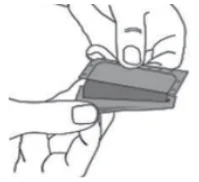
- 3 Remove the patch from its sachet and then peel one part of the silvery aluminium backing away. Avoid touching the sticky surface of the patch with your fingers.
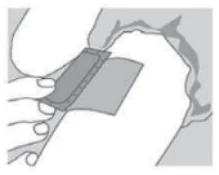
- 4 Carefully apply the sticky part of the patch to the chosen area of skin and then peel off the remaining half of the silvery aluminium backing foil.
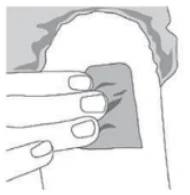
- 5 Press the patch firmly onto the skin with your palm or finger tips.
- 6
Run your fingers around the edge to ensure it sticks firmly.
- Removing and disposing of the patch
- 1. The patch should be removed before you go to bed as Nicorette is not designed to be worn when you go to sleep at night or for more than 16 hours each day.
- 2. After removal, the patch should be folded in half, sticky side inwards and placed inside the opened sachet or a piece of aluminium foil.
- 3.
The patch should then be disposed of carefully in the household rubbish, out of the sight and reach of children and animals.
- When to use Nicorette
If you are able to stop smoking/vaping immediately you should use Nicorette, when needed, in place of cigarettes/e-cigarettes by following the dosing instructions detailed under section ‘Stopping Immediately’.
If you are unable to stop smoking/vaping or do not feel ready to quit at this time, you should replace as many cigarettes/e-cigarettes as possible with Nicorette. There are toxins in cigarettes that can cause harm to your body. The effects of vaping on your body are not established. Nicorette provides a safer alternative to smoking tobacco, for both you and those around you. Reducing the amount of cigarettes/e-cigarettes may also help you to become more motivated to stop smoking/vaping. As soon as you are ready you should aim to stop smoking/vaping completely.
If you are planning to stop smoking/vaping or reduce the number of cigarettes/e-cigarettes you smoke/vape, Nicorette can be used while you are still smoking/vaping. However, during this time, you should aim to replace as many cigarettes/e-cigarettes as possible with Nicorette. As soon as you feel ready you should stop smoking/vaping completely. Follow the dosing instructions detailed under section ‘Stopping Gradually’.
You can also use Nicorette on those occasions when you can’t or don’t want to smoke/vape e.g. long haul flights, social situations, or when at work. However, in smoke/vape free areas such as pub, work breaks, public transport, car journeys etc., an alternative flexible Nicorette product (e.g. gum, inhalator) would be more suitable. Follow the dosing instructions detailed under section ‘Temporary Abstinence’.
When making a quit attempt behavioural therapy, advice and support will normally improve the success rate. If you have quit smoking/vaping and want to stop using Nicorette but are finding this difficult you should contact your doctor, pharmacist or nurse for advice.
Below is the dosage information for nicorette. This shows the number of patches you should be using, when you should use them and where applicable the maximum amount of time you should be using Nicotine
Replacement Therapy (NRT) for.
Please read this information carefully and then go to the ‘How to stop smoking/vaping your choice’ section which shows you how to give up.
- Depending on where you are in your treatment programme, the strength of the patch that you are using may differ. See the ‘How to stop smoking/vaping your choice’ for more information.
However all patches are used and applied in the same way.
- How to stop smoking/vaping - your choice
Because smoking/vaping is an addiction you may find it difficult to give up. From time to time you may still have strong urges to smoke/vape but if you follow these recommendations, you have a good chance of quitting.
If you find it hard to stop smoking/vaping using Nicorette, you are worried that you will start smoking/vaping again without it, or you find it difficult to reduce the number of patches you are using, talk to your doctor, pharmacist or nurse.
Children under 12 years
Do not give this product to children under 12 years.
- Adults and Children aged 12 years and over
| Age | Dose |
|---|---|
| Adults and children aged 12 years and over |
|
| |
- Stopping Immediately
The idea is to stop smoking/vaping immediately and use the patch to relieve the cravings to smoke/vape. After achieving this you then slowly reduce the amount of nicotine that you are getting by switching to lower strength patches. You then stop using the patches. You should aim to do this within 12 weeks (3 months).
- Adults and Children aged 12 years and over
The following diagram shows the basic step by step process. Make sure that you read the instructions for each step in the information which follows.
Patch reduction guide
25mg
Nicorette
15mg
Nicorette
10mg
Nicorette
8 weeks
Step 1
2 weeks
Step 2
2 weeks
Step 3
12 weeks programme
Nicorette® invisi 25mg patch Step 1.
Nicorette® invisi 10mg patch Step 3.
Nicorette® invisi 15mg patch Step 2.
For best results, most smokers/vapers are recommended to start on 25mg patch (Step 1). Lighter smokers (i.e. those who smoke less than 10 cigarettes per day) and light to moderate vapers (e.g. vape infrequently or use low strength e-liquid) are recommended to start at Step 2 (15mg) for 8 weeks and decrease the dose to 10mg for the final 4 weeks.
Step 1: Begin treatment with the highest strength Nicorette invisi 25mg patch the day after you stop smoking/vaping completely. Use a new Nicorette invisi 25mg patch each day for eight weeks.
Step 2: If you are successful and avoid smoking/vaping during this eight week period, you should then begin to reduce the amount of nicotine you are getting by switching to a lower strength patch.
- Now use the Nicorette each day for two weeks.
Step 3: If you are successful and avoid smoking/vaping over this two
week period, then switch from the Nicorette invisi 15mg patch to the Nicorette invisi10mg patch each day for a further two weeks.
You might feel a sudden craving to smoke/vape long after you have given up smoking/vaping and stopped using Nicorette. Remember you can use nicotine replacement therapy again if this should happen.
- If you experience excessive side-effects or are a lighter smoker/vaper
When using the highest strength 25mg patch, if you experience excessive side-effects which do not disappear after a few days of use, you should move to the medium strength 15mg patch and use it for the remainder of the 8 weeks. You should then reduce to the low strength 10mg patch and use it for the remaining 4 weeks of the treatment programme.
If you are a lighter smoker (less than 10 cigarettes per day) or a light to moderate vaper (e.g. vape infrequently or use low strength e-liquid), you should start on the medium strength 15mg patch and use it for 8 weeks and then step down to the lower strength 10mg patch for the last 4 weeks of treatment.
- Stopping Gradually
Nicorette can be used whilst you are still smoking/vaping. The idea is to start by gradually replacing some of your cigarettes/e-cigarettes you smoke/vape whilst using Nicorette. After achieving this you should aim to give up cigarettes/e-cigarettes completely whilst using the patch. Finally, you should stop using the patch completely.
For best results, you should ideally start on 25mg patch (Step 1). Slowly reduce the amount of nicotine that you are getting by switching to 15mg (Step 2) as soon as the number of cigarettes you smoke is less than
10 cigarettes per day or you are vaping infrequently or using low strength e-liquid, until you have given up patches completely.
Lighter smokers (i.e. those who smoke less than 10 cigarettes per day) and light to moderate vapers (e.g. vape infrequently or use low strength
e-liquid) are recommended to start at Step 2 (15mg). When trying to stop smoking/vaping, you are recommended to continue on 15mg (Step 2) for 8 weeks and then step down to the lower strength 10mg (Step 3) for the last 4 weeks of treatment.
- Temporary Abstinence
A patch should be applied in those situations when you are unable to smoke/vape e.g. long haul flights, social situations or when at work.
For best results, you should use 25mg patch (Step 1). However, lighter smokers (i.e. those who smoke less than 10 cigarettes per day) and light to moderate vapers (e.g. vape infrequently or use low strength e-liquid)
are recommended to use Step 2 (15mg).
- If you have used too many Nicorette
If you have used more than the recommended dosage of
Nicorette, left the patch on for too long or have smoked/vaped whilst using Nicorette , you may experience nausea (feeling sick), vomiting, increased salivation, pain in your abdomen, diarrhoea, sweating, headache, dizziness, hearing disturbance or weakness.
If you do get any of these effects contact a doctor or your nearest hospital Accident and Emergency department immediately. Remove the patch and rinse the application site with water. Do not smoke or vape. Take this leaflet and the pack with you.
- If a child uses Nicorette
- Contact a doctor or your nearest hospital Accident and Emergency department immediately if a child under 12 years uses, chews, sucks or swallows this medicine. Take this leaflet and the pack with you.
Nicotine ingestion by a child may result in severe poisoning.
4 Possible side-effects
Like all medicines, Nicorette can have side effects. As many of the effects are due to nicotine, they can also occur when nicotine is obtained by smoking/vaping.
Effects related to stopping smoking/vaping (nicotine withdrawal)
You may experience unwanted effects because by stopping smoking/vaping you have reduced the amount of nicotine you are taking. You may also experience these effects if you under use Nicorette before you are ready to reduce your nicotine intake.
- These effects include:
- irritability or aggression
- feeling low
- anxiety
- restlessness
- poor concentration
- increased appetite or weight gain
- urges to smoke (craving)
- night-time awakening or sleep disturbance
- lowering of heart rate
- dizziness, light-headedness, blurry vision, nausea
- cough
- constipation
- bleeding gums
- mouth ulcers
- swelling of the nasal passages and back of the throat
Effects of too much nicotine
You may also get these effects if you are not used to inhaling tobacco smoke or e-cigarettes.
- These effects include:
- feeling faint
- feeling sick (nausea)
- headache
Side-effects of Nicorette
When you use the Nicorette for the first time it may cause a mild skin reaction. This is usually redness or itching of the skin where the patch has been. This will usually disappear after a few days. Rarely the reaction may persist or if there is a more severe skin reaction, you should stop using the patches and consult a doctor, pharmacist or nurse.
If you notice any of the following: fast heart rate/beat, abnormal beating of the heart, chest palpitations, shortness of breath, seizures (fits), or allergic reactions (swelling of the mouth, lips, throat or tongue, itching of the skin, swelling of the skin, ulceration or inflammation of the lining of the mouth) stop using Nicorette, do not smoke/vape and contact a doctor immediately.
Very common side-effects:
(may affect more than 1 in 10 people)
- itching – this usually disappears within a few days
Common side-effects:
(may affect up to 1 in 10 people)
- headache
- dizziness
- feeling sick (nausea)
- sickness (vomiting)
- hives (urticaria) or rash
Uncommon side-effects:
(may affect up to 1 in 100 people)
- tingling or numbness of the hands and feet
- allergic reaction
- flushing, high blood pressure
- excessive sweating
- aching muscles, muscle tenderness or weakness not caused by exercise
- chest discomfort and pain
- feeling unwell or tired
Rare side-effects:
(may affect up to 1 in 1,000 people)
- difficulty in swallowing
- pain in your hands or feet
- stomach discomfort
- redness of the skin – this usually disappears within a few days
When you stop smoking you may develop mouth ulcers.
The reason why this happens is unknown.
Reporting of side effects
If you get any side effects, talk to your doctor, pharmacist or nurse. This includes any possible side effects not listed in this leaflet. You can also report side effects directly via the Yellow Card Scheme at: www.mhra.gov.uk/yellowcard or search for MHRA Yellow Card in the Google Play or Apple App Store.
By reporting side effects, you can help provide more information on the safety of this medicine.
5 Storing and disposal
Keep out of the sight and reach of children and animals. Nicotine in high doses can be very dangerous and sometimes fatal if taken by children.
Do not store above 25°C.
Do not use Nicorette after the ‘Use before’ date shown on the carton or sachet.
Remember if your doctor tells you to stop using this medicine, return any unused medicine to your pharmacist for safe disposal. Only keep this medicine if your doctor tells you to.
Dispose of Nicorette as directed by folding it in half and placing inside the empty sachet (or wrapping in a piece of aluminium foil) before throwing away. Always dispose of used Nicorette sensibly, out of the sight and reach of children and animals.
6 Further information
What Nicorette contains
The active ingredient in the Nicorette is Nicotine.
Each 9.0cm2 transdermal patch contains nicotine 1.75mg/cm2, releasing a nominal 10mg nicotine over 16 hours.
The other ingredients are medium chain triglycerides, basic butylated methacrylate copolymer, polyethylenterephthalate film (PET), acrylic adhesive solution, potassium hydroxide, croscarmellose sodium, aluminium acetylacetonate, siliconised PET release liner with aluminised single side, printing inks.
What Nicorette looks like and contents of the pack
Nicorette is a beige, semi-transparent patches with ‘Nicorette’ printed on the top face of the product, packed into individual sachets.
It is available in pack size of 7 patches, which are individually sealed in sachets.
Manufactured by: LTS Lohmann Therapie-Systeme AG (LTS), Lohmannstr. 2, 56626 Andernach, Germany.
Procured from within the EU and repackaged by the Product Licence holder: B&S Healthcare, Unit 4, Bradfield Road, Ruislip, Middlesex,
HA4 0NU, UK.
Nicorette® invisi 10mg patch; PL 18799/4255
Leaflet date: 15.05.2026
Nicorette is the registered trademark of McNeil AB.
Blind or partially sighted?
Is this leaflet hard to see or read?
Call 0208 515 3763 to obtain the leaflet in a format suitable for you.
GSL