

Patient leaflet - Zarzio 48 MU/0.5 ml solution for injection or infusion in Pre-filled syringe
1 What Zarzio is and what it is used for
Zarzio is a white blood cell growth factor (granulocyte
colony stimulating factor) and belongs to a group of
medicines called cytokines. Growth factors are proteins
that are produced naturally in the body but they can also
be made using biotechnology for use as a medicine. Zarzio
works by encouraging the bone marrow to produce more
white blood cells.
A reduction in the number of white blood cells
(neutropenia) can occur for several reasons and makes
your body less able to fight infection. Zarzio stimulates the
bone marrow to produce new white cells quickly.
Zarzio can be used:
to increase the number of white blood cells after
treatment with chemotherapy to help prevent infections;
to increase the number of white blood cells after a bone
marrow transplant to help prevent infections;
before high-dose chemotherapy to make the bone
marrow produce more stem cells which can be
collected and given back to you after your treatment.
These can be taken from you or from a donor. The
stem cells will then go back into the bone marrow and
produce blood cells;
- to increase the number of white blood cells if you suffer from severe chronic neutropenia to help prevent infections;
- in patients with advanced HIV infection which will help reduce the risk of infections.
2 What you need to know before you
use Zarzio
Do not use Zarzio
if you are allergic to filgrastim or any of the other
ingredients of this medicine (listed in section 6). Warnings and precautions
Talk to your doctor, pharmacist or nurse before using Zarzio.
Please tell your doctor before starting treatment if you have:
sickle cell anaemia, as Zarzio may cause sickle cell
crisis;
- osteoporosis (bone disease).
Please tell your doctor immediately during treatment with Zarzio, if you:
have sudden signs of allergy such as rash, itching or
hives on the skin, swelling of the face, lips, tongue or other parts of the body, shortness of breath, wheezing or trouble breathing as these could be signs of a severe allergic reaction (hypersensitivity).
experience puffiness in your face or ankles, blood in
your urine or brown-coloured urine or you notice you urinate less than usual (glomerulonephritis). .
get left upper belly (abdominal) pain, pain below
the left rib cage or at the tip of your left shoulder [these may be symptoms of an enlarged spleen (splenomegaly), or possibly rupture of the spleen].
notice unusual bleeding or bruising [these may
be symptoms of a decrease in blood platelets (thrombocytopenia), with a reduced ability of your blood to clot].
have symptoms of inflammation of the aorta (the
large blood vessel which transports blood from the heart to the body); this was reported in rare cases in cancer patients and healthy donors. The symptoms can include fever, abdominal pain, malaise, back pain and increased inflammatory markers. Tell your doctor if you experience these symptoms. Loss of response to filgrastim
If you experience a loss of response or failure to maintain a response with filgrastim treatment, your doctor will investigate the reasons why including whether you have developed antibodies which neutralise filgrastim’s activity. Your doctor may want to monitor you closely, see section 4 of the package leaflet.
If you are a patient with severe chronic neutropenia, you may be at risk of developing cancer of the blood (leukaemia, myelodysplastic syndrome [MDS]). You should talk to your doctor about your risks of developing cancers of the blood and what testing should be done. If you develop or are likely to develop cancers of the blood, you should not use Zarzio unless instructed by your doctor. If you are a stem cell donor, you must be aged between 16 and 60 years.
Take special care with other products that stimulate white blood cells.
Zarzio is one of a group of products that stimulate the production of white blood cells. Your healthcare professional should always record the exact product you are using.
Other medicines and Zarzio
Tell your doctor or pharmacist if you are taking, have recently taken or might take any other medicines. Pregnancy and breast‑feeding
Zarzio has not been tested in pregnant or breast-feeding women.
Zarzio is not recommended during pregnancy. It is important to tell your doctor if you:
- are pregnant or breast-feeding;
- think you may be pregnant; or
- are planning to have a baby.
If you become pregnant during Zarzio treatment, please inform your doctor.
Unless your doctor directs you otherwise, you must stop breast feeding if you use Zarzio.
Driving and using machines
Zarzio may have a minor influence on your ability to drive and use machines. This medicine may cause dizziness. It is advisable to wait and see how you feel after taking Zarzio and before driving or operating machinery.
Zarzio contains sorbitol and sodium
Zarzio contains sorbitol (E420).
Sorbitol is a source of fructose. If you (or your child) have hereditary fructose intolerance (HFI), a rare genetic disorder, you (or your child) must not receive this medicine. Patients with HFI cannot break down fructose, which may cause serious side effects.
You must tell your doctor before receiving this medicine if you (or your child) have HFI or if your child can no longer take sweet foods or drinks because they feel sick, vomit or get unpleasant effects such as bloating, stomach cramps or diarrhoea.
This medicine contains less than 1 mmol sodium (23 mg) per dose, that is to say essentially ‘sodium-free’.
3 How to use Zarzio
Always use this medicine exactly as your doctor has told you. Check with your doctor, nurse or pharmacist if you are not sure.
How is Zarzio given and how much should I take?
Zarzio is usually given as a daily injection into the tissue just under the skin (known as a subcutaneous injection). It can also be given as a daily slow injection into the vein (known as an intravenous infusion). The usual dose varies depending on your illness and weight. Your doctor will tell you how much Zarzio you should take.
Patients having a bone marrow transplant after chemotherapy:
You will normally receive your first dose of Zarzio at least 24 hours after your chemotherapy and at least 24 hours after receiving your bone marrow transplant.
You, or people caring for you, can be taught how to give subcutaneous injections so that you can continue your treatment at home. However, you should not attempt this unless you have been properly trained first by your health care provider.
How long will I have to take Zarzio?
You will need to take Zarzio until your white blood cell count is normal. Regular blood tests will be taken to monitor the number of white blood cells in your body. Your doctor will tell you how long you will need to take Zarzio.
Use in children
Zarzio is used to treat children who are receiving chemotherapy or who suffer from severe low white blood cell count (neutropenia). The dosing in children receiving chemotherapy is the same as for adults.
Administration of small doses
You should not inject a dose of less than 0.3 mL with the pre-filled syringe, as it cannot be measured accurately because the 0.1 and 0.2 mL graduation marks are not visible.
If required, the solution for injection may be diluted.
If you use more Zarzio than you should
Do not increase the dose your doctor has given you. If you think you have injected more than you should, contact your doctor as soon as possible.
If you forget to use Zarzio
If you have missed an injection, or injected too little, contact your doctor as soon as possible. Do not take a double dose to make up for any missed doses. If you have any further questions on the use of this medicine, ask your doctor, pharmacist or nurse.
4 Possible side effects
Like all medicines, this medicine can cause side effects, although not everybody gets them.
Please tell your doctor immediately during treatment:
- if you experience an allergic reaction including weakness, drop in blood pressure, difficulty breathing, swelling of the face (anaphylaxis), skin rash, itchy rash (urticaria), swelling of the face, lips, mouth, tongue or throat (angioedema) and shortness of breath (dyspnoea).
- if you experience a cough, fever and difficulty breathing (dyspnoea) as this can be a sign of Acute Respiratory Distress Syndrome (ARDS).
- if you experience kidney injury (glomerulonephritis). Kidney injury has been seen in patients who received filgrastim. Call your doctor right away if you experience puffiness in your face or ankles, blood in your urine or brown-coloured urine or you notice you urinate less than usual.
if you have any of the following or combination of the following side effects:
swelling or puffiness, which may be associated with
passing water less frequently, difficulty breathing, abdominal swelling and feeling of fullness, and a general feeling of tiredness. These symptoms generally develop in a rapid fashion.
These could be symptoms of a condition called “Capillary Leak Syndrome” which causes blood to leak from the small blood vessels into your body and needs urgent medical attention.
if you have a combination of any of the following symptoms:
fever, or shivering, or feeling very cold, high heart
rate, confusion or disorientation, shortness of breath, extreme pain or discomfort and clammy or sweaty skin.
These could be symptoms of a condition called “sepsis” (also called “blood poisoning”), a severe infection with whole-body inflammatory response which can be life threatening and needs urgent medical attention.
- if you get left upper belly (abdominal) pain, pain below the left rib cage or pain at the tip of your shoulder, as there may be a problem with your spleen [enlargement of the spleen (splenomegaly) or rupture of the spleen].
- if you are being treated for severe chronic neutropenia and you have blood in your urine (haematuria). Your doctor may regularly test your urine if you experience this side effect or if protein is found in your urine (proteinuria).
A common side effect of filgrastim use is pain in your muscles or bones (musculoskeletal pain), which can be helped by taking standard pain relief medicines (analgesics). In patients undergoing a stem cell or bone marrow transplant, Graft versus Host Disease (GvHD) may occur- this is a reaction of the donor cells against
the patient receiving the transplant; signs and symptoms include rash on the palms of your hands or soles of your feet and ulcer and sores in your mouth, gut, liver, skin, or your eyes, lungs, vagina and joints. Very commonly seen in normal stem cell donors is increase in white blood cells (leukocytosis) and decrease of platelets which reduces the ability of blood to clot (thrombocytopenia), these will be monitored by your doctor.
Very common side effects (may affect more than 1 in 10 people)
- decrease of platelets which reduces the ability of blood to clot (thrombocytopenia)
- low red blood cell count (anaemia)
- headache
- diarrhoea
- vomiting
- nausea
- unusual hair loss or thinning (alopecia)
- tiredness (fatigue)
- soreness and swelling of the digestive tract lining which runs from the mouth to the anus (mucosal inflammation)
- fever (pyrexia)
Common side effects (may affect up to 1 in 10 people)
- inflammation of the lung (bronchitis)
- upper respiratory tract infection
- urinary tract infection
- decreased appetite
- trouble sleeping (insomnia)
- dizziness
- decreased feeling of sensitivity, especially in the skin (hypoaesthesia)
- tingling or numbness of the hands or feet (paraesthesia)
- low blood pressure (hypotension)
- high blood pressure (hypertension)
- cough
- coughing up blood (haemoptysis)
- pain in your mouth and throat (oropharyngeal pain)
- nose bleeds (epistaxis)
- constipation
- oral pain
- enlargement of the liver (hepatomegaly)
- rash
- redness of the skin (erythema)
- muscle spasm
- pain when passing urine (dysuria)
- chest pain
- pain
- generalised weakness (asthenia)
- generally feeling unwell (malaise)
- swelling in the hands and feet (oedema peripheral)
- increase of certain enzymes in the blood
- changes in blood chemistry
- transfusion reaction
Uncommon side effects (may affect up to 1 in 100 people)
- increase in white blood cells (leukocytosis)
- allergic reaction (hypersensitivity)
- rejection of transplanted bone marrow (graft versus host disease)
- high uric acid levels in the blood, which may cause gout (hyperuricaemia) (Blood uric acid increased)
- liver damage caused by blocking of the small veins within the liver (veno-occlusive disease)
lungs do not function as they should, causing breathlessness (respiratory failure)
- swelling and/or fluid in the lungs (pulmonary oedema)
- inflammation of the lungs (interstitial lung disease)
- abnormal x-rays of the lungs (lung infiltration)
- bleeding from the lung (pulmonary haemorrhage)
- lack of absorption of oxygen in the lung (hypoxia)
- bumpy skin rash (rash maculo-papular)
- disease which causes bones to become less dense, making them weaker, more brittle and likely to break
 (osteoporosis)
 - injection site reaction
Rare side effects (may affect up to 1 in 1,000 people):
- severe pain in the bones, chest, gut or joints (sickle cell
 anaemia with crisis)
 - sudden life-threatening allergic reaction (anaphylactic reaction)
- pain and swelling of the joints, similar to gout
 (pseudogout)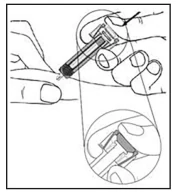
- a change in how your body regulates fluids within your body and may result in puffiness (fluid volume disturbances)
- inflammation of the blood vessels in the skin (cutaneous vasculitis)
- plum-coloured, raised, painful sores on the limbs and sometimes the face and neck with a fever (Sweets
 syndrome)
 - worsening of rheumatoid arthritis
- unusual change in the urine
- bone density decreased
- inflammation of the aorta (the large blood vessel which transports blood from the heart to the body), see
 section 2.
 - formation of blood cells outside of the bone marrow
 (extramedullary haematopoiesis)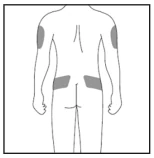
Reporting of side effects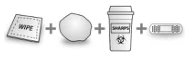
If you get any side effects, talk to your doctor, pharmacist or nurse. This includes any possible side effects not listed in this leaflet. You can also report side effects directly via the Yellow Card Scheme: www.mhra.gov.uk/yellowcard or search for MHRA Yellow Card in the Google Play or Apple 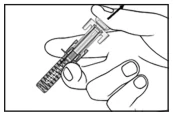 App Store. By reporting side effects you can help provide more information on the safety of this medicine.
5 How to store Zarzio
Keep this medicine out of the sight and reach of children. Do not use this medicine after the expiry date which is stated on the carton and on the syringe label after EXP. The expiry date refers to the last day of that month. Store in a refrigerator (2°C – 8°C).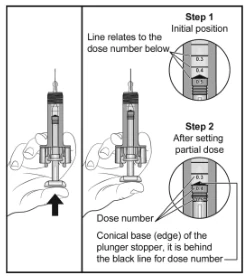
Keep the pre-filled syringe in the outer carton in order to protect from light.
Accidental freezing will not harm Zarzio.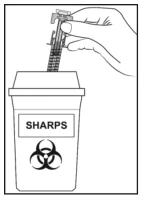
The syringe can be removed from the refrigerator and left 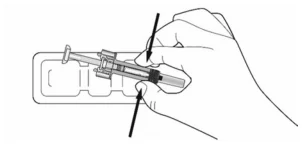 at room temperature for a single period of maximum 8 days (but not above 25°C). At the end of this period, the product should not be put back in the refrigerator and should be disposed of.
Do not use this medicine if you notice discolouration, cloudiness or particles, it should be a clear, colourless to slightly yellowish liquid.
Do not throw away any medicines via wastewater or household waste. Ask your pharmacist how to throw away medicines you no longer use. These measures will help protect the environment.
6 Contents of the pack and other
information
What Zarzio contains
The active substance is filgrastim.
Zarzio 30 MU/0.5 ml solution for injection or infusion in pre-filled syringe: Each pre-filled syringe contains 30 MU filgrastim in 0.5 ml, corresponding to 60 MU/ml. Zarzio 48 MU/0.5 ml solution for injection or infusion in pre-filled syringe: Each pre-filled syringe contains 48 MU filgrastim in 0.5 ml, corresponding to 96 MU/ml
- The other ingredients are glutamic acid, sorbitol (E420), polysorbate 80, sodium hydroxide and water for injections. See section 2 “Zarzio contains sorbitol and sodium”.
What Zarzio looks like and contents of the pack
Zarzio is a clear, colourless to slightly yellowish solution for injection or infusion in pre-filled syringe containing 0.5 mL solution.
Zarzio is available in packs containing 1, 3, 5 or 10 glass pre-filled syringes (type I glass) with a plunger stopper (bromobutyl rubber), a stainless steel 29-gauge needle with an automatic needle guard and a needle cap (thermoplastic elastomer).
The pre-filled syringe bears printed markings from 0.1 mL to 1 mL, however, it is not designed to measure volumes less than 0.3 mL due to the spring mechanism. Not all pack sizes may be marketed.
Marketing Authorisation Holder
Sandoz GmbH
Biochemiestr. 10
6250 Kundl
Austria
Manufacturer
Sandoz GmbH
Biochemiestr. 10
6336 Langkampfen
Austria
Or
Novartis Pharmaceutical Manufacturing GmbH Biochemiestr. 10
6336 Langkampfen
Austria
This leaflet was last revised in 04/2025.
Detailed information on this medicine is available on the European Medicines Agency web site: http://www.ema.europa.eu.
7 Instructions for use
To help avoid a possible infection, you should follow these instructions.
It is important not to try to inject yourself or someone else until you have been trained by your doctor, nurse or
pharmacist. Please read all the instructions before injecting. Each sealed blister contains one pre-filled syringe.
Each pre-filled syringe contains 30 MU/0.5 mL or 48 MU/0.5 mL of filgrastim.
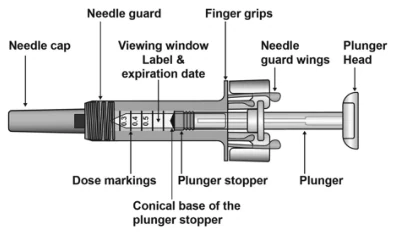
Figure 7‑1 Zarzio pre‑filled syringe with needle guard
After the medication has been injected, the needle guard will be activated to cover the needle. The needle guard is intended to protect healthcare professionals, caregivers, and patients from accidental needle-stick injuries after the injection.
What you additionally need for your injection:
- 1 Alcohol swab
- 1 Cotton ball or gauze
Sharps disposal
container
1 Adhesive bandage
Figure 7-2
Additional items needed
Important safety information
Caution: Keep the pre‑filled syringe out of the reach of children.
- 1. Do not open the outer box until you are ready to use the pre-filled syringe.
- 2. Do not use the pre-filled syringe if the seal of the blister is broken, as it may not be safe for you to use.
- 3. Do not use the pre-filled syringe if there is liquid in the plastic tray. Do not use the pre-filled syringe if the needle cap is missing or not securely attached. In all these instances, return the entire product pack to the pharmacy.
- 4. Do not attempt to inject a dose less than 0.3 mL from a pre-filled syringe. A dose less than 0.3 mL cannot be accurately measured using the Zarzio pre-filled syringe as the 0.1 and 0.2 mL graduation markings on the syringe barrel are not visible.
- 5. Never leave the pre-filled syringe unattended where others might tamper with it.
- 6. Do not shake the pre-filled syringe.
- 7. Be careful not to touch the needle guard wings before use. By touching them, the needle guard may be activated too early.
- 8. Do not remove the needle cap until just before you give the injection.
- 9. The pre-filled syringe cannot be re-used. Please dispose of the used pre-filled syringe immediately after use in a sharps container.
- 10.
Do not use if the syringe has been dropped onto a hard surface or dropped after removing the needle cap.
Storage of the Zarzio pre‑filled syringe
- 1. Store the pre-filled syringe in its outer carton box to protect it from light. Store it in a refrigerator between 2 °C and 8 °C (36 °F and 46 °F). Do not freeze.
- 2. Remember to take the blister out of the refrigerator and let it warm up for 15-30 minutes to allow it to reach room temperature before preparing it for the injection.
- 3. Do not use the pre-filled syringe after the expiration date shown on the outer box or syringe label. If it has expired, return the entire pack to the pharmacy.
- 4. The syringe can be removed from the refrigerator and left at room temperature for a single period of maximum 8 days (but not above 25 °C). At the end of this period, the product should not be put back in the refrigerator and should be disposed of.
The injection site
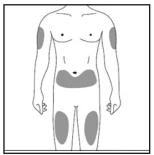
Figure 7‑3 Injection sites
The injection site is the place on the body where you are going to use the pre-filled syringe.
- The recommended site is the front of your thighs. You may also use the lower abdomen, but not the area 5 cm (2 inches) around the navel (belly button).
- If a caregiver is giving you the injection, the outer upper arms and the upper areas of the buttocks may also be used.
- Choose a different site each time you give yourself an injection.
- Do not inject into areas where the skin is tender, bruised, red, scaly or hard. Avoid areas with scars or stretch marks. Preparing the Zarzio pre‑filled syringe ready for use
- Take the blister containing the pre-filled syringe out of the refrigerator and leave it unopened for approximately 15-30 minutes, so that it can reach room temperature.
- When you are ready to use the pre-filled syringe, open the blister and wash your hands thoroughly with soap and water.
- Clean the injection site with an alcohol swab.
- Remove the pre-filled syringe from the blister by holding it in the middle as shown in Figure 7-4. Do not grab the plunger rod. Do not grab the needle cap.
Figure 7‑4 Remove the pre‑filled syringe from the
blister
- 5.
Check to ensure the plastic transparent needle guard is situated over the barrel of the glass syringe. If the transparent needle guard is covering the needle cap (as shown below Figure 7-5) the syringe has been
activated, DO NOT use this syringe and take a new syringe. Figure 7-6 shows a ready to use syringe. Figure 7‑5 DO NOT USE
In this configuration the needle guard is ACTIVATED
- DO NOT USE the pre-filled syringe
Figure 7‑6 Ready to Use
In this configuration the needle guard is NOT
ACTIVATED and the
pre-filled syringe is ready for use
- 6. Inspect the pre-filled syringe. The liquid should be clear. The color may be colorless to slightly yellowish, DO NOT USE if any other particulates and/or discolorations are observed and return the pre-filled syringe and the package it came in to the pharmacy.
- 7. DO NOT USE if the pre-filled syringe is broken or the needle guard activated. In all these instances, return the entire product pack to the pharmacy.
How to use the Zarzio pre‑filled syringe
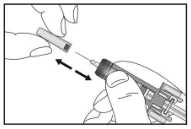
Figure 7‑7 Remove needle cap
Carefully pull the needle cap straight off to remove it from the pre-filled syringe. Discard the needle cap. You may see a drop of liquid at the end of the needle. This is normal.
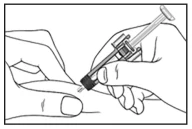
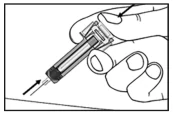
Holding the syringe as shown, press slowly on the plunger to push out the excess medicine until the edge of the conical base of the plunger stopper lines up with the syringe marking for your prescribed dose. Below example for a dose of 0.4 mL.
Be careful not to touch the needle guard wings before use. The needle guard may be activated too early. Check again to make sure the correct dose of Zarzio is in the pre-filled syringe.
Call your healthcare provider or nurse if you have problems measuring or injecting your dose of Zarzio
Figure 7‑8 Partial dose example for a dose of 0.4 mL
Figure 7‑9 Insert needle
Gently pinch the skin at the injection site and insert the needle as shown. Push the needle all the way in to ensure that the medication can be fully administered.
Figure 7‑10 Depress plunger
Holding the pre-filled syringe as shown, slowly depress the plunger as far as it will go so that the plunger head is completely between the needle guard wings.
Keep the plunger pressed fully down while you hold the syringe in place for 5 seconds.
Figure 7‑11 Withdraw needle
Keep the plunger fully depressed while you carefully pull the needle straight out from the injection site.
Figure 7‑12 Release plunger
Slowly release the plunger and allow the needle guard to automatically cover the exposed needle.
There may be a small amount of blood at the injection site. You can press a cotton ball or gauze onto the injection site and hold it for 10 seconds. Do not rub the injection site. You may cover the injection site with a small adhesive bandage, if needed.
Disposal instructions
Figure 7‑13 Disposal
Dispose of the used syringe in a sharps container (closable, puncture-resistant container). For the safety and health of you and others, needles and used syringes must never be re-used.
The following information is intended for healthcare professionals only
The solution should be visually inspected prior to use. Only clear solutions without particles should be used. Accidental exposure to freezing temperatures does not adversely affect the stability of Zarzio.
Zarzio contains no preservative: In view of the possible risk of microbial contamination, Zarzio syringes are for single use only.
Dilution prior to administration (optional)
If required, Zarzio may be diluted in glucose 50 mg/ml (5%) solution. Zarzio must not be diluted with sodium chloride solutions.
Dilution to a final concentration < 0.2 MU/ml (2 micrograms/ ml) is not recommended at any time.
For patients treated with filgrastim diluted to concentrations < 1.5 MU/ml (15micrograms/ml), human serum albumin (HSA) should be added to a final concentration of 2 mg/ml. Example: In a final volume of 20 ml, total doses of filgrastim less than 30 MU (300 micrograms) should be given with 0.2 ml of human serum albumin 200 mg/ml (20%) solution Ph. Eur. added.
When diluted in glucose 50 mg/ml (5%) solution, filgrastim is compatible with glass and a variety of plastics including polyvinylchloride, polyolefin (a copolymer of polypropylene and polyethylene) and polypropylene.
After dilution: Chemical and physical in-use stability of the diluted solution for infusion has been demonstrated for 24 hours at 2°C to 8°C. From a microbiological point of view, the product should be used immediately. If not used immediately, in-use storage times and conditions prior to use are the responsibility of the user and would normally not be longer than 24 hours at 2°C to 8°C, unless dilution has taken place in controlled and validated aseptic conditions.
Using the pre-filled syringe with a needle safety guard The needle safety guard covers the needle after injection to prevent needle stick injury. This does not affect normal operation of the syringe. Depress the plunger slowly and evenly until the entire dose has been given and the plunger cannot be depressed any further. While maintaining pressure on the plunger, remove the syringe from the patient. The needle safety guard will cover the needle when releasing the plunger.
Disposal
Any unused product or waste material should be disposed of in accordance with local requirements.
| V024: POM – SPC, PIL | Tec | hnical Colours: | ||||
| Legend: | ||||||
| Cutting: | ||||||
| 420 x 175 mm | ||||||
| Technical data | : | |||||
| SKUs: | N/A | |||||
| SZ codes: | SZ06601LT07B | |||||
| N/A | Col | ours: | ||||
| N/A | ||||||