

Patient leaflet - Votubia 3 mg dispersible tablets
1. What Votubia is and what it is used for
Votubia dispersible tablets contain an active substance called everolimus. It is used to treat children aged 2 years and above and adults with partial seizures with or without secondary
generalisation (epilepsy) associated with a genetic disorder called tuberous sclerosis complex (TSC) and which are not controlled by other antiepileptic medicines. Partial seizures start by only affecting one side of the brain but can spread and extend to larger areas on both sides of the brain (called a “secondary generalisation”). Votubia dispersible tablets are given together with other medicines for epilepsy.
Votubia is also an anti-tumour medicine which can block certain cells in the body from growing. It may reduce the size of brain tumours called subependymal giant cell astrocytomas (SEGA) which are also caused by TSC.
Votubia dispersible tablets are used to treat SEGA associated with TSC in adults and children for whom surgery is not appropriate.
2. What you need to know before you take Votubia
Votubia will only be prescribed by a doctor with experience in treating patients with SEGA or seizures and with access to blood tests which will measure how much Votubia is in your blood. Follow all the doctor’s instructions carefully. They may differ from the general information contained in this leaflet. If you have any questions about Votubia or why it has been prescribed for you, ask your doctor.
Do not take Votubia
- if you are allergic to everolimus, to related substances such as sirolimus or temsirolimus, or to any of the other ingredients of this medicine (listed in section 6). If you had allergic reactions before, please ask your doctor for advice.
Warnings and precautions
Talk to your doctor before taking Votubia:
if you have any problems with your liver or if you have ever had any disease which may have affected your liver. If this is the case, your doctor may need to prescribe a different
dose of Votubia or stop treatment, either for a short time or permanently.
- if you have diabetes (high level of sugar in your blood). Votubia may increase blood sugar levels and worsen diabetes mellitus. This may result in the need for insulin and/or oral antidiabetic agent therapy. Tell your doctor if you experience any excessive thirst or increased frequency of urination.
- if you need to receive a vaccine while taking Votubia as vaccination may be less effective. For children with SEGA or seizures, it is important to have a discussion with the doctor about the childhood vaccination program before treatment with Votubia.
- if you have high cholesterol. Votubia may elevate cholesterol and/or other blood fats.
- if you have had recent major surgery, or if you still have an unhealed wound following surgery. Votubia may increase the risk of problems with wound healing.
- if you have an infection. It may be necessary to treat your infection before starting Votubia.
- if you have previously had hepatitis B, because this may occur again during treatment with Votubia (see section 4 ‘Possible side effects’).
- if you have received or are about to receive radiation therapy. Votubia may also:
- cause mouth sores (oral ulcerations).
- weaken your immune system. Therefore, you may be at risk of getting an infection while you are taking Votubia. If you have fever or other signs of an infection, consult with your doctor. Some infections may be severe and may have fatal consequences in adults and children.
- impact your kidney function. Therefore, your doctor will monitor your kidney function while you are taking Votubia.
- cause shortness of breath, cough and fever (see section 4 ‘Possible side effects’).
cause complications of radiation therapy. Severe complications of radiotherapy (such as shortness of breath, nausea,
diarrhoea, skin rashes and soreness in mouth, gums and throat), including fatal cases, have been observed in some patients who were taking everolimus at the same time as radiation therapy or who were taking everolimus shortly after they had radiation therapy. In addition, so-called radiation recall syndrome (comprising skin redness or lung inflammation at the site of previous radiation therapy) has been reported in patients who had radiation therapy in the past. Tell your doctor if you are planning to have radiation therapy in the near future, or if you have had radiation therapy before. Tell your doctor immediately if you experience these symptoms.
You will have blood tests before and periodically during treatment. These will check the amount of blood cells (white blood cells, red blood cells and platelets) in your body to see if Votubia is having an unwanted effect on these cells. Blood tests will also be carried out to check your kidney function (levels of creatinine, blood urea nitrogen or urinary protein), liver function (level of transaminases) and your blood sugar and lipid levels. This is because these can also be affected by Votubia. Regular blood tests are also necessary to measure how much Votubia is in your blood since this will help your doctor decide how much Votubia you need to take.
Children and adolescents
Votubia can be used in children and adolescents with SEGA associated with TSC.
Votubia is not to be used in children below the age of 2 years with TSC and seizures.
Other medicines and Votubia
Votubia may affect the way some other medicines work. If you are taking other medicines at the same time as Votubia, your doctor may need to change the dose of Votubia or the other medicines.
300026739
Tell your doctor or pharmacist if you are taking, have recently taken or might take any other medicines.
The following may increase the risk of side effects with Votubia:
- ketoconazole, itraconazole, voriconazole, or fluconazole and other antifungals used to treat fungal infections.
- clarithromycin, telithromycin or erythromycin, antibiotics used to treat bacterial infections.
- ritonavir, and other medicines used to treat HIV infection/AIDS.
- verapamil or diltiazem, used to treat heart conditions or high blood pressure.
- dronedarone, a medicine used to help regulate your heart beat.
- ciclosporin, a medicine used to stop the body from rejecting organ transplants.
- imatinib, used to inhibit the growth of abnormal cells.
- angiotensin-converting enzyme (ACE) inhibitors (such as ramipril) used to treat high blood pressure or other cardiovascular problems.
- cannabidiol (uses amongst others include treatment of seizures).
The following may reduce the effectiveness of Votubia:
- rifampicin, used to treat tuberculosis (TB).
- efavirenz or nevirapine, used to treat HIV infection/AIDS.
- St. John’s wort (Hypericum perforatum), a herbal product used to treat depression and other conditions.
- dexamethasone, a corticosteroid used to treat a wide variety of conditions including inflammatory or immune problems.
- phenytoin, carbamazepine or phenobarbital and other anti-epileptics used to stop seizures or fits.
All medicines listed above should be avoided during your treatment with Votubia. If you are taking any of them, your doctor may switch you to a different medicine, or may change your dose of Votubia.
If you are taking an anti-seizure medicine, a change in the dose of the anti-seizure medicine (increase or decrease) may make a change in the Votubia dose necessary. Your doctor will
decide this. If the dose of your anti-seizure medicine changes, please inform your doctor.
If you are following a specific diet to reduce the frequency of your seizures, please inform your doctor before taking Votubia. Votubia with food and drink
Avoid grapefruit and grapefruit juice while you are on Votubia. It may increase the amount of Votubia in the blood, possibly to a harmful level.
Pregnancy, breast‑feeding and fertility
Pregnancy
Votubia could harm an unborn baby and is not recommended during pregnancy. Tell your doctor if you are pregnant or think that you may be pregnant.
Women who could potentially become pregnant must use highly effective contraception during treatment, and for up to 8 weeks after ending treatment. If, despite these measures, you think you may have become pregnant, ask your doctor for advice before taking any more Votubia.
Breast-feeding
Votubia could harm a breast-fed baby. You should not breast-feed during treatment and for 2 weeks after the last dose of Votubia. Tell your doctor if you are breast-feeding. Fertility
Votubia may affect male and female fertility. Talk to your doctor if you wish to have children.
Driving and using machines
If you feel unusually tired (fatigue is a common side effect), take special care when driving or using machines.
Votubia contains lactose
Votubia contains lactose (milk sugar). If you have been told by your doctor that you have an intolerance to some sugars, contact your doctor before taking this medicine.
3. How to take Votubia
Always take this medicine exactly as your doctor or pharmacist has told you. Votubia exists as tablets and dispersible tablets. Consistently take only the tablets or only the dispersible tablets, and never a combination of both. Check with your doctor or pharmacist if you are not sure.
How much Votubia to take
Your doctor will determine the dose of Votubia you need to take depending on:
- your age
- your body size
- the health of your liver
- other medicines you are taking.
You will have blood tests during treatment with Votubia. This is to measure the amount of Votubia in your blood and find the best daily dose for you.
If you experience certain side effects (see section 4) while you are taking Votubia, your doctor may lower your dose or stop treatment, either for a short time or permanently. How to take this medicine
- Take Votubia dispersible tablets once a day.
- Take them at the same time every day.
You can take them either with or without food, but you need to do this in the same way each day.
Take Votubia dispersible tablets as an oral suspension only
Do not chew or crush the dispersible tablets. Do not swallow them whole. You must mix the dispersible tablets with water to create a cloudy liquid (known as an oral suspension). How to prepare and take the oral suspension
Prepare the oral suspension by mixing the dispersible tablets with water either in an oral syringe or in a small glass. You must drink the suspension immediately after preparing it. If you do not drink it within 30 minutes when using an oral syringe or within 60 minutes when using a small glass, throw it away and
prepare a new suspension. Please read the detailed instructions at the end of this leaflet to find out how to do this. Ask your doctor or pharmacist if you are not sure.
Special information for caregivers
Caregivers are advised to avoid contact with suspensions of Votubia dispersible tablets. Wash hands thoroughly before and after preparation of the suspension.
If you take more Votubia than you should
- If you have taken too much Votubia, or if someone else accidentally takes your dispersible tablets, see a doctor or go to a hospital immediately. Urgent treatment may be necessary.
- Take the carton and this leaflet, so that the doctor knows what has been taken.
If you forget to take Votubia
If you miss a dose, take your next dose as scheduled. Do not take a double dose to make up for the forgotten dispersible tablets. If you stop taking Votubia
Do not stop taking Votubia dispersible tablets unless your doctor tells you to.
If you have any further questions on the use of this medicine, ask your doctor or pharmacist.
4. Possible side effects
Like all medicines, this medicine can cause side effects, although not everybody gets them.
STOP taking Votubia and seek medical help immediately if you or your child experiences any of the following signs of an allergic reaction:
- difficulty breathing or swallowing
- swelling of the face, lips, tongue or throat (signs of angioedema)
- severe itching of the skin, with a red rash or raised bumps 300026739
| B-612 Graphic Studio ul. Wólczańska 143 90-525 Łódź, Poland +48 42 633 612 7 email: biuro@b612.pl | Creation date: | ||||||||||
| Andrzej Szymański | 05-Jan-2023 | 3 | |||||||||
| AW identifier No. New: | AW identifier No. Old: | ||||||||||
| 300026739 | 300026739-GB | N/A | |||||||||
| Leaflet_AFINITOR (VOTUBIA)_DISP. TAB_GB_LO | |||||||||||
| Packaging site: P | S, CH, STEIN (SOLIDS), NTO | ||||||||||
| Dimension: 8 | 84.0 x 148.0 mm | Black Cutting Guides Print enhancements: N/A | |||||||||
| Tech. Drawing No.: 8 | 0249135_06 | ||||||||||
| Live text: | Yes | No | Both | ||||||||
| No | Both | ||||||||||
| ews Gothic, OCR-B | |||||||||||
| 9pt | |||||||||||
| N/A | |||||||||||
| Braille: N/A | |||||||||||
| ! P L E A S E T U R N O V E R P R I N T I N G O N ! | |||||||||||
Technical approval by Packaging Site not using OneArt: electronic or handwritten signature. (If handwritten, it must be legible, include the approver’s full name and date of approval)
300026739 GB
- 16.
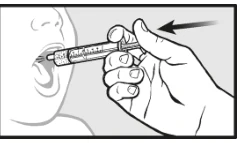
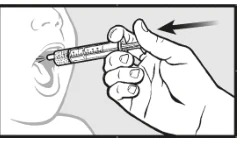
Put the oral syringe into the patient’s mouth.
Push the plunger in slowly to release the full contents of the oral syringe.
- 17.
Carefully remove the oral syringe from the patient’s mouth.
If the total prescribed dose is more than
10 mg or has to be prepared using more than 5 dispersible tablets, repeat steps
2 to 17 to finish giving the dose.
Cleaning up
- 18. Ask your pharmacist how to throw away the oral syringe.
- 19. Wash and dry your hands.
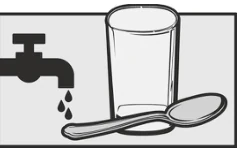
Instructions for patients or caregivers preparing the suspension using a small glass:
You will need:
- Blister with Votubia dispersible tablets
- Scissors to open the blister
- 1 small glass (maximum size 100 ml)
- 30 ml dose cup for measuring water
- Approximately 50 ml of water to prepare the suspension
Spoon for stirring
Getting ready
- 1. Wash and dry your hands.
Adding water
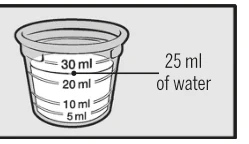
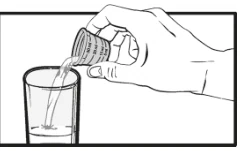
- 2. Add about 25 ml of water to the 30 ml dose cup. The amount of water added does not need to be exact. of water
- 3. Pour the water from the dose cup into the small glass.
Adding the dispersible tablets
- 4.
Use scissors to open the blister along the dotted line.
Remove the dispersible tablets from the blister.
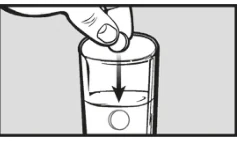
- 5. Add the dispersible tablets into the water.
Mixing the medicine
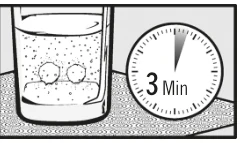
- 6.
Wait for 3 minutes until the dispersible tablets have completely broken apart. 3 Min
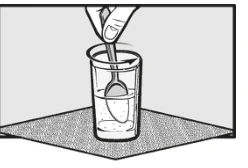
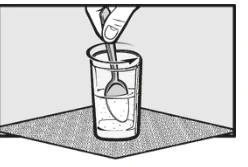
- 7. Gently stir the contents of the glass with a spoon and then proceed immediately to step 8.
Taking the medicine
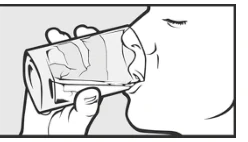
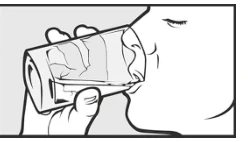
- 8. The patient must immediately drink all of the oral suspension from the glass. If the suspension is not used within 60 minutes, throw it away and prepare a new suspension.
Making sure all of the medicine has been taken
- 9. Refill the glass with the same amount of water (about 25 ml). Stir the contents with the spoon to remove any medicine left on the glass and spoon.
10 The patient must drink all of the oral suspension from the glass.
If the total prescribed dose is more than 10 mg or has to be prepared using more than 5 dispersible tablets, repeat steps 2 to 10 to finish taking the dose.
Cleaning up
- 11. Wash the glass and the spoon thoroughly with clean water. Wipe the glass and spoon with a clean paper towel. Store them in a dry and clean place until next time.
- 12. Wash and dry your hands.
Reporting of side effects
If you get any side effects, talk to your doctor or pharmacist. This includes any possible side effects not listed in this leaflet. You can also report side effects directly via the Yellow Card Scheme at: www.mhra.gov.uk/yellowcard or search for MHRA Yellow Card in the Google Play or Apple App Store. By reporting side effects you can help provide more information on the safety of this medicine.
5. How to store Votubia
- Keep this medicine out of the sight and reach of children.
- Do not use this medicine after the expiry date which is stated on the carton and blister foil. The expiry date refers to the last day of that month.
- This medicine does not require any special temperature storage conditions.
- Store in the original package in order to protect from light and moisture.
- Open the blister just before taking Votubia dispersible tablets.
- The stability of the ready to use suspension has been demonstrated for 60 minutes. After preparation the suspension must be taken straight away. If you do not use it within 60 minutes, throw it away and prepare a new suspension.
- Do not use this medicine if the pack is damaged or shows signs of tampering.
Do not throw away any medicines via wastewater or household waste. Ask your pharmacist how to throw away medicines you no longer use. These measures will help to protect the environment.
6. Contents of the pack and other information What Votubia dispersible tablets contain
The active substance is everolimus.
Each Votubia 1 mg dispersible tablet contains 1 mg of everolimus.
Each Votubia 2 mg dispersible tablet contains 2 mg of everolimus.
Each Votubia 3 mg dispersible tablet contains 3 mg of everolimus.
Each Votubia 5 mg dispersible tablet contains 5 mg of everolimus.
- The other ingredients are butylated hydroxytoluene (E321), magnesium stearate, lactose monohydrate, hypromellose, crospovidone type A, mannitol, cellulose microcrystalline and silica colloidal anhydrous (see section 2 “Votubia contains lactose”).
What Votubia dispersible tablets looks like and contents of the pack
Votubia 1 mg dispersible tablets are white to slightly yellowish, round, flat tablets with a bevelled edge and no score. They are engraved with “D1” on one side and “NVR” on the other. Votubia 2 mg dispersible tablets are white to slightly yellowish, round, flat tablets with a bevelled edge and no score. They are engraved with “D2” on one side and “NVR” on the other. Votubia 3 mg dispersible tablets are white to slightly yellowish, round, flat tablets with a bevelled edge and no score. They are engraved with “D3” on one side and “NVR” on the other. Votubia 5 mg dispersible tablets are white to slightly yellowish, round, flat tablets with a bevelled edge and no score. They are engraved with “D5” on one side and “NVR” on the other. Votubia 1 mg dispersible tablets are available in packs containing 30 dispersible tablets in perforated unit-dose blisters of 10 x 1 tablets each.
Votubia 2 mg dispersible tablets are available in packs containing 10 x 1, 30 x 1 or 100 x 1 dispersible tablets in perforated unit-dose blisters of 10 x 1 tablets each. Votubia 3 mg and Votubia 5 mg dispersible tablets are available in packs containing 30 x 1 or 100 x1 dispersible tablets in perforated unit-dose blisters of 10 x 1 tablets each.
Not all pack sizes or strengths may be marketed in your country.
Marketing Authorisation Holder
Novartis Pharmaceuticals UK Limited 2nd Floor, The WestWorks Building,
White City Place,
195 Wood Lane,
London, W12 7FQ
United Kingdom
Manufacturer
Novartis Farmacéutica SA
Gran Via de les Corts Catalanes, 764
08013 Barcelona
Spain
Novartis Pharmaceuticals UK Limited
2nd Floor, The WestWorks Building,
White City Place,
195 Wood Lane,
London, W12 7FQ
United Kingdom
For any information about this medicine, please contact the local representative of the Marketing Authorisation Holder:
United Kingdom
Novartis Pharmaceuticals UK Ltd.
Tel: +44 1276 698370
This leaflet was last revised in 01/2023.
INSTRUCTIONS FOR USE
Read and follow these instructions carefully so that you know how to correctly prepare the medicine. This will look like a cloudy liquid (known as an oral suspension). Use an oral syringe or a small glass for preparing and taking the Votubia suspension only – do not use it for anything else.
Important information:
Take Votubia dispersible tablets as a suspension only. These instructions are for taking a dose between 1 mg and 10 mg.
- The most you can take at one time using the oral syringe or small glass is 10 mg, using a maximum of 5 dispersible tablets.
- If you need to take a higher dose or need to use more than 5 dispersible tablets, split the dose and repeat the steps using the same oral syringe or small glass.
- Ask your doctor or pharmacist about how to split the dose if you are not sure.
Caregivers should try to avoid skin contact with the oral suspension. Keep the medicine out of the reach of children. Only use water (drinkable tap water or non-sparkling bottled water) to prepare the oral suspension. Do not use juice or any other liquids.
The patient must drink the suspension immediately after it is prepared. If the patient does not drink it within 30 minutes if an oral syringe has been used or within 60 minutes if a small glass has been used, throw it away and prepare a new suspension. Instructions for caregivers preparing the suspension using an oral syringe:
You will need:
- The blister with Votubia dispersible tablets
Scissors to open the blister
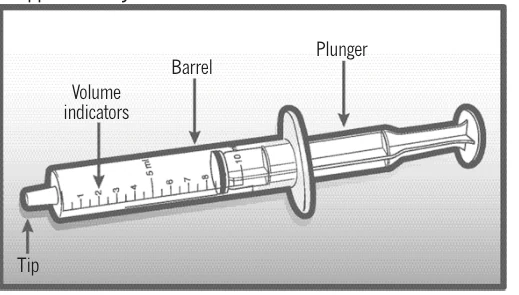
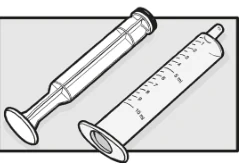
- 10 ml oral syringe with 1 ml increments (for single use): see figure below
- 2 clean glasses
Approximately 30 ml of water
Volume indicators
Barrel Plunger
Tip
Getting ready
- 1. Wash and dry your hands.
- 2. Take the 10 ml oral syringe and pull out the plunger, removing it completely from the barrel of the syringe.
Adding the dispersible tablets
- 3.
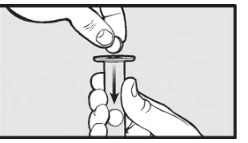
Use scissors to open the blister along the dotted line. Remove the dispersible tablets from the blister. Place them into the barrel of the oral syringe straight away.
- 4. Re-insert the plunger into the barrel of the oral syringe. Push the plunger in until it touches the dispersible tablets.
Adding water
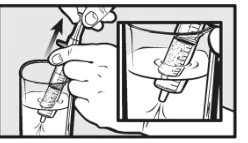
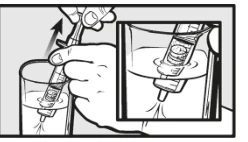
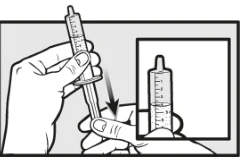
- 5. Fill a small glass with water (drinkable tap water or non-sparkling bottled water). Put the tip of the syringe into the water. Draw up about 5 ml of water by slowly pulling the plunger out until it is at the 5 ml mark on the syringe. Note: The amount of water in the oral syringe does not need to be exact but all the tablets should be covered. If any tablets get stuck in the dry upper part of the oral syringe, gently tap the oral syringe until they fall down into the water. Mixing the medicine
- 6.
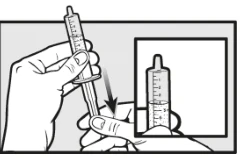
Hold the oral syringe with the tip pointing up. Pull the plunger slowly down to draw in air until it is at the 9 ml mark on the syringe.
- 7.
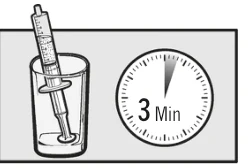
Put the filled oral syringe in the clean, empty glass with the tip pointing up. Wait for 3 minutes – until the dispersible tablets have completely broken apart.
3 Min
- 8.
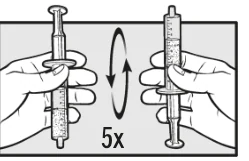
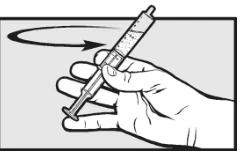
Mix the medicine by slowly turning the oral syringe upside down and back again five times just before using the dose. Do not shake it. Use the oral suspension immediately. If you do not use it within 30 minutes, throw it away and prepare a new suspension.
5x
- 7.
Removing air
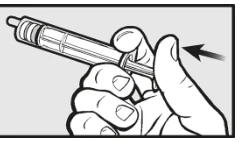
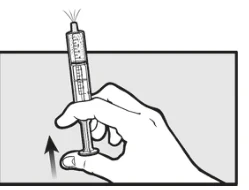
- 9. Hold the oral syringe with the tip pointing upwards. Push the plunger up slowly to remove most of the air (it is okay for a small amount of air to remain around the tip).
Taking the medicine
- 10.
Put the oral syringe into the patient’s mouth. Push the plunger in slowly to release the full contents of the oral syringe.
- 11. Carefully remove the oral syringe from the patient’s mouth.
Making sure all of the medicine has been taken
- 12. Insert the tip of the oral syringe into the glass filled with water. Draw up 5 ml of water by slowly pulling the plunger up.
- 13. Hold the oral syringe with the tip pointing up. Pull the plunger slowly down to draw in air until it is at the 9 ml mark on the syringe.
- 14. With the tip of the oral syringe pointing upwards, swirl the water around to collect any medicine that is left inside.
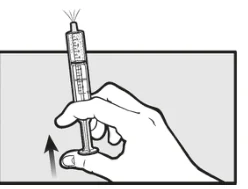
- 15. Hold the oral syringe with the tip pointing upward. Push the plunger up slowly to remove most of the air.