

Patient leaflet - Teduglutide 5 mg powder and solvent for solution for injection
1. What Teduglutide is and what it is used for
Teduglutide contains the active substance teduglutide. It improves the absorption of nutrients and fluid from your remaining gastrointestinal tract (gut).
Teduglutide is used to treat adults, children and adolescents (aged 4 months and above) with Short Bowel Syndrome. Short Bowel Syndrome is a disorder arising from an inability to absorb food nutrients and fluid across the gut. It is often caused by surgical removal of all or part of the small intestine.
2. What you need to know before you use Teduglutide
Do not use Teduglutide:
if you are allergic to teduglutide or any of the other ingredients of this medicine (listed in
- if you have or are suspected to have cancer.
if you have had cancer in the gastrointestinal tract, including liver, gallbladder or bile ducts,
and pancreas within the last five years.
Warnings and precautions
Talk to your doctor before using Teduglutide:
if you have severely decreased liver function. Your doctor will consider this when
prescribing this medicine.
if you suffer from certain cardiovascular diseases (affecting the heart and/or blood vessels)
such as high blood pressure (hypertension) or have a weak heart (cardiac insufficiency). The signs and symptoms include sudden weight gain, face swelling, swollen ankles and/or shortness of breath.
if you have other severe diseases that are not well controlled. Your doctor will consider this
when prescribing this medicine.
if you have decreased kidney function. Your doctor may need to give you a lower dose of
this medicine.
When starting and while getting treated with Teduglutide, your doctor may adjust the amount of intravenous fluids or nutrition you receive.
Medical check-ups before and during treatment with Teduglutide
Before you start treatment with this medicine, your doctor will need to perform a colonoscopy (a procedure to see inside your colon and rectum) to check for the presence of polyps (small abnormal growths) and remove them. It is recommended that your doctor performs these examinations once a year during the first 2 years after starting treatment, and then at a minimum of five-year intervals. If polyps are found either before or during your treatment with Teduglutide, your doctor will decide whether you should continue using this medicine. Teduglutide should not be used if a cancer is detected during your colonoscopy. The doctor will monitor your body fluids and electrolytes as an imbalance may cause fluid overload or dehydration.
Your doctor will take special care and monitor your small bowel function and monitor for signs and symptoms indicating problems with your gallbladder, bile ducts and pancreas.
Children and adolescents
Medical check-ups before and during treatment with Teduglutide
Before you start treatment with this medicine, you will need to have a test done to see if there is blood in the stool. You will also have a colonoscopy done (a procedure to see inside your colon and rectum to check for the presence of polyps (small abnormal growths) and have them removed) if you have unexplained blood in your bowel movements (stools). If polyps are found before your treatment with Teduglutide, your doctor will decide whether you should use this medicine. Teduglutide
should not be used if a cancer is detected during your colonoscopy. Your doctor will perform further colonoscopies if you continue treatment with Teduglutide. The doctor will monitor your child’s body fluids and electrolytes as an imbalance may cause fluid overload or dehydration.
Children aged below 4 months
Teduglutide should not be used in children under 4 months of age. This is because there is limited experience with teduglutide in this age group.
Other medicines and Teduglutide
Tell your doctor, pharmacist or nurse if you are using, have recently used or might use any other medicines.
Teduglutide may affect how other medicines are absorbed from the gut and therefore how well they work. Your doctor may have to change your dose of other medicines.
Pregnancy and breast-feeding
If you are pregnant or breast-feeding, the use of Teduglutide is not recommended. If you are pregnant or breast-feeding, think you may be pregnant or are planning to have a baby, ask your doctor, pharmacist or nurse for advice before using this medicine.
Driving and using machines
This medicine may cause you to feel dizzy. If this happens to you, do not drive or use machines until you feel better.
Important information about some of the ingredients in Teduglutide
This medicine contains less than 1 mmol sodium (23 mg) per dose. This means that it is essentially ‘sodium-free’.
Caution is needed if you are hypersensitive to tetracycline (see “Do not use Teduglutide” section).
3. How to use Teduglutide
Always use this medicine exactly as your doctor has told you. Check with your doctor, pharmacist or nurse if you are not sure.
Dose
The recommended daily dose is 0.05 mg per kg body weight. The dose will be given in millilitres (ml)
of solution.
Your doctor will choose the dose that is right for you depending on your body weight. Your doctor will tell you which dose to inject. If you are not sure, ask your doctor, pharmacist or nurse.
Use in children and adolescents
Teduglutide can be used in children and adolescents (aged 4 months and above). Use this medicine exactly as your doctor has told you.
How to use Teduglutide
Teduglutide is injected under the skin (subcutaneously) once daily. The injection can be self-administered or given by another person, for example your doctor, his/her assistant or your home nurse. If you, or your carer, are injecting the medicine, you or your carer must receive adequate training by your doctor or nurse. You will find detailed instructions for injections at the end of this leaflet.
It is strongly recommended that every time you or your child receive a dose of Teduglutide, the name and lot number of the product are recorded in order to maintain a record of the lots used.
If you use more Teduglutide than you should
If you inject more Teduglutide than you are told to by your doctor, you should contact your doctor, pharmacist or nurse.
If you forget to use Teduglutide
If you forget to inject this medicine (or cannot inject it at your usual time), use it as soon as possible on that day. Never use more than one injection in the same day. Do not inject a double dose to make up for a forgotten dose.
If you stop using Teduglutide
Keep using this medicine for as long as your doctor prescribes it for you. Do not stop using this medicine without consulting your doctor, as a sudden stop can cause changes in your fluid balance.
If you have any further questions on the use of this medicine, ask your doctor, pharmacist or nurse.
4. Possible side effects
Like all medicines, this medicine can cause side effects, although not everybody gets them. Seek immediate medical attention if any of the following side effects occur: Common (may affect up to 1 in 10 people):
- Congestive heart failure. Contact your doctor if you experience tiredness, shortness of breath or swelling of ankles or legs or face swelling.
- Inflammation of the pancreas (pancreatitis). Contact your doctor or the emergency unit if you experience severe stomach ache and fever.
- Intestinal obstruction (blockage of the bowel). Contact your doctor or the emergency unit if you experience severe stomach ache, vomiting and constipation.
- Reduced flow of bile from the gallbladder and/or inflammation of the gallbladder. Contact your doctor or the emergency unit if you experience yellowing of the skin and the whites in the eyes, itching, dark urine and light-coloured stools or pain in the upper right side or middle of the stomach area.
Uncommon (may affect up to 1 in 100 people):
- Fainting. If heart rate and breathing is normal and you awaken fast, speak to your doctor. In other cases, seek help as soon as possible.
Other side effects include:
Very common (may affect more than 1 in 10 people):
- Respiratory tract infection (any infection of the sinuses, throat, airways or lungs)
- Headache
- Stomach pain, bloated stomach, feeling sick (nausea), swelling of stoma (an artificial opening for waste removal), vomiting
- Reddening, pain or swelling at the site of the injection
Common (may affect up to 1 in 10 people):
- Flu (influenza) or flu-like symptoms
- Decreased appetite
- Swelling of hands and/or feet
- Problems sleeping, anxiety
- Cough, shortness of breath
- Polyps (small abnormal growths) in your large bowel
- Passing gas (flatulence)
- Narrowing or blockage of your pancreatic duct, which may cause inflammation of the pancreas
- Inflammation of the gallbladder
Uncommon (may affect up to 1 in 100 people)
- Polyps (small abnormal growths) in your small bowel
Not known (frequency cannot be estimated from the available data):
- Allergic reaction (hypersensitivity)
- Fluid retention
- Polyps (small abnormal growths) in your stomach
Use in children and adolescents
In general, the side effects in children and adolescents are similar to those seen in adults.
There is limited experience in children under 4 months of age.
Reporting of side effects
If you get any side effects, talk to your doctor or pharmacist. This includes any possible side effects not listed in this leaflet. You can also report side effects directly via Yellow Card Scheme website: www.mhra.gov.uk/yellowcard or search for MHRA Yellow Card in the Google Play or Apple App Store.
By reporting side effects you can help provide more information on the safety of this medicine.
5. How to store Teduglutide
Keep this medicine out of the sight and reach of children.
Do not use this medicine after the expiry date which is stated on the carton, vial and the pre-filled syringe after EXP. The expiry date refers to the last day of that month.
Powder
Store in a refrigerator (2 °C – 8 °C).
Do not freeze.
Solvent
This does not require any special storage conditions.
After reconstitution, from a microbiological point of view, the solution should be used immediately. However, chemical and physical stability has been demonstrated for 3 hours at 20-25°C.
Do not use this medicine if you notice that the solution is cloudy or contains particulate matter.
Do not throw away any medicines via wastewater or household waste. Ask your pharmacist how to throw away medicines you no longer use. These measures will help protect the environment.
Dispose of all needles and syringes in a sharps disposal container.
6. Contents of the pack and other information
What Teduglutide contains:
- The active substance is teduglutide. One vial of powder contains 5 mg of teduglutide. After reconstitution, each vial contains 5 mg teduglutide in 0.5 ml of solution, corresponding to a concentration of 10 mg/ml.
- The other ingredients are mannitol, sodium dihydrogen phosphate monohydrate, disodium hydrogen phosphate heptahydrate and L-Histidine.
- The solvent contains water for injections.
What Teduglutide looks like and contents of the pack
Teduglutide is a powder and solvent for solution for injection (5 mg teduglutide in vial, 0.5 ml solvent in pre-filled syringe).
The powder is white and the solvent is clear and colourless.
Teduglutide is available in packs of 28 vials of powder with 28 pre-filled syringes.
Marketing Authorisation Holder
Mylan,
Station Close,
Potters Bar,
EN6 1TL,
United Kingdom.
Manufacturer
Pharmadox Healthcare Ltd,
KW20A Kordin Industrial Park, Paola, PLA3000
Malta
This leaflet was last revised in December 2025
Date: Time:
Page Count
No. of colours
Site Barcode/ DataMatrix
Viatris SAP No.
Description
MA No.
3D Render ID
New Supplier Code
Supplier SAP No.
Leaflet
N/A
3922104
PL 04569/1897
N/A
G030118-00
N/A
Teduglutide_5mg_28
3922104
N/A
N/A
N/A
United Kingdom
400580111
Front - 8294 / Back - 8295
11 pt
10 pt 1 2 of 2
07-DEC-2025 20:32
GTIN/PC
320 mm
<-----------------------------------------------------------------------------------------------------------------------------------> Instructions for preparing and injecting Teduglutide
Important information:
- Read the Package Leaflet before using Teduglutide.
- Teduglutide is for injection under the skin (subcutaneous injection).
- Do not inject Teduglutide into a vein (intravenously) or muscle (intramuscularly).
- Keep Teduglutide out of the sight and reach of children.
Do not use Teduglutide after the expiry date which is stated on the carton, the vial and the pre-filled
syringe. The expiry date refers to the last day of that month.
- Store in a refrigerator (2 °C – 8 °C).
- Do not freeze.
After reconstitution, from a microbiological point of view, the solution should be used immediately.
However, chemical and physical stability has been demonstrated for 3 hours at 20-25°C.
- Do not use Teduglutide if you notice that the solution is cloudy or contains particulate matter.
Do not throw away any medicines via wastewater or household waste. Ask your pharmacist how to
throw away medicines you no longer use. These measures will help protect the environment.
- Dispose of all needles and syringes in a sharps disposal container.
Materials needed but not included in the pack:
- Reconstitution needles (size 22G, length 1½" (0.7 x 40 mm))
0.5 or 1 ml injection syringes (with scale intervals of 0.02 ml or smaller). For children, a
0.5 ml (or smaller) injection syringe may be used
Thin injection needles for subcutaneous injection (e.g., size 26G, length 5/8" (0.45 x 16 mm), or
smaller needles for children, as appropriate)
- Alcohol wipes
- Alcohol swabs
- A puncture-proof container for safe disposal of the used syringes and needles
NOTE: Before you start, make sure you have a clean work surface and that you have washed your hands before proceeding.
- 1. Assemble the pre-filled syringe
Once you have all the materials ready, you need to assemble the pre-filled syringe. The following procedure shows how you do this.
- 2. Dissolve the powder
Now you are ready to dissolve the powder with the solvent.
NOTE: Do not shake the vial. Shaking the vial may produce foam, which makes it difficult to extract the solution from the vial.
2.7 Observe the vial for any undissolved powder. If any powder remains, repeat steps 2.5 and 2.6.
Do not shake the vial. If there is still some undissolved powder, discard the vial and start the preparation again from the beginning with a new vial.
Materials provided in the pack:
- 28 vials with 5 mg teduglutide as a powder
- 28 pre-filled syringes with solvent
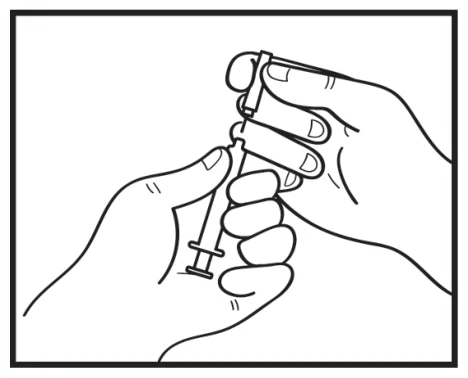
1.1 Take the pre-filled syringe with the solvent and flip off
the top part of the white plastic cap on the pre-filled syringe so that it is ready for the reconstitution needle to be attached.
1.2 Attach the reconstitution needle (22G, 1½" (0.7 x
40 mm)) to the assembled pre-filled syringe by screwing it on in a clockwise direction.
2.1 Remove the blue flip-off button from the powder vial,
wipe the top with an alcohol wipe and allow to dry. Do not touch the top of the vial.
2.2 Uncap the reconstitution needle on the assembled
pre-filled syringe with solvent without touching the tip of the needle.
2.3 Taking the powder vial, insert the reconstitution
needle attached to the assembled pre-filled syringe into the centre of the rubber stopper and gently push the plunger all the way down to inject all the solvent into the vial.
2.4 Leave the reconstitution needle and empty syringe in
the vial. Let the vial rest for approximately 30 seconds.
2.5 Gently roll the vial between your palms for about
15 seconds. Then gently turn the vial upside-down once with the reconstitution needle and empty syringe still in the vial.
2.6 Let the vial rest for about two minutes.
NOTE: The final solution should be clear. If the solution is cloudy or contains particulate matter, do not inject it.
NOTE: Once prepared, the solution should be used immediately. It should be kept below 20-25°C and maximum storage time is 3 hours.
- 3. Prepare the injection syringe
NOTE: If your doctor has told you that you need two vials, prepare a second pre-filled syringe with solvent and a second powder vial as shown in the main steps 1 and 2. Withdraw the solution from the second vial into the same injection syringe by repeating step 3.
- 4. Inject the solution
NOTE: Do not use the same area each day for each injection - rotate sites (use upper, lower, and left and right side of your belly) to avoid discomfort. Avoid areas that are inflamed, swollen, scarred or covered by a mole, birthmark or other lesion.
4.4 Pull back the plunger slightly. If you see any blood in the syringe, withdraw the needle and replace the needle on the injection syringe with a clean one of the same size. You can still use the medicine that is already in the syringe. Try to inject in another place in the cleaned skin area. 4.5 Inject the medicine slowly by pushing steadily on the plunger until all the medicine is injected and the syringe is empty.
4.6 Pull the needle straight out of the skin and discard the needle and syringe together into the sharps disposal container. A small amount of bleeding may occur. If necessary, press gently on the injection site with an alcohol swab or 2x2 gauze until any bleeding has stopped. 4.7 Dispose all needles and syringes in a sharps disposal container or hard-walled container (for example, a detergent bottle with a lid). This container must be puncture proof (top and sides). If
you need a sharps disposal container, please contact your doctor.
3.1 Remove the reconstitution syringe from the reconstitution needle which is still in the vial and discard the reconstitution syringe.
3.2 Take the injection syringe and attach it to the reconstitution needle which is still in the vial.
3.3 Turn the vial upside down, slide the tip of the reconstitution needle close to the stopper and allow all the medicine to fill the syringe by pulling the plunger back gently.
3.4 Remove the injection syringe from reconstitution needle leaving the needle in the vial. Discard the vial and reconstitution needle together into the sharps disposal container.
3.5 Take the injection needle, but do not remove the plastic needle cap. Attach the needle to the injection syringe containing the medicine.
3.6 Check for air bubbles. If air bubbles are present, gently tap the syringe until they rise to the top. Then gently push up the plunger to expel the air.
3.7 Your dose in ml has been calculated by your doctor.
Expel any excessive volume from the syringe with the needle cap still on until your dose is reached.
4.1 Find an area on your belly, or if you have pain or hardening of the tissue on your belly, on your thigh where it is easy for you to give the injection (see the diagram).
4.2 Clean the intended site of injection on your skin with an alcohol swab, using a circular motion, working outwards. Allow the area to air-dry.
4.3 Remove the plastic cap from the needle of the prepared injection syringe. Gently grasp the cleaned skin at the injection site with one hand.
With the other hand, hold the syringe as you would with a pencil. Bend your wrist back and quickly insert the needle at a 45° angle.
3922104