

Patient leaflet - Tafamidis 61 mg capsules, soft
1. What Tafamidis soft capsules are and what they are used for
Tafamidis soft capsules contain the active substance tafamidis.
Tafamidis soft capsules are a medicine which treats a disease called hereditary transthyretin amyloidosis. Transthyretin amyloidosis is caused by a protein called transthyretin (TTR) that does not work properly. TTR is a protein that carries other substances, such as hormones, through the body.
In patients with this disease, TTR breaks up and may form fibres called amyloid. Amyloid can build up between cells in your heart (known as transthyretin amyloid cardiomyopathy or ATTR-CM) and in other places in your body. The amyloid causes the symptoms of this disease. When this occurs in your heart, it prevents your heart from working normally.
Tafamidis can prevent TTR from breaking up and forming amyloid. This medicine is used to treat adult patients whose heart has been affected (people with symptomatic cardiomyopathy).
2. What you need to know before you take Tafamidis soft capsules
Do not take Tafamidis soft capsules
If you are allergic to tafamidis or any of the other ingredients of this medicine (listed in section 6).
Warnings and precautions
Talk to your doctor, pharmacist or nurse before taking this medicine. • Women that can become pregnant should use birth control while taking
tafamidis and should continue using birth control for one month after stopping treatment with this medicine. There are no data on the use of tafamidis in pregnant women.
Children and adolescents
Children and adolescents do not have the symptoms of transthyretin amyloidosis. This medicine is therefore not used for children and adolescents.
Other medicines and Tafamidis soft capsules
Tell your doctor or pharmacist if you are taking, have recently taken or might take any other medicines.
You should inform your doctor or pharmacist if you are taking any of the following:
- non-steroidal anti-inflammatory drugs
- diuretic medicines (e.g. furosemide, bumetanide)
- anti-cancer medicines (e.g. methotrexate, imatinib)
- statins (e.g. rosuvastatin, atorvastatin)
- anti-clotting medicines (e.g. apixaban, rivaroxaban)
anti-viral medicines (e.g. oseltamivir, tenofovir, ganciclovir, adefovir, cidofovir,
lamivudine, zidovudine, zalcitabine)
Pregnancy, breast-feeding and fertility
If you are pregnant or breast-feeding, think you may be pregnant or are planning to have a baby, ask your doctor or pharmacist for advice before taking this medicine.
You should not take this medicine if you are pregnant or breast-feeding. • If you are able to become pregnant, you must use birth control during
treatment and for one month after stopping treatment.
Driving and using machines
This medicine is believed to have no or negligible influence on the ability to drive and use machines.
Tafamidis soft capsules contain sorbitol
This medicine contains 26 mg sorbitol in each capsule. Sorbitol is a source of fructose.
3. How to take Tafamidis soft capsules
Always take this medicine exactly as your doctor or pharmacist has told you. Check with your doctor or pharmacist if you are not sure.
The recommended dose is one Tafamidis 61 mg soft capsule taken once a day.
If you vomit after taking this medicine and can identify the intact Tafamidis soft capsule, then an additional dose of this medicine should be taken in the same day; if you cannot identify the Tafamidis soft capsule, then no additional dose of this medicine is necessary, and you can resume taking this medicine the next day as usual.
Method of administration
Tafamidis soft capsules are for oral use.
The soft capsule should be swallowed whole, not crushed or cut. The capsule may be taken with or without food.
Instructions for opening the blisters
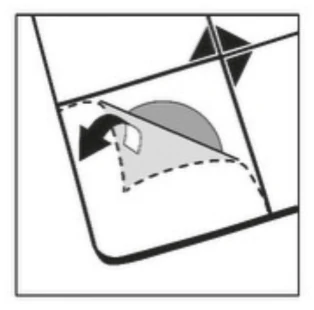
Tear off one individual blister from the blister card along the perforated line. • Next, remove the protective film. Start at the corner indicated by the mark
(see figure below).
- Afterwards, push the capsule through the aluminium foil.
If you take more Tafamidis soft capsules than you should
You should not take more capsules than your doctor tells you to. If you take more capsules than you have been told to take, contact your doctor.
If you forget to take Tafamidis soft capsules
If you forget to take a dose, take your capsules as soon as you remember. If it is within 6 hours before your next dose, skip the missed dose and take the next dose
at the usual time. Do not take a double dose to make up for a forgotten dose.
If you stop taking Tafamidis soft capsules
Do not stop taking this medicine without first speaking to your doctor. As tafamidis works by stabilising the TTR protein, if you stop taking this medicine, the protein will no longer be stabilised, and your disease may progress.
If you have any further questions on the use of this medicine, ask your doctor or pharmacist.
4. Possible side effects
Like all medicines, this medicine can cause side effects, although not everybody gets them.
Common: may affect up to 1 in 10 people
- Diarrhoea
- Rash, itching
In clinical studies, the side effects in patients taking tafamidis were generally similar to that of patients not taking tafamidis. Flatulence and increase in liver function tests were reported more often in ATTR-CM patients treated with tafamidis.
Reporting of side effects
If you get any side effects, talk to your doctor, pharmacist or nurse. This includes any possible side effects not listed in this leaflet. You can also report side effects directly via the Yellow Card Scheme at: www.mhra.gov.uk/yellowcard or search for MHRA Yellow Card in the Google Play or Apple App Store. By reporting side effects you can help provide more information on the safety of this medicine.
5. How to store Tafamidis soft capsules
Keep this medicine out of the sight and reach of children.
Do not use this medicine after the expiry date which is stated on the blister card and on the carton. The expiry date refers to the last day of that month.
Do not store above 30°C.
Do not throw away any medicines via wastewater or household waste. Ask your pharmacist how to throw away medicines you no longer use. These measures will help protect the environment.
6. Contents of the pack and other information
What Tafamidis soft capsules contain
- The active substance is tafamidis. Each capsule contains 61 mg micronised tafamidis.
- The other ingredients are: gelatin (E 441), glycerol (E 422), sorbitol sorbitan solution (E 420) [see section 2 “Tafamidis soft capsules contain sorbitol”], red iron oxide (E 172), purified water, macrogol 400 (E 1521), polysorbate 20 (E 432), povidone K-30, butylated hydroxytoluene (E 321), isopropyl alcohol, shellac – dewaxed bleached resins, titanium dioxide (E 171), propylene glycol (E 1520), and sodium laurilsulfate.
What Tafamidis soft capsules look like and contents of the pack
Tafamidis 61 mg soft capsules are reddish brown, opaque, oblong shaped soft capsules (approximately 20 mm) filled with white to pink coloured suspension imprinted with ‘200’ in white ink.
Tafamidis soft capsules are available in PVC/OPA/Alu/PVC-Paper/PET/Alu, perforated unit dose blisters. The two pack sizes available are a pack of 30 x 1 soft capsules and a multipack of 90 soft capsules comprising of 3 cartons, each containing 30 x 1 soft capsules.
Not all pack sizes may be marketed.
Marketing Authorisation Holder and Manufacturer
Marketing Authorisation Holder
STADA, Manchester Road, Linthwaite, Huddersfield, HD7 5QH, UK
Manufacturer
Pharmadox Healthcare Limited, KW20A Kordin Industrial Park, Paola, PLA 3000, Malta
This leaflet was last revised in September 2026.
Package leaflet: Info
rmation for the user
Tafamidis 61 m
g soft capsules
9389789 2604 GB