

Summary of Product Characteristics (SmPC) - Soluprep 2% w/v / 70% v/v cutaneous solution
1 NAME OF THE MEDICINAL PRODUCT
Soluprep 2% w/v / 70% v/v cutaneous solution
2 QUALITATIVE AND QUANTITATIVE COMPOSITION
1 ml solution contains 20 mg chlorhexidine digluconate and 0.70 mL isopropyl alcohol.
For the full list of excipients, see section 6.1.
3 PHARMACEUTICAL FORM
Cutaneous solution.
Colourless solution.
4 CLINICAL PARTICULARS
4.1 Therapeutic indications
The medicinal product is to be used in subjects aged 1 year and above for disinfection of the skin prior to invasive medical procedures to help reduce bacteria that can potentially cause skin infection.
4.2 Posology and method of administration
Posology
For cutaneous use.
Soluprep may be used in all age groups and patient populations. However, Soluprep is not recommended in the paediatric population less than 1 year old (see Section 4.4 Special warnings and precautions for use).
Two sized single use applicators are available:
- 10.5 mL green tinted or colourless solution
26 mL green tinted solution
The choice of applicator size will depend on the type of invasive medical procedure being performed and the preference of the clinician.
As this product does not have presentations of smaller volumes, prescribers should use alternate products for disinfection of skin prior to simple invasive procedures that require small volume.
Solution Volume (mL) | Maximum Coverage Area (cm x cm) | To be used for: | |
10.5 (colourless) | (1156 cm2) | Head, neck and small prep areas |
|
10.5 (green tinted) | (1156 cm2) | Head, neck and small prep areas | |
26 (green tinted only) | (2500 cm2) | Large prep areas below the neck | |
Method of administration 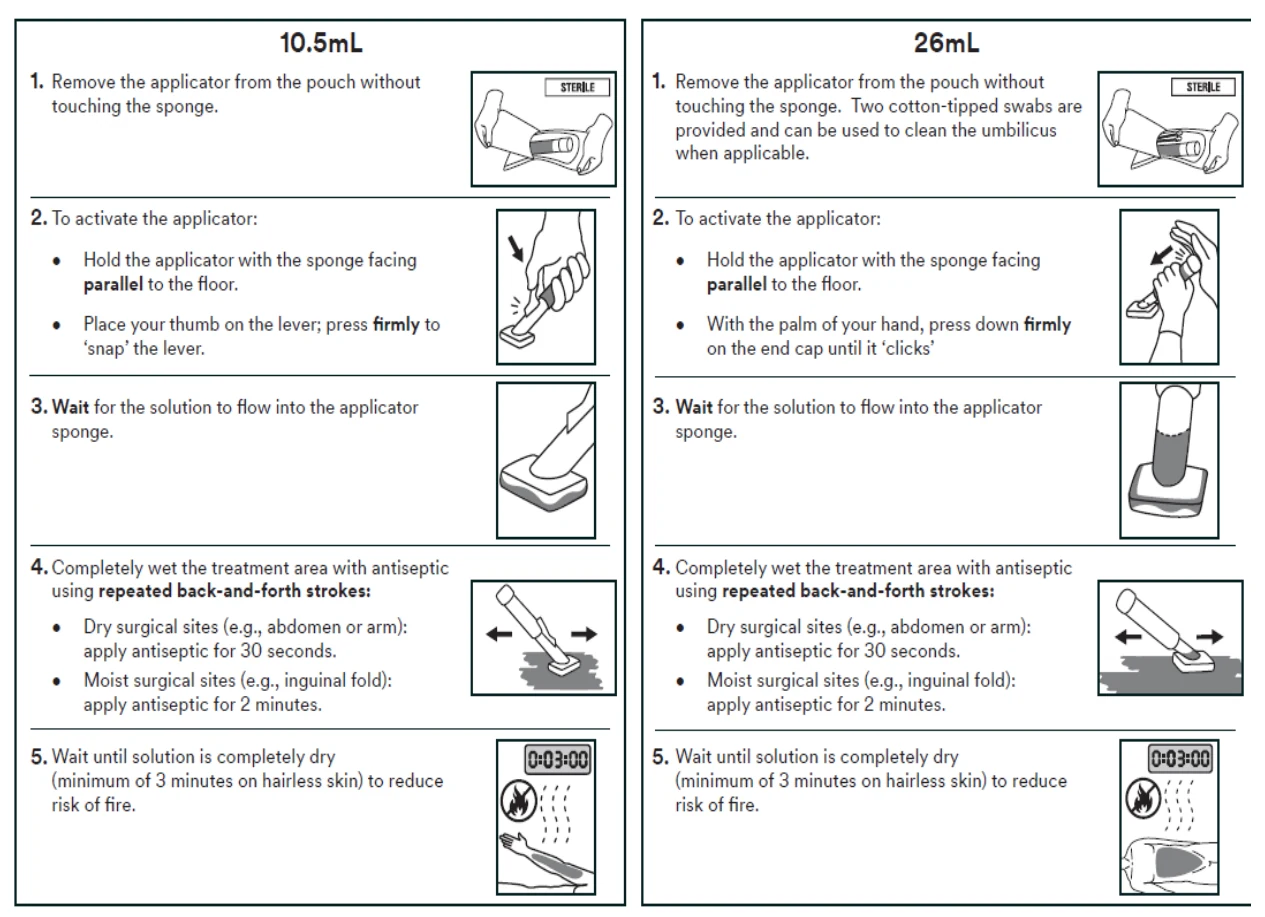
Avoid getting solution into hair. Wet hair is flammable. Hair may take up to 1 hour to dry.
It is recommended that the antiseptic solution remain on the skin after the procedure for continued protection. The antiseptic will gradually wear away. If early removal is desired, use soap and water or isopropyl alcohol.
4.3 Contraindications
Known hypersensitivity to chlorhexidine, isopropyl alcohol or any other ingredients listed in section 6.1, especially in those with a history of possible chlorhexidine-related allergic reactions (see Sections 4.4 and 4.8).
4.4 Special warnings and precautions for use
For external use only on intact skin.
The solution is flammable. Do not use electrocautery procedures or other ignition sources until the skin is completely dry.
Remove any soaked materials, drapes or gowns before proceeding with the intervention. Do not use excessive quantities and do not allow the solution to pool in skin folds or under the patient or drip on sheets or other material in direct contact with the patient. Where occlusive dressings are to be applied to areas previously exposed to Soluprep, care must be taken to ensure no excess product is present prior to application of the dressing.
To reduce risk of fire, apply the solution carefully:
- Avoid getting solution into hair. Wet hair is flammable. Hair may take up to 1 hour to dry.
Begin draping and/or using electrocautery only after solution is completely dry
(minimum of 3 minutes on hairless skin; up to 1 hour in hair) and all wet materials are removed.
Soluprep contains chlorhexidine. Rare but serious allergic reactions have been reported with products containing chlorhexidine. Soluprep should not be administered to anyone with a potential history of an allergic reaction to a chlorhexidine-containing compound (see Section 4.3 and 4.8)
Keep out of eyes, ears and mouth. The solution may cause serious or permanent injury if it comes into contact with these areas. If contact occurs, rinse immediately and thoroughly with cold water and contact a doctor.
The use of chlorhexidine solutions, both alcohol based and aqueous, for skin antisepsis prior to invasive procedures has been associated with chemical burns in neonates. Based on available case reports and the published literature, this risk appears to be higher in preterm infants, especially those born before 32 weeks of gestation and within the first 2 weeks of life. As the development of the epidermal barrier is a continuous process beyond the first months of life, Soluprep is not recommended in the age group less than 1 year old.
Do not use for lumbar puncture or in contact with the meninges. In addition, direct contact with neural tissue or the middle ear must be avoided.
Do not use on open skin wounds, broken or damaged skin or as a general skin cleaner.
Prolonged skin contact with alcohol containing solutions should be avoided. At the first sign of local skin reaction the use of Soluprep should be discontinued.
The product is for single use only. It is important to ensure that the correct method of application is followed (see section 4.2). Discard the applicator after a single use along with any portion of the solution not required to cover the treatment area.
4.5 Interaction with other medicinal products and other forms of interaction
The product is applied topically and the expected systemic activity is very low. No studies were performed to investigate its pharmacologic effects when used concomitantly with other medications.
4.6 Fertility, Pregnancy and lactation
There are no studies with this product in pregnant or lactating women.
Pregnancy
No effects during pregnancy are anticipated since systemic exposure to chlorhexidine gluconate and isopropyl alcohol is negligible. Soluprep may be used during pregnancy.
Breast-feeding
No effects on the breastfed newborn/infant are anticipated since the systemic exposure of the breast-feeding woman to chlorhexidine gluconate and isopropyl alcohol is negligible. Soluprep may be used during breast-feeding.
Fertility
The effects of chlorhexidine gluconate on human reproduction have not been studied.
No effects on fertility are anticipated since systemic exposure to isopropyl alcohol is negligible.
4.7 Effects on ability to drive and use machines
Soluprep has no influence on the ability to drive or use machines.
4.8 Undesirable effects
Very common (≥1/10)
Common (≥1/100 to <1/10)
Uncommon (≥1/1,000 to <1/100)
Rare (≥1/10,000 to <1/1,000)
Very rare (<1/10,000)
Not known (cannot be estimated from the available data)
Skin disorders:
Very rare (<1/10,000) allergic or irritation skin reactions have been reported with chlorhexidine, isopropyl alcohol including erythema, rash (e.g. erythematous, papular, or maculopapular), pruritus and blisters or application site vesicles. Other local symptoms have included skin burning sensation, pain and inflammation.
Frequency unknown: dermatitis, eczema, urticaria, chemical burns in neonates.
Immune disorders:
Frequency unknown: chlorhexidine is known to induce hypersensitivity, including generalised allergic reactions and anaphylactic shock. The prevalence of chlorhexidine hypersensitivity is not known, but available literature suggests that this is likely to be rare in the perioperative setting (see Section 4.3 and 4.4).
Common: application site rash, application site erythema, application site vesicles, application site pain and application site pruritus.
Frequency, type and severity of adverse reactions in children are expected to be the same as in adults.
Reporting of suspected adverse reactions
Reporting suspected adverse reactions after authorisation of the medicinal product is important. It allows continued monitoring of the benefit/risk balance of the medicinal product. Healthcare professionals are asked to report any suspected adverse reactions via the Yellow Card Scheme at: www.mhra.gov.uk/yellowcard or search for MHRA Yellow Card in the Google Play or Apple App Store.
4.9 Overdose
This product is indicated for use as a preoperative surgical skin preparation and will be administered in a controlled environment by qualified personnel. In addition, the product is administered to a localised body region and is not absorbed through the skin in any significant amounts. Therefore, the potential for an overdose with this product is low.
5 PHARMACOLOGICAL PROPERTIES
5.1 Pharmacodynamic properties
Pharmacotherapeutic group: Chlorhexidine, combinations, ATC code: D08A C52.
Mechanism of Action: Bisbiguanide antiseptics exert their lethal effect upon bacterial cells through non-specific interaction with acidic phospholipids of the cell membranes.
Chlorhexidine gluconate is a cationic biguanide. Its antimicrobial action is due to the disruption of the cell membrane and the precipitation of cell contents. It has a bactericidal or bacteriostatic action against a wide range of gram-positive and gram-negative bacteria. It is relatively ineffective against mycobacteria. It inhibits some viruses and is active against some fungi. It is inactive against bacterial spores. Chlorhexidine gluconate has a strong binding property to skin and has a residual property on the skin. Chlorhexidine gluconate is not neutralised in the presence of organic matter.
Isopropyl alcohol is a rapidly-bactericidal and a fast-acting, broad spectrum antiseptic, but is not considered persistent. Its mechanism of action appears to be denaturation of proteins.
Soluprep is a sterile antiseptic solution containing active ingredients of 2% CHG and 70% IPA, that is effective for both rapid and persistent reduction of bacterial load across various body regions for a broad spectrum of organisms. Isopropyl alcohol (70%) provides an immediate kill of transient and resident microorganisms on the stratum corneum and 2% chlorhexidine gluconate binds to the superficial cell layers of the epidermis and provides persistent antimicrobial property that prevents regrowth of microorganisms.
Clinical studies with 2% Chlorhexidine gluconate in 70% Isopropyl alcohol have demonstrated that the combination offers equal or similar effectiveness in reducing skin bacterial load and more sustained antibacterial effects over longer periods after application, compared to the individual components alone, as well as to other commonly used antiseptics such as Povidone-iodine.
In vitro studies
Soluprep meets the criteria for chemical disinfectants and antiseptic products as established by European Standards:
EN 1040 – basic bactericidal activity (Phase 1)
EN 1275 – basic yeasticidal activity (Phase 1)
Soluprep meets these EN criteria for bactericidal and fungicidal activity for the following organisms at 5 minutes and 15 minutes contact time (Table 1).
Table 1: In vitro EN 1040 and EN 1275 microbiocidal effects
| Strain | Contact Time | Conditions | Log Reduction | EN Criteria |
| Pseudomonas aeruginosa | 5 min | 100%, 75% | >5.08 | EN 1040 |
| Staphylococcus aureus | 5 min | 100%, 75% | >5.08 | EN 1040 |
| Aspergillus brasiliensis | 15 min | 100%, 75% | >4.22 | EN 1275 |
| Candida Albicans | 15 min | 100%, 75% | >4.08 | EN 1275 |
An in vitro time-kill study was conducted using both the tinted and colourless Soluprep solutions (at full strength and at 50% strength) to determine how rapidly and effectively the test products killed a variety of organisms. A total of 48 repository isolates and 144 clinical isolates were evaluated. Both the colourless and tinted formulations demonstrated >5 log10 reductions at both the 3-minute and 5-minute time points for all microorganisms tested.
Another in vitro time-kill study was conducted using both the tinted and colourless solutions to determine how rapidly and effectively the test products killed a variety of organisms in the presence of a serum challenge. Six challenge microorganisms were evaluated. Both the colourless and tinted formulations demonstrated >5 log10 reductions at both the 3-minute and 5-minute time points for all microorganisms tested.
An in vitro antimicrobial resistance study was conducted to detect the potential for development of resistance to the test product (tinted Soluprep) by the sequential passage of 42 clinically relevant microorganisms through increasing concentrations of the antimicrobial included in the culture media. The maximum inhibitory concentration (MIC) did not increase for any of the strains evaluated for emergence of resistance; therefore, tinted Soluprep was not considered to have the potential for the development of resistance. An evaluation of the potential for antibiotic cross-resistance was done by comparing the MIC of several antibiotics before and after extended exposure to sub-lethal levels of each antiseptic. There was no indication of a change in MIC related to cross-resistance observed for any of the organism/antibiotic combinations tested.
Paediatric population
The European Medicines Agency granted a product-specific waiver for all subsets of the paediatric population on the grounds that the specific medicinal product does not represent a significant therapeutic benefit over existing treatments for paediatric patients. (see section 4.2 and 4.4 for information on use in infants).
5.2 Pharmacokinetic properties
There is little absorption of isopropyl alcohol or of chlorhexidine gluconate through intact skin..Chlorhexidine gluconate was below the limit of detection (< 1 ng/ml) in all subjects in a clinical study designed to evaluate pharmacokinetics following dermal exposure to a maximum amount of product (4 X 26 ml applicators) applied to intact skin.
5.3 Preclinical safety data
Chlorhexidine gluconate and isopropyl alcohol both have long histories of safe and effective use as patient preoperative skin preparation active ingredients and a large literature database on the safety and efficacy of these two active ingredients exists. The Soluprep product was evaluated in a Primary Skin Irritation Study in Rabbits, a Murine Local Lymph Node Assay in Mice, a Repeated Dose Dermal Toxicity Study in Rabbits, and a Primary Irritancy and Phototoxicity in Hairless Mice. These studies demonstrated that there was little or no skin irritation/sensitization and with no systemic toxicity observed.
Adverse effects associated with chlorhexidine gluconate and isopropyl alcohol in non-clinical studies described in the literature were observed at systemic exposures considered sufficiently in excess of the maximum human exposure achieved by topical use, indicating little relevance to clinical use of Soluprep.
6 PHARMACEUTICAL PARTICULARS
6.1 List of excipients
Colourless Solution:
Tributyl acetylcitrate
Purified water
Trisodium Hydroxyethyl Ethylenediamine Triacetic Acid (HEDTA)
6.2 Incompatibilities
Chlorhexidine is incompatible with soap and other anionic agents.
6.3 Shelf life
2 years
6.4 Special precautions for storage
Do not store above 30°C. Do not refrigerate or freeze.
Flammable. Keep away from fire or naked flame during use, storage and disposal.
Store in the original package. Applicator is sterile unless the seal is broken.
6.5 Nature and contents of container
Soluprep is provided in an applicator that consists of foam sponge attached to a plastic barrel which holds a glass ampoule containing the sterile antiseptic cutaneous solution. The container closure system is not made with natural rubber latex. The applicators are sterile and individually packaged. It is available as tint solution and colourless solution:
10.5 mL colourless solution: 50 applicators
10.5 mL green tinted solution: 50 applicators
26 mL green tinted solution: 20 applicators
Not all pack sizes may be marketed.
6.6 Special precautions for disposal
This product is for single use only.
Any unused medicinal product or waste material should be disposed of in accordance with local requirements.
7 MARKETING AUTHORISATION HOLDER
KCI MEDICAL LIMITED
Building 47 Charnwood Campus
10 Bakewell Road
Loughborough
England
LE11 5RB
8 MARKETING AUTHORISATION NUMBER(S)
PL 59283/0001
9 DATE OF FIRST AUTHORISATION/RENEWAL OF THE
AUTHORISATION
31/07/2023
10 DATE OF REVISION OF THE TEXT
21/06/2024