

Patient leaflet - Sodium Chloride 0.9%w/v solution for infusion
1. What Sodium chloride 0.9% is and what it is used for
Sodium chloride 0.9% is a solution of sodium chloride in water. Sodium chloride is a chemical substance (often called “salt”) found in the blood.
Sodium chloride 0.9% is used to treat:
- a loss of body water (dehydration)
- a loss of sodium from the body (sodium depletion)
Situations that may cause sodium chloride and waterloss include:
- when you cannot eat or drink, due to illness or after surgery
pronounced sweating due to high fever
- extensive skin loss, as can occur in severe burns.
Sodium chloride 0.9% may also be used to deliver or to dilute other medicines for infusion.
2. What you need to know before you are given Sodium chloride 0.9%
Do NOT receive Sodium chloride 0.9% if you are suffering from any of the following conditions
higher levels of chloride in the blood than normal
(hyperchloraemia)
higher levels of sodium in the blood than normal
(hypernatraemia)
If a medicine has been added to Sodium chloride 0.9%, the Package Leaflet of the added medicine must be consulted to determine whether or not you can receive the solution.
Warnings and precautions
Please tell your doctor if you have or have had any of the following medical conditions:
- any type of heart disease or poor heart function
- poor kidney function
- acidification of the blood (acidosis)
when there is a larger volume of blood in the blood
vessels than there should be (hypervolaemia)
- high blood pressure (hypertension)
build-up of fluid under the skin, particularly around
the ankles (peripheral oedema)
- build-up of fluid in the lungs (pulmonary oedema)
- liver disease (eg cirrhosis)
- high blood pressure during pregnancy (pre-eclampsia)
raised production of the hormone aldosterone
(aldosteronism)
any other condition associated with sodium retention
(when the body retains too much sodium), such as treatment with steroids (see also below “Other medicines and Sodium chloride 0.9%”).
if you have a condition that could cause high levels
of vasopressin, a hormone regulating fluid in your body. You may have too much vasopressin in your body because, for example:
- you have had a sudden and serious illness
- you are in pain
- you have had surgery
- you have infections, burns or brain disease
- you have diseases linked to your heart, liver, kidneys or central nervous system
- because you are taking certain medicines (see also below “Other medicines and Sodium chloride 0.9%”).
This may increase the risk of low levels of sodium in your blood and can lead to headache, nausea, seizures, lethargy, coma, swelling of the brain and death. Brain swelling increases the risk of death and brain damage. People who are at higher risk of brain swelling are:
- children
- women (particularly if you are of a fertile age)
- people who have problems with their brain fluid levels, for example, because of meningitis, bleeding in the skull or a brain injury
When you are given this infusion, your doctor will take blood and urine samples to monitor:
- the amount of fluid in your body
- your vital signs
the amount of chemicals such as sodium and potassium
in your blood (your plasma electrolytes)
This is especially important for children and (premature) babies as they can retain too much sodium due to their immature kidney function.
Your doctor will take into account if you are receiving parenteral nutrition (nutrition given by infusion into a vein). During long term treatment with Sodium chloride 0.9% you may need to be given extra nutrition.
Other medicines and Sodium chloride 0.9%
Tell your doctor or nurse if you are using, have recently used or might use any other medicines.
It is particularly important that you inform your doctor if you are taking:
corticosteroids (anti-inflammatory medicines)
These medicines can cause the body to accumulate sodium and water, leading to tissue swelling due
to fluid collection under the skin (oedema) and high blood pressure (hypertension).
- lithium (used to treat psychiatric illness)
Some medicines act on the hormone vasopressin.
These may include:
- anti-diabetic medication (chlorpropamide)
- cholesterol medicine (clofibrate)
- some cancer drugs (vincristine, ifosfamide,
cyclophosphamide)
- selective serotonin reuptake inhibitors (used to treat depression)
- antipsychotics
- opioids for severe pain reliefmedicines for pain and/or inflammation (also known as NSAIDs)
- medicines that imitate or strengthen the effects of vasopressin such as desmopressin (used to treat increased thirst and urination), terlipressin (used to treat bleeding of the gullet) and oxytocin (used to induce labour)
- anti-epileptic medication (carbamazepine
and oxcarbazepine)
- diuretics (water tablets).
Sodium chloride 0.9% with food and drink
You should ask your doctor about what you can eat or drink.
Pregnancy, breast-feeding and fertility
If you are pregnant or breast-feeding, think you may be pregnant or are planning to have a baby, ask your doctor or nurse for advice before taking this medicine. However, if another medicine is to be added to your solution for infusion during pregnancy or breast-feeding you should:
- consult your doctor
read the Package Leaflet of the medicine
that is to be added
Driving and using machines
Ask your doctor or nurse for advice before driving or using machines.
3. How you will be given Sodium chloride 0.9%
Sodium chloride 0.9% will be given to you by a doctor or nurse. Your doctor will decide on how much you need and when it is to be given. This will depend on your age, weight, condition, the reason for treatment and whether or not
the infusion is being used to deliver or dilute another medicine. The amount you are given may also be affected by other treatments you are receiving.
You should NOT be given Sodium chloride 0.9% if there are particles floating in the solution or if the pack is damaged in any way.
Sodium chloride 0.9% will usually be given to you through a plastic tube attached to a needle in a vein. Usually a vein in your arm is used to give you the infusion; however, your doctor may use another method to give you the medicine.
Before and during the infusion, your doctor will monitor:
- the amount of fluid in your body
- the acidity of your blood and urine
the amount of electrolytes in your body (particularly
sodium, in patients with high levels of the hormone vasopressin, or are taking other medicines which increase the effects of vasopressin).
Any unused solution should be thrown away. You should NOT be given an infusion of Sodium chloride 0.9% from a bag that has been partly used.
If you receive more Sodium chloride 0.9% than you should
If you are given too much Sodium chloride 0.9% (over- infusion), this may lead to the following symptoms:
- nausea (feeling sick)
- vomiting
- diarrhoea (loose stools)
- stomach cramps
- thirst
- dry mouth
- dry eyes
- sweating
- fever
- rapid heart rate (tachycardia)
- raised blood pressure (hypertension)
- kidney failure (renal failure)
fluid collection in the lungs making it difficult
to breathe (pulmonary oedema)
fluid collection under the skin, particularly around
the ankles (peripheral oedema)
- stopping breathing (respiratory arrest)
- headache
dizziness
- restlessness
- irritability
- weakness
- muscular twitching and stiffness
- convulsions
- acidification of the blood (acidosis), leading to tiredness, confusion, lethargy and increased breathing rate
higher levels of sodium in the blood than normal
(hypernatraemia), which can lead to seizures, coma, swelling of the brain (cerebral oedema) and death
If you develop any of these symptoms you must inform your doctor immediately. Your infusion will be stopped and you will be given treatment depending on the symptoms.
If a medicine has been added to your Sodium chloride 0.9% before over infusion occurs, that medicine may also cause symptoms. You should read the Package Leaflet of the added medicine for a list of possible symptoms.
Stop receiving your Sodium chloride 0.9%
Your doctor will decide when to stop giving you this infusion. If you have any further questions on the use of this product, ask your doctor or nurse.
4. Possible side effects
Like all medicines, this medicine can cause side effects, although not everybody gets them. The frequency of the side-effects is unknown.
- tremor
- decreased blood pressure
- hives (urticaria)
- skin rash
- itching (pruritus)
Low levels of sodium in the blood that may be acquired during hospitalization (nosocomial hyponatraemia) and related neurological disorder (acute hyponatraemic encephalopathy). Hyponatraemia can lead to irreversible brain injury and death due to (cerebral oedema/swelling) (see also in the section 2 “Warning and precautions”).
Side effects that may occur due to the administration technique include:
- infection at the site of infusion
- local pain or reaction (redness or swelling at the site of infusion)
- ADDING A MEDICINE TO THE SOLUTION
Break off a transparent cover on the injection port.
(Figure 3a).
Disinfect the medication site. Puncture the injection
port and add the medicine. Recommended needle size: 19 G (1.10 mm) to 22 G (0.70 mm) (Figure 3b).
- Thoroughly mix the bag contents (Figure 3c).
Warning: Follow the instructions for the disposal of bags in the healthcare area (regarding content of the added medicinal product).
The bag may be filled up with the following maximum amounts of other medicines:
100 ml bag max. 70 ml
250 ml bag max. 75 ml
500 ml bag max. 115 ml
1 000 ml bag max. 130 ml
sodium chloride
8 1 2 3
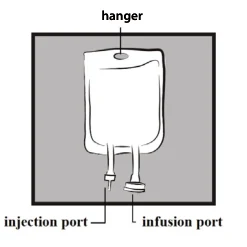
 hanger
irritation and inflammation of the vein into which
the solution is infused (phlebitis). This can cause redness, pain or burning and swelling along the path of the vein into which the solution is infused.
the formation of a blood clot (venous thrombosis)
at the site of infusion, which causes pain, swelling or redness in the area of the clot
escape of the infusion solution into the tissues around
the vein (extravasation). This can damage the tissues and cause scarring.
- an excess of fluid in the blood vessels (hypervolaemia)
- itching at the site of infusion (urticaria)
- fever (pyrexia)
- chills
Other side effects noted with similar products (other sodium containing solutions) include:
higher levels of sodium in the blood than normal
(hyponatraemia)
lower levels of sodium in the blood than normal
(hyponatraemia)
acidification of the blood linked with a higher level
of chloride in the blood than normal (hyperchloremic metabolic acidosis).
If you get any side effects, talk to your doctor or nurse. Reporting suspected adverse reactions after authorisation of the medicinal product is important. It allows continued monitoring of the benefit/risk balance of the medicinal product. Healthcare professionals are asked to report any suspected adverse reactions via the Yellow Card Scheme at: www.mhra.gov.uk/yellowcard or search for MHRA Yellow Card in the Google Play or Apple App Store.
5. How to store Sodium chloride 0.9%
Keep this medicine out of the sight and reach of children.
Do not store above 25°C. Do not freeze.
You should NOT be given this medicine after the expiry date which is stated on the bag after EXP. The expiry date refers to the last day of that month.
This medicine must not be applied repeatedly, it is only intended for a single use and any unused solution must be discarded in accordance with local requirements.
6. Contents of the pack and other information
What Sodium chloride 0.9% contains
The active substance is sodium chloride: 9 g per litre The only other ingredient is water for injections
What Sodium chloride 0.9% looks like and contents of the pack
Sodium chloride 0.9% is a clear, colourless solution, free from visible particles. This medicine is supplied in polyolefin / polypropylene bag with a polycarbonate-chlorobutyl infusion port covered with a blue flip-cap and a polycarbonate-isoprene injection port covered with a breakable cap.
Bags may be wrapped in a sealed, protective, plastic dustcover. The bags are available in the following sizes: 1 x 100 ml, 1 x 250 ml, 1 x 500 ml, 1 x 1 000 ml (individually) 40 x 100 ml, 18 x 250 ml, 20 x 500 ml, 10 x 1 000 ml (in a cardboard box)
Not all pack sizes may be marketed.
Marketing Authorisation Holder and Manufacturer:
IMUNA PHARM, a.s.
Jarková 269/17
082 22 Šarišské Michaľany
Slovak Republic
This leafet was last revised in 04/2021.
The following information is intended for healthcare professionals only:
Handling and Preparation
Use only if the solution is clear, free of any visible particles, and if the packaging is intact. Administer immediately once attached to the infusion set.
Do not use plastic bags in series connections. Such use could result in air embolism due to residual air being drawn from the primary container before the administration of the fluid from the secondary container is completed.
Pressurizing intravenous solutions contained in flexible plastic containers to increase flow rates can result in air embolism if the residual air in the container is not fully evacuated prior to administration.
Use of a vented intravenous administration set with the vent in the open position could result in air embolism. Vented intravenous administration sets with the vent in the open position should not be used with flexible plastic containers.
The solution must be administered aseptically, using a sterile device. To prevent the air from penetrating into the system, the device must be filled up with the solution.
Other medicinal products may be added before or during the infusion administration via a venous line.
If another medicinal product is added to the solution, check the isotonicity prior to the parenteral administration. Al added medicinal products must be thoroughly and carefully mixed in an aseptic manner. Solutions containing other added medicinal products must be used immediately and must not be stored for later use.
Discard after single use.
Discard any unused portion.
Do not reconnect partially used bags.
INSTRUCTION FOR HANDLING THE INFUSION BAG
FIgure 1: Bag
- 1. INSPECTION PRIOR TO ADMINISTRATION
- a)
Check for minute leaks by squeezing the bag gently.
If you observe any bag integrity disruption, discard the bag containing the solution, as its sterility may be impaired.
- b) Check visually whether the solution meets the characteristics listed in the section 3 of the Summary of Product Characteristics. If not, the solution should be discarded. For preparation and administration use sterile material.
- 2. PREPARATION FOR THE ADMINISTRATION
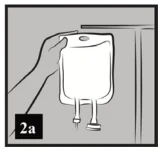
- a) Hang the bag on a stand position (Figure 2a).
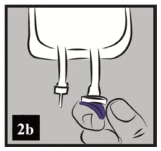
- b)
Break off a blue plastic cover from the delivery port
(infusion port) (Figure 2b).
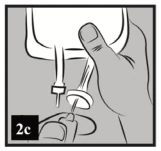
- c) Disinfect the medication site. Connect a thick perforation needle of the infusion set to the infusion port (Figure 2c).
- d) Proceed as described in the instructions accompanying the infusion set (set filling and solution application). Sodium chloride 0.9%w/v Solution for Infusion IMUNA
4 5 6 7