

Patient leaflet - Ropivacaine 7.5 mg / ml solution for injection
1. What Ropivacaine is and what it is used for
- Ropivacaine contains a medicine called ropivacaine hydrochloride.
- It belongs to a group of medicines called local anaesthetics.
Ropivacaine 2 mg/ml solution for injection is used in adults and children of all ages for acute pain management. It numbs (anaesthetises) parts of the body e.g. after surgery. Ropivacaine 7.5 mg/ml solution for injection is used in adults and children above 12 years to numb (anaesthetise) parts of the body. It is used to stop pain happening or to provide pain relief. It can be used to:
- Numb parts of the body during surgery, including having a baby by Caesarean section.
- Relieve pain during childbirth, after surgery, or after an accident. Ropivacaine 10 mg/ml solution for injection is used in adults and children above 12 years to numb (anaesthetise) parts of the body during surgery.
2. What you need to know before you are given Ropivacaine
You must not be given Ropivacaine
- If you are allergic (hypersensitive) to ropivacaine hydrochloride or any of the other ingredients of this medicine (listed in section 6).
- If you are allergic to any other local anaesthetics of the same class (such as lidocaine or bupivacaine).
- If you have been told that you have decreased volume of blood (hypovolaemia).
- Into a blood vessel to numb a specific area of your body, or into the neck of the womb to relieve pain during childbirth.
If you are not sure if any of the above apply to you, talk to your doctor before you are given Ropivacaine.
Warnings and precautions
Special care should be taken to avoid any injection of Ropivacaine directly into a blood vessel to prevent any immediate toxic effects. Injection should not be performed in inflamed areas.
Talk to your doctor, nurse or to any other healthcare professional before Ropivacaine is given to you
- if you are in a poor general conditon due to your age or other factors.
- if you have heart problems (partial or complete heart conduction block)
- if you have advanced liver problems
- if you have severe kidney problems.
Tell your doctor if you have any of these problems because your doctor may need to adjust the dose of Ropivacaine.
Talk to your doctor, nurse or to any other healthcare professional before Ropivacaine is given to you
- if you suffer from acute porphyria (problems with building up red blood pigment, sometimes resulting in neurological symptoms).
Tell your doctor if you or somebody in your family have porphyria because your doctor may need to use another anaesthetic.
Tell your doctor before treatment about any diseases or medical conditions you have.
Children
Ropivacaine 2 mg/ml solution for injection
Take special care:
- In newborn children as they are more susceptible to Ropivacaine 2 mg/ml solution for injection.
- In children < 12 years as some injections of Ropivacaine 2 mg/ml solution for injection in order to numb parts of the body are not established in younger children.
Ropivacaine 7.5 mg/ml and 10 mg/ml solution for injection
In children up to and including 12 years. Other strengths (2 mg/ml, 5 mg/ml) may be more appropriate.
Other medicines and Ropivacaine
Tell your doctor, or healthcare personnel if you are taking, have recently taken or might take any other medicines. This is because Ropivacaine can affect the way some medicines work and some medicines can have an effect on Ropivacaine.
In particular, tell your doctor if you are taking any of the following medicines:
- Other local anaesthetics
- Strong pain killers, such as morphine or codeine
- Drugs used to treat an uneven heart beat (arrhythmia), such as lidocaine and mexiletine.
Your doctor needs to know about these medicines to be able to work out the correct dose of Ropivacaine for you.
Also tell your doctor if you are taking any of the following medicines:
- Medicines for depression (such as fluvoxamine)
- Antibiotics to treat infections caused by bacteria (such as enoxacin). This is because your body takes longer to get rid of Ropivacaine if you are taking these medicines. If you are taking either of these medicines, prolonged use of Ropivacaine should be avoided.
Pregnancy and breast-feeding
If you are pregnant or breast-feeding, think you may be pregnant or are planning to have a baby, ask your doctor for advice before this medicine is given to you. It is not known if ropivacaine affects pregnancy or passes into breast milk. If you are given this medicine while pregnant, it may lower your baby’s heart rate (known as foetal heart rate) and your doctor should monitor foetal heart rate.
Ask your doctor or pharmacist for advice before taking any medicine if you are pregnant or breast-feeding.
Driving and using machines
Ropivacaine may make you feel sleepy and affect the speed of your reactions. After you have been given Ropivacaine, you should not drive or use any tools or machines until the next day.
Ropivacaine contains sodium chloride
Ropivacaine 2 mg/ml solution for injection
This medicinal product contains 3.4 mg sodium (main component of cooking/table salt) in each ml. This is equivalent to 0.17% of the recommended maximum daily dietary intake of sodium for an adult.
Ropivacaine 7.5 mg/ml solution for injection
This medicinal product contains 2.99 mg sodium (main component of cooking/table salt) in each ml. This is equivalent to 0.15% of the recommended maximum daily dietary intake of sodium for an adult.
Ropivacaine 10 mg/ml solution for injection
This medicinal product contains 2.8 mg sodium (main component of cooking/table salt)in each ml. This is equivalent to 0.14% of the recommended maximum daily dietary intake of sodium for an adult.
3. How to use Ropivacaine
Ropivacaine will be given to you by a doctor. The dose that your doctor gives you will depend on the type of pain relief that you need. It will also depend on your body size, age, and physical condition.
Ropivacaine will be given to you as an injection. The part of the body where it will be used will depend on why you are being given Ropivacaine. Your doctor will give you Ropivacaine in one of the following places:
- The part of the body that needs to be numbed.
- Near to the part of the body that needs to be numbed.
- In an area away from the part of the body that needs to be numbed. This is the case if you are given an epidural injection (into the area around the spinal cord). When Ropivacaine is used in one of these ways, it stops the nerves from being able to pass pain messages to the brain. It will stop you feeling pain, heat or cold in where it is used however you may still have other feelings like pressure or touch. Your doctor will know the correct way to give you this medicine.
Dosage
- The dose used will depend on what it is being used for and also on your health, age and weight.
Duration of treatment
Administration of ropivacaine usually takes between 2 to 10 hours in case of anaesthesia prior to certain surgeries and can take up to 72 hours in case of pain relief during or after surgery.
If you are given more Ropivacaine than you should be
Serious side effects from getting too much Ropivacaine need special treatment and the doctor treating you is trained to deal with these situations. The first signs of being given too much Ropivacaine are usually as follows:
- problems with hearing and sight (vision),
- numbness of lips, tongue and around the mouth,
- dizziness or light-headedness,
- tingling,
- speech disorder characterised by poor articulation (dysarthria),
- muscular stiffness, muscular twitching, fits (convulsions),
- low blood pressure,
- slow or irregular heart beat.
These symptoms may precede to cardiac arrest, breathing arrest or severe fits.
To reduce the risk of serious side effects, your doctor will stop giving you Ropivacaine as soon as these signs appear. This means that if any of these happen to you, or you think you may have received too much Ropivacaine, tell your doctor or healthcare personnel immediately.
More serious side effects from being given too much Ropivacaine include problems with your speech, twitching of your muscles, tremors, trembling, fits (seizures), and loss of consciousness.
Tell your doctor or health care professional if you notice any of the symptoms above.
4. Possible side effects
Like all medicines, this medicine can cause side effects, although not everybody gets them.
Important side effects to look out for:
Sudden life-threatening allergic reactions (such as anaphylaxis, including anaphylactic shock) are rare, affecting 1 to 10 in 10,000 people. Possible symptoms include
- sudden onset of rash,
- itching or lumpy rash (hives),
- swelling of the face, lips, tongue or other parts of the body,
- shortness of breath, wheezing or difficulty breathing,
- a feeling of loss of consciousness.
If you think that Ropivacaine is causing an allergic reaction, tell your doctor or healthcare personnel immediately.
Other possible side effects:
Very common (may affect more than 1 in 10 people)
- Low blood pressure (hypotension). This might make you feel dizzy or light-headed.
- Feeling sick (nausea).
Common (may affect up to 1 in 10 people)
- Pins and needles (paraesthesia)
- Feeling dizzy
- Headache
- Slow or fast heart-beat (bradycardia, tachycardia)
- High blood pressure (hypertension)
- Being sick (vomiting)
- Difficulty in passing urine (urinary retention)
- High temperature (fever) or shivering (chills)
- Stiffness (rigor)
- Back pain
01-59-18-060G
The following information is intended for healthcare professionals only:
Handling
Ropivacaine should only be used by, or under the supervision of, clinicians experienced in regional anaesthesia (see section 3).
Shelf-life after opening
To be used immediately.
Ropivacaine products are intended for single use only. Discard any unused solution.
The medicinal product should be visually inspected prior to use. The solution should only be used if it is clear, practically free from particles and if the container is undamaged.
The intact container must not be re-autoclaved.
Incompatibilities
In the absence of compatibility studies, this medicinal product must not be mixed with other medicinal products.
In alkaline solutions precipitation may occur as ropivacaine shows poor solubility at pH > 6.0.
Disposal
Any unused medicinal product or waste material should be disposed of in accordance with local requirements.
182 S
| a | m | p | l | e |
s
Uncommon (may affect up to 1 in 100 people)
- Anxiety
- Decreased sensitivity or feeling in the skin
- Fainting
- Difficulty breathing
- Low body temperature (hypothermia)
- Some symptoms can happen if the injection was given into a blood vessel by mistake, or if you have been given too much Ropivacaine (see also section 3 “If you are given more Ropivacaine than you should be” above). These include fits (seizures), feeling dizzy or light-headed, numbness of the lips and around the mouth, numbness of the tongue, hearing problems, problems with your sight (vision), problems with your speech, stiff muscles and trembling
Rare (may affect up to 1 in 1,000 people)
- Heart attack (cardiac arrest)
- Uneven heart beat (arrhythmias)
Not known (frequency cannot be estimated from the available data)
- Horner’s Syndrome
Other possible side effects include:
- Numbness, due to nerve irritation caused by the needle or the injection. This does not usually last for long.
- Involuntary muscle movements (dyskinesia).
Possible side effects seen with other local anaesthetics which might also be caused by Ropivacaine include:
- Damaged nerves. Rarely (affecting 1 to 10 people in 10,000), this may cause permanent problems.
- If too much Ropivacaine is given into the spinal fluid, the whole body may become numbed (anaesthetised).
- Receiving an epidural injection (injection into the space around your spinal nerves) may cause a disruption of a nerve pathway from the brain to the head and neck, especially in pregnant women, which may sometimes result in a condition called Horner’s syndrome. This is characterized by decrease in the size of the pupil, drooping of the upper eyelid, and failure of the sweat glands to make sweat. It will resolve on its own when the treatment is stopped.
Children
In children, the side effects are the same as in adults except for low blood pressure which happens less often in children (affecting 1 to 10 children in 100) and being sick which happens more often in children (affecting more than 1 in 10 children).
Reporting of side effects
If you get any side effects, talk to your doctor or nurse. This includes any possible side effects not listed in this leaflet. You can also report side effects directly (see details below). By reporting side effects you can help provide more information on the safety of this medicine.
Ireland
HPRA Pharmacovigilance Website: www.hpra.ie
United Kingdom
Yellow Card Scheme Website: www.mhra.gov.uk/yellowcard or search for MHRA Yellow Card in the Google Play or Apple App Store.
By reporting side effects you can help provide more information on the safety of this medicine.
5. How to store Ropivacaine
This medicinal product does not require any special storage conditions. Keep this medicine out of the sight and reach of children.
Do not use this medicine after the expiry date which is stated on the blister, ampoule or carton box. The expiry date refers to the last day of that month.
Do not use this medicine if you notice any precipitation in the solution for injection.
Your doctor or the hospital will normally store Ropivacaine and they are responsible for the quality of the product when it has been opened if it is not used immediately. They are also responsible for disposing of any unused Ropivacaine correctly.
Do not throw away any medicines via wastewater or household waste. Ask your pharmacist how to throw away medicines you no longer use. These measures will help protect the environment.
6. Contents of the pack and other information
What Ropivacaine contains
The active substance is ropivacaine hydrochloride 2 mg/ml/7.5 mg/ml/10 mg/ml. Each 10 ml polypropylene ampoule contains 20 mg /75 mg /100 mg ropivacaine hydrochloride.
Each 20 ml polypropylene ampoule contains 40 mg/ 150 mg/ 200 mg ropivacaine hydrochloride.
- The excipients are sodium chloride, hydrochloric acid (for pH adjustment), sodium hydroxide (for pH adjustment), and water for injections.
What Ropivacaine looks like and contents of the pack
Ropivacaine solution for injection is a clear, colourless solution for injection. Ropivacaine 2 mg/ml/7.5 mg/ml/10 mg/ml solution for injection is available in 10 ml and 20 ml transparent polypropylene ampoules.
Pack sizes:
1, 5, 10 ampoule(s) in blister pack
Not all pack sizes may be marketed.
Marketing Authorisation Holder
United Kingdom
Fresenius Kabi Limited
Cestrian Court, Eastgate Way, Manor Park,
Runcorn, Cheshire, WA7 1NT
United Kingdom
Ireland
Fresenius Kabi Deutschland GmbH
Else-Kroener Strasse 1
Bad Homburg v.d.H 61352
Germany
Manufacturer
HP Halden Pharma AS
Svinesundsveien 80
1788 Halden
Norway
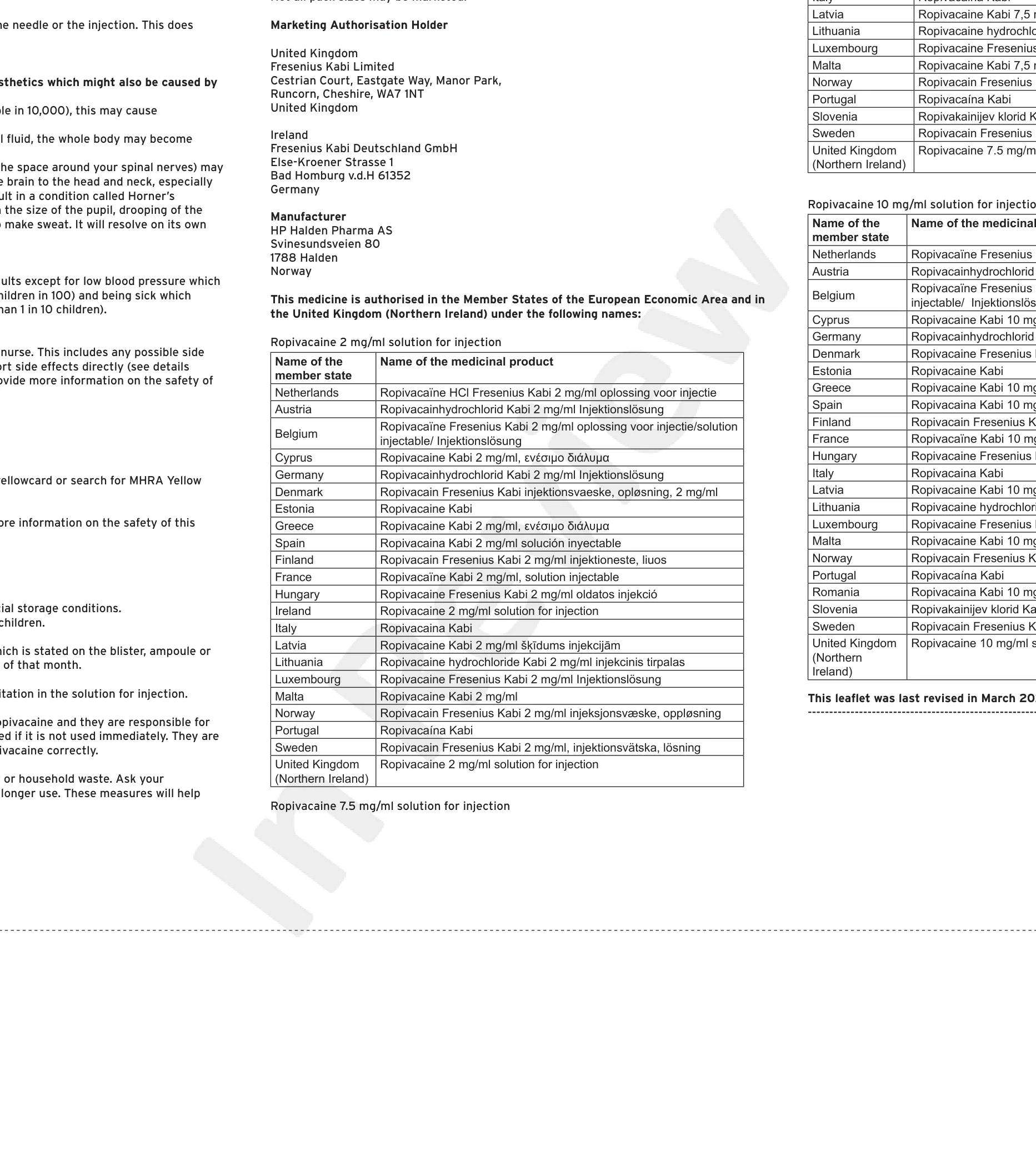
This medicine is authorised in the Member States of the European Economic Area and in the United Kingdom (Northern Ireland) under the following names:
Ropivacaine 2 mg/ml solution for injection
| Name of the member state | Name of the medicinal product |
| Netherlands | Ropivacaïne HCl Fresenius Kabi 2 mg/ml oplossing voor injectie |
| Austria | Ropivacainhydrochlorid Kabi 2 mg/ml Injektionslösung |
| Belgium | Ropivacaïne Fresenius Kabi 2 mg/ml oplossing voor injectie/solution injectable/ Injektionslösung |
| Cyprus | Ropivacaine Kabi 2 mg/ml, ενέσιμο διάλυμα |
| Germany | Ropivacainhydrochlorid Kabi 2 mg/ml Injektionslösung |
| Denmark | Ropivacain Fresenius Kabi injektionsvaeske, opløsning, 2 mg/ml |
| Estonia | Ropivacaine Kabi |
| Greece | Ropivacaine Kabi 2 mg/ml, ενέσιμο διάλυμα |
| Spain | Ropivacaina Kabi 2 mg/ml solución inyectable |
| Finland | Ropivacain Fresenius Kabi 2 mg/ml injektioneste, liuos |
| France | Ropivacaïne Kabi 2 mg/ml, solution injectable |
| Hungary | Ropivacaine Fresenius Kabi 2 mg/ml oldatos injekció |
| Ireland | Ropivacaine 2 mg/ml solution for injection |
| Italy | Ropivacaina Kabi |
| Latvia | Ropivacaine Kabi 2 mg/ml šķīdums injekcijām |
| Lithuania | Ropivacaine hydrochloride Kabi 2 mg/ml injekcinis tirpalas |
| Luxembourg | Ropivacaine Fresenius Kabi 2 mg/ml Injektionslösung |
| Malta | Ropivacaine Kabi 2 mg/ml |
| Norway | Ropivacain Fresenius Kabi 2 mg/ml injeksjonsvæske, oppløsning |
| Portugal | Ropivacaína Kabi |
| Sweden | Ropivacain Fresenius Kabi 2 mg/ml, injektionsvätska, lösning |
| United Kingdom (Northern Ireland) | Ropivacaine 2 mg/ml solution for injection |
Ropivacaine 7.5 mg/ml solution for injection
V0011/UK
01-59-18-060G
| Name of the member state | Name of the medicinal product |
| Netherlands | Ropivacaïne Fresenius Kabi 7,5 mg/ml oplossing voor injectie |
| Austria | Ropivacainhydrochlorid Kabi 7,5 mg/ml Injektionslösung |
| Belgium | Ropivacaïne Fresenius Kabi 7,5 mg/ml oplossing voor injectie/ solution injectable/ Injektionslösung |
| Cyprus | Ropivacaine Kabi 7,5 mg/ml, ενέσιμο διάλυμα |
| Germany | Ropivacainhydrochlorid Kabi 7,5 mg/ml Injektionslösung |
| Denmark | Ropivacaine Fresenius Kabi, injektionsvaeske, opløsning,7.5 mg/ml |
| Estonia | Ropivacaine Kabi |
| Greece | Ropivacaine Kabi 7,5 mg/ml, ενέσιμο διάλυμα |
| Spain | Ropivacaina Kabi 7,5 mg/ml solución inyectable |
| Finland | Ropivacain Fresenius Kabi 7,5 mg/ml injektioneste, liuos |
| France | Ropivacaïne Kabi 7,5 mg/ml, solution injectable |
| Hungary | Ropivacaine Fresenius Kabi 7,5 mg/ml oldatos injekció |
| Ireland | Ropivacaine 7.5 mg/ml solution for injection |
| Italy | Ropivacaina Kabi |
| Latvia | Ropivacaine Kabi 7,5 mg/ml šķīdums injekcijām |
| Lithuania | Ropivacaine hydrochloride Kabi 7,5 mg/ml injekcinis tirpalas |
| Luxembourg | Ropivacaine Fresenius Kabi 7,5 mg/ml Injektionslösung |
| Malta | Ropivacaine Kabi 7,5 mg/ml |
| Norway | Ropivacain Fresenius Kabi 7,5 mg/ml injeksjonsvæske, oppløsning |
| Portugal | Ropivacaína Kabi |
| Slovenia | Ropivakainijev klorid Kabi 7,5 mg/ml raztopina za injiciranje |
| Sweden | Ropivacain Fresenius Kabi 7,5 mg/ml, injektionsvätska, lösning |
| United Kingdom (Northern Ireland) | Ropivacaine 7.5 mg/ml solution for injection |
Ropivacaine 10 mg/ml solution for injection
| Name of the member state | Name of the medicinal product |
| Netherlands | Ropivacaïne Fresenius Kabi 10 mg/ml oplossing voor injectie |
| Austria | Ropivacainhydrochlorid Kabi 10 mg/ml Injektionslösung |
| Belgium | Ropivacaïne Fresenius Kabi 10 mg/ml oplossing voor injectie/solution injectable/ Injektionslösung |
| Cyprus | Ropivacaine Kabi 10 mg/ml, ενέσιμο διάλυμα |
| Germany | Ropivacainhydrochlorid Kabi 10 mg/ml Injektionslösung |
| Denmark | Ropivacaine Fresenius Kabi, injektionsvaeske, opløsning,10 mg/ml |
| Estonia | Ropivacaine Kabi |
| Greece | Ropivacaine Kabi 10 mg/ml, ενέσιμο διάλυμα |
| Spain | Ropivacaina Kabi 10 mg/ml solución inyectable |
| Finland | Ropivacain Fresenius Kabi 10 mg/ml injektioneste, liuos |
| France | Ropivacaïne Kabi 10 mg/ml, solution injectable |
| Hungary | Ropivacaine Fresenius Kabi 10 mg/ml oldatos injekció |
| Italy | Ropivacaina Kabi |
| Latvia | Ropivacaine Kabi 10 mg/ml šķīdums injekcijām |
| Lithuania | Ropivacaine hydrochloride Kabi 10 mg/ml injekcinis tirpalas |
| Luxembourg | Ropivacaine Fresenius Kabi 10 mg/ml Injektionslösung |
| Malta | Ropivacaine Kabi 10 mg/ml |
| Norway | Ropivacain Fresenius Kabi 10 mg/ml injeksjonsvæske, oppløsning |
| Portugal | Ropivacaína Kabi |
| Romania | Ropivacaina Kabi 10 mg/ml soluţie injectabilă |
| Slovenia | Ropivakainijev klorid Kabi 10 mg/ml raztopina za injiciranje |
| Sweden | Ropivacain Fresenius Kabi 10 mg/ml, injektionsvätska, lösning |
United Kingdom (Northern Ireland) | Ropivacaine 10 mg/ml solution for injection |
This leaflet was last revised in March 2026.
---------------------------------------------------------------------------------------------------------------