

Patient leaflet - Qvar 100 micrograms Aerosol
1. What Qvar Aerosol is and what it is used for
Qvar Aerosol contains beclometasone dipropionate, which is one of a group of medicines known as corticosteroids.
Qvar Aerosol is used to prevent the symptoms of mild, moderate, or severe asthma, in patients who require regular treatment.
How your medicine works
- Qvar Aerosol works deep in your lungs to make breathing easier by reducing the inflammation, swelling and irritation in the airways. This type of medicine is known as a ‘preventer’. It needs to be taken regularly every day, even if you have no symptoms.
- This inhaler will not give immediate relief of wheezing or breathlessness during a sudden asthma attack. You will need to use a ‘reliever’ inhaler, which contains a different medicine. You should still continue to use this inhaler.
2. What you need to know before you use Qvar Aerosol
Do not use Qvar Aerosol:
- If you are allergic to beclometasone dipropionate or any of the other ingredients of this medicine (listed in section 6).
- If you are allergic to other similar inhalers.
- If you are suffering from a sudden attack of breathlessness. It will not help. Use a quick-acting ‘reliever’ inhaler for this purpose and carry it with you at all times.
Warnings and precautions
Talk to your doctor before using Qvar Aerosol if:
- You are suffering from tuberculosis (TB) now or have suffered from it in the past.
You must avoid alcohol for any reason.
- Your asthma seems to be getting worse. Perhaps you are more wheezy and short of breath than usual, your ‘reliever’ inhaler seems to be less effective, you require more puffs from your ‘reliever’ inhaler than usual, or you do not seem to be getting better. Your doctor may need to increase the dose of your steroid inhaler or give you a course of steroid tablets, or change your treatment altogether. If you have had an infection in your chest your doctor may prescribe a course of antibiotics.
- When transferring from steroid tablets to an inhaler you find that, even if your chest is getting better, you feel generally unwell, you develop a rash, eczema or a runny nose and sneezing (rhinitis). Do not stop treatment with your inhaler unless your doctor tells you to.
Important points to remember while you are using this medicine:
- Your doctor may prescribe this inhaler to replace steroid tablets, which may mean for a short time you have to take both medicines. It is important to follow your doctor’s advice. Whilst you are reducing the number of steroid tablets that you take you may feel generally unwell even though you can breathe as well as normal or better. If you have other allergies you may find that stopping your steroid tablets makes them worse. If this happens keep using your inhaler and tell your doctor.
- If you have been treated for a long time with high doses of inhaled steroid, you may require a course of steroid tablets or possibly a steroid injection in times of stress. For example, during admission to hospital after a serious accident, before an operation, during an acute attack of asthma or if you have a chest infection or other serious illness. Your doctor will decide if you need any extra steroid treatment and will also advise you as to how long you need to take the course of steroid tablets and how you should reduce these as you get better.
- There may be times when you need to take steroid tablets as well as using your inhaler, for example if you have worsening asthma attacks, you get a chest infection, or you need an operation. Your doctor may give you a small supply of steroid tablets to be taken in these situations; if he/she does you will be given full instructions on how and when to take them. Contact your doctor immediately if you think that you need to take steroid tablets, even if you have your own supply.
- You should have been given a steroid card with this inhaler, if you have not, please ask your pharmacist for one. Make sure you carry your steroid card with you at all times until your doctor decides that it is no longer necessary.
- Visit your doctor regularly for a review of your condition.
- If you have to go into hospital, remember to take all your inhalers and other medicines including those bought without prescription with you.
- Contact your doctor if you experience blurred vision or other visual disturbances.
Other medicines and Qvar Aerosol
- Please tell your doctor or pharmacist if you are taking or have recently taken any other medicines, including any medicines obtained without a prescription.
In particular tell your doctor if you are taking:
- Disulfiram.
- Metronidazole.
Some medicines may increase the effects of Qvar Aerosol and your doctor may wish to monitor you carefully if you are taking these medicines (including some medicines for HIV: ritonavir, cobicistat).
Pregnancy, breast-feeding and fertility
- If you are pregnant, planning to become pregnant or are breast-feeding, ask your doctor for advice before taking this medicine.
Driving and using machines
- Qvar Aerosol is not known to affect your ability to drive or operate machinery.
Important information about some of the ingredients of Qvar Aerosol:
Qvar Aerosol contains a small amount of alcohol. Talk to your doctor if you need to avoid alcohol for any reason.
Qvar Aerosol contains ethanol
This medicine contains 4.74 mg of alcohol (ethanol) in each puff. The amount in one puff of this medicine is equivalent to less than 1ml beer or 1 ml wine. The small amount of alcohol in this medicine will not have any noticeable effects.
3. How to use Qvar Aerosol
Always take this medicine exactly as your doctor or pharmacist has told you. Check with your doctor or pharmacist if you are not sure.
There are two strengths of Qvar Aerosol available and your doctor will have chosen the strength which best suits your condition.
This inhaler has a softer feel and a different taste than other inhalers you may have used before. This inhaler is an extra fine aerosol which results in more of each dose being delivered to your lungs. Your doctor may, therefore, prescribe a lower dose of this inhaler than your previously used inhaler.
Even when your doctor has prescribed a lower dose you may find that the number of puffs you are asked to take from this inhaler is the same as from your previous inhaler; this is because this inhaler may be a lower strength product (which means that each puff of this inhaler contains less beclometasone dipropionate than your old inhaler).
Do not take more puffs than your doctor has told you to.
In some circumstances, your doctor may prescribe more than the usual number of puffs. The usual number of puffs to take is:
Qvar 50 Aerosol
Adults (including the elderly) and adolescents over 12 years
Mild Asthma
The starting dose is one puff twice a day. This may be increased up to two puffs twice a day.
- Moderate Asthma The starting dose is two puffs twice a day. This may be increased up to four puffs twice a day.
- Severe Asthma The starting dose is four puffs twice a day. This may be increased up to eight puffs twice a day.
The maximum dose is a total of sixteen puffs a day.
Qvar 100 Aerosol
Adults (including the elderly) and adolescents over 12 years
Mild Asthma
The Qvar 100 Aerosol device is not suitable for the starting dose. It is suitable for an increased dose of one puff twice a day.
Moderate Asthma
The starting dose is one puff twice a day. This may be increased to two puffs twice a day.
- Severe Asthma The starting dose is two puffs twice a day. This may be increased up to four puffs twice a day.
The maximum dose is a total of eight puffs a day.
Children aged 5 years and over
The starting dose is one puff of Qvar 50 Aerosol twice a day.
Children with well-controlled asthma on doses of up to 400 micrograms per day of other beclomethasone dipropionate inhalers or equivalent may be titrated to a dose of 50-100 micrograms twice daily of Qvar.
Qvar 100 Aerosol would not normally be recommended in this age group. However, during periods of deterioration in asthma control, the dose may be increased to 200 micrograms per day in two divided doses. The dose should be reduced to the minimum needed to maintain effective control of asthma.
What to do if you think your treatment is not working
If you think your usual treatment is not working, for example your symptoms are not getting better, or are getting worse, or you need to use more puffs from your reliever inhaler, or if your reliever inhaler does not seem to be working as well as usual, or your peak flow falls, please tell your doctor. Your asthma may be getting worse.
If you use more Qvar Aerosol than you should
It is important that you take your dose as stated on the pharmacist’s label, or as advised by your doctor. You should not increase or decrease your dose without seeking medical advice. If you accidentally take more puffs than recommended, please tell your doctor.
If you forget to use Qvar Aerosol
If you forget to use this inhaler at your usual time, take your recommended number of puffs as soon as you remember unless it is nearly time to use your inhaler again. DO NOT take a double dose to make up for a forgotten dose. Then continue to use your inhaler regularly at the correct time, as prescribed by your doctor.
If you stop using Qvar Aerosol
This inhaler must be used regularly, even when you feel well. You must not stop using your inhaler unless your doctor tells you to.
Ask your doctor for a prescription for a replacement inhaler before this one is empty.
If your doctor decides to stop treatment, return the inhaler to your doctor or pharmacist for safe disposal.
If you have any further questions on the use of this medicine, ask your doctor or pharmacist.
Using your Qvar Aerosol inhaler
Before Use
- If this is a new inhaler or if you have not used your inhaler for two weeks or more, it must be tested before use by removing the mouthpiece cover and pressing down on the canister inside the inhaler. Release 2 puffs into the air, away from you.
How to use your inhaler
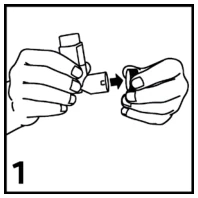
- 1. Take the cover off the mouthpiece.
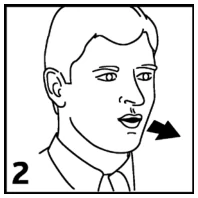
- 2. Breathe out as far as is comfortable and then immediately place the mouthpiece in your mouth and close your lips around it.
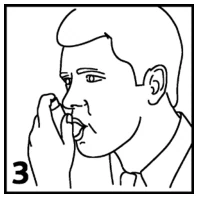
- 3. Start to breathe in slowly and deeply through your mouth and press down on the canister inside the inhaler as shown. This releases one puff of medicine. It is important that you carry on breathing in after the puff is released.
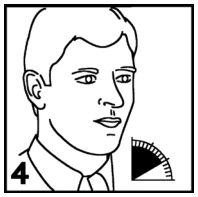
- 4. Hold your breath for 10 seconds, then breathe out slowly. If your doctor has prescribed more than one puff repeat steps 2 to 4 again. After use, replace the cover on the mouthpiece.
- •
Some people including children and the elderly find it difficult to press their inhaler and breathe in at the same time.
A spacer device helps to overcome this problem. The spacer that fits Qvar Aerosol is called the AeroChamber Plus® spacer device. If you use the AeroChamber Plus® spacer device, please follow the instructions provided with it. Your doctor, nurse or pharmacist will be able to advise you about the AeroChamber Plus® device. Alternatively, your doctor may wish to prescribe the Qvar Autohaler® device which automatically releases a puff of medication as you breathe in.
How to tell when your Qvar Aerosol device is empty
When the canister is completely empty you will not feel or hear any propellant being discharged.
Cleaning instructions
For normal hygiene, the mouthpiece of your inhaler should be cleaned weekly with a clean, dry tissue or cloth. You should also rinse your mouth with water after using your inhaler.
Do not wash or put any part of your inhaler in water.
If you have any further questions on the use of this medicine, ask your doctor or pharmacist.
4. Possible side effects
Like all medicines, this medicine can cause side effects, although not everybody gets them.
If immediately after taking a puff of this inhaler, you feel wheezy or tight chested do not take any more puffs. Use your reliever inhaler to help your breathing and contact your doctor immediately.
Stop using your inhaler and tell your doctor immediately or go to the casualty department at your nearest hospital if the following happens:
- an allergic reaction (swelling of the lips, face or neck leading to severe difficulty in breathing; skin rash or hives).
This is a very serious but rare side effect. You may need urgent medical attention or hospitalisation.
Treatment with Qvar Aerosol may affect the normal production of corticosteroids in the body, your doctor may take a blood sample from time to time to check on this.
Keep using your inhaler but see your doctor as soon as possible if you become unwell, particularly with any of the following:
- Abdominal pain.
- Weakness.
- Vomiting.
This is especially important if you have been exposed to other stress such as other illness, surgery, or infection.
The following side effects may also occur in patients taking beclometasone dipropionate. If you experience any of these effects, keep using your inhaler but see your doctor if they last for a while or they are worrying you:
Common (may affect up to 1 in 10 people):
- Hoarseness.
- Difficulty in swallowing accompanied by earache and swollen glands, sore throat (pharyngitis).
- A sore mouth or thrush (white spots in your mouth and throat). These are less likely if you rinse your mouth out with water after using your inhaler. If you get thrush your doctor may recommend a medicine to treat you.
- Change in taste.
Uncommon (may affect up to 1 in 100 people):
- Feeling sick.
- Headache.
- Tremor (shaking).
- Feeling dizzy or faint.
- Difficulty in breathing, increase in wheezing, shortness of breath and cough (bronchospasm).
- Blurred vision.
Very rare (may affect up to 1 in 10,000 people):
- Bone thinning
- Clouding of the lens of the eye (cataract) resulting in blurred vision
- Loss of vision due to abnormally high pressure in the eye may occur.
- Rounded face (full moon) (Cushing’s syndrome).
The following may also occur, although the frequency is not known (cannot be estimated from the available data):
- sleeping problems, depression or feeling worried, restless, nervous, over-excited or irritable. These effects are more likely to occur in children.
Children or adolescents who are using the inhaler for a prolonged period may grow more slowly. Your doctor may therefore wish to monitor the height of a child receiving prolonged treatment with Qvar Aerosol.
Reporting of side effects
If you get side effects, talk to your doctor, pharmacist or nurse. This includes any possible side effects not listed in this leaflet.
You can also report side effects directly via the Yellow Card Scheme at: www.mhra.gov.uk/yellowcard or search for MHRA Yellow Card in the Google Play or Apple App Store.
By reporting side effects, you can help provide more information on the safety of this medicine.
5. How to store Qvar Aerosol
- Keep out of the sight and reach of children.
- Do not store above 25°C.
- Avoid storage in direct sunlight or heat.
- Protect from frost. You can use your inhaler at temperatures as low as -10°C.
- Do not use Qvar 100 micrograms Aerosol after the expiry date that is stated on the outer packaging. The expiry date refers to the last day of that month.
- The canister is pressurised. Do not puncture, break or burn even when apparently empty.
- If your inhaler shows any signs of deterioration, please return to your pharmacist who will advise you.
- Medicines should not be disposed of via wastewater or household waste. If your doctor decides to stop treatment, return the inhaler to your doctor or pharmacist for safe disposal. These measures will help to protect the environment.
6. Contents of the pack and other information
Your Qvar aerosol does not contain CFCs; instead, the inhaler contains a hydrofluoroalkane (called propellant HFA-134a or norflurane) as an inactive ingredient. Hydrofluoroalkanes have been developed as a replacement for CFCs.
What Qvar 100 micrograms Aerosol contains:
- The active ingredient is beclometasone dipropionate. Each actuation delivers 100 micrograms of beclometasone dipropionate into the mouthpiece.
- The other ingredients are: norflurane (HFA 134a) and ethanol.
What Qvar 100 micrograms Aerosol looks like and contents of the pack:
- Qvar 100 micrograms Aerosol is a dark red inhaler with a grey cap, without a counter, containing colourless solution in a pressurised canister closed with a metering valve.
Your inhaler contains 200 actuations.
Manufacturer
Manufactured by: 3M Health Care Limited, 1, Morley Street, Loughborough, UK.
Or
3M Health Care Limited, Derby Road, Loughborough, UK.
Or
Norton (Waterford) Limited, T/A Teva Pharmaceuticals Ireland, Unit 27/35 IDA Industrial Park, Cork Road, Waterford, Ireland.
Procured from within the EU and repackaged by: BModesto B.V., Minervaweg 2, 8239 DL, Lelystad, Netherlands.
Product Licence holder: Doncaster Pharma Limited, Crompton Road, Doncaster, DN2 4PW, UK.
PL No: 56830/0116
Leaflet revision and issue date (Ref.): 28.11.2024
Qvar® is a registered trademark of IVAX International GmbH.
AeroChamber Plus® is a registered trademark of Trudell Medical International.
Autohaler® is a registered trademark of 3M Company.
For further information about asthma, contact Asthma UK, the independent UK charity working to conquer asthma: Asthma UK, Summit House, 70 Wilson Street, London, EC2A 2DB.
Asthma Helpline: 08457 010203 (Open Monday to Friday, 9am to 5pm, calls charged at local rates).
Blind or partially sighted?
Is this leaflet hard to see or read?
Call +44 (0) 1302 365000 (Regulatory)
Please be ready to give the following information:
Product name:
QVAR 100 MICROGRAMS AEROSOL
Reference No: 56830/0116
POM