

Patient leaflet - Beclu 100 micrograms per actuation pressurised inhalation solution
1. What Beclu is and what it is used for
Beclu pressurised inhalation solution is used to help prevent the symptoms of mild, moderate or severe asthma. The active ingredient, beclometasone dipropionate, is one of a group of medicines called corticosteroids which are often referred to simply as steroids. Steroids have an anti-inflammatory action reducing the swelling and irritation in the walls of the small air passages in the lungs, which eases breathing problems.
2. What you need to know before you use Beclu
Do not use Beclu:
- if you are allergic to beclometasone dipropionate or any of the other ingredients of this medicine (listed in section 6) or to any other medicines used to treat asthma
- to treat a sudden attack of breathlessness. It will not help. Use a quick-acting 'reliever' inhaler for this purpose and carry it with you at all times
Warnings and precautions
Talk to your doctor, pharmacist or nurse before using Beclu if any of the following applies to you:
- you are being, or have ever been, treated for tuberculosis (TB)
you must avoid alcohol for any reason
- your asthma seems to be getting worse. Perhaps you are more wheezy and short of breath than usual, your 'reliever' inhaler seems to be less effective, you require more puffs from your 'reliever' inhaler than usual, or you do not seem to be getting better. Your doctor may need to increase the dose of your steroid inhaler or give you a course of steroid tablets, or change your treatment altogether. If you have an infection in your chest your doctor may prescribe a course of antibiotics
- when transferring from steroid tablets to an inhaler you find that, even if your chest is getting better, you feel generally unwell, you develop a rash, eczema or a runny nose and sneezing (rhinitis). Do not stop treatment with your inhaler unless your doctor tells you to
If you have been treated for a long time with high doses of inhaled steroid, you may require a course of steroid tablets or possibly a steroid injection in times of stress. For example, during admission to hospital after a serious accident, before an operation, during an acute attack of asthma or if you have a chest infection or other serious illness. Your doctor will decide if you need any extra steroid treatment and will also advise you as to how long you need to take the course of steroid tablets and how you should reduce these as you get better. If you are using Beclometasone dipropionate instead of, or as well as taking steroid tablets, or if your doctor is trying to reduce the dose of your steroid tablets, you should carry a steroid warning card until your doctor tells you that you don't need to.
Children and adolescents
If your child is receiving prolonged treatment with Beclu, your doctor should regularly monitor their height to evaluate if their growth is impaired.
Other medicines and Beclu
Before starting treatment, please tell your doctor if you are taking or have recently taken any other medicines, including medicines obtained without a prescription. Remember to take these medicines and your inhalers with you if you have to go into hospital. Some medicines may increase the effects of Beclu and your doctor may wish to monitor you carefully if you are taking these medicines (including some medicines for HIV e.g. ritonavir, cobicistat).
Pregnancy and breast-feeding:
If you are pregnant or breast-feeding, think you may be pregnant or are planning to have a baby, ask your doctor or pharmacist for advice before taking this medicine.
Beclu contains alcohol:
Beclu contains a small amount of alcohol. Each puff (actuation) from your inhaler contains about 9 mg of ethanol.
3. How to use Beclu
Beclu is available in 2 different strengths. Your doctor will have decided which strength you need. Beclu 200 is not suitable for children. Always use your inhaler exactly as your doctor has told you. You should check with your doctor or pharmacist if you are not sure. Instructions for using your inhaler are given after the dosage section.
It takes a few days for your inhaler to work. It is very important that you use it regularly. Do not stop treatment even if you feel better unless told to do so by your doctor. Do not stop using your inhaler abruptly.
While you are using Beclu your doctor will want to check your asthma regularly by carrying out simple breathing tests and may need to carry out blood tests from time to time.
Dosage:
The starting dose will depend on how severe your asthma is and will be decided by your doctor.
It may be higher than the doses given below. Your doctor will prescribe the lowest dose of Beclu that will control your symptoms.
A device called a Volumatic spacer should always be used when:
- adults, the elderly and adolescents 16 years of age and older are taking total daily doses of Beclu of 1,000 micrograms or more · when Beclu is used by children and adolescents under 15 years of age at whatever dose has been prescribed.
Beclu 100 micrograms
Starting dose
Adults and the elderly: 200 micrograms (2 puffs) twice a day
Children: 100 micrograms (one puff) twice a day
Maximum daily dose
Adults and the elderly: 800 micrograms (8 puffs)
Children: 400 micrograms (4 puffs)
The total daily dose may be divided into 2, 3 or 4 doses per day.
Beclu 200 micrograms
This product strength is not suitable for children
Starting dose
Adults and the elderly: 200 micrograms (1 puff) twice a day
Maximum daily dose
800 micrograms (4 puffs)
The total daily dose may be divided into 2, 3 or 4 doses per day.
If you use more Beclu than you should:
Tell your doctor as soon as possible. Your doctor may want to check the cortisol levels in your blood and may need to take a blood sample (cortisol is a steroid hormone which occurs naturally in the body).
It is important that you take your dose as stated on the pharmacist's label or as advised by your doctor. You should not increase or decrease your dose without seeking medical advice.
If you forget to use Beclu
If you forget to take your Beclu, skip your forgotten dose and take the next dose when it is due. Do not take more puffs than you were told to take in a day.
Instructions for use:
It is important that you know how to use your inhaler properly. Your doctor, nurse or pharmacist will show you how to use your inhaler correctly and will check regularly that you are using your inhaler correctly. You must follow their instructions carefully, so that you know how, when and how many puffs to inhale and how often you must use your inhaler. The instructions should be on the pharmacist's label and are given in this leaflet. If you are not sure what to do or have problems inhaling then ask your doctor, nurse or pharmacist for advice.
This medicine is contained in a pressurised canister in a plastic casing with a mouthpiece. There is a dose indicator on the front of the inhaler which tells you how many puffs are left: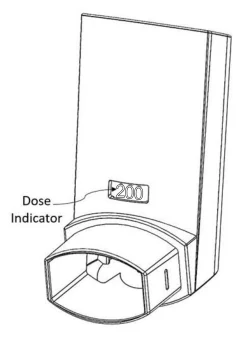
Each time you press the canister, the dose indicator rotates by a small amount. The number of puffs remaining is displayed in intervals of 20. Take care not to drop the inhaler as this may cause the dose indicator to count down.
PREVENTER
180 mm
34 mm
180 mm
- 1.
To remove the mouthpiece cover, hold between the thumb and forefinger, squeeze gently and pull apart as shown. Check inside and outside to make sure that the mouthpiece is clean, and that there are no foreign objects.
Testing Your Inhaler: If the inhaler is new or if it has not been used for three days or more, one puff should be released into the air to make sure that it works.
If you are testing your inhaler for the first time, 200 should be displayed on the dose indicator.
- 2.
Hold the inhaler upright as shown, with your thumb on the base, below the mouthpiece.
Breathe out as far as is comfortable.
- 3. Place the mouthpiece in your mouth between your teeth and close your lips around it but do not bite down.
- 4. Just after starting to breathe in through your mouth press down on the top of the inhaler to release a puff while still breathing in steadily and deeply.
- 5.
Hold your breath; take the inhaler from your mouth and your finger from the top of the inhaler.
Continue holding your breath for a few seconds or as long as is comfortable. Breathe out slowly.
- 6. If you are to take another puff, keep the inhaler upright and wait about half a minute before repeating steps 2 to 5.
- 7. After use always replace the mouthpiece cover to keep out dust and fluff. Replace firmly, snap into position and check the dose indicator.
Important: Do not rush steps 2, 3, 4 and 5.
It is important that you start to breathe in as slowly as possible just before operating the inhaler. Practice in front of a mirror for the first few times.
When to replace your inhaler
When the indicator shows 20 doses left, you should request a new inhaler from your doctor. This will ensure you have a replacement in good time. When the '0' appears centrally in the window the medicine has run out and you should discard the inhaler. It may feel like there is still something remaining inside, but any remaining puffs may not contain enough medicine and should not be used.
If you see 'mist' coming from the top of the inhaler or the sides of your mouth, Beclu will not get into your lungs as it should. Take another puff, carefully following the instructions from Step 2 onwards.
People with weak hands or children may find it easier to hold the inhaler with both hands. Put your two forefingers on top of the inhaler and both thumbs on the base below the mouthpiece.
If you find it difficult to operate the inhaler while starting to breathe in, you may use the Volumatic spacer device. Ask your doctor, pharmacist or a nurse about this device.
Additionally, the Volumatic spacer device must always be used if:
- you are an adult, elderly person or adolescent 16 years or older and are taking total daily doses of Beclu of 1,000 micrograms or more · Beclu is used by children and adolescents 15 years of age and younger, whatever dose has been prescribed
Young children may find it difficult to use the inhaler properly and will require help. Using the inhaler with the Volumatic spacer device with a face mask may help in children under 5 years. Tell your doctor, nurse or pharmacist if you have any difficulties.
Cleaning your inhaler:
You should clean your inhaler once a week. When cleaning, do not remove the canister can from the actuator and do not use water or other liquids to clean your inhaler.
To clean your inhaler:
- 1. Remove the protective cap from the mouthpiece by pulling it away from your inhaler.
- 2. Use a clean cotton swab to clean the small circular opening where the medicine sprays out of the canister. Gently twist the swab in a circular motion to remove any medicine.
- 3. Replace the mouthpiece cover.
It is important that you also read the package leaflet which is supplied with your Volumatic spacer device and that you follow the instructions on how to use the Volumatic and how to clean it, carefully.
4. Possible side effects
Like all medicines, Beclu can cause side effects, although not everybody gets them.
If you notice an immediate increase in wheezing, shortness of breath and coughing straight after using your inhaler, stop using Beclu and use a quick-acting 'reliever' inhaler immediately. Contact your doctor straightaway. Your doctor will review your asthma and may change your treatment and prescribe a different inhaler to treat your asthma.
The following side effects have been reported. Tell your doctor as soon as possible if you suffer from any of these side effects but do not stop treatment unless told to do so. Your doctor will try to prevent these effects by prescribing Beclu in the lowest dose possible to control your asthma.
Very Common (may affect more than 1 in 10 people):
- Thrush in the mouth and throat. This is more likely if the daily dose taken is greater than 400 micrograms. Thrush can be treated with anti-fungal medicines whilst you continue to use Beclu. Brushing your teeth, or thoroughly rinsing your mouth with water immediately after each dose may help prevent thrush.
Common (may affect up to 1 in 10 people):
- Hoarse voice or a sore throat or tongue. Using a Volumatic spacer device or rinsing your mouth with water immediately after using your inhaler may help prevent this.
Uncommon (may affect up to 1 in 100 people):
- Allergic reactions including skin rashes, hives, itching or redness.
Very rare (may affect up to 1 in 10,000 people):
- Swelling of the face, eyes, lips and throat.
- Changes to the normal production of the steroids in the body, particularly after treatment with Beclu at high doses over a long period of time.
- Children and adolescents may grow more slowly and may need to have their height checked regularly by their doctor. This occurs particularly after treatment with Beclu at high doses over a long period of time.
- A decrease in bone mineral density (thinning and weakening of the bones) and eye problems which include the formation of cataracts and glaucoma (increased pressure in the eye).
- If you become unwell or develop symptoms such as loss of appetite, abdominal pain, weight loss, tiredness, nausea (feeling sick), vomiting (being sick), feeling faint, sweating and possible convulsions (fits), you should consult your doctor. This is particularly important if you have been exposed to stress such as surgery, infection, an acute attack of asthma, or other serious illness. Your doctor may carry out blood tests from time to time to monitor the levels of steroids in your body.
Unknown (frequency cannot be estimated from the available data):
- Sleeping problems, depression or feeling worried, restless, nervous, over-excited or irritable. These effects are more likely to occur in children.
- Headaches.
- Nausea (feeling sick).
- Blurred vision.
If any of the side effects gets serious, or if you notice any side effects not listed in this leaflet, please tell your doctor or pharmacist.
Reporting of side effects
If you get any side effects talk to your doctor, pharmacist, or nurse. This includes any possible side effects not listed in this leaflet. You can also report side effects directly via the Yellow Card Scheme at www.mhra.gov.uk/yellowcard or search for MHRA Yellow Card in the Google Play or Apple App Store.
By reporting side effects you can help provide more information on the safety of this medicine.
5. How to store Beclu
- Keep this medicine out of the sight and reach of children.
- Do not use Beclu after the expiry date which is stated on the carton and label. The expiry date refers to the last day of that month. · Do not store the inhaler above 30°C. Protect from frost and direct sunlight.
- If the inhaler gets very cold, take the metal canister out of the plastic case and warm it in your hands for a few minutes before use. Never use anything else to warm it up.
- Medicines should not be disposed of via wastewater or household waste. Ask your pharmacist how to dispose of medicines no longer required. These measures will help to protect the environment.
Warning: The canister contains a pressurised liquid. Keep away from heat and direct sunlight, do not expose to high temperatures (above 50°C) and do not puncture or burn (incinerate), even when empty.
6. Contents of the pack and other information
What Beclu contains
The active substance of your inhaler is beclometasone dipropionate. Each puff contains 100 and 200 micrograms of beclometasone dipropionate.
The other ingredients are: glycerol, ethanol and the CFC-free propellant norflurane (HFA-134a).
To help protect the environment, the inhaler contains the CFC-free propellant HFA-134a, which has completely replaced chlorofluorocarbon (CFC) propellants and appears to have a less damaging effect on the ozone layer. The only differences you might notice from your previous CFC-containing inhaler are the taste and feel of the spray in your mouth.
What Beclu looks like and content of the pack
Beclu 100 micrograms iis a pressurised inhalation solution contained in an aluminium canister, fitted in a cream white plastic actuator with a dark brown coloured actuator label, an integrated dose indicator and a light brown coloured dust cap. Each canister contains 200 puffs.
Beclu 200 micrograms is a pressurised inhalation solution contained in an aluminium canister, fitted in a cream white plastic actuator with a light brown coloured actuator label, an integrated dose indicator and a dark maroon coloured dust cap. Each canister contains 200 puffs.
Marketing Authorisation Holder and Manufacturer
Lupin Healthcare (UK) Limited
The Urban Building, 2nd floor,
3-9 Albert Street, Slough, Berkshire,
SL1 2BE, United Kingdom.
This leaflet was last revised in September 2022
M.L. No.: 25/01/2016
ID#: 270014