Patient leaflet - Pelgraz 6 mg solution for injection in Pre-filled syringe
1. What Pelgraz is and what it is used for
Pelgraz contains the active substance pegfilgrastim. Pegfilgrastim is a protein produced by biotechnology in bacteria called E. coli. It belongs to a group of proteins called cytokines, and is very similar to a natural protein (granulocyte-colony stimulating factor) produced by your own body.
Pelgraz is used to reduce the duration of neutropenia (low white blood cell count) and the occurrence of febrile neutropenia (low white blood cell count with a fever) which can be caused by the use of cytotoxic chemotherapy (medicines that destroy rapidly growing cells). White blood cells are important as they help your body fight infection. These cells are very sensitive to the effects of chemotherapy which can cause the number of these cells in your body to decrease. If white blood cells fall to a low level there may not be enough left in the body to fight bacteria and you may have an increased risk of infection.
Your doctor has given you Pelgraz to encourage your bone marrow (part of the bone which makes blood cells) to produce more white blood cells that help your body fight infection.
2. What you need to know before you use Pelgraz
Do not use Pelgraz
if you are allergic to pegfilgrastim, filgrastim, or any of the other ingredients of this medicine
(listed in section 6).
Warnings and precautions
Talk to your doctor, pharmacist or nurse before using Pelgraz if you:
experience an allergic reaction including weakness, drop in blood pressure, difficulty breathing,
swelling of the face (anaphylaxis), redness and flushing, skin rash and areas of the skin that itch.
have an allergy to latex. The needle cap on the pre-filled syringe contains a derivative of latex and
may cause severe allergic reactions.
experience a cough, fever and difficulty breathing. This can be a sign of Acute Respiratory Distress
Syndrome (ARDS).
have any of the following or combination of the following side effects:
swelling or puffiness, which may be associated with passing water less frequently, difficulty
breathing, abdominal swelling and feeling of fullness, and a general feeling of tiredness. These could be symptoms of condition called “Capillary Leak Syndrome” which causes blood to leak from the small blood vessels into your body. See section 4.
get left upper abdominal pain or pain at the tip of your shoulder. This may be a sign of a problem with
your spleen (splenomegaly).
have recently had a serious lung infection (pneumonia), fluid in the lungs (pulmonary oedema),
inflammation of the lungs (interstitial lung disease) or an abnormal chest x-ray (lung infiltration).
are aware of any altered blood cell counts (e.g. increase in white blood cells or anaemia) or
decreased blood platelet counts, which reduces the ability of your blood to clot (thrombocytopenia). Your doctor may want to monitor you more closely.
- have sickle cell anaemia. Your doctor may monitor your condition more closely.
are a patient with breast cancer or lung cancer, Pelgraz in combination with chemotherapy and/or
radiation therapy may increase your risk of a precancerous blood condition called myelodysplastic syndrome (MDS) or a blood cancer called acute myeloid leukaemia (AML). Symptoms may include tiredness, fever, and easy bruising or bleeding.
have sudden signs of allergy such as rash, itching or hives on the skin, swelling of the face, lips,
tongue or other parts of the body, shortness of breath, wheezing or trouble breathing, these could be signs of a severe allergic reaction.
have symptoms of inflammation of the aorta (the large blood vessel which transports blood from the
heart to the body) has been reported rarely in cancer patients and healthy donors. The symptoms can include fever, abdominal pain, malaise, back pain and increased inflammatory markers (e.g. C-reactive protein and white blood cell count). Tell your doctor if you experience these symptoms.
Your doctor will check your blood and urine regularly as Pelgraz can harm the tiny filters inside your kidneys (glomerulonephritis).
Severe skin reactions (Stevens-Johnson syndrome) have been reported with the use of Pelgraz. Stop using Pelgraz and seek medical attention immediately if you notice any of the symptoms described in section 4.
You should talk to your doctor about your risks of developing cancers of the blood. If you develop or are likely to develop cancers of the blood, you should not use Pelgraz, unless instructed by your doctor. Loss of response to pegfilgrastim
If you experience a loss of response or failure to maintain a response with pegfilgrastim treatment, your doctor will investigate the reasons why including whether you have developed antibodies which neutralise pegfilgrastim’s activity.
Children and adolescents
The safety and efficacy of Pelgraz in children has not yet been established. Ask your doctor or pharmacist for advice before taking any medicine.
Other medicines and Pelgraz
Tell your doctor or pharmacist if you are taking, have recently taken or might take any other medicines.
Pregnancy and breast-feeding
Ask your doctor or pharmacist for advice before taking any medicine. Pelgraz has not been tested in pregnant women. It is important to tell your doctor if you:
- are pregnant;
- think you may be pregnant; or
- are planning to have a baby.
If you become pregnant during Pelgraz treatment, please inform your doctor.
Unless your doctor directs you otherwise, you must stop breast-feeding if you use Pelgraz.
Driving and using machines
Pelgraz has no or negligible effect on the ability to drive or use machines.
Pelgraz contains sorbitol (E420) and sodium
This medicine contains 30 mg sorbitol in each pre-filled syringe which is equivalent to 50 mg/mL. This medicine contains less than 1 mmol (23 mg) sodium per 6 mg dose, that is to say essentially ‘sodium-free’
3. How to use Pelgraz
Pelgraz is for use in adults aged 18 and over.
Always take Pelgraz exactly as your doctor has told you. You should check with your doctor or pharmacist if you are unsure. The usual dose is one 6 mg subcutaneous injection (injection under your skin) using a pre-filled syringe and it should be given at least 24 hours after your last dose of chemotherapy at the end of each chemotherapy cycle.
Do not shake Pelgraz vigorously as this may affect its activity.
Injecting Pelgraz yourself
Your doctor may decide that it would be more convenient for you to inject Pelgraz yourself. Your doctor or nurse will show you how to inject yourself. Do not try to inject yourself unless you have received special training from your doctor or nurse.
The instructions how to inject yourself are given below, but proper treatment of your disease requires close and constant co-operation with your doctor.
If you are not sure about giving yourself the injection or you have any questions, please ask your doctor or nurse for help.
How do I inject Pelgraz myself?
You will need to give yourself the injection into the tissue just under the skin. This is known as a subcutaneous injection.
Equipment that you need
To give yourself a subcutaneous injection you will need:
- a pre-filled syringe of Pelgraz;
alcohol swab.
What should I do before I give myself a subcutaneous injection of Pelgraz?
- 1. Take the pre-filled syringe out of the refrigerator.
- 2. Do not remove the needle cover from the syringe until just before you are ready to inject.
- 3.
Check the expiry date on the pre-filled syringe label (EXP). Do not use it if the date has passed the
last day of the month shown or if it has been kept outside of the refrigerator for more than 15 days or has otherwise expired.
- 4.
Check the appearance of Pelgraz. It must be a clear and colourless liquid. If there are particles in it,
you must not use it.
- 5.
For a more comfortable injection, let the pre-filled syringe stand for 30 minutes to reach room
temperature or hold the pre-filled syringe gently in your hand for a few minutes. Do not warm Pelgraz in any other way (for example, do not warm it in a microwave or in hot water).
- 6. Wash your hands thoroughly.
- 7.
Find a comfortable, well-lit place and put everything you need where you can reach them (the pre-
filled syringe and alcohol swab).
How do I prepare my Pelgraz injection?
Before you inject Pelgraz you must do the following:
Do not use a pre-filled syringe if it has been dropped on a hard surface.
Step-1: Check the integrity of the system
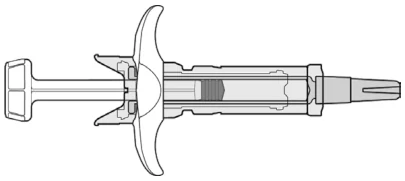
- 1. Ensure the system is intact/ not damaged. Do not use the product if you see any damage (syringe or needle safety guard breakage) or lose components and if the needle safety guard is on safety position before use as shown on picture 9 because this indicate system already operated. In general the product should not be used if it does not conform to the picture 1. If so discard the product in a biohazard (sharps) container.
Picture 1
Step 2: Remove the Needle Cap
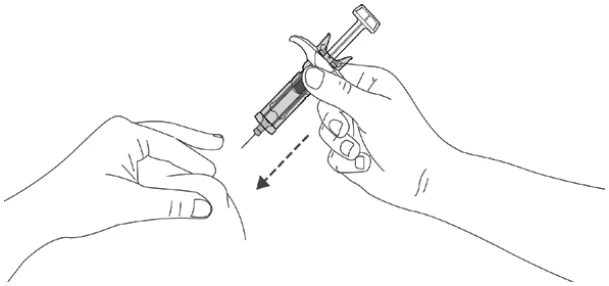
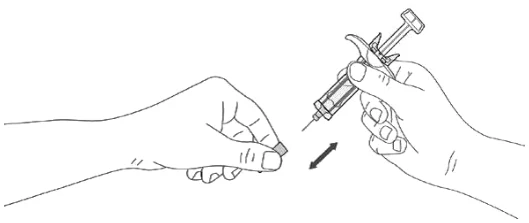
- 1. Remove the protective cap as shown in picture 2. Hold the body of the needle safety guard in one hand with the needle end pointing away from you and without touching the plunge rod. Pull the needle cap straight off with your other hand. After removal, throw away the needles cap in a biohazard (sharps) container.
- 2. You may notice a small air bubble in the pre-filled syringe. You do not have to remove the air bubble before injecting. Injecting the solution with the air bubble is harmless.
- 3. You can now use the pre-filled syringe.
Picture 2
Where should I give my injection?
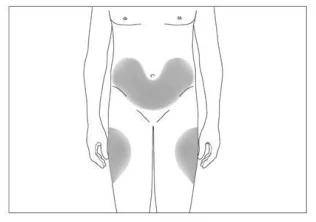
The most suitable places to inject yourself are:
- the top of your thighs; and
- the abdomen, except for the area around the navel (see picture 3).
Picture 3
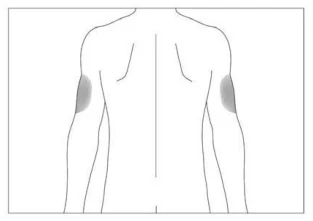
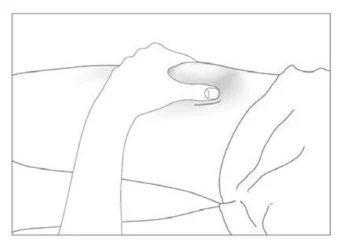
If someone else is injecting you, they can also use the back of your arms (see picture 4)
Picture 4
It is better to change the injection site every time to avoid the risk of soreness at any one site.
How do I give my injection?
Disinfect the injection site by using an alcohol swab and pinch the skin between your thumb and forefinger, without squeezing it (see picture 5).
Picture 5
 Package leaflet: Information for the user Pelgraz® 6 mg solution for injection in pre-filled syringe
(pegfilgrastim) Step 3: Insert the Needle
- Lightly pinch the skin at the injection site with one hand;
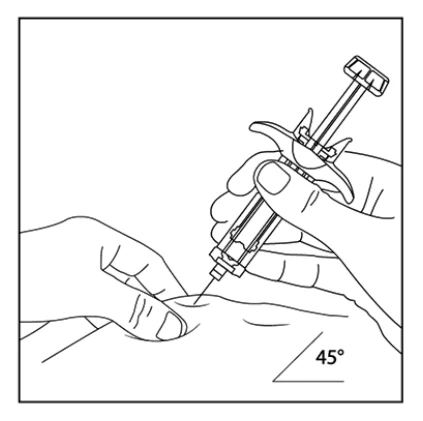
With the other hand insert the needle into the injection site without touching the plunger rod head
(with 45-90 degree angle) (see picture 6 and 7).
Picture 6
Picture 7
Pre-filled syringe with needle safety guard
b. Put the needle fully into the skin as shown by your nurse or doctor.
c. Pull slightly on the plunger to check that a blood vessel has not been punctured. If you see blood in
the syringe, remove the needle and re-insert it in another place.
Inject the dose your doctor has told you following the instructions below:
Step-4: Injection
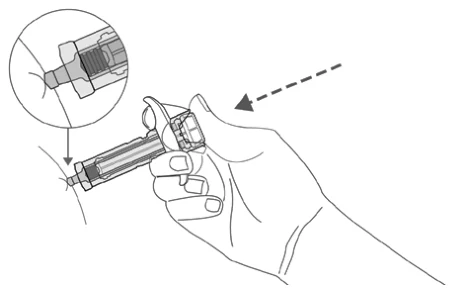
Place the thumb on the plunger rod head. Depress the plunger rod and push firmly at the end of the injection to ensure that syringe emptying is completed (see picture 8). Hold the skin securely until the injection is completed.
Picture 8
Step-5: Needle Stick Protection
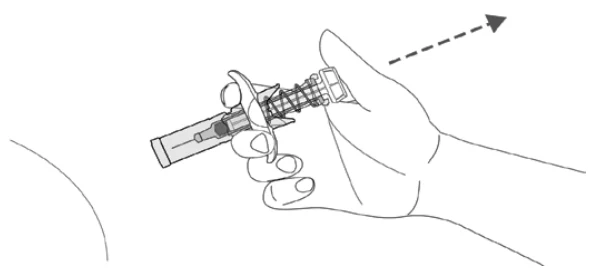
The safety system will activate once the plunger rod is fully depressed:
- Keep the syringe still and slowly lift your thumb from the plunger rod head;
The plunger rod will move up with your thumb and the spring retracts the needle from the site, into
the Needle safety guard (see picture 9).
Picture 9
Remember
If you have any problems, please ask your doctor or nurse for help and advice.
Disposing of used syringes
Dispose of the syringe as instructed by your doctor, pharmacist or nurse.
If you use more Pelgraz than you should
If you use more Pelgraz than you should contact your doctor, pharmacist or nurse.
If you forget to inject Pelgraz
If you are injecting yourself and have forgotten your dose of Pelgraz, you should contact your doctor to discuss when you should inject the next dose.
If you stop using Pelgraz
Your doctor will tell you when to stop using Pelgraz. It is quite normal to have a number of courses of treatment with Pelgraz.
If you have any further questions on the use of this medicine, ask your doctor or pharmacist.
4. Possible side effects
Like all medicines, Pelgraz can cause side effects, although not everybody gets them.
Please tell your doctor immediately if you have any of the following or combination of the following side effects:
swelling or puffiness, which may be associated with passing water less frequently, difficulty breathing,
abdominal swelling and feeling of fullness, and a general feeling of tiredness. These symptoms generally develop in a rapid fashion.
These could be symptoms of an uncommon (may affect up to 1 in 100 people) condition called “Capillary Leak Syndrome” which causes blood to leak from the small blood vessels into your body and needs urgent medical attention.
Very common side effects (may affect more than 1 in 10 people):
- bone pain. Your doctor will tell you what you can take to ease the bone pain.
- nausea and headaches.
Common side effects (may affect up to 1 in 10 people):
- pain at the site of injection.
- general aches and pains in the joints and muscles.
- pain in the chest that is not caused by heart disease or a heart attack.
some changes may occur in your blood, but these will be detected by routine blood tests. Your white
blood cell count may become high for a short period of time. Your platelet count may become low which might result in bruising.
Uncommon side effects (may affect up to 1 in 100 people):
allergic-type reactions, including redness and flushing, skin rash, and raised areas of the skin
that itch.
serious allergic reactions, including anaphylaxis (weakness, drop in blood pressure, difficulty
breathing, swelling of the face).
- increased spleen size.
spleen rupture. Some cases of splenic rupture were fatal. It is important that you contact your doctor
immediately if you experience pain in the upper left side of the abdomen or left shoulder pain since this may relate to a problem with your spleen.
- breathing problems. If you have a cough, fever and difficulty breathing please tell your doctor.
Sweet’s syndrome (plum-coloured, raised, painful lesions on the limbs and sometimes the face and
neck with fever) has occurred but other factors may play a role.
- cutaneous vasculitis (inflammation of the blood vessels in the skin).
- damage to the tiny filters inside your kidneys (glomerulonephritis).
- redness at the site of injection.
- abnormal blood test results (lactate dehydrogenase, uric acid and alkaline phosphatase).
abnormal blood test results related to the liver (alanine aminotransferase and aspartate
aminotransferase).
- coughing up blood (haemoptysis)
- blood disorders (myelodysplastic syndrome [MDS] or acute myeloid leukaemia [AML]).
Rare side effects (may affect up to 1 in 1,000 people):
inflammation of the aorta (the large blood vessel which transports blood from the heart to the body),
see section 2.
- bleeding from the lung (pulmonary haemorrhage)
Stevens-Johnson syndrome, which can appear as reddish target-like or circular patches often with
central blisters on the trunk, skin peeling, ulcers of mouth, throat, nose, genitals and eyes and can be preceded by fever and flu-like symptoms. Stop using Pelgraz if you develop these symptoms and contact your doctor or seek medical attention immediately. See also section 2.
Reporting of side effects
If you get any side effects, talk to your doctor, pharmacist or nurse. This includes any possible side effects not listed in this leaflet. You can also report side effects directly via Yellow Card Scheme Website: www.mhra.gov.uk/yellowcard or search for MHRA Yellow Card in the Google Play or Apple App Store. By reporting side effects you can help provide more information on the safety of this medicine.
5. How to store Pelgraz
Keep this medicine out of the sight and reach of children.
Do not use this medicine after the expiry date which is stated on the carton and on the syringe label after EXP. The expiry date refers to the last day of that month.
Store in a refrigerator (2°C – 8°C).
Pelgraz may be exposed to room temperature (not above 25°C ± 2°C) for a maximum single period of up to 15 days. Pelgraz left at room temperature for more than 15 days should be discarded. For all questions about storage, ask your doctor, nurse or pharmacist.
Do not freeze. Accidental exposure to freezing temperatures for a single period of less than 24 hours does not adversely affect the stability of Pelgraz.
Keep the pre-filled syringe in the carton in order to protect from light.
Do not use this medicine if you notice it is cloudy or there are particles in it.
Do not throw away any medicines via wastewater or household waste. Ask your pharmacist how to throw away medicines you no longer use. These measures will help to protect the environment.
If the medicine becomes discolored or shows any other signs of deterioration, you should seek the advice of your pharmacist who will tell you what to do.
6. Contents of the pack and other information
What Pelgraz contains
- The active substance is pegfilgrastim. Each pre-filled syringe contains 6 mg of pegfilgrastim in 0.6 mL of solution.
The other ingredients are sodium acetate, sorbitol (E420), polysorbate 20 and water for injections.
(see section 2).
What Pelgraz looks like and contents of the pack
Pelgraz is a clear colourless solution for injection in a pre-filled syringe with an injection needle. Each pre-filled syringe contains 0.6 mL of solution.
Pelgraz is available in packs containing 1 pre-filled syringe, with prefixed needle safety guard in individual blister pack and one alcohol swab.
Manufacturer
Accord Healthcare Polska Sp. z o.o.
ul. Lutomierska 50
95-200 Pabianice
Poland
Or
Accord Healthcare B.V.
Winthontlaan 200
3526 KV Utrecht
Netherlands
Procured from within the EU and repackaged for the PL Holder: Abacus Medicine Ltd., Abbey House, 282 Farnborough Road, Farnborough, GU14 7NA, United Kingdom
PL 45763/1202
PL 45763/1203
PL 45763/1204
PL 45763/1205
PL 45763/1206
PL 45763/1207
PL 45763/1208
POM
Pelgraz® is a registered trademark of Accord Healthcare Limited
For any information about this medicine, please contact the local representative of the Product Licence Holder:
Abacus Medicine Ltd.
tel: +44(0)2036301244
email: MedInfo@abacusmedicine.co.uk
or
drugsafetyuk@abacusmedicine.co.uk
This leaflet was last revised on 04.06.2025.
The following information is intended for medical or healthcare professionals only:
Pelgraz does not contain any preservative. In view of the possible risk of microbial contamination, Pelgraz syringes are for single use only.
Do not freeze. Accidental exposure to freezing temperatures for up to 24 hours does not affect the stability of Pelgraz. If exposure has been greater than 24 hours or frozen more than once, then Pelgraz should NOT be used.
In order to improve traceability of granulocyte-colony stimulating factors, the medicine name (Pelgraz) and batch number of the administered syringe should be clearly recorded in the patient file.
Using the pre-filled syringe with needle safety guard
The needle safety guard covers the needle after injection to prevent needle stick injury. This does not affect normal operation of the syringe. Depress the plunger rod and push firmly at the end of the injection to ensure that syringe emptying is completed. Hold the skin securely until the injection is completed. Keep the syringe still and slowly lift your thumb from the plunger rod head. The plunger rod will move up with your thumb and the spring retracts the needle from the site, into the Needle safety guard.
Do not use a pre-filled syringe if it has been dropped on a hard surface.
Disposal
Any unused medicinal product or waste material should be disposed of in accordance with local requirements.
Blind or partially sighted?
Is this leaflet hard to see or read?
Call 02036301310 or write to
info@abacusmedicine.com to obtain the leaflet in a format suitable for you.