

Patient leaflet - Myalepta 5.8 mg powder for solution for injection
1. What Myalepta is and what it is used for
Myalepta contains the active substance metreleptin. Metreleptin is similar to a human hormone called leptin.
What Myalepta is used for
Myalepta is used to treat the complications of not having enough leptin in patients with lipodystrophy.
It is used in adults, adolescents and children 2 years or over:
who have generalised lipodystrophy (the whole of your body does
not have enough fatty tissue)
It is used, when other treatments have been ineffective, in adults, and adolescents 12 years or over:
who have partial lipodystrophy which is inherited (also called
congenital or familial lipodystrophy)
or partial lipodystrophy has been caused by your body’s response
to something such as a viral illness (also called acquired lipodystrophy)
How Myalepta works
Natural leptin is produced by fatty tissue and has many functions in the body including:
- controlling how hungry you feel and your energy levels
- helping the insulin in your body manage sugar levels. Metreleptin works by copying the effects of leptin. This improves the ability of the body to control energy levels.
2. What you need to know before you use Myalepta
Do not use Myalepta if:
you are allergic to metreleptin or any of the other ingredients of
this medicine (listed in section 6).
Warnings and precautions
Talk to your doctor, pharmacist or nurse before using Myalepta if:
- you are pregnant
- you have ever had a type of cancer called lymphoma
you have ever had problems with your blood (such as a low
blood count)
you have ever had inflammation of an organ called the pancreas
(‘pancreatitis’)
you have or ever have had problems with your immune system
(autoimmune disease including autoimmune-related liver problems)
Lymphoma
People with lipodystrophy can get a type of blood cancer called
lymphoma, whether or not they are using Myalepta.
However, you may be at higher risk of getting a lymphoma when using the medicinal product.
Your doctor will decide if you should use Myalepta and will monitor you during treatment.
Serious and severe infections
While being treated with Myalepta, your body might produce antibodies which may increase the risk of developing serious or severe infections. Tell your doctor straight-away if you develop a high temperature, accompanied by
increasing tiredness (see section 4).
Low blood sugar with insulin or other anti-diabetic medicines If you are using a medicine such as insulin or other medicines to treat diabetes, your doctor will closely monitor your blood sugar. Your doctor will change your dose of insulin or other medicines if needed. This is to prevent your blood sugar from getting too low (‘hypo-glycaemia’). For signs of low blood sugar levels, see section 4 under ‘Signs of high and low blood sugar'.
High blood sugar and fat levels
You may have higher amounts of sugar (‘hyper-glycaemia’) or fat (‘hyper-triglyceridaemia’) in your blood while on Myalepta, which may be a sign that this medicine is not working as well as it should. Signs of high blood sugar levels and high fat levels are listed in section 4 under “Signs of high and low blood sugar” and “Signs of high fat”.
If you notice any of the symptoms referred to above and described further in section 4 of this leaflet, or you are not sure, talk to your doctor straight away. Your doctor might need to change your treatment.
Autoimmune disease
People who have or have had problems with their immune system (autoimmune disease including autoimmune-related liver problems) may have worsening of their symptoms with Myalepta. Talk to your healthcare provider about what symptoms you should watch for that would warrant further testing.
Allergic reactions
While being treated with Myalepta, you may get an allergic reaction. Tell your doctor straight-away if you have any symptoms of an allergic reaction. Signs of an allergic reaction can be seen in section 4 under “Allergic reactions”.
Fertility
Myalepta might increase fertility in women with lipodystrophy (see section “Pregnancy, breast-feeding and fertility”).
Myalepta contains sodium
This medicine contains less than 1 mmol sodium (23 mg) per dose, that is to say essentially “sodium free”.
Children and adolescents
Do not give this medicine to children below the age of 2 years with generalised lipodystrophy, or below the age of 12 years with partial lipodystrophy. This is because it is not known how this medicine will affect children under these ages.
Other medicines and Myalepta
Tell your doctor if you are using, have recently used or might use any other medicines. Myalepta can affect the way some other medicines work. Also some other medicines can affect the way this medicine works. In particular, tell your doctor if you are taking any of the following
medicines:
hormonal contraceptives as Myalepta may reduce how well they work
at preventing pregnancy
- theophylline used in lung problems such as asthma
- blood-thinning medicines (such as warfarin or phenprocoumon)
medicines which suppress the immune system (such as cyclosporine)
anti-diabetic medicines (such as insulin or insulin secretagogues), see
section 2 ‘Low blood sugar with insulin or other anti-diabetic medicines’ If any of the above apply to you (or you are not sure), talk to your doctor before using Myalepta. Some medicines need to be monitored while you are using Myalepta since the dose of these medicines might need to be changed.
Pregnancy, breast-feeding and fertility
If you are pregnant or breast-feeding, think you may be pregnant or are planning to have a baby, ask your doctor for advice before using this medicine.
You should not use Myalepta if you are pregnant or might become pregnant. This is because it is not known how Myalepta will affect your unborn baby. Women who could get pregnant should use effective contraception, including non-hormonal methods such as condoms, while using Myalepta. Discuss appropriate contraceptive methods with your
doctor as Myalepta may reduce how well hormonal contraceptives work at preventing pregnancy.
It is not known if Myalepta will pass into breast milk. Talk to your doctor if you are breast-feeding or plan to do so. You and your doctor will decide whether or not to continue breast-feeding while using this medicine, considering the benefit of breast-feeding the baby and the benefit of Myalepta to the mother.
Myalepta might increase fertility in women with lipodystrophy.
Driving and using machines
Myalepta has minor influence on the ability to drive and use machines. You might feel dizzy or tired when using this medicine. If this happens, do not drive or use any tools or machines. Talk to your doctor if you are not sure.
3. How to use Myalepta
Always use this medicine exactly as your doctor has told you. Check with your doctor if you are not sure.
Myalepta is an injection once a day under the skin (‘subcutaneous injection’). This medicine is for use in children aged 2 years and above, adolescents and adults with generalised lipodystrophy; it is also for use in children aged 12 years and above, adolescents and adults with partial lipodystrophy.
While using this medicine, you or your child will be monitored by your doctor, who will decide the dose you or your child should use. Your doctor may decide that you inject the medicine yourself. Your doctor, nurse or pharmacist will show you how to prepare and inject this medicine.
Do not try to prepare the medicine or inject yourself if you have not
been trained.
How much to inject
Your dose of Myalepta may change over time depending on how this medicine works for you. The Myalepta powder is dissolved by mixing it with water for injections to make the solution for injecting. Read the “Instructions for Use” for how to make the solution before injecting. Your doctor will have prescribed the correct dose for you, based on the following:
If you weigh 40 kg or less:
A starting dose is 0.06 mg (0.012 mL of solution) for each kilogram
of body weight.
If you are male and weigh more than 40 kg:
- A starting dose is 2.5 mg (0.5 mL of solution).
If you are female and weigh more than 40 kg:
- A starting dose is 5 mg (1 mL of solution).
Your doctor or pharmacist will tell you how much of the solution to inject. If you are not sure how much of the solution to inject, talk to your doctor
or pharmacist before injecting.
The syringe you need to use to inject this medicine depends on the dose
prescribed for you.
o Your pharmacist will give you the correct syringe for injecting.
o See the “Instructions for Use” to find out which syringe to use.
To know how much medicine to inject (in mL), you divide your dose
(in mg) by 5.
o For example, if you have been prescribed a 5 mg dose of Myalepta, 5 mg divided by 5 gives you 1 mL which is the amount you need to inject of the solution, using a 1 mL syringe.
If your dose is 1.50 mg (0.30 mL of solution) or less, you will need to
use a 0.3 mL syringe.
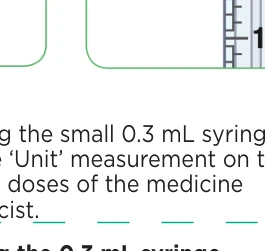
o The 0.3 mL syringe will show the injection amount in ‘Unit’ instead of ‘mL’. See the “Instructions for Use” (section 7) for more information on reading and using the different syringes.
o To know how much solution to inject (in Units), divide your dose (in mg) by 5, and then times it by 100.
If you need to inject 1 mL or more of Myalepta solution, your doctor might tell you to give the dose as two separate injections. This can help make the injections more comfortable.
You must use a clean syringe and needle for both injections.
If you are not sure how much of the solution to inject, talk to your doctor or pharmacist before injecting.
When small doses/volumes are prescribed (e.g. in children), the vials will remain almost completely filled with product after withdrawal of the required dose. Remaining solution should be discarded after use. If you use more Myalepta than you should
If you use more Myalepta than you should, talk to your doctor or go to a hospital straight away. Your doctor will monitor you for side effects. If you forget to use Myalepta
- If you forget to inject a dose, inject it as soon as you remember.
- Then have your normal dose the next day.
- Do not use a double dose to make up for a forgotten dose. If you have injected less Myalepta than you should, talk to your doctor straight away. Your doctor will monitor you for side effects. If you stop using Myalepta
Do not stop using Myalepta without talking to your doctor. Your doctor will decide if you should stop using this medicine.
If you need to stop using Myalepta, your doctor will gradually reduce the dose over two weeks before stopping it altogether. Your doctor will also ask you to follow a reduced fat diet.
It is important to gradually reduce the dose over two weeks because
this can help prevent a sudden increase in the levels of fat (called ‘triglycerides’) in your blood.
A sudden increase in the amount of triglyceride in your blood can make
your pancreas inflamed (‘pancreatitis’). Gradually reducing your dose, and following a reduced fat diet may help to prevent this. You should not stop using Myalepta unless your doctor tells you to. If you have any further questions on the use of this medicine, ask your doctor.
4. Possible side effects
Like all medicines, this medicine can cause side effects, although not everybody gets them.
Possible side effects with this medicine:
Serious side effects
Tell your doctor straight away if you notice any of the following serious side effects – you may need urgent medical treatment. If you cannot contact your doctor, you should seek emergency medical help:
low blood sugar (glucose), see section ‘Signs of high and low blood
sugar’ below.
- increased blood sugar (glucose)
blood clot in your veins (deep vein thrombosis) - pain, swelling,
warmth & redness, usually occurring in lower leg or thigh
- fluid in your lungs - difficulty breathing or cough
- feeling sleepy or confused
Allergic reactions
Talk to a doctor straight away if you notice any severe allergic reactions, including:
- breathing problems
- swelling and reddening of the skin, hives
swelling of your face, lips, tongue or throat
- stomach pain, feeling sick (nausea) and being sick (vomiting)
- fainting or feeling dizzy
- severe pain in your stomach (abdomen)
- very fast heartbeat
Inflamed pancreas (‘pancreatitis’):
Talk to a doctor straight away if you notice any signs of an inflamed pancreas, including:
- sudden severe pain in your stomach (abdomen)
- feeling sick (nausea) or being sick (vomiting)
- diarrhoea
Other side effects
Tell your doctor if you notice any of the following side effects.
Very common (may affect more than 1 in 10 people):
- weight loss
Common (may affect up to 1 in 10 people):
- loss of interest in food
- headache
- hair loss
- unusually heavy or long menstrual bleeding
- feeling tired
- bruising, reddening, itching or hives where the injection is given
your body producing antibodies to metreleptin which may increase the risk
of developing serious or severe infections. You may notice you develop a high temperature, accompanied by increasing tiredness
Not known (frequency cannot be estimated from the available data):
- flu
- chest infection
- diabetes
- a higher than normal desire for food or excessive eating
- a faster than normal heart rate
- cough
- breathlessness
- muscle pain (‘myalgia’)
- joint pain
- swelling in your hands and feet
- increase in fatty tissue
- swelling or bleeding under the skin, where you injected
- pain at the injection site
- itchiness at the injection site
- a feeling of general discomfort, uneasiness or pain (‘malaise’)
- increased fat in the blood (‘triglycerides’) (see section ‘Signs of high fat’ below)
- an increase in ‘HbA1c’ in your blood, shown in tests
- weight gain
- swelling or bleeding under the skin (‘haemorrhage’)
- high blood sugar levels (see section ‘Signs of high and low blood sugar below).
Tell your doctor if you notice any of the above side effects. Signs of high and low blood sugar
Symptoms of low blood sugar levels include:
- feeling dizzy
- feeling more sleepy or confused
- being clumsy and dropping things
- feeling more hungry than normal
- sweating more than normal
- feeling more irritable or more nervous
If you notice any of the symptoms above, or you are not sure, talk to your doctor straight away. Your doctor might need to change your treatment. Symptoms of high blood sugar levels include:
- feeling very thirsty or hungry
- going to the toilet to pass urine more often
- feeling more sleepy
- feeling sick or being sick
- blurred vision
- pain in the chest or back
feeling out of breath
Signs of high fat
Symptoms of high fat levels include:
- pain in the chest
- pain below the ribs like heartburn or indigestion
- feeling sick or being sick
Tell your doctor if you notice any of the above side effects.
Reporting of side effects
If you get any side effects, talk to your doctor, pharmacist or nurse. This includes any possible side effects not listed in this leaflet. You can also report side effects directly via:
Yellow Card Scheme
Website: www.mhra.gov.uk/yellowcard or search for MHRA Yellow Card in the Google Play or Apple App Store
By reporting side effects, you can help provide more information on the safety of this medicine.
5. How to store Myalepta
Keep this medicine out of the sight and reach of children. Do not use this medicine after the expiry date which is stated on the vial and carton. The expiry date refers to the last day of that month. Store in a refrigerator (2 °C-8 °C). Keep the vial in the outer carton in order to protect from light.
After reconstitution, the solution must be administered immediately and
cannot be stored for later use. Dispose of any unused medicine. Do not use this medicine if the solution is not clear, is coloured or has bits or lumps in it.
Do not throw away any medicines via wastewater or household waste. Ask your pharmacist how to throw away medicines you no longer use. These measures will help protect the environment.
6. Contents of the pack and other information
What Myalepta contains
- The active substance is metreleptin.
Each vial contains 5.8 milligrams of metreleptin. After dissolving the
vial contents in 1.1 millilitres of water for injections, each millilitre contains 5 milligrams of metreleptin.
The other ingredients are: glycine, sucrose, polysorbate 20, glutamic
acid, sodium hydroxide (for pH adjustment).
What Myalepta looks like and contents of the pack
Myalepta is presented as a powder for solution for injection (powder for
injection). It is a white powder supplied in a glass vial with a rubber stopper and an aluminium seal with a blue plastic flip-off cap. Myalepta is available in packs containing 1 or 30 vials.
Not all pack sizes may be marketed in your country.
Your doctor, nurse or pharmacist should provide you separately with the appropriate syringes and needles, wipes and water for injections to enable you to prepare and inject Myalepta. They will provide a ‘sharps disposal container’ for you to put your used vials, syringes and needles in.
Marketing Authorisation Holder
Chiesi Ltd
333 Styal Road
Manchester
M22 5LG
Tel: 0161 488 5555
Manufacturer
Amryt Pharmaceuticals DAC
45 Mespil Road
Dublin 4
Ireland
This leaflet was last revised in June 2025
This medicine has been authorised under ‘exceptional circumstances’. This means that because of the rarity of this disease it has been impossible to get complete information on this medicine.
The Medicines and Healthcare products Regulatory Agency will review any new information on this medicine every year and this leaflet will be updated as necessary.
Other sources of information
Detailed information on this medicine is available on the Medicines and Healthcare products Regulatory Agency web site:
http://www.mhra.gov.uk.
There are also links to other websites about rare diseases and treatments.
CP0086/3
984 mm
28mm
| 10mm quiet zone | 10mm quiet zone |
bleeding 3mm off top cutting edge
11mm in total
CUTTER CYAN MAGENTA YELLOW BLACK 100% 95% 50% 5% | |
Product Name Market Asset No. Production Site No. Production Site Originated on Originated by Originated at Proof Status Amended by Amended on Myalepta 5.8 mg UK 1346 7626-01 / 781288 PCI IE 04/07/2025 Operator 019 Ark P1 / M1 - - | |
| Main Body Text 9 pt Line Spacing 11 pt | |
FONTS USED Gotham |
PLEASE NOTE:
WHILST ARK PHARMA GRAPHICS WILL MAKE EVERY EFFORT TO ENSURE THE ACCURACY OF TEXT, BRAILLE AND BARCODES ARE CAPTURED, IT IS THE ULTIMATE RESPONSIBILITY OF THE CUSTOMER’S REGULATORY DEPARTMENT AND PRODUCTION SITES TO ENSURE THAT TEXT (INCLUDING BRAILLE) AND BARCODES ARE
CORRECT IN BOTH CONTENT AND ACCURACY.
| Chiesi Ltd. | |
| Chiesi No.: | 7626-01 |
Client Approval Signature Box Proofreader Site Packaging Chiesi Ltd. | |
Chiesi Ltd. - Version 2 - May 2024
Ark Pharma Graphics, 17 Tenter Road, Moulton Park, Northampton NN3 6PZ e-mail: ark.support@ark-pharma.com
ARTW-7626-01-01 (1.0) - Approved - 08 Oct 2025
Instructions for Use Before using Myalepta, you must first read Sections 1 – 6 of this package leaflet, and then read this Instructions for Use. Before you begin self-administering this medicine at home, your doctor, nurse or pharmacist will train you how to prepare and inject Myalepta. Contact them if you are unclear about anything or if you need more information or help. Take your time to carefully prepare and inject your medicine, which when including the period of the vial warming up after being taken out of the fridge, can be approximately 20 minutes in total. Additional training information There are additional education training information and videos to help you understand how to use Myalepta correctly. Details on how to access these are available from your doctor. Reading the syringe Line up the top rim of the plunger with the line for the prescribed dose. An example is given below for the different syringe sizes. If your syringe looks different or has different dose markings, talk to your doctor, nurse or pharmacist for more information. Using the 0.3 mL syringe
Converting dose from ‘mL’ to ‘Units’ when using the 0.3 mL syringe Weight of child 9 kg 10 kg 11 kg 12 kg 13 kg 14 kg 15 kg 16 kg 17 kg 18 kg 19 kg 20 kg 21 kg 22 kg 23 kg 24 kg 25 kg Dose of Myalepta 0.54 mg 0.60 mg 0.66 mg 0.72 mg 0.78 mg 0.84 mg 0.90 mg 0.96 mg 1.02 mg 1.08 mg 1.14 mg 1.20 mg 1.26 mg 1.32 mg 1.38 mg 1.44 mg 1.50 mg L Amount of mixed Myalepta solution 0.10 mL 0.12 mL 0.13 mL 0.14 mL 0.15 mL 0.16 mL 0.18 mL 0.19 mL 0.20 mL 0.21 mL 0.22 mL 0.24 mL 0.25 mL 0.26 mL 0.27 mL 0.28 mL 0.30 mL Amount of mixed Myalepta solution to inject in ‘Unit’ measurements on your 0.3 mL syringe 10 12 13 14 15 16 18 19 20 21 22 24 25 26 27 28 30 | Using the 1 mL syringe
|
| Break point Glass ampoule of water for injection | With the needle still in the vial, turn the vial and syringe upside down. The needle will now be facing up.
|
|
|
Step G: Throwing away used materials
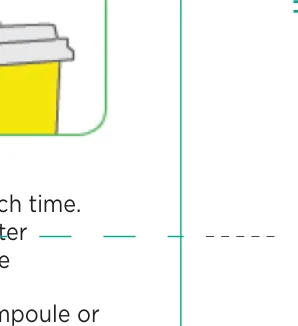
Important o Do not use the syringes more than once. Use new syringes each time. o The vials may remain almost completely filled with product after withdrawal of the required dose. Remaining solution should be discarded after use. o Do not dissolve another dose of Myalepta powder with any ampoule or vial containing unused remaining water for injection. This unused water for injection should be disposed of in your sharps container. Always use a new ampoule or vial of water for injection each time when preparing to dissolve Myalepta powder. o Do not recycle the syringes, caps, or sharps disposal container, or throw them into household waste. o Always keep the sharps disposal container out of reach of children.
|
|
Step B: Filling the 3 mL syringe with 1.1 mL of water for injections
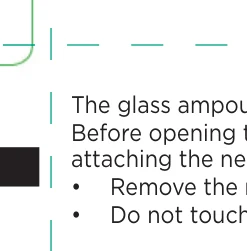
| The glass ampoule is a sealed container. Before opening the water for injection ampoule, prepare the 3 mL syringe by attaching the needle to it. Do not over-tighten the needle.
To remove the water for injection, break open the | Pull the plunger down carefully
|
|
| ||
Using the 3.0 mL syringe
| glass vial (see below for specific instructions).
Your doctor, nurse or pharmacist will give you ‘water for injection’ with the medicine vial and syringes. This is mixed with the Myalepta powder to dissolve the powder to make the liquid medicine that you inject. The water for injection will come in either:
| ampoule at the break-point as shown in the picture above.
|
|
|
| ||
Step A: Setting up
On a clean, well-lit work surface, place the following items:
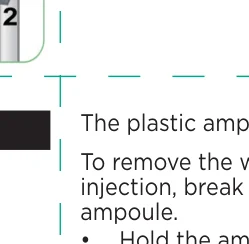
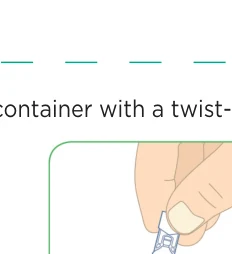
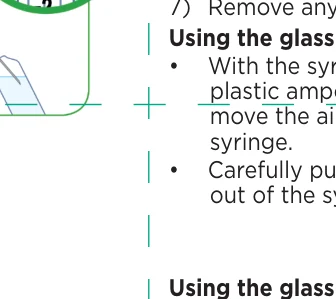
| Always use a new ampoule or vial of water for injection. Never use remaining water for injection left over from a previous day’s preparation of Myalepta solution. The plastic ampoule is a sealed container with a twist-off top. To remove the water for injection, break open the ampoule.
Plastic ampoule of water for injection |
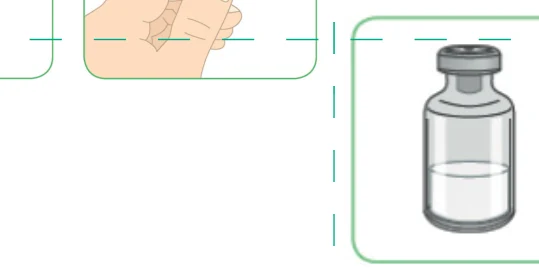
Glass vial of water for injection Insert the 3 mL syringe into the glass ampoule.
With the needle still in the ampoule, pull the plunger up carefully.
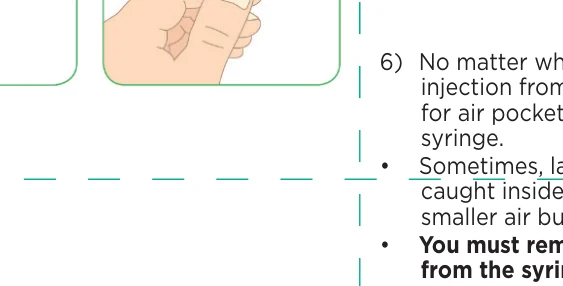
| 1 1 Air bubble Air caught inside the syringe. You might also see smaller air bubbles in the syringe.
Using the glass vial or plastic ampoule
|
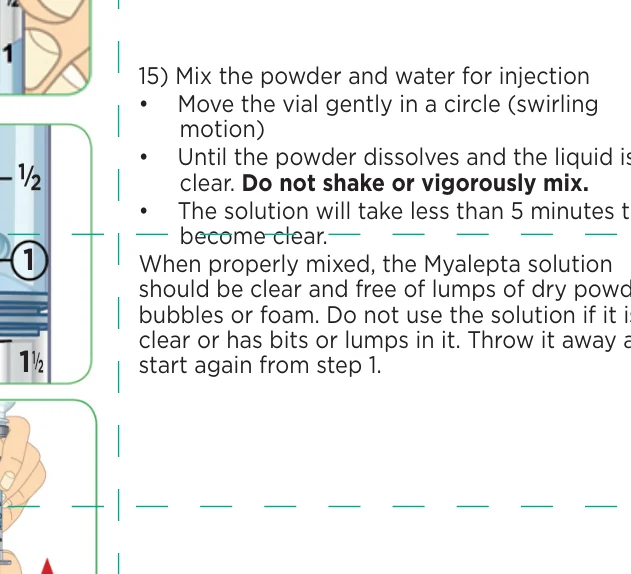
When properly mixed, the Myalepta solution should be clear and free of lumps of dry powder, bubbles or foam. Do not use the solution if it is not clear or has bits or lumps in it. Throw it away and start again from step 1. | of Myalepta solution, remove the needle from the vial.
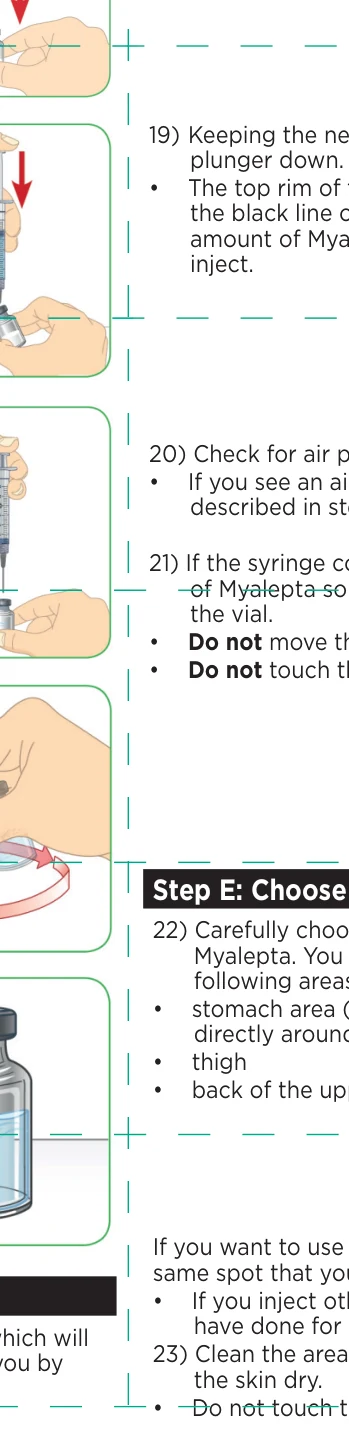
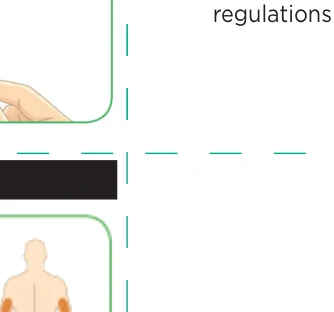
Step E: Choose and preparing where to inject
| ||
You will also need 2 syringes:
|
With the syringe still in the ampoule, turn the ampoule and syringe upside down. The syringe will now be facing up. With the syringe still in the ampoule, pull the plunger down carefully,
| The glass vial will have a plastic cap that you should remove, revealing a rubber seal below.
Attach the needle to the 3 mL syringe. Do not over-tighten the needle.
Place the vial on a hard, flat surface.
| syringe.
Using the glass ampoule
| Step D: Filling the syringe with Myalepta for injection
| If you want to use the same area of the body for each injection, do not use the same spot that you used for your last injection.
Step F: Injecting Myalepta Important: Myalepta must be injected under the skin (‘subcutaneous’). Do not inject into a muscle.
| ||
syringe.
Attach the needle to the syringe.
|
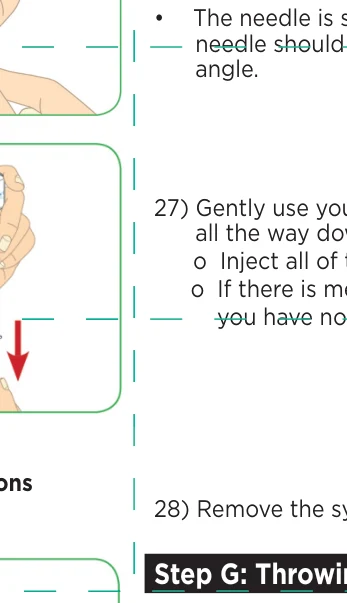
Push the plunger all the way down. | Step C: Dissolving Myalepta
|
984 mm
CUTTER CYAN MAGENTA YELLOW BLACK 100% 95% 50% 5% | |
Product Name Market Asset No. Production Site No. Production Site Originated on Originated by Originated at Proof Status Amended by Amended on Myalepta 5.8 mg UK 1346 7626-01 / 781288 PCI IE 04/07/2025 Operator 019 Ark P1 / M1 - - | |
| Main Body Text 9 pt Line Spacing 11 pt | |
FONTS USED Gotham |
PLEASE NOTE:
WHILST ARK PHARMA GRAPHICS WILL MAKE EVERY EFFORT TO ENSURE THE ACCURACY OF TEXT, BRAILLE AND BARCODES ARE CAPTURED, IT IS THE ULTIMATE RESPONSIBILITY OF THE CUSTOMER’S REGULATORY DEPARTMENT AND PRODUCTION SITES TO ENSURE THAT TEXT (INCLUDING BRAILLE) AND BARCODES ARE
CORRECT IN BOTH CONTENT AND ACCURACY.
| Chiesi Ltd. | |
| Chiesi No.: | 7626-01 |
Client Approval Signature Box Proofreader Site Packaging Chiesi Ltd. | |
Chiesi Ltd. - Version 2 - May 2024
Ark Pharma Graphics, 17 Tenter Road, Moulton Park, Northampton NN3 6PZ e-mail: ark.support@ark-pharma.com
ARTW-7626-01-01 (1.0) - Approved - 08 Oct 2025