

Patient leaflet - Hibiscrub
1. What Hibiscrub is and what it is used for
Hibiscrub belongs to a group of medicines called antiseptics. This means that it helps to prevent infections by killing germs on the skin.
Hibiscrub cutaneous solution contains the active ingredient chlorhexidine gluconate 4% w/v (40 mg/ml), which has antimicrobial properties.
Hibiscrub is used to disinfect the hands and skin prior to or after an operation or clean procedure (pre- and post-operative hand and skin disinfection / antisepsis).
Hibiscrub is also used to disinfect hands after handling infected materials (antiseptic handwashing).
2. What you need to know before you use Hibiscrub
Do not use Hibiscrub
- if you are allergic (hypersensitive) to chlorhexidine gluconate or any of the other ingredients of this medicine (listed in section 6).
- Hibiscrub contains soya oil. If you are allergic to peanut or soya, do not use this medicinal product.
Warnings and precautions
Talk to your doctor, pharmacist or nurse before using Hibiscrub.
- Prolonged use of Hibiscrub, especially in young patients, or in patients with broken skin, may lead to hypersensitivity to chlorhexidine gluconate. Therefore, Hibiscrub should only be used on intact skin.
- Areas of skin that have been treated with Hibiscrub should be thoroughly rinsed with water and dried on a clean towel.
- Avoid contact with the brain, meninges (the membranes surrounding the brain and spinal cord) and middle ear.
- -
- In patients with head or spinal injuries or a perforated ear drum (an ear drum with a hole or tear in it), the benefit of use in pre-operative preparation should be evaluated against the risk of contact.
- Hibiscrub must not come into contact with the eye due to the risk of visual damage. If it comes into contact with the eyes, wash out immediately and thoroughly with water. In case of any irritation, redness or pain in the eye, or visual disturbance, ask for medical advice promptly. Serious cases of persistent corneal injury (injury to the surface of the eye) potentially requiring corneal transplant have been reported when similar products have accidentally come in contact with the eye during surgical procedures, in patients under general anaesthesia (deep painless sleep).
- Common bleaches (which contain hypochlorites) may cause brown stains to develop on fabrics which have previously been in contact with chlorhexidine.
- Hibiscrub’s action may be reduced if used with soap or detergents.
- Hibiscrub is flammable. Do not use with ignition sources until dry.
- If you go into hospital, let your doctor know if you are using Hibiscrub.
Children
Use with care in newborn babies, especially those born prematurely. Hibiscrub may cause chemical skin burns.
Hibiscrub contains isopropyl alcohol and citrus perfume
This medicine contains 40 mg isopropyl alcohol in each ml. Dryness, irritation, redness or burning sensation of the skin may occur. Allergic contact dermatitis or contact allergies are very rare.
This medicine contains fragrance with 3-Methyl-4-(2,6,6-trimethyl-2-cyclohexen-1-yl)-3-buten-2-one, Amyl cinnamal, Amylcinnamyl alcohol, Anisyl alcohol, Benzyl alcohol, Benzyl benzoate, Benzyl cinnamate, Benzyl salicylate, Cinnamal, Citral, Citronellol, Coumarin, d-Limonene, Eugenol, Farnesol, Geraniol, Hexyl cinnamaldehyde, Hydroxymethylpentyl-cyclohexenecarboxaldehyde, Isoeugenol, Lilial, Linalool, Methyl heptine carbonate, Oak moss and Tree moss. These may cause allergic reactions.
The fragrance also contains Bergamot oil (containing bergapten), Soya oil, Ethanol, Methyl benzoate, Benzoic acid, Balsam of Peru, Formaldehyde and Sodium laurilsulfate.
Bergamot oil (containing bergapten) may increase sensitivity to UV light (natural and artificial sunlight).
Ethanol may cause burning sensation on damaged skin.
Benzoic acid, Benzyl benzoate and Methyl benzoate may cause local irritation. Benzoic acid, Benzyl benzoate and Methyl benzoate may increase jaundice (yellowing of the skin and eyes) in newborn babies (up to 4 weeks old).
Balsam of Peru may cause skin reactions.
Formaldehyde may cause local skin reactions (e.g. contact dermatitis).
Sodium laurilsulfate may cause local skin reactions (such as stinging or burning sensation) or increase skin reactions caused by other products when applied on the same area.
3. How to use Hibiscrub
Always use this medicine exactly as described in this leaflet or as your doctor, pharmacist or nurse have told you. Check with your doctor, pharmacist or nurse if you are not sure.
FOR EXTERNAL USE ONLY
Do not inject. Do not use in the body’s internal spaces.
Chlorhexidine must not be used in direct contact with nerve tissue, for example brain and spinal cord tissue.
For Pre-operative Surgical Hand Disinfection
Wet the hands and forearms. Wash with 5 ml of Hibiscrub using the following procedure, each step consisting of five strokes backwards and forwards.
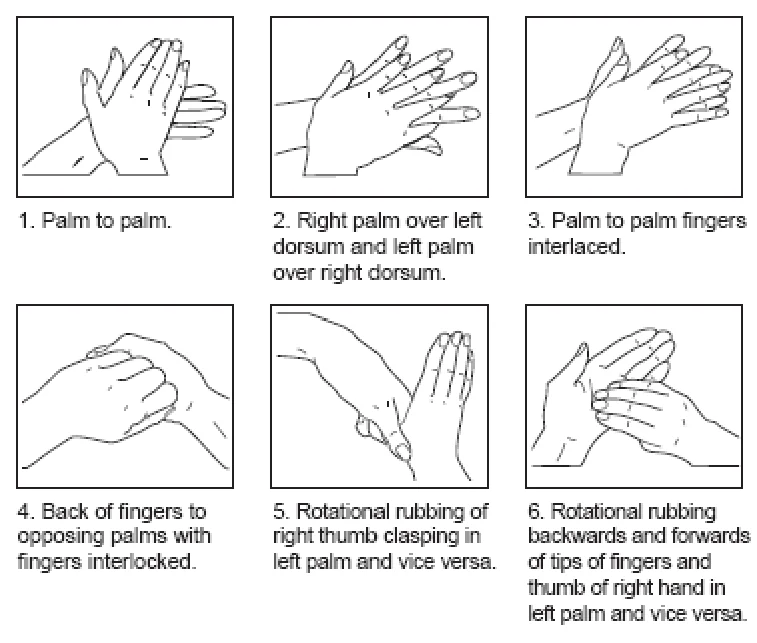
Continue washing hands and wrists until one minute has elapsed. Clean the fingernails with a brush or scraper. Rinse thoroughly. For pre-operative use repeat the wash a second time for two minutes.
The Hibiscrub handwashing technique is based on a procedure described by Ayliffe GAJ et al. J Clin Path 1978; 31: 923.
For Antiseptic Handwashing on the Ward
Wet the hands and forearms, apply 5 ml of Hibiscrub and wash for one minute. Rinse thoroughly and dry.
For Preventing Infection Before Your Operation
Wash the whole of your body in the bath or the shower on at least two occasions. This is usually done on the day before the operation and the day of the operation. Use the following method:
- Use 25 ml of Hibiscrub as a soap solution.
- Wash the whole body. Start with the face. Work down the body. Pay special attention to the skin around the nose, under the arms, around the belly button, between the legs and around the bottom.
- Rinse the whole body.
- Repeat the wash. Use the same amount of Hibiscrub. This time, wash the hair as well.
- Rinse the whole body and dry thoroughly with a clean towel.
For Preventing Infection After Your Operation
Wash the whole of your body, excluding the operation site, in the bath or the shower. This is usually done on the third day after the operation. Use the method described above.
If you accidentally swallow any Hibiscrub
You should go to your nearest Accident and Emergency department or contact your doctor immediately. Take this leaflet and any other packaging with you so they know what you have taken.
If you have any further questions on the use of this medicine, ask your doctor, pharmacist or nurse.
4. Possible side effects
Like all medicines, this medicine can cause side effects, although not everybody gets them.
The following side effects may occur; it is not known how often they occur but available data suggests these are very rare (probably affect fewer than 1 in every 10,000 people).
- Serious allergic reactions which can cause breathing difficulties, weakness, collapse and death, and can sometimes be preceded by swelling (in particular lip/tongue and facial swelling), or rash.
Allergic reactions to chlorhexidine-impregnated patches have been reported rarely when used in newborn babies.
At the first sign of any of these reactions, tell your doctor, pharmacist or nurse and application of Hibiscrub should be stopped immediately.
Other possible side effects, for which it is not known how often they occur, are:
- allergic skin disorders such as dermatitis (inflammation of the skin), pruritus (itch), erythema (redness of the skin), eczema, rash, urticaria (hives), skin irritation and blisters.
- corneal injury (injury to the surface of the eye), and permanent eye damage including permanent visual impairment (following accidental ocular exposure during head, face and neck surgical procedures) in patients under general anaesthesia (deep painless sleep).
- inflammation of the membranes of the brain and spinal cord has been reported when they have come into direct contact with chlorhexidine.
- delayed hypersensitivity reactions in the skin have been reported including allergic contact dermatitis.
Reporting of side effects
If you get any side effects, talk to your doctor, pharmacist or nurse. This includes any possible side effects not listed in this leaflet. You can also report side effects directly via the Yellow Card Scheme, Website: www.mhra.gov.uk/yellowcard or search for MHRA Yellow Card in the Google Play or Apple App Store. By reporting side effects you can help provide more information on the safety of this medicine.
5. How to store Hibiscrub
Keep this medicine out of the sight and reach of children.
Do not use this medicine after the expiry date which is printed on the bottle after “EXP”. The expiry date refers to the last day of that month.
Do not store above 25 °C. Store in the original package.
Do not throw away any medicines via wastewater or household waste. Ask your pharmacist how to throw away medicines you no longer use. These measures will help protect the environment.
6. Contents of the pack and other information
What Hibiscrub contains
- The active substance is chlorhexidine gluconate 4% w/v (40 mg/ml).
- The other ingredients are poloxamer 237, isopropyl alcohol, lauryl dimethyl amine oxide, glycerol, macrogol 7 glycerol cocoate, gluconolactone, citrus perfume, ponceau 4R (E124), sodium hydroxide and purified water.
What Hibiscrub looks like and contents of the pack
Hibiscrub is a clear, red, slightly viscous solution and comes in white bottles containing 125 ml, 250 ml, 500 ml or 5 litres of liquid.
Marketing Authorisation Holder
Regent Medical Limited, Medlock Street, Oldham, Lancashire, OL1 3HS, UK.
Manufacturer
BCM Ltd., Thane Road, Beeston, Nottingham, NG90 2PR, UK.