

Summary of medicine characteristics - Hiberix vaccine
1 NAME OF THE MEDICINAL PRODUCT
Hiberix Vaccine
Haemophilus influenzae type b (Hib) vaccine.
2. QUALITATIVE AND QUANTITATIVE COMPOSITION
Hiberix is a lyophilised vaccine of purified polyribosyl-ribitol-phosphate capsular polysaccharide (PRP) of Hib, covalently bound to tetanus toxoid.
The Hib polysaccharide is prepared from Hib, strain 20,752 and after activation with cyanogen bromide and derivatisation with adipic hydrazide spacer is coupled to tetanus toxoid via carbodiimide condensation. After purification the conjugate is lyophilised in the presence of lactose as a stabiliser.
Hiberix meets the World Health Organisation requirements for manufacture of biological substances of Hib conjugated vaccines.
Hiberix is a white powder.
The solvent is a clear and colourless liquid.
Each 0.5 mL dose of the vaccine contains 10 micrograms of purified capsular polysaccharide of Hib covalently bound to approximately 25 micrograms tetanus toxoid.
3 PHARMACEUTICAL FORM
Hib vaccine (lyophilised) for reconstitution.
4 CLINICAL PARTICULARS
4.1 Therapeutic indications
Active immunisation against invasive disease caused by Haemophilus influenzae type b.
4.2 Posology and method of administration
Posology
Primary series
Under 13 months of age:
Three 0.5ml doses, with an interval of at least four weeks between doses, the first dose to be given not earlier than two months of age.
13 months of age and over:
A single 0.5ml dose.
Booster
Following completion of a primary series in which one or more of the three doses consisted of Hiberix mixed with Infanrix, an additional (fourth) dose of Hib conjugate vaccine should be administered.
Children who were primed with Hiberix may be boosted with Hiberix or with another Hib conjugate vaccine. Similarly, Hiberix may be used to boost children who were primed with other Hib conjugate vaccines.
The timing of the Hib conjugate booster dose should be in accordance with official recommendations (see also section 5.1 Pharmacodynamic properties).
Method of administration
Intramuscular injection. (For patients with thrombocytopenia or bleeding disorders the injection should be given subcutaneously, see Section 4.4).
4.3 Contraindications
Hypersensitivity to the active substance or to any of the excipients listed in section 6.1
Hiberix should not be administered to subjects that have shown any signs of hypersensitivity after previous administration of Hib vaccines.
As with other vaccines, the administration of Hiberix should be postponed in subjects suffering from acute severe febrile illness. The presence of a minor non-febrile infection, however, is not a contra-indication to vaccination.
4.4 Special warnings and precautions for use
It is good clinical practice that immunisation should be preceded by a review of the medical history (especially with regard to previous immunisation and possible occurrence of undesirable events) and a clinical examination.
As with all vaccinations, appropriate medical treatment should be available for injection should an anaphylactic reaction occur. Recipients of the vaccine should remain under observation until they have been seen to be in good health and not to be experiencing an immediate adverse reaction. It is not possible to specify an exact length of time.
Syncope (fainting) can occur following, or even before, any vaccination especially in adolescents as a psychogenic response to the needle injection. This can be accompanied by several neurological signs such as transient visual disturbance, paraesthesia and tonic-clonic limb movements during recovery. It is important that procedures are in place to avoid injury from faints.
Hiberix should be administered with caution to subjects with thrombocytopenia or a bleeding disorder since bleeding may occur following an intramuscular administration to these subjects. In these subjects Hiberix may be administered by deep subcutaneous injection, see Section 4.2.
The potential risk of apnoea and the need for respiratory monitoring for 48-72h should be considered when administering the primary immunisation series to very premature infants (born ≤28 weeks of gestation) and particularly for those with a previous history of respiratory immaturity.
As the benefit of vaccination is high in this group of infants, vaccination should not be withheld or delayed.
Human Immunodeficiency Virus (HIV) infection is not considered as a contra-indication for Hiberix.
Although limited immune response to the tetanus toxoid component may occur, vaccination with Hiberix alone does not substitute for routine tetanus vaccination.
Excretion of capsular polysaccharide antigen in the urine has been described following receipt of the Hib vaccine and therefore antigen detection may not have a diagnostic value in suspected Hib disease within one to two weeks of vaccination.
Hiberix does not protect against disease caused by other types of Haemophilus influenzae nor against meningitis caused by other organisms.
Hiberix should under no circumstances be administered intravascularly.
4.5 Interaction with other medicinal products and other forms of interaction
Hiberix can be administered either simultaneously or at any time before or after a different inactivated or live vaccine.
Different injectable vaccines should be administered at different injection sites.
As with other vaccines it may be expected that in patients receiving immunosuppressive therapy or patients with immunodeficiency, an adequate response may not be achieved.
4.6 Fertility, pregnancy and lactation
No reproductive studies have been conducted in animals since vaccination against Hib in adults is uncommon. There is no accurate information on the safety of this vaccine in pregnancy therefore this vaccine should not be used in pregnancy or during lactation.
4.7 Effects on ability to drive and use machines
Hiberix has no or negligible influence on the ability to drive and use machines.
4.8. Undesirable Effects
Clinical trial data
The following frequencies were based on the analysis of approximately 3000 infants enrolled in study Hib-097 and of approximately 1200 infants enrolled in study DTPa-HBV-IPV-011.
Adverse reactions reported are listed according to the following frequency: Very common ≥ 1/10
Common ≥ 1/100 to < 1/10
Uncommon ≥ 1/1000 to < 1/100
Rare ≥ 1/10000 to < 1/1000
Very rare < 1/10000
Metabolism and nutrition disorders
Very common: loss of appetite
Psychiatric disorders
Very common: unusual crying, irritability, restlessness
Nervous system disorders
Very common: somnolence
Rare: convulsions (including febrile convulsions)
Gastrointestinal disorders
Very common: diarrhoea
Common: vomiting
General disorders and administration site conditions
Very common: fever, swelling, pain and redness at the injection site
Post-marketing surveillance
Immune system disorders
Not known: allergic reactions (including anaphylactic and anaphylactoid reactions), angioedema
Nervous system disorders
Not known: collapse or shock-like state (hypotonic-hyporesponsiveness episode; HHE), syncope or vasovagal responses to injection
Respiratory, thoracic and mediastinal disorders
Not known: Apnoea [see section 4.4. for apnoea in very premature infants (≤28 weeks of gestation)]
Skin and subcutaneous tissue disorders
Not known: urticaria, rash
General disorders and administration site conditions
Not known: extensive swelling of vaccinated limb, injection site induration
Reporting of suspected adverse reactions
Reporting suspected adverse reactions after authorisation of the medicinal product is important. It allows continued monitoring of the benefit/risk balance of the medicinal product. Healthcare professionals are asked to report any suspected adverse reactions via the Yellow Card Scheme Website www.mhra.gov.uk/yellowcard or search for MHRA Yellow Card in Google Play or Apple App Store.
4.9 Overdose
In general, the adverse event profile reported following overdosage was similar to that observed after administration of the recommended dose of Hiberix.
5 PHARMACOLOGICAL PROPERTIES
5.1 Pharmacodynamic properties
ATC code: Pharmaco-therapeutic group: Bacterial vaccines, ATC code J07AG01
Primary vaccination
Table 1 presents the immunogenicity results from 5 clinical trials in which infants received a 3-dose primary vaccination with Hiberix in the first 6 months of life. Anti-PRP concentration ≥ 0.15 µg/ml (a level indicative of short term protection) was obtained in 96.6-100% of infants.
Table 1: Percentage of subjects with antibody concentration ≥ 0.15 µg/ml one month after primary vaccination with Hiberix
Study code / country or region of study / calendar years of study | Number of Subjects | Age at primary vaccination | Trade name of co- administered vaccines | % subjects with anti-PRP ≥ 0.15 µg/ml (95% CI) | GMC (95% CI) |
| Studies conducted in EU | |||||
| Hib-018/UK/1994-1995 | 48 | 2-3-4 months | EVANS DTwP | 100.0*a | 5.42 (3.82;7.69)* |
Hib- 006/Germany/1993-1994 | 185 | 3-4-5 months | Infanrix | 97.3 (93.8; 99.1)* | 7.20 (5.91-8.78)* |
| DTPa-HBV-IPV-005/Belgium/1994-1996 | 343 | 3-4-5 months | Infanrix penta | 98.8 (96.8-99.6)* | 5.52 (4.84-6.30)* |
| 67 | Infanrix penta + Polio Sabin OPV (at 3rd dose) | 100 (93.2-100)* | 7.74 (5.89-10.16)* | ||
| Studies conducted outside EU | |||||
| Hib-097/US/2010-2012 | 1590 | 2-4-6 months | Pediarix Prevnar 13 Rotarix | 96.6 (95.6;97.4)** | 5.19 (4.76;5.66) ** |
DTPw-HBV-Hib-008 PRI/Latin America/1996-1998 | 171 | 2-4-6 months | Tritanrix-HepB | 99.4 (96.8;100)* | 22.44 (18.24;27.62)* |
CI: Confidence Interval
Evans DTwP: combined Diphtheria, Tetanus, Pertussis (whole cell) Vaccine Infanrix: DTPa - combined Diphtheria, Tetanus, Pertussis (acellular) Vaccine Tritanrix-HepB: DTPw-HBV - combined Diphtheria, Tetanus, Pertussis (whole cell) and Hepatitis B Vaccine
Infanrix penta (Pediarix in US): DTPa-HBV-IPV - combined Diphtheria, Tetanus, Pertussis (acellular), Hepatitis B and Poliomyelitis Vaccine
Rotarix: HRV - Human Rotavirus Vaccine
Number of subjects: number of subjects in the according to protocol (ATP) cohort Polio Sabin: OPV - Oral Polio Vaccine
Prevnar 13: PCV13 - 13-valent Pneumococcal Conjugate Vaccine PRP: Polyribosylribitol phosphate
* Assay used was RABA (Radiolabelled antigen binding assay) ** Assay used was ELISA (Enzyme linked immunoassay)
a 95% CI not available
In addition, in a study in Estonia in 1997-1998, unprimed toddlers aged 22-26 months (study Hib-036) who received a single dose of Hiberix co-administered with DTPa, 100% of subjects [N= 54, 95 % CI (93.4;100)] achieved anti-PRP concentrations ≥ 1.0 µg/ml one month after vaccination.
Booster vaccination:
Table 2 presents the immunogenicity results from 3 clinical trials in which children received a booster vaccination with Hiberix after a 3-dose priming schedule. Anti-PRP concentration ≥ 1.0 µg/ml (a level indicative of long term protection) was obtained in 97.2–99.4% of children.
Table 2: Percentage of subjects with antibody concentration ≥ 1.0 µg/ml one month after booster vaccination with Hiberix
Study code / country or region of study / calendar years of study | Number of Subjects | Age at primary vaccination | Age at booster vaccination | Trade name of co- administered vaccines at booster | % of subject s with anti- PRP ≥ 1.0 µg/ml (95% CI) | GMC (95% CI) |
| Studies conducted in EU | ||||||
Hib- 017/Germany /1994-1995 | 36 | 3-4-5 months | 12-27 months | Infanrix | 97.2* (85.5-99.9) | 84.78 (53.69; 133.88) * |
| Studies conducted outside EU | ||||||
Hib- 097/US/2011 -2013 | 336 | 2-4-6 months | 15-18 months | Infanrix | 99.1 (97.4;9 9.8)** | 48.78 (42.00; 56.66) ** |
DTPw-HBV-Hib-008 BST/Latin America/199 7-1999 | 161 | 2-4-6 months | 18 months | Tritanrix-HepB | 99.4 (96.6;1 00)** | 117.0 (94.45; 144.83) ** |
CI: Confidence Interval
Number of subjects: number of subjects in the ATP cohort
Infanrix: DTPa - combined Diphtheria, Tetanus, Pertussis (acellular) Vaccine Tritanrix-HepB: DTPw-HBV - combined Diphtheria, Tetanus, Pertussis (whole cell) Vaccine and Hepatitis B Vaccine
PRP: Polyribosylribitol phosphate
* Assay used was RABA (Radiolabelled antigen binding assay) ** Assay used was ELISA (Enzyme linked immunoassay)
The percentages of infants with anti-PRP titres ≥ 0.15 micrograms/ml following vaccination with Hiberix as a mix with the vaccines listed in section 4.5 were not different from those obtained with Hiberix when given as a separate injection. However, the geometric mean titres of anti-PRP in infants administered Hiberix as a mix with Infanrix as a three-dose primary course were approximately one-third of those seen in infants who received Hiberix as a separate injection.
5.2 Pharmacokinetic properties
Evaluation of pharmacokinetic properties is not required for vaccines.
5.3 Preclinical safety data
Not applicable.
6. PHARMACEUTICAL PARTICULARS
6.1 List of excipients
Vaccine: Lactose
Solvent: when provided contains Sodium Chloride, Water for Injections (as Sterile Saline Solution (0.9%))
6.2 Incompatibilities
In the absence of compatibility studies, the vaccine must not be mixed with other medicinal products.
6.3 Shelf life
The shelf-life of the Hiberix vaccine is 3 years when stored unopened and unmixed at 2°C to 8°C. The expiry date printed on the outer carton should be adhered to strictly.
6.4 Special precautions for storage
Store between 2°C and 8°C. Protect from light.
6.5 Nature and contents of container
Powder for reconstitution
Hiberix is supplied as a white pellet in a vial (Type I neutral glass) with stoppers (bromobutyl rubber) and overcaps with flip-off tops (aluminium), containing one dose.
Solvent for reconstitution
The solvent (Sterile Saline Solution (0.9%)), when provided, is a clear and colourless liquid in a pre-filled syringe. The pre-filled syringe (Type I glass) contains 0.5 mL, with a plunger stopper (rubber butyl).
The green, 38mm, 21-gauge needle has been provided for reconstitution of the Hiberix vaccine.
The blue, 25mm, 23-gauge needle has been provided for administration of the Hiberix vaccine. This vaccine needs to be injected to the appropriate depth in order for it to be effective. Choose the most appropriate needle for your patient to ensure the vaccine reaches the correct tissue as specified in section 4.2 (Posology and Method of Administration). If the needle supplied for administration is not appropriate for your patient, a different needle can be used.
6.6 Special precautions for disposal
The solvent and reconstituted Hiberix vaccine should be inspected visually for any foreign particulate matter and/or variation of appearance prior to reconstitution or administration. If either is observed, do not use the solvent or the reconstituted vaccine
Instructions for reconstitution of the vaccine with solvent presented in pre-filled syringe
Hiberix must be reconstituted by adding the entire contents of the pre-filled syringe of solvent to the vial containing the powder.
To attach the needle to the syringe, carefully read the instructions given with pictures 1 and 2. However, the syringe provided with Hiberix might be slightly different than the syringe illustrated. 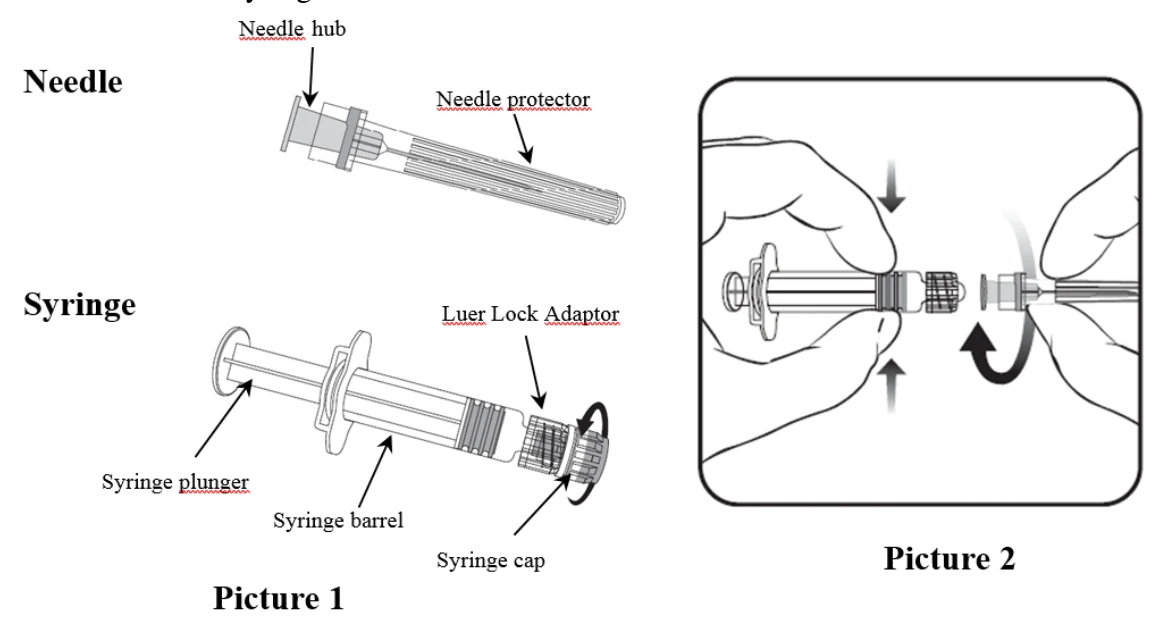
Always hold the syringe by the barrel, not by the syringe plunger or the Luer Lock Adaptor (LLA) and maintain the needle in the axis of the syringe (as illustrated in picture 2). Failure to do this may cause the LLA to become distorted and leak.
During assembly of the syringe, if the LLA comes off, a new vaccine dose (new syringe and vial) should be used.
- 1. Unscrew the syringe cap by twisting it anticlockwise (as illustrated in picture 1).
Whether the LLA is rotating or not, please follow below steps:
- 2. Attach the needle to the syringe by gently connecting the needle hub into the LLA and rotate a quarter turn clockwise until you feel it lock (as illustrated in picture 2).
- 3. Remove the needle protector, which may be stiff.
- 4. Add the solvent to the powder. The mixture should be well shaken until the powder is completely dissolved in the solvent.
The reconstituted vaccine is a clear to opalescent and colourless solution.
After reconstitution, the vaccine should be used promptly.
- 5. Withdraw the entire contents of the vial.
- 6. A new needle should be used to administer the vaccine. Unscrew the needle from the syringe and attach the injection needle by repeating step 2.
Any unused product or waste material should be disposed of in accordance with local requirements.
7. Marketing Authorisation Holder
SmithKline Beecham Limited
79 New Oxford Street
London
WC1A 1DG
United Kingdom
Trading as:
GlaxoSmithKline UK
8 MARKETING AUTHORISATION NUMBER(S)
PL 10592/0120
9 DATE OF FIRST AUTHORISATION/RENEWAL OF THE
AUTHORISATION
02/03/2009
10 DATE OF REVISION OF THE TEXT
03/04/2025