

Patient leaflet - Fragmin 7 500 IU/0.3 ml solution for injection
1. What Fragmin is and what it is used for
Fragmin is a solution for injection. Its active ingredient is dalteparin sodium. Fragmin belongs to a group of medicines called low molecular weight heparins or anti-thrombotics, which help prevent the formation of blood clots by thinning the blood.
- Fragmin is used in adults above 18 years old to treat blood clots (venous thromboembolism) and to prevent their recurrence. Venous thromboembolism is a condition where blood clots develop in the legs (deep vein thrombosis) or the lungs (pulmonary embolism), e.g. after surgery, prolonged bed-rest or in patients with certain types of cancer.
- Fragmin is also used in adults above 18 years old to treat a condition known as unstable coronary artery disease. In coronary artery disease the coronary arteries (blood vessels to the heart) are furred up and narrowed by patches of fatty deposits.
- Unstable coronary artery disease means that a furred up bit of the artery has ruptured and a clot has formed on it, reducing the flow of blood to the heart. Patients with this condition may be more likely to go on to have a heart attack without treatment with blood thinning drugs such as Fragmin.
Fragmin is indicated in children for:
Treatment of blood clots in the veins (venous thromboembolism or VTE) in children and adolescents 1 month of age and older.
Ask your doctor if you are unsure why you have been given Fragmin.
2. What you need to know before you are given or
use Fragmin
You should not be given or use Fragmin
- if you are allergic (hypersensitive) to the active ingredient dalteparin sodium or a similar product or any of the other ingredients of this medicine (listed in section 6).
- if you have an active stomach ulcer or ulcer of the duodenum (small intestine).
- if you have suffered from a brain haemorrhage (bleeding in your brain).
- if you have fluid mixed with blood that appears around heart and lungs.
- if you suffer from any condition which may cause you to bleed more easily (e.g. haemophilia, liver failure). Ask your doctor if you are unsure.
- if you have a condition called septic endocarditis (an infection and inflammation of the lining of the heart and heart valves). Your doctor will have told you if you have this.
- if you have had a condition called “heparin-induced thrombocytopenia” (a decrease in the number of clotting cells (platelets) in your blood caused by heparin, which may cause you to bruise and bleed more easily). Your doctor will have told you if you have this.
- if you have an injury to, or have had an operation involving your spine, head, eyes or ears.
If you are receiving Fragmin to treat blood clots, you should not have a local, spinal or epidural anaesthetic.
If you are given this medicine as part of your cancer treatment your doctor will check that you weigh more than 40 kg, and that you have not had a stroke within the last 3 months. Warnings and precautions
Talk to your doctor, pharmacist or nurse before you are given or use Fragmin:
if you have conditions which make you more susceptible to bleeding e.g.:
- after an operation or trauma
- a stroke caused by a bleed
- brain tumour
- severe liver or kidney failure
- abnormal or low numbers of platelets (clotting cells)
- eye disease caused by blood pressure or diabetes
- taking other medicines that thin the blood (e.g. aspirin, warfarin, dipyridamole)
- uncontrolled high blood pressure
- if you have been told by your doctor that you have a lot of potassium in your blood or have a low blood pH. Your doctor will monitor your blood regularly before and during treatment.
- if you have ever had an operation to insert artificial heart valves.
- if you need any other injections.
- if you are allergic or suspect you have a possible allergy to latex (natural rubber) or if the needle cover of Fragmin prefilled syringes will be handled by someone with a known or possible allergy to latex (natural rubber). The needle cover of Fragmin prefilled syringes may contain latex (natural rubber) which may cause severe allergic reactions in individuals with allergy to latex (natural rubber).
You may need to have blood tests to monitor the effects of Fragmin:
- if you have kidney failure or liver problems
- if you are very thin or morbidly obese
if you are pregnant
- if you are at increased risk of bleeding or rethrombosis (more blood clots)
- if you are a child
- if you have blood problems due to cancer treatment
Children and adolescents
Fragmin is not used for new born babies under 1 month of age. Other medicines and Fragmin
Tell your doctor, pharmacist or nurse if you are taking, have recently taken or are planning to take or use any other medicines. This includes medicines that you have bought for yourself.
Some medicines can affect the way Fragmin works, or Fragmin itself can reduce the effectiveness of other medicines taken at the same time.
Medicines that increase the effect of Fragmin include:
Thrombolytic (clot-dissolving) treatment or certain medicines which affect blood clotting may increase the risk of haemorrhage when combined with Fragmin:
- Aspirin (acetylsalicylic acid).
Platelet inhibitors (used to decrease platelet aggregation and reduce the risk of blood clots).
kilogram you weigh, given every 12 hours.
The maximum dose in a 12 hour period is 10,000 IU (units).
Doses are usually given for between 5 and 8 days.
If you have an artificial heart valve, the normal dose for prevention of blood clots is not sufficient. Your doctor will discuss this with you.
▪
- Nonsteroidal anti-inflammatories (NSAIDs) (medicines used to treat inflammation).
- Antagonists of GP IIb/IIIa receptors (medicines affecting platelet aggregation, used to treat cardiac disorders).
- Antagonists of vitamin K and other types of (oral anticoagulants).
- Dextran (used in certain artificial tears).
Medicines that can reduce the effect of Fragmin, include:
- Those for allergy and hay fever (e.g. antihistamines).
- Those used for heart or circulation problems (e.g. digoxin or digitoxin).
- Antibiotics known as tetracyclines which are used to treat bacterial infections.
- Vitamin C (e.g. some vitamin supplements).
Andexanet alfa (medicine used to reverse the effects of certain blood thinning medications,
Thrombolytics (used to dissolve blood clots).
PAA237553
397 such as apixaban or rivaroxaban).
Other medicines that may interfere with Fragmin include:
- Those used to treat angina (intravenous nitroglycerine).
- Antibiotics such as high dose penicillin which are used to treat bacterial infections.
- Anti-malarials (e.g. quinine).
- Tobacco smoking.
Please note that if you are being treated with Fragmin for unstable coronary artery disease your doctor may adjust your dose of aspirin accordingly.
Please tell your doctor or pharmacist if you are taking or have recently taken any other low molecular weight heparins or anti-thrombotics.
Pregnancy and breast-feeding
Fragmin has not been found to cause harmful effects during pregnancy. The possibility of harm to the baby appears remote. Tell your doctor if you are pregnant and they will advise you.
Fragmin is not recommended for the prevention of blood clots on artificial heart valves during pregnancy.
If you are receiving Fragmin to treat blood clots, you should not have a local, spinal or epidural anaesthetic.
Ask your doctor or pharmacist for advice before being given or using this medicine whilst breast-feeding.
Driving and using machines
Fragmin does not affect the ability to drive and operate machinery.
Fragmin contains sodium
Fragmin 7,500 IU (anti-Xa)/0.3 ml contains less than 1 mmol (23 mg) of sodium per pre-filled syringe, i.e. that is to say essentially “sodium-free”. Patients on low sodium diets and parents whose children receive treatment with Fragmin can be informed that this medicinal product formulation is essentially ‘sodium-free’.
This product may be prepared with a solution that contains sodium. Tell your doctor if you or your child are on a low salt (sodium) diet.
3. How Fragmin is given to you
Your medicine will usually be administered by a doctor or nurse or you may be shown how to give the injection yourself at home (see section on How to Inject Fragmin). The amount of Fragmin you receive will depend on your body weight.
Fragmin is given as a single, once daily, subcutaneous injection, which means it is injected beneath the skin. It is usually injected into a skin fold in your abdomen (stomach), or the outer aspects of your thigh. It should not be injected into your muscles. Use in adults and the elderly
To treat blood clots (venous thromboembolism)
Deep Vein Thrombosis
The usual dose of Fragmin used to treat deep vein thrombosis is 200 IU (units) for every kilogram you weigh, given once a day. Your doctor will select the dose which is appropriate for you based on your bodyweight.
The following table shows the dose you will receive depending on your body weight:
Body weight (kg)
Dose (IU)
< 46
7,500
46-56
10,000
57-68
12,500
69-82
15,000
> 83
18,000
Abbreviations: IU = International Unit
The maximum daily dose is 18,000 IU.
Fragmin can be used together with other blood thinning medicines known as Vitamin K antagonists. Should this be desired, a minimum of five days would be required. To treat blood clots (venous thromboembolism) in certain types of cancer and prevent recurrence
The usual dose used to treat venous thromboembolism in cancer is 200 IU (units) for every kilogram you weigh (see previous table) once daily during the first month after a thromboembolic event (blood clot), followed by 150 IU for every kilogram you weigh (during months 2-6).
Dose of Fragmin during months 2-6
Body Weight (kg)
Dose (IU)
< 56
7,500
57 to 68
10,000
69 to 82
12,500
83 to 98
15,000
> 99
18,000
This treatment course is not recommended for patients weighing less than 40 kg.
The maximum daily dose is 18,000 IU. The recommended duration of treatment is 6 months. If you are suffering from severe kidney disease or a decreased platelet count (clotting cells) caused by chemotherapy or another condition with an elevated bleeding risk, your doctor will adjust this dose accordingly.
In some cases of decreased platelet count (clotting cells), your doctor may interrupt your treatment with Fragmin for a short period.
Medical staff may take blood samples during your treatment to monitor the effects of Fragmin.
- Unstable Coronary Artery Disease
The usual dose used to treat unstable coronary artery disease is 120 IU (units) for every
7,500 IU/0.3 ml
Sterile Solution for Injection Package leaflet: Information for the user
Fragmin® dalteparin sodium
Date: PUURS Time: 17:21 16 Apr 2025 | Print Colors | |||||
| ITF / DM | ||||||
| Description | N/A | ITF - 3971 | ||||
| Source Code | ||||||
| 397 | ||||||
Extended use Adults and the Elderly
If your doctor has recommended a special procedure to restore the blood supply to your heart (angiography or coronary artery surgery), it may be necessary to continue to administer Fragmin for up to 45 days. In this case, the typical dose for adults, including elderly patients should be either 5,000 IU (units) (women less than 80 kg and men less than 70 kg) or 7,500 IU (women 80 kg and above and men 70 kg and over) every 12 hours.
The maximum dose in a 12 hour period is 10,000 IU.
Medical staff may take blood samples during your treatment to monitor the effects of
Step 6:
Push the plunger all the way down at a slow, steady rate to deliver the correct dose. Keep pinching the fold of skin while you are injecting and then release the fold of skin and pull the needle out.
If there is any oozing of blood at the injection site, apply gentle pressure. Do not rub the injection site as this may encourage bruising.
Press a cotton ball over the injection site for 10 seconds. Slight bleeding may occur. Do not rub the injection site. You may place a bandage over the injection site.
Fragmin.
Use in Children and Adolescents
Treatment of blood clots in the veins (Symptomatic Venous Thromboembolism - VTE)
The recommended dose depends on the child’s body weight and age group and will be calculated by your doctor. Your doctor will advise you about the individualised dose of Fragmin according to these criteria. Do not change the dosage and treatment schedule without consulting your doctor.
The following table shows the recommended starting dose for children and adolescents depending on their age:
Children 1 month to less than 2 years: 150 IU/kg twice daily.
Children 2 years to less than 8 years: 125 IU/kg twice daily. Children 8 years to less than 18 years: 100 IU/kg twice daily. The effect of Fragmin will be monitored after the initial dose and subsequent dose adjustment made using a blood test.
How to Inject Fragmin
Fragmin is administered under the skin (subcutaneously). This section of the leaflet explains how you should inject Fragmin to yourself or to your child. You should follow these instructions only after you have been trained by your doctor. If you are not sure what to do, talk to your doctor immediately. You should inject (or give) the dose of Fragmin at the times recommended by your doctor.
When dilution is required before administering Fragmin to children, it should be performed by a healthcare professional. You should follow your doctor’s instructions on how and when to inject the diluted drug that is provided to you.
Please follow the steps explained below
Step 1: How you prepare your syringe for injection will depend on specific Fragmin presentation that you will be using If you are using a Prefilled syringe with needle trap:
The Needle-Trap safety system is specially designed to help prevent needle accidents after correct use of Fragmin. It consists of a plastic safety device attached to the label stuck on the syringe. It is used to avoid accidental punctures after the proper injection of Fragmin. The Needle-Trap consists of a plastic tab (gripper) lying parallel along the needle, firmly attached to the label on the syringe barrel.
The safety system requires the following actions in order to be activated: Pick up the syringe, grasp the tip of the plastic needle catcher and bend it away from the shield (see Figure 1). Figure 1
Remove the grey rubber cover by pulling it straight off (see Figure 2).
Figure 2
You will notice an air bubble in the syringe. It is supposed to be there and you can just ignore it. It is important not to press the plunger just yet as some of the medicine may be lost. The air bubble in the disposable syringes should not be pushed out before injecting, as this may lead to loss of medicine and therefore a reduced dose.
You are now ready to inject. Continue to Step 2.
Step 2: Choosing and preparing the subcutaneous injection area
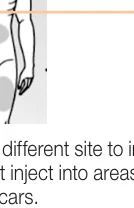
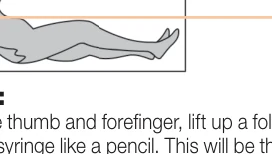
Choose one of the recommended injection sites below (see shaded areas Figure 3): A “U” shaped area around the navel.
Side of the middle thighs.
Figure 3
- Use a different site to inject each time a dose is given.
- Do not inject into areas where the skin is tender, bruised, red, or hard. Avoid areas with scars.
- If you or the child have psoriasis, do not inject directly into any raised, thick, red, or scaly skin patches (“psoriasis skin lesions”).
- Wash and dry your hands.
Clean the injection site with a new alcohol swab, using a circular motion. Allow the skin to dry thoroughly. Do not touch this area again before giving the injection. Step 3: Getting the right position
You or your child should be sitting or lying down for subcutaneous injection administration. If you are self-injecting, get yourself in a comfortable sitting down position where you can see your stomach (see Figure 4).
Figure 4
Step 4:
Using the thumb and forefinger, lift up a fold of skin with one hand. With the other hand, hold the syringe like a pencil. This will be the injection site.
Step 5:
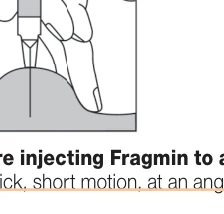
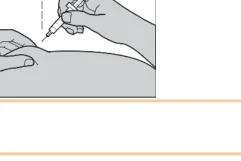
If you are injecting Fragmin to an adult or yourself, hold the syringe above the folded skin keeping it at a right angle (i.e. vertically as in the diagram and not at an angle). Insert the needle into the skin until the needle is fully inserted (see Figure 5). Figure 5
If you are injecting Fragmin to a child, push the needle all the way into the skin with a quick, short motion, at an angle between 45° and 90° (see Figure 6).
Figure 6 CT13 9NJ
UK
Manufacturer
Pfizer Manufacturing Belgium
NV, Rijksweg 12, 2870 Puurs (Puurs-Sint-Amands), Belgium
This leaflet was last revised in 05/2025. Ref: FR 23_0
PAA237553
Step 7: If your syringe has a needle trap, activate the needle-trap
Place the plastic catcher against a hard, stable surface and with one hand pivot the syringe barrel upwards against the needle forcing the needle into the catcher where it locks in place. Continue bending the needle until the syringe exceeds a 45-degree angle with the flat surface to render it permanently unusable.
Step 8:
Dispose of the syringe and needle into a sharps container. Keep your sharps bin out of reach of other people. When the sharps bin is almost full, dispose of it as instructed or speak to your doctor or nurse.
If you are given more Fragmin than you should
If you feel that you have been given more Fragmin than you should, inform your doctor or nursing staff immediately. Your doctor may initiate measures to decrease the risk of bleeding.
If you forget to use Fragmin
Tell your doctor or pharmacist if you think that a dose has been forgotten. A double dose should not be given to make up for a forgotten dose. If you have any further questions on the use of this medicine, ask your doctor, pharmacist or nurse.
4. Possible side effects
Like all medicines, this medicine can cause side effects, although not everybody gets them. Stop using Fragmin and talk to a doctor or nurse at once if you get any signs of a severe allergic reaction (such as difficulty breathing, swelling of the lips, mouth, throat or eyes).
Common side effects (may affect up to 1 in 10 people):
- A reversible decrease in the number of clotting cells (platelets) in your blood (Type I thrombocytopenia). This may make you bruise more easily
- Increased levels of potassium in your blood (symptoms may include temporary muscle weakness, loss of feeling and changes in your heartbeat)
- Bleeding at any site
- Certain substances produced by your liver may increase
- Pain and reactions at the site of injection
- Haematoma – collection of blood under the skin
Uncommon side effects (may affect up to 1 in 100 people):
- Red skin rash and itchiness
- Itching
- Allergic reactions
- Your bones may weaken and break more easily. This is known as osteoporosis and has been seen in patients using heparin for a long time
Rare side effects (may affect up to 1 in 1,000 people):
- An immune system problem resulting in a severe decrease in the number of clotting cells (platelets) in your blood (Type II thrombocytopenia)
- Alopecia (hair loss)
- Painful skin lesions
Not known (frequency cannot be estimated from the available data):
- Bleeding inside or around your brain, symptoms may include sudden severe headache
- Bleeding behind your abdomen (stomach), symptoms may include a feeling of tenderness and swelling around your stomach
- Bruising of the spine which may lead to back pain, tingling, numbness or weakness in your legs, bowel or bladder problems
Heparin products can cause hypoaldosteronism (characterised by the reduced secretion of aldosterone, a hormone produced by the adrenal cortex), which can lead to increased potassium levels in the blood (hyperkalaemia). Rarely, especially in patients with chronic renal failure and diabetes, clinically significant hyperkalaemia may occur.
If you have an artificial heart valve, treatment with Fragmin might not be sufficient to prevent a blood clot, and you might develop a clot in the heart valve. The adverse reactions in children are expected to be the same as in adults, however there is only a little information about the possible side effects of long-term use in children. If you get any side effects, talk to your doctor, pharmacist or nurse. This includes any possible side effects not listed in this leaflet. Reporting of side effects
If you get any side effects, talk to your doctor, pharmacist or nurse. This includes any possible side effects not listed in this leaflet. You can also report side effects directly via the Yellow Card Scheme at: www.mhra.gov.uk/yellowcard or search for MHRA Yellow Card in the Google Play or Apple App Store.
By reporting side effects you can help provide more information on the safety of this medicine.
5. How to store Fragmin
Keep this medicine out of the sight and reach of children.
After opening, immediate use is recommended.
Fragmin should not be used after the expiry date which is printed on the label and carton. The expiry date refers to the last day of that month.
Store below 25°C.
Your doctor or nurse will store Fragmin in a safe place under the above conditions. Do not throw away any medicines via wastewater or household waste. Ask your pharmacist how to throw away medicines that you no longer use. These measures will help to protect the environment.
6. Contents of the pack and other information
What Fragmin contains
The active ingredient in Fragmin is dalteparin sodium.
Each pre-filled syringe provides a single dose of 7,500 IU (International Units) of dalteparin sodium.
The other ingredients are water for injections, either sodium hydroxide or hydrochloric acid (to balance the acidity of the injection).
What Fragmin looks like and contents of the pack Fragmin is available as a clear, colourless or straw-coloured solution, in pre-filled single dose syringes, each containing 0.3 ml of dalteparin sodium solution. Each box contains 10 disposable syringes.
Marketing Authorisation Holder
Pfizer Limited
Ramsgate Road
Sandwich
Kent