

Patient leaflet - Foscarnet Sodium 24 mg / ml solution for infusion
1. What Foscarnet is a
nd what it is used for
| Foscarnet belongs to a |
group of medicines called
| antivirals. It acts on |
certain viruses [all viruses
| belonging to the herpes |
group and certain retroviruses
| such as cytomegaloviru |
s (CMV)]. It stops the virus
| reproducing in infected c |
ells.
| Foscarnet is used for i |
ndividuals with a weakened
| immune system: |
To treat CMV retinitis i
f you have AIDS.
To treat herpes infectio
n (of the lips, nose, eyes and
genitalia).
Foscarnet is given to i
ndividuals with CMV infection
following a bone mar
row transplant. This is also
known as a haemat
opoietic stem cell transplant
(HSCT). The infection
can sometimes be detected
before the patient star
ts to have symptoms. This is
known as CMV viraem
ia.
2. What you need to
know before you are given
Foscarnet
Do not use foscarnet:
If you are allergic to f
oscarnet or any of the other
ingredients of this med
icine (listed in section 6).
CHECK WITH YOUR D
OCTOR OR PHARMACIST IF
YOU ARE NOT SURE.
Warnings and precauti
ons
Talk to your doctor or nu
rse before using foscarnet:
If you have kidney prob
lems. In this case, your doctor
may be able to adapt t
he dose to your condition.
If you have low blood c
alcium levels before receiving
this medicine, and if yo
u are taking a medicine which
lowers blood calcium l
evels.
If you have heart probl
ems.
If you have tingling in y
our hands or lips, and nausea.
In this case, your nurs
e will reduce the infusion rate.
In case of accidental c
ontact with the product, rinse
the exposed skin or m
ucous membranes
(inside the mouth, nos
e, ears or genitalia) with water.
Close attention to perso
nal hygiene is recommended
after passing urine: wa
sh the penis (or vulva) with
running water to avo
id genital lesions (genital
ulceration).
Blood tests
Before and during trea
tment, your doctor may ask
you to have blood and u
rine tests. These tests aim to
check your kidney funct
ion and the mineral levels in
your blood.
Children and adolescent
s
Not applicable.
Other medicines and fo
scarnet
Tell your doctor or nurse i
f you are taking, have recently
taken or might take any o
ther medicines. This includes
medicines that you buy
without a prescription and
herbal medicines. This is
because foscarnet can affect
the way some medicine
s work and some medicines
can have an effect on fo
scarnet.
In particular, tell your doc
tor or nurse if you are already
having any of the followi
ng medicines:
Pentamidine (for infec
tions).
Amphotericin B (for fu
ngal infections).
Aciclovir (for viral infec
tions).
Antibiotics called
aminoglycosides, such as
gentamicin and strepto
mycin (for infections).
Ciclosporin A, methot
rexate or tacrolimus (used to
suppress the immune
system).
Medicines called pr
otease inhibitors, such as
ritonavir and saquinav
ir.
Quinidine, amiodaro
ne, sotalol or any other
medicines which ma
y affect your heart rate or
rhythm.
Anxiolytics (neurolepti
cs).
Pregnancy and breast-
feeding
Foscarnet is not recom
mended during pregnancy.
You should avoid
becoming pregnant during
foscarnet therapy
and should therefore use
effective birth control
methods while being treated
with foscarnet and for
7 months following completion
of treatment.
Men treated with fos
carnet recommended to use
effective contraceptiv
e measures and should not
father a child during treatment or up to 4 months following completion of treatment.
- Do not take foscarnet while breast-feeding.
Driving and using machines
Foscarnet may affect you being able to drive or use tools or machines. This is due to the risk of seizures, abnormal movements and dizziness reported with this medicine. Talk to your doctor before you do any of these activities.
Foscarnet contains sodium
Foscarnet contains 240 micromoles (5.5 mg) of sodium per ml. This should be taken into consideration by patients on a controlled sodium diet, so please tell your doctor or nurse if you are on a low sodium (salt) diet.
The maximum recommended daily dose of this medicinal product contains 2.89 grams sodium (found in table salt). This is equivalent to 144.5% of the adult recommended maximum daily dietary intake for sodium.
Talk to your pharmacist or do
ctor if you need foscarnet on a daily basis for a pro
longed period of time, especially if you have been a
dvised to have a low salt diet.
3. How to use Foscarnet
Always use this medicine e
xactly as your doctor has told you. Check with your d
octor if you are not sure.
Foscarnet will be given to y
ou by a doctor or nurse. It will be given to you as an i
nfusion (drip) into a vein.
It may be given into a centr
al line in your chest if you already have one in place.
Each infusion will take a
t least 1 hour. Do not interfere with your drip duri
ng the infusion.
The dose of foscarnet a
dministered depends on your weight and how well y
our kidneys are working.
It is important to keep u
p adequate fluid intake during the infusion, which
will also help prevent kidney problems. If necess
ary, your doctor or nurse will administer the necess
ary hydration regimen at the same time as your fosc
arnet infusion.
Personal hygiene
Wash your genitals carefully a
fter passing water (urine).
This will help to prevent any s
ores from developing.
If you get foscarnet soluti
on on your skin or in your eyes
If you get foscarnet solution
on your skin or in your eyes by mistake, rinse your s
kin or your eyes straight away with water.
If you take more foscarnet
If you are given an extremely
than you should:
large dose of foscarnet, tell your doctor or pharmacist Cases of overdose have be
immediately.
en reported. The highest dose was 20 times the norma Symptoms resemble acut
l dose.
e hypocalcaemia, with tingling sensations, and oc
casionally seizures and functional renal failure. Haemodialysis increases fo
scarnet elimination and may be of benefit in some ca
If you forget to take foscarn
Not applicable.
If you stop taking foscarne
Not applicable.
4. Possible side effects
Like all medicines, this m
ses.
et
t
edicine can cause side effects, although not everybo
dy gets them.
Some side effects can
be serious and need immediate medical attentio
n:
Severe allergic reaction
s including a fall in blood pressure, shock a
nd swelling of the skin
(angioedema). They are k
nown as hypersensitivity, anaphylactic or anaphylact
oid reactions.
Severe skin rashes. These
types of rashes can be associated with redness,
swelling, and blisters of the skin, mouth, throat, eye
s and other places inside the body and can sometim
es result in death. They are called erythema multi
forme, Stevens-Johnson syndrome and toxic epider
mal necrolysis.
If you get any of the above,
tell your doctor straight away or go to the nearest e
mergency unit.
Other side effects include:
Very common: may affect m
ore than 1 in 10 people
Reduced red blood cell cou
nt (shown in blood tests).
You may feel tired or look p
ale.
Low levels of white blood
cells (granulocytopenia).
The signs include infectio
ns and high temperature
(fever).
- Loss of appetite.
Reduced potassium level i
n the blood.
Reduced magnesium level
in the blood.
Reduced calcium level in t
he blood.
- Dizziness.
- Headache.
- Tingling.
- Diarrhoea.
- Nausea, vomiting.
- Feeling weak or tired.
- High temperature or chills.
- Skin rash.
Changes in how well yo
ur kidneys are working
(shown in blood tests)
: e.g. elevated blood creatinine, reduced haemo
globin.
M0xxxxx/02 UK The following infor
mation is intended for
healthcare professiona
ls only:
Take special care with F
oscarnet
In patients with impair
ed renal function:
Serum creatine sho
uld be regularly monitored.
Dose adjustment sh
ould be envisaged in patients
with impaired renal
function. To prevent changes
in renal function tha
t may occur during treatment,
adequate hydration should be maintained.
- Do not use solutions which may contain calcium.
- In case of accidental contact, rinse the exposed skin or mucous membranes with water.
Method of administration
Foscarnet should be administered by the intravenous route only, either by a central venous line (catheter) or in a peripheral vein.
Caution: Do not administer foscarnet by rapid intravenous injection.
Do not administer foscarnet without a hydration regimen.
Do not use solutions which may contain calcium, 30% glucose, amphotericin B, acyclovir sodium, ganciclovir, pentamidine isethionate, trimethoprim-sulfamethoxazole and vancomycin hydrochloride.
As with all infusions, compli
ance with strictly aseptic conditions is required during
handling.
When peripheral veins are
used, the solution of foscarnet 24 mg/ml must
be diluted. Individually dispensed doses of foscarn
et should be aseptically transferred to plastic infusio
n bags by the hospital pharmacy and diluted with eq
ual parts of 0.9% sodium chloride (9 mg/ml) or 5% de
xtrose (50 mg/ml) by the hospital pharmacy. The phy
sico-chemical stability of foscarnet and dilutions foscarnet and dilutions thereof in PVC bags is 9 days. The diluted solutions should be used as soon as possible after preparation but can be stored for up to 24 hours if kept refrigerated.
Renal toxicity of foscarnet can be reduced by adequate hydration of the patient. See “Hydration” section below.
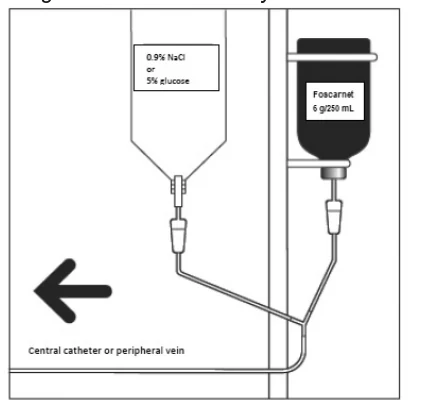
If a Y-infusion system is used, simultaneously infuse 0.5 to 1 litre of 0.9% NaCl or 5% glucose.
Do not administer other products in the same infusion. When the product is administered by infusion into a peripheral vein, simultaneous intravenous hydration serves as dilution (see “Hydration”).
| Product name: | Territory: | ||
| Foscarnet 24mg/ml | UK | ||
| Type of packaging: | Dosage: | ||
| Leaflet | 250 ml | ||
| Material number: | 2-D-Matrix-Code: | ||
| M0xxxxx/02 UK | - | ||
| EAN-Code: | |||
| 180 x 588 mm | Arial | ||
| 06.10.2025, 16:30 | Mock up | |
| 10.10.2025, 08:30 | ||
| |||
| |||
| |||
| rr | ||
| rr | ||
| rr | ||
| rr | ||
| rr | ||
| Temp | late: | ||
Common: may affect u
- Low levels of white bl neutropenia). The sign temperature (fever).
- Reduced levels of plat make you bruise more
- Infection of the blood (
- Increased or reduced
- Reduced sodium level
- Increased calcium lev
- Dehydration.
- Abnormal liver functio
- Elevated liver enzy aminotransferase, a LDH).
- Change in your me agitation, anxiety, nervousness.
- Coordination problems
- Seizures.
- Reduced feeling in the
- Unusual heartbeat (he
- Rapid heart rate (tach
Nervous disorders liab
p to 1 in 10 people
ood cells (leukopenia and/or s include infections and high elets in your blood. This may easily.
sepsis).
phosphate level in the blood. in the blood.
el in the blood.
n.
mes (gamma-GT, alanine spartate aminotransferase, ntal state. e.g. aggression, confusion, depression,
.
skin.
art palpitations).
ycardia).
le to cause sensory changes or muscle weakness (
- Tremor.
- Hypertension.
- Hypotension, which ca
- Swelling, pain and red
- Stomach (abdomina indigestion.
- Gastrointestinal bleedi
- Inflamed pancreas (pa well your pancreas is
- include severe stoma changes in blood tests
- Itchy skin.
- Muscle pain.
- Kidney problems, e.g. your lower back), kidn in the urine.
- Pain when passing uri
- Genital sores or ulcer multiple lesions which (see “Precautions for u
- Generally feeling unw
- Injection site pain and
- Chest pain.
- Swelling of the feet an
Changes in tests that working (ECG).
neuropathy).
n cause dizziness.
ness along a vein.
- l) pain, constipation and ng.
ncreatitis) or changes in how working. The signs
ch pain and there may be (increased lipases).
pain in your kidneys (pain in ey failure, presence of protein ne.
ation. These are isolated or subside on stopping treatment se”).
ell.
inflammation.
d legs.
show how well your heart is
Uncommon: may affec
- Reduced red blood platelets.
- Too much acid in the breathe more quickly.
- Itchy skin rash (hives).
- Kidney problems glomerulonephritis, ne
- Elevation of certain amylase, creatine pho
Not known: frequency the available data
- Diabetes. The signs often than usual. Mo excessively thirsty.
- Increased sodium leve
- Encephalopathy.
- Unusual heartbeat or torsades de pointes.
- Oesophageal ulcer.
- Muscle problems: trembling muscles, d (rhabdomyolysis: abno muscle stiffness, tende
- Kidney problems, e.g. necrosis, crystal nephr
Extravasation.
t up to 1 in 100 people
cells, white blood cells and blood. This may make you
(renal tubular disorder, phrotic syndrome).
enzymes in the blood, e.g. sphokinase.
cannot be estimated from include passing urine more re rarely, you may also feel l in the blood.
changes in heart rate, e.g.
painful, aching, weak or estruction of muscle tissue rmal urine colour, and severe rness or weakness).
pain, blood in urine, tubular opathy.
Reporting of side effec
If you get any side eff
ts
ects, talk to your doctor or pharmacist. This include
s any possible side effects not listed in the leaflet. You
can also report side effects directly via The Yellow C
ard Scheme
Website www.mhra.gov
.uk/yellowcard or search or
MHRA Yellow Card in th
e Google Play or Apple App
Store.
By reporting side effects
you can help provide more information on the safety
of this medicine.
5. How to store Fosca
rnet
Keep this medicine o
ut of the sight and reach of children.
Do not use this medici
ne after the expiry date which is stated on the label.
The expiry date refers to the last day of that month.
Do not refrigerate o
r freeze. If refrigerated or exposed to tempera
tures below freezing point precipitation may oc
cur. By keeping the bottle at room temperature
with repeated shaking, the precipitate can be bro
ught into solution again.
Chemical and phy
sical in-use stability has been demonstrated f
or 9 days at 25°C. From a microbiological point of opening and dilu microbial contaminati used immediately. If storage times and co responsibility of the us
Foscarnet may be mi pharmacist. This is to use. The pharmacist w when to use it by.
of view, unless the method tion precludes the risk of on, the product should be not used immediately, in-use nditions prior to use are the er.
xed with another liquid by a give you a medicine ready to ill tell you how to store it and
- Do not throw away any m or household waste. Ask throw away medicines yo measures will help protect
6. Contents of the pack an
What Foscarnet sodium co
The active substance is fosca Each ml contains 24 mg hexahydrate
The other ingredients are hydrochloric acid.
What Foscarnet sodium loo the pack
Foscarnet is a sterile solution The solution is clear and colo Foscarnet comes in bottles c
Marketing Authorisation Ho
Fresenius Kabi Ltd
edicines via wastewater your pharmacist how to u no longer use. These the environment.
d other information ntains rnet.
of foscarnet sodium water for injection and ks like and contents of for infusion.
urless.
ontaining 250 ml.
lder
Cestrian Court
Eastgate Way, Manor Park Runcorn, Cheshire
WA7 1NT
United Kingdom
Manufacturer
Fresenius Kabi Austria GmbH Hafnerstrasse 36
A-8055 Graz
Austria
This leaflet was last revised
in October 2025.
Diagram of a Y-infusion
system
Hydration:
Particular attention shou of preventing renal toxi patients receive adequat
If a Y-infusion system is u or 5% glucose should b compliant patients, oral h regimens has been patients should have the initiating foscarnet thera
ld be given to the importance city of foscarnet by ensuring e hydration.
sed, 0.5 to 1 litre of 0.9% NaCl e infused simultaneously. In ydration with similar hydration used. Clinically dehydrated ir condition corrected before py.
Each bottle of foscarnet sho one patient with a single infus
Accidental skin and eye co sodium solution may cause l sensation. If accidental cont area should be rinsed with w
If foscarnet refrigerated or e below freezing point preci
uld only be used to treat ion.
ntact with the foscarnet ocal irritation and burning act occurs, the exposed ater.
xposed to temperatures pitation may occur. By keeping the bottle at room te shaking, the precipitate can again.
Any unused medicinal produc be disposed of in accordance
mperature with repeated be brought into solution t or waste material should with local requirements.