

Summary of Product Characteristics (SmPC) - Foscarnet Sodium 24 mg / ml solution for infusion
1 NAME OF THE MEDICINAL PRODUCT
Foscarnet sodium 24 mg/ml solution for infusion
2 QUALITATIVE AND QUANTITATIVE COMPOSITION
1 ml solution for injection/infusion contains 24 mg foscarnet sodium hexahydrate.
Excipient(s) with known effect
1 ml of solution for injection/infusion contains 5.5 mg sodium.
For the full list of excipients, see section 6.1
3 PHARMACEUTICAL FORM
Solution for infusion.
Clear colorless solution
4 CLINICAL PARTICULARS
4.1 Therapeutic indications
Treatment of cytomegalovirus (CMV) viraemia in haematopoietic stem cell transplant
(HSCT) recipients, for whom the use of ganciclovir cannot be considered.
Induction and maintenance therapy of cytomegalovirus (CMV) retinitis in patients with
AIDS.
- Acute, mucocutaneous herpes simplex virus (HSV) infections resistant or not susceptible to aciclovir in immunocompromised patients.
Consideration should be given to official guidance on the appropriate use of medicines to treat cytomegalovirus or herpes simplex infections.
4.2 Posology and method of administration
Posology
The following dosages must be adjusted to renal function status (see dosing chart).
Treatment must be administered in combination with a hydration regimen given via infusion (see “Hydration”).
Adults:
The following dosages are based on patients with normal renal function.
- CMV viraemia in HSCT recipients
As an induction regimen, foscarnet should be administered at a dose of 120 mg/kg/day as 2 infusions at 12-hour intervals, for at least 2 weeks. Each infusion should last at least an hour, and should be given in combination with a hydration regimen (see “Hydration”).
As maintenance treatment, following an induction regimen for CMV viraemia, foscarnet should be administered as a daily infusion over approximately two hours, at a dosage of 90 to 120 mg/kg, 7 days a week, combined with a hydration regimen.
These dosages should be adjusted based on renal function status (see dosing chart).
Patients who experience progression of infection while receiving maintenance therapy may be re-treated with the induction regimen.
- CMV retinitis in patients with AIDS
As an induction regimen, foscarnet should be administered at a dose of 180 mg/kg/day as 2 or 3 infusions at 12- or 8-hour intervals, each lasting at least one hour (60 to 90 min) and must imperatively be given in combination with a hydration regimen (see “Hydration”).
Maintenance treatment is introduced after healing, or after 2 to 3 weeks of the induction regimen.
Foscarnet is administered as a daily infusion over approximately two hours, at a dosage of 90 to 120 mg/kg, 7 days a week, combined with a hydration regimen.
These dosages should be adjusted based on renal function status (see dosing chart).
Patients who experience progression of retinitis while receiving maintenance therapy may be re-treated with the induction regimen.
- HSV infections
Induction regimen:
Foscarnet should be administered for 2 or 3 weeks, or until lesions have healed.
The usual dose is 80 mg/kg/day as two infusions, each lasting at least one hour, in patients with normal renal function. If response is inadequate, this dose may be increased to 120 mg/kg/day, usually given as three infusions.
The dosage should be adjusted based on renal function status (see dosing chart).
Treatment should be combined with a hydration regimen.
Maintenance therapy:
The efficacy of maintenance therapy for Herpes virus infections has not been established.
Elderly:
As for adults.
Paediatric population:
The safety and efficacy of foscarnet in children have not been established. Please refer to sections 4.4 and 5.3.
Patients with renal or hepatic impairment:
The dose must be reduced in patients with renal impairment according to the creatinine clearance level as described in the table below. Dose adjustment is not required in patients with hepatic impairment.
Patients on haemodialysis:
Use of foscarnet is not recommended in patients undergoing haemodialysis since dosage guidelines have not been established.
Method of administration
Precautions to be taken before handling or administering the medicinal product:
Foscarnet should be administered by the intravenous route only, either by a central venous line (catheter) or in a peripheral vein.
Caution: Do not administer foscarnet by rapid intravenous injection.
Do not administer foscarnet without a hydration regimen (see “Hydration”).
An individual dose at the appropriate concentration (24 mg/mL or 12 mg/mL) for the route of administration (central or peripheral venous line) should be prepared under aseptic conditions before administration.
The 24 mg/mL solution standard may be used pure or diluted when administered intravenously via a central venous line (catheter).
If administered by infusion into a peripheral vein, the 24 mg/mL solution must be diluted before administration to a concentration of 12 mg/mL, with 0.9% NaCl or 5% glucose solution, to avoid local irritation of peripheral veins. Dilution and/or disposal of excess quantities should be performed under aseptic conditions. The dilute solutions should be used as soon as possible after preparation (see section 6.6).
Renal toxicity of foscarnet can be reduced by adequate hydration of the patient. See “Hydration” section below.
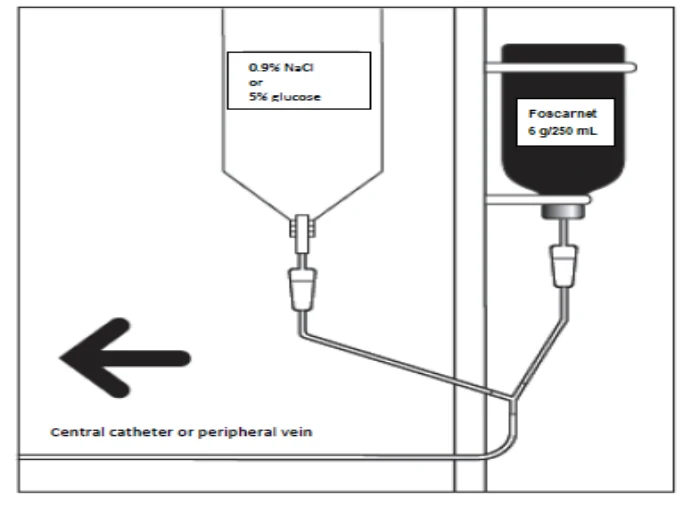
If a Y-infusion system is used, simultaneously infuse 0.5 to 1 litre of 0.9% NaCl or 5% glucose.
Do not administer other products in the same infusion.
When the product is administered by infusion into a peripheral vein, simultaneous intravenous hydration serves as dilution (see “Hydration”).
Do not administer other products in the same infusion. When the product is administered by infusion into a peripheral vein, simultaneous intravenous hydration serves as dilution (see “Hydration”).
Diagram of a Y-infusion system
Hydration:
Particular attention should be given to the importance of preventing renal toxicity of foscarnet by ensuring patients receive adequate hydration.
If a Y-infusion system is used, 0.5 to 1 litre of 0.9% NaCl or 5% glucose should be infused simultaneously.
In compliant patients, oral hydration with similar hydration regimens has been used. Clinically dehydrated patients should have their condition corrected before initiating foscarnet therapy.
Treatment duration:
An induction regimen should be administered for 2 to 3 weeks, or until lesions have healed.
Maintenance therapy for retinitis should theoretically continue over a longer period.
DOSING CHART
Induction Regimen
| Creatinine clearance | Serum creatinine μ | CMV viraemia (HSCT) | CMV retinitis (AIDS) | HSV | |
| (ml/kg/min) | mol/L | Dose every 12 hours (mg/kg) as a one-hour | Dose every 8 hours (mg/kg) as a one-hour | Dose every 12 hours (mg/kg) as a one-hour | Dose every 8 to 12 hours (mg/kg) as a one-hour |
infusion infusion infusion infusion >1.6 < 110 60 60 90 40 1.6 – 1.4 110 – 120 60 55 82 37 1.4 – 1.2 120 – 140 45 49 73 33 1.2 – 1.0 140 – 170 45 42 63 28 1.0 – 0.8 170 – 210 35 35 52 24 0.8 – 0.6 210 – 237 25 28 42 19 0.6 – 0.5 237 – 244 20 21 31 14 0.5 – 0.4 244 - 250 15 21 31 14 < 0.4 > 250 treatment not
recommended
treatment not recommended
treatment not
recommended
treatment not recommended
Maintenance Therapy
Creatinine
clearance
Serum
creatinine
CMV viraemia
(HSCT)
CMV retinitis (AIDS)
(ml/kg/min) μmol/L (mg/kg in 2 hours) (mg/kg in 2 hours) >1.4 < 120 90 Every 24 hours 90 – 120 Every 24 hours
1.4 – 1.2 120 – 140 70 Every 24 hours 78 – 104 Every 24 hours
1.2 – 1.0 140 – 170 70 Every 24 hours 75 – 100 Every 24 hours
1.0 – 0.8 170 – 210 50 Every 48 hours 71 – 94 Every 24 hours
0.8 – 0.6 210 – 237 80 Every 48 hours 63 – 84 Every 24 hours
0.6 – 0.5 237 – 244 60 Every 48 hours 67 – 76 Every 24 hours
0.5 – 0.4 244 - 250 50 Every 48 hours 57 – 67 Every 24 hours
< 0.4 > 250 treatment not
recommended
treatment not recommended
4.3 Contraindications
Hypersensitivity to the active substance or to any of the excipients listed in section 6.1.
4.4 Special warnings and precautions for use
Foscarnet should be used with caution in patients with reduced renal function.
Since renal function impairment may occur during foscarnet administration, serum creatinine should be monitored every second day during induction therapy and once weekly during maintenance therapy and appropriate dose adjustments should be performed according to renal function. Adequate hydration should be maintained in all patients (see section 4.2).
The renal function of patients with renal disease or receiving concomitant treatment with other nephrotoxic medicinal products must be closely monitored (see section 4.5).
This medicinal product contains 962.5 mg sodium per dose, equivalent to 48.1% of the WHO recommended maximum daily intake for sodium.
The maximum daily dose of this product is equivalent to 144.4% of the WHO recommended maximum daily intake for sodium.
Foscarnet is considered high in sodium. This should be particularly taken into account for those on a low salt diet.
Foscarnet use should be avoided when a saline load cannot be tolerated (e.g. in cardiomyopathy)
Due to the propensity of foscarnet to chelate bivalent metal ions, such as calcium, administration of this medicinal product may be associated with decrease in ionised serum calcium concentration proportional to the rate of foscarnet infusion, which may not be reflected in total serum calcium levels.
Electrolytes, especially calcium and magnesium, should be assessed prior to and during foscarnet therapy and any detected deficiencies should be corrected.
Foscarnet has been associated with cases of prolongation of QT interval and more rarely with cases of torsade de pointes (see section 4.8). Patients with known existing prolongation of cardiac conduction intervals, particularly QTc, patients with significant electrolyte disturbances (hypokalaemia, hypomagnesaemia), bradycardia, as well as patients with underlying cardiac diseases such as congestive heart failure or who are taking medications known to prolong the QT interval should be carefully monitored due to increased risk of ventricular arrhythmia. Patients should be advised to promptly report any cardiac symptoms.
Foscarnet is deposited in teeth, bone and cartilage. Animal data show that deposition is greater in young animals. The safety of foscarnet and its effect on skeletal development have not been investigated in children. Please refer to section 5.3.
Seizures, related to alterations in plasma minerals and electrolytes, have been associated with foscarnet treatment. Cases of status epilepticus have been reported. Therefore, patients must be carefully monitored for such changes and their potential sequelae. Mineral and electrolyte supplementation may be required.
Foscarnet is excreted in high concentrations in the urine and may be associated with significant genital irritation and/or ulceration. To prevent irritation and ulceration, close attention to personal hygiene is recommended and cleaning of the genital area after each micturition is recommended.
If patients experience extremity paraesthesia or significant nausea, the infusion rate should be reduced.
When diuretics are indicated, thiazides are recommended.
Development of resistance: If the administration of Foscarnet does not lead to a therapeutic response or leads to a worsened condition after an initial response, this may result from a reduced sensitivity of viruses towards foscarnet. In this case, termination of Foscarnet therapy and a change to an appropriate other medicinal product should be considered.
When foscarnet is administered for CMV viraemia, patients should be carefully monitored for onset of organ-specific infection. If symptoms of infection (CMV disease) appear, therapeutic management should be adapted.
4.5 Interaction with other medicinal products and other forms of interaction
Since foscarnet can impair renal function, additive toxicity may occur when used in combination with other nephrotoxic active substances such as aminoglycosides, amphotericin B, ciclosporin A, aciclovir, methotrexate and tacrolimus. Moreover, since foscarnet can reduce serum levels of ionised calcium, extreme caution is advised when used concurrently with other active substances known to influence serum calcium levels, like i.v. pentamidine. Renal impairment and symptomatic hypocalcaemia (Trousseau's and Chvostek's signs) have been observed during concurrent treatment with foscarnet and i.v. pentamidine. Abnormal renal function has been reported in connection with the use of foscarnet in combination with ritonavir and/or saquinavir.
Due to the potential increased risk of QT prolongation and torsade de pointes, foscarnet should be used with caution with active substances known to prolong QT interval, notably class IA (e.g. quinidine) and III (e.g. amiodarone, sotalol), antiarrhythmic agents or neuroleptic active substances. Close cardiac monitoring should be performed in cases of co-administration.
There is no pharmacokinetic interaction with zidovudine (AZT), ganciclovir, didanosine (ddI), zalcitabine (ddC) or probenecid.
Pharmaceutical interactions (incompatibilities for infusion) are described in section 6.2.
4.6 Fertility, pregnancy and lactation
Fertility
There are no data available regarding the influence of foscarnet on fertility.
No effects on fertility were observed in animal studies (see section 5.3).
Women of childbearing potential / contraception in males and females Due to the genotoxic potential of foscarnet (see section 5.3), women of childbearing potential should use effective contraceptive measures while being treated with foscarnet and for 7 months following completion of treatment.
Men are recommended to use effective contraceptive measures and should not father a child while receiving foscarnet and for 4 months following completion of treatment.
Pregnancy
There are no or limited amount of data from the use of foscarnet in pregnant women. Animal studies are insufficient with respect to reproductive toxicity (see section 5.3).
Foscarnet is not recommended during pregnancy.
Lactation
There is insufficient information on the excretion of foscarnet in human milk.
Available pharmacodynamic/toxicological data in animals have shown excretion of foscarnet in milk (for details see section 5.3).
A risk to the newborns/infants cannot be excluded.
Foscarnet should not be used during breast-feeding.
A decision must be made whether to discontinue breast-feeding or to discontinue/abstain from foscarnet therapy taking into account the benefit of breast feeding for the child and the benefit of therapy for the woman. In general, women with HIV infection should not breast-feed to avoid passing HIV to the baby.
4.7 Effects on ability to drive and use machines
Foscarnet has moderate influence on the ability to drive and use machines. Due to the disease itself and possible undesirable effects of foscarnet (such as dizziness and convulsions, see section 4.8), the ability to drive and use machines can be impaired. The physician is advised to discuss this issue with the patient, and based upon the condition of the disease and the tolerance of medication, give a recommendation in the individual case.
4.8 Undesirable effects
The majority of patients who receive foscarnet are severely immuno-compromised and suffering from serious viral infections. Patients' physical status, the severity of the underlying disease, other infections and concurrent therapies contribute to adverse events observed during use of foscarnet.
The undesirable effects reported with foscarnet during clinical trials and post-marketing surveillance are shown in the table below. They are listed by System-Organ Class (SOC) and in order of frequency, using the following convention: very common (≥1/10); common (≥1/100 to <1/10); uncommon (≥1/1,000 to <1/100); rare (≥1/10,000 to <1/1,000); very rare (<1/10,000); not known (cannot be estimated from the available data).
Please note that in these clinical trials, hydration and attention to electrolyte balance was not consistently given; the frequency of some adverse events will be lower when current recommendations are followed (see sections 4.2 and 4.4).
Table 2 Frequency of adverse events
| SOC | Frequency | Event |
| SOC | Frequency | Event |
Blood and lymphatic system disorders | Very common | Granulocytopenia, anaemia |
| Common | Leukopenia, thrombocytopenia, neutropenia | |
| Uncommon | Pancytopenia | |
| Immune system disorders | Common | Sepsis |
| Not known | Hypersensitivity (including anaphylactic reactions), anaphylactoid reactions | |
| Endocrine disorders | Not known | Diabetes insipidus |
| Metabolism and nutrition disorders | Very common | Decreased appetite, hypokalaemia, hypomagnesaemia, hypocalcaemia |
| Common | Hyperphosphataemia, hyponatraemia, hypophosphataemia, blood alkaline phosphatase increased, blood lactate dehydrogenase increased, hypercalcaemia, dehydration | |
| Uncommon | Acidosis | |
| Not known | Hypernatraemia | |
| Psychiatric disorders | Common | Aggression, agitation, anxiety, confusional state, depression, nervousness |
| Not known | Mental status changes | |
| Nervous system disorders | Very common | Dizziness, headache, paraesthesia |
| Common | Coordination abnormal, convulsion, hypoaesthesia, muscle contractions involuntary, neuropathy peripheral, tremor | |
| Not known | Encephalopathy | |
| Cardiac disorders | Common | Palpitations, tachycardia |
| Not known | Electrocardiogram QT prolonged, ventricular arrhythmia, torsade de pointes | |
| Vascular disorders | Common | Hypertension, hypotension, thrombophlebitisa |
| Gastrointestinal disorders | Very common | Diarrhoea, nausea, vomiting |
| Common | Abdominal pain, constipation, dyspepsia, pancreatitis, gastrointestinal haemorrhage | |
| Not known | Oesophageal ulceration | |
| Hepatobiliary disorders | Common | Hepatic function abnormal |
Skin and subcutaneous | Very common | Rash |
| Common | Pruritus |
| SOC | Frequency | Event |
| disorders | Uncommon | Urticaria, angioedema |
| Not known | Erythema multiforme, toxic epidermal necrolysis, Stevens Johnson syndromeb | |
| Musculoskeletal and connective tissue disorders | Common | Myalgia |
| Not known | Muscular weakness, myopathy, myositis, rhabdomyolysis | |
| Renal and urinary disorders | Common | Renal impairment, renal failure acute, dysuria, polyuria, proteinuria |
| Uncommon | Renal tubular disorder, Glomerulonephritis, nephrotic syndrome | |
| Not known | Renal pain, renal tubular acidosis, renal tubular necrosis, acute tubular necrosis, crystal nephropathy, haematuria | |
| Reproductive system and breast disorders | Common | Genital discomfort and ulcerationc |
| General disorders and administration site conditions | Very common | Asthenia, chills, fatigue, pyrexia |
| Common | Malaise, oedema, chest paind, injection site pain, injection site inflammation | |
| Not known | Extravasation | |
| Investigations | Very common | Blood creatinine increased, haemoglobin decreased |
| Common | Creatinine renal clearance decreased, electrocardiogram abnormal, gamma-glutamyltransferase increased, alanine aminotransferase increased, aspartate aminotransferase increased, lipase increased | |
| Uncommon | Amylase increased, blood creatine phosphokinase increased |
a Thrombophlebitis in peripheral veins following infusion of undiluted foscarnet solution has been observed.
b Cases of vesiculobullous eruptions including erythema multiforme, toxic epidermal necrolysis, and Stevens Johnson syndrome have been reported. In most cases, patients were taking other medications that have been associated with toxic epidermal necrolysis or Stevens Johnson syndrome.
c Foscarnet is excreted in high concentrations in the urine and may be associated with significant irritation and ulceration in the genital area, particularly after prolonged therapy. d Transient chest pain has been reported as part of infusion reactions to foscarnet.
Reporting of suspected adverse reactions
Reporting suspected adverse reactions after authorisation of the medicinal product is important.
It allows continued monitoring of the benefit/risk balance of the medicinal product. Healthcare professionals are asked to report any suspected adverse reactions via the Yellow Card Scheme at www.mhra.gov.uk/yellowcard or search for MHRA Yellow Card in the Google Play or Apple App Store.
4.9 Overdose
Overdose has been reported during the use of foscarnet, the highest being some 20 times the recommended dose. Some of the cases were relative overdoses, in that the dose of active substances used had not been promptly adjusted for a patient experiencing reduced renal function.
There are cases where it has been reported that no clinical sequelae were consequent on the overdose.
The pattern of adverse events reported in association with an overdose of foscarnet is in accordance with the known adverse event profile of the active substance.
Haemodialysis increases foscarnet elimination and may be of benefit in relevant cases.
5 PHARMACOLOGICAL PROPERTIES
5.1 Pharmacodynamic properties
Pharmacotherapeutic group: Antivirals for systemic use; direct acting antivirals; phosphonic acid derivatives, ATC code: J05AD01
Foscarnet is an antiviral agent with a broad spectrum inhibiting in vitro all known human viruses of the herpes group: herpes simplex virus type 1 and 2; human herpes virus 6; varicella zoster virus; Epstein-Barr virus and cytomegalovirus (CMV) and some retroviruses, including human immunodeficiency virus (HIV) at concentrations not affecting normal cell growth. Foscarnet also inhibits the in vitro viral DNA polymerase from hepatitis B virus.
Foscarnet exerts its antiviral activity by a direct inhibition of viral specific DNA polymerase a reverse transcriptase at concentrations that do not affect cellular DNA polymerases. Foscarnet does not require activation (phosphorylation) by thymidine kinase or other kinases and therefore is active in vitro against HSV mutants deficient in thymidine kinase. CMV strains resistant to ganciclovir may be sensitive to foscarnet. Sensitivity test results expressed as concentration of the drug required to inhibit growth of virus by 50% in cell culture (IC50) vary greatly depending on the assay method used and cell type employed. A number of sensitive viruses and their IC50 are listed below.
Table 2 Foscarnet inhibition of virus multiplication cell culture
| Virus | IC50(μm) |
| CMV | 50–800 * |
| HSV-1, HSV-2 | 10–130 |
| VZV | 48–90 |
| Virus | IC50(μm) |
| EBV | <500** |
| HHV-6 | 49 |
| Ganciclovir resistant CMV | 190 |
| HSV - TK Minus Mutant | 67 |
| HSV - DNA Polymerase Mutant | 5–443 |
| HIV-1 | 11–32 |
| Zidovudine resistant HIV-1 | 10–32 |
* Mean = 269 micrograms
** 97% of viral antigen synthesis inhibited at 500 micrograms
If no clinical response to foscarnet is observed, viral isolates should be tested for sensitivity to foscarnet since naturally resistant mutants may exist or emerge under selective pressure both in vitro and in vivo.
Foscarnet has been shown in vitro to have a synergistic activity with zidovudine on HIV.
CMV viraemia in HSCT recipients
A pivotal clinical trial studied the efficacy of foscarnet (n=110) on CMV viraemia in HSCT recipients, in comparison with ganciclovir (n=103). Patients in the ‘foscarnet’ arm received induction therapy for 2 weeks at a dosage of 60 mg twice daily, followed by maintenance therapy at a dosage of 90 mg/kg/day for 2 weeks. The proportion of patients in event-free survival after transplantation (these events being onset of CMV disease or death from any cause) in the 180 days after transplantation (primary endpoint) was 66% in the foscarnet group, and 73% in the ganciclovir group. The non-inferiority of foscarnet relative to ganciclovir was not formally demonstrated in this study (lower limit of the confidence interval of -17.9% instead of -15% expected). The percentage of patients requiring re-treatment between 7 days and 100 days after discontinuation of their randomised treatment is considerably higher in the foscarnet arm relative to the ganciclovir arm (35.4% vs. 19.1%, p=0.027 significant) with a mean period of 21 days for foscarnet, and 27 days for ganciclovir.
CMV disease in HSCT recipients
Only data from limited prospective studies are available in the literature on the use of foscarnet in CMV disease, other than HIV infection, in patients who are immunocompromised associated with bone marrow transplantation, with an induction regimen of 180 mg/kg/day, and maintenance therapy of 90-120 mg/kg/day.
CMV retinitis in patients with AIDS
The 50% mean inhibitory concentration (ID50) on more than a hundred clinical CMV isolates is approximately 270 μmol/L (81 mg/L), while reversible inhibition of normal cell growth is observed at approximately 1000 μmol/L (300 mg/L).
Following induction therapy in humans, foscarnet stabilises retinal lesions in approximately 90% of cases. However, in view of the latent nature of CMV infections and the virustatic activity of foscarnet, relapses occur in the majority of immunocompromised patients after treatment discontinuation.
In patients experiencing relapse of retinitis, further induction therapy displays the same efficacy as initial treatment
HSV infections
In a randomised prospective study in patients with AIDS, patients treated with foscarnet (120 mg/kg/day) healed in 11 to 25 days, with resolution of pain in 9 days, and suppression of HSV proliferation in 7 days.
5.2 Pharmacokinetic properties
Distribution
Foscarnet diffuses into tissue. Its distribution half-life is approximately 2 to 4 hours in patients with normal renal function.
It binds extensively to bone and weakly to plasma proteins (< 20%). It is excreted in CSF, and concentrations ranging from 10 to 70% of the plasma concentration have been observed in HIV-infected patients.
The total volume of distribution is 5 L/kg.
Metabolism
Foscarnet is not metabolised in the body.
Elimination
Foscarnet is mainly eliminated via the kidneys by glomerular filtration and tubular secretion.
Renal clearance is approximately 130 mL/min, and is closely related to creatinine clearance.
The mean terminal plasma half-life is 80 hours.
Foscarnet is dialysable.
5.3 Preclinical safety data
The most pronounced effects noted during general toxicity studies performed with foscarnet are perturbation of some serum electrolytes, and kidney and bone changes.
An observed reduction of serum electrolytes such as calcium and magnesium can be explained by the property of foscarnet to form chelate with divalent metal ions. The reduction of ionised calcium and magnesium is, most probably the explanation to seizures/convulsions seen during and shortly after the infusion of high doses of foscarnet. This reduction may also have a bearing on heart function (e.g. ECG) although the toxicological studies performed did not disclose any such effects. The rate of infusion of foscarnet is critical to disturbances in the homeostasis of some serum divalent cations.
The mechanism behind the kidney changes e.g. tubular atrophy, mainly confined to juxtamedullary nephrons, is less clear. The changes were noted in all species investigated. It is known that other complex binders of divalent cations (EDTA and biphosphonates) can cause changes of the kidney similar to those of foscarnet. It has been shown that hydration, to induce diuresis, significantly reduces kidney changes during foscarnet treatment.
The bone changes were characterised as increased osteoclast activity and bone resorption. Roughly 20% of the administered active substance is taken up into bone and cartilage and deposition is greater in young and growing animals. This effect has only been seen in the dog. The reason to these changes may be that foscarnet, due to the structural similarity to phosphate is incorporated into the hydroxyapatite. Autoradiographic studies showed that foscarnet has a pronounced affinity to bone tissue. Recovery studies revealed that the bone changes were reversible. Foscarnet sodium has been demonstrated to adversely affect development of tooth enamel in mice and rats. The effects of this deposition on skeletal development have not been studied.
Mutagenicity studies showed that foscarnet has a genotoxic potential. The possible explanation for the observed effect in the mutagenicity studies is an inhibition of the DNA polymerase in the cell line used. Foscarnet therapeutically acts by inhibition of the herpes virus specific DNA polymerase. The human cellular polymerase is about 100 times less sensitive to foscarnet. The carcinogenicity studies performed did not disclose any oncogenic potential. The information gained from teratogenicity and fertility studies did not reveal any adverse events upon the reproductive process. However, the results are of limited value since the dose levels used in these studies are below or at most similar (75–150 mg/kg sc) to those used in man for treatment of CMV retinitis.
6 PHARMACEUTICAL PARTICULARS
6.1 List of excipients
Water for injection
Hydrochloric acid
6.2 Incompatibilities
This medicinal product must not be mixed with any other medicinal products except those mentioned in section 4.2.
Foscarnet is not compatible with dextrose 30% solution, amphotericin B, aciclovir sodium, ganciclovir, pentamidine isethionate, trimethoprim-sulfamethoxazole and vancomycin hydrochloride. Neither is foscarnet compatible with solutions containing calcium. It is recommended that other drugs should not be infused concomitantly in the same line.
6.3 Shelf life
2 years
After first opening: the product should be used immediately.
After dilution:
Chemical and physical in-use stability has been demonstrated for 9 days at 25°C. From a microbiological point of view, unless the method of opening and dilution precludes the risk of microbial contamination, the product should be used immediately. If not used immediately, in-use storage times and conditions prior to use are the responsibility of the user.
6.4 Special precautions for storage
Do not refrigerate or freeze. If refrigerated or exposed to temperatures below freezing point precipitation may occur. By keeping the bottle at room temperature with repeated shaking, the precipitate can be brought into solution again.
For storage conditions after first opening and/or dilution of the medicinal product, see section 6.3.
6.5 Nature and contents of container
Type-I, clear glass bottles and with 32 mm chlorobutyl rubber stoppers and sealed with aluminium crimp.
Infusion glass bottles of 250 ml.
6.6 Special precautions for disposal
When peripheral veins are used, the solution of foscarnet 24 mg/ml must be diluted. Individually dispensed doses of foscarnet should be aseptically transferred to plastic infusion bags by the hospital pharmacy and diluted with equal parts of 0.9% sodium chloride (9 mg/ml) or 5% dextrose (50 mg/ml) by the hospital pharmacy. The physico-chemical stability of foscarnet and dilutions foscarnet and dilutions thereof in PVC bags is 9 days. The diluted solutions should be used as soon as possible after preparation but can be stored for up to 24 hours if kept refrigerated.
Each bottle of foscarnet should only be used to treat one patient with a single infusion.
Accidental skin and eye contact with the foscarnet sodium solution may cause local irritation and burning sensation. If accidental contact occurs, the expose d area should be rinsed with water.
Any unused medicinal product or waste material should be disposed of in accordance with local requirements.
7 MARKETING AUTHORISATION HOLDER
Fresenius Kabi Limited
Cestrian Court
Eastgate Way, Manor Park
Runcorn
WA7 1NT
United Kingdom
8 MARKETING AUTHORISATION NUMBER(S)
PL 08828/0288
9 DATE OF FIRST AUTHORISATION/RENEWAL OF THE
AUTHORISATION
09/04/2020
10 DATE OF REVISION OF THE TEXT
26/08/2022