

Patient leaflet - Ecbirio 0.3 mg / ml + 5 mg / ml eye drops solution
1. What Ecbirio is and what it is used for
Ecbirio contains two different active substances (bimatoprost and timolol) that both reduce pressure in the eye. Bimatoprost belongs to a group of medicines called prostamides, a prostaglandin analogue. Timolol belongs to a group of medicines called beta-blockers.
Your eye contains a clear, watery liquid that feeds the inside of the eye. Liquid is constantly being drained out of the eye and new liquid is made to replace this. If the liquid cannot drain out quickly enough, the pressure inside the eye builds up and could eventually damage your sight (an illness called glaucoma). Ecbirio works by reducing the production of liquid and also increasing the amount of liquid that is drained. This reduces the pressure inside the eye.
Ecbirio eye drops are used to treat high pressure in the eye in adults, including the elderly. This high pressure can lead to glaucoma. Your doctor will prescribe you Ecbirio when other eye drops containing beta-blockers or prostaglandin analogues have not worked sufficiently on their own.
This medicine does not contain a preservative.
2. What you need to know before you use Ecbirio
Do not use Ecbirio
- if you are allergic to bimatoprost, timolol, beta-blockers or any of the other ingredients of this medicine (listed in section 6)
- if you have now or have had in past respiratory problems such as asthma, severe chronic obstructive bronchitis (severe lung disease which may cause wheeziness, difficulty in breathing and/ or long-standing cough)
- if you have heart problems such as low heart rate, heart block, or heart failure
Warnings and precautions
Talk to your doctor or pharmacist before using Ecbirio if you have now or have had in the past:
- coronary heart disease (symptoms can include chest pain or tightness, breathlessness or choking), heart failure, low blood pressure
- disturbances of heart rate such as slow heart beat
- breathing problems, asthma or chronic obstructive pulmonary disease
- poor blood circulation disease (such as Raynaud’s disease or Raynaud’s syndrome)
- overactivity of the thyroid gland as timolol may mask signs and symptoms of thyroid disease
- diabetes as timolol may mask signs and symptoms of low blood sugar
- severe allergic reactions
- liver or kidney problems
- eye surface problems
- separation of one of the layers within the eyeball after surgery to reduce the pressure in the eye
- known risk factors for macular oedema (swelling of the retina within the eye leading to worsening vision), for example, cataract surgery
Tell your doctor before surgical anaesthesia that you are using Ecbirio as timolol may change effects of some medicines used during anaesthesia.
If you have a history of contact hypersensitivity to silver, you should not use this medicine.
During treatment, Ecbirio may cause a loss of fat around the eye, which may cause your eyelid crease to deepen, your eye to appear sunken (enophthalmos), your upper eyelid to droop (ptosis), the skin around your eye to tighten (involution of dermatochalasis) and the lower white part of your eye to become more visible (inferior scleral show). The changes are typically mild, but if pronounced, they can affect your field of vision. The changes may disappear if you stop taking Ecbirio. Ecbirio may also cause your eyelashes to darken and grow, and cause the skin around the eye to darken too. The colour of your iris may also go darker. These changes may be permanent. The change may be more noticeable if you are only treating one eye. Ecbirio may cause hair growth when in contact with the skin surface.
Children and adolescents
Ecbirio should not be used in children and teenagers less than 18 years.
Other medicines and Ecbirio
Tell your doctor or pharmacist if you are using, have recently used or might use any other medicines.
Ecbirio can affect or be affected by other medicines you are using, including other eye drops for the treatment of glaucoma.
If you are using other eye drops, leave at least 5 minutes between putting in Ecbirio and the other drops. Eye ointments should be administered last.
Tell your doctor if you are using or intend to use medicines to lower blood pressure, heart medicine, medicines to treat diabetes, quinidine (used to treat heart conditions and some types of malaria) or medicines to treat depression known as fluoxetine and paroxetine.
Pregnancy and breastfeeding
If you are pregnant or breast-feeding, think you may be pregnant or are planning to have a baby, ask your doctor or pharmacist for advice before taking this medicine.
Do not use Ecbirio if you are pregnant unless your doctor still recommends it.
Do not use Ecbirio if you are breast-feeding. Timolol may get into your breast milk.
Ask your doctor for advice before taking any medicine during breast-feeding.
Driving and using machines
Your sight may become blurred for a short time just after using Ecbirio. You should not drive or use machines until your sight is clear again.
Ecbirio contains phosphates
This medicine contains 1.4 mg phosphates in each millilitre. If you suffer from severe damage to the clear layer at the front of the eye (the cornea), phosphates may cause in very rare cases cloudy patches on the cornea due to calcium build-up during treatment.
3. How to use Ecbirio
Always use this medicine exactly as your doctor or pharmacist has told you. Check with your doctor or pharmacist if you are not sure.
The recommended dose is one drop once a day, either in the morning or in the evening in each eye that needs treatment. Use at the same time each day.
Ecbirio is a sterile solution that does not contain a preservative. See section 6. What Ecbirio looks like and contents of the pack.
Before administering the eye drops:
- When using for the first time, practise using the dropper bottle by squeezing it slowly to deliver one drop into the air, away from the eye.
- When you are confident that you can deliver one drop at a time, choose the position that you find most comfortable for the administering the drops (sitting down, lying on your back, or standing in front of a mirror).
Instructions for use:
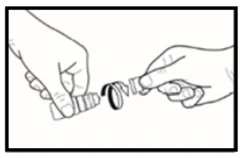
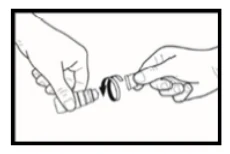
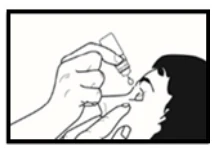
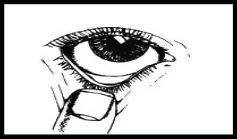
Picture 1. Picture 2. Picture 3. Picture 4.
- 1. Wash your hands carefully before using this medicine.
- 2. If the packaging or bottle is damaged do not use the medicine.
- 3. When using the medicine for the first time, unscrew the cap after making sure that the sealed ring on the cap has not been broken. You should feel a slight resistance until this tamper-proof ring breaks off (see picture 1).
- 4. If the tamper-proof ring is loose throw it away because it may fall into your eye and cause injuries.
- 5. Tilt your head back and gently pull down your lower eyelid to form a pocket between your eye and eyelid (see picture 2). Avoid contact between the tip of the bottle touch your eye, eyelids or fingers.
- 6. Instill one drop into the pouch by pressing slowly on the bottle (see picture 3). Squeeze the bottle gently in the middle to release one drop into your eye. There may be a few seconds delay between squeezing and the drop being released. Do not squeeze too hard. If you are not sure how to administer your medicine, ask your doctor, pharmacist or nurse.
- 7. Compress the tear duct for about 2 minutes (by pressing a finger against the corner of the eye by the nose) and close your eye(s) and keep it/them closed during this time. This ensures that the drop is absorbed by the eye and that the amount of medicine draining through the tear duct to the nose will probably be reduced.
- 8. Repeat steps 5 , 6 and 7 in your other eye if your doctor has told you to do this.
- 9. After use and prior to recapping, the bottle should be shaken once in a downwards direction, without touching the dropper tip in order to remove any residual liquid on the tip. This is necessary in order to ensure delivery of subsequent drops. After instillation screw the cap back on the bottle (see picture 4).
If a drop misses your eye, try again.
If you are not sure how to administer your medicine, ask your doctor, pharmacist or nurse.
If you wear contact lenses, take your lenses out before using this medicine. Wait 15 minutes after using the drops, and before you put your lenses back in.
If you use Ecbirio with another eye medicine, leave at least 5 minutes between putting in Ecbirio and the other medicine. Use any eye ointment or eye gel last.
If you use more Ecbirio than you should
If you use more Ecbirio than you should, it is unlikely to cause you any serious harm. Put your next dose in at the usual time. If you are worried, talk to your doctor or pharmacist.
If you forget to use Ecbirio
If you forget to use this medicine, use a single drop as soon as you remember, and then go back to your regular routine. Do not take a double dose to make up for a forgotten dose.
If you stop using Ecbirio
Ecbirio should be used every day to work properly.
If you have any further questions on the use of this medicine, ask your doctor or pharmacist.
4. Possible side effects
Like all medicines, this medicine can cause side effects, although not everybody gets them.
If you get any side effects, talk to your doctor or pharmacist. This includes any possible side effects not listed in this leaflet.
You can usually carry on taking the drops, unless the effects are serious. If you’re worried, talk to a doctor or pharmacist. Do not stop using Ecbirio without speaking to your doctor.
The following side effects may be seen with Ecbirio:
Very common side effects
These may affect more than 1 in 10 patients
Affecting the eye
Redness, loss of fat in the eye region which can lead to deepening of your eyelid crease, sunken eye (enophthalmos), drooping eyelid (ptosis), tightening of the skin around your eye (involution of dermatochalasis), and the lower white part of your eye to become more visible (inferior scleral show).
Common side effects
These may affect between 1 in 10 and 1 in 100 patients
Affecting the eye
burning, itching, stinging, irritation of the conjunctiva (see-through layer of the eye), sensitivity to light, eye pain, sticky eyes, dry eyes, a feeling of something in the eye, small breaks in the surface of the eye with or without inflammation, difficulty in seeing clearly, redness and itching of the eyelids, hair growing around the eye, darkening of the eyelids, darker skin colour around the eyes, longer eyelashes, eye irritation, watery eyes, swollen eyelids, reduced vision.
Affecting other parts of the body
runny nose, headache.
Uncommon side effects
These may affect more than 1 in 1,000 patients
Affecting the eye
abnormal sensation in the eye, iris inflammation, swollen conjunctiva (see-through layer of the eye)**, painful eyelids, tired eyes, in-growing eyelashes, darkening of iris colour, eyelid has moved away from the surface of the eye, darkening of eyelashes.
Affecting other parts of the body
shortness of breath.
Side effects where the frequency is not known
Frequency cannot be estimated from the available data.
Affecting the eye
cystoid macular oedema (swelling of the retina within the eye leading to worsening vision), eye swelling, blurred vision.
Affecting other parts of the body
difficulty breathing / wheezing, symptoms of allergic reaction (swelling, redness of the eye and rash of the skin), changes in your taste sensation, slowing of heart rate, difficulty sleeping, nightmare, asthma, hair loss, tiredness
Additional side effects have been seen in patients using eye drops containing timolol or bimatoprost and so may possibly be seen with Ecbirio. Like other medicines applied into eyes, timolol is absorbed into the blood. This may cause similar side effects as seen with “intravenous” and /or “oral” beta-blocking agents. The chance of having side effects after using eye drops is lower than when medicines are for example, taken by mouth or injected. Listed side effects include reactions seen within bimatoprost and timolol when used for treating eye conditions:
- Severe allergic reactions with swelling and difficulty breathing which could be life-threatening
- Low blood sugar
- Depression; memory loss; dizziness; hallucination
- Fainting; stroke; decreased blood flow to the brain; worsening of myasthenia gravis (increased muscle weakness); tingling sensation
- Decreased sensation of your eye surface; double vision; drooping eyelid; separation of one of the layers within the eyeball after surgery to reduce the pressure in the eye; inflammation of the surface of the eye, bleeding in the back of the eye (retinal bleeding), inflammation within the eye, increased blinking, sticky eyes, ocular discomfort
- Heart failure; irregularity or stopping of the heartbeat; slow or fast heartbeat; too much fluid, mainly water, accumulating in the body; chest pain
- Low blood pressure, high blood pressure, swelling or coldness of your hands, feet and extremities, caused by constriction of your blood vessels
- Cough, worsening of asthma, worsening of the lung disease called chronic obstructive pulmonary disease (COPD)
- Diarrhoea; stomach pain; feeling and being sick; indigestion; dry mouth
- Red scaly patches on skin; skin rash, sticky eyes, ocular discomfort
- Muscle pain
- Reduced sexual urge; sexual dysfunction
- Weakness
- An increase in blood test results that show how your liver is working
Other side effects reported with eye drops containing phosphates
In very rare cases, some patients with severe damage to the clear layer at the front of the eye (the cornea) have developed cloudy patches on the cornea due to calcium build-up during treatment.
Reporting of side effects
If you get any side effects, talk to your doctor or pharmacist. This includes any possible side effects not listed in this leaflet. You can also report side effects directly via the Yellow Card Scheme at:
www.mhra.gov.uk/yellowcard or search for MHRA Yellow Card in the Google Play or Apple App Store. By reporting side effects you can help provide more information on the safety of this medicine.
5. How to store Ecbirio
Keep this medicine out of the sight and reach of children.
Do not use this medicine after the expiry date which is stated on the carton and bottle. The expiry date refers to the last day of that month.
This medicine does not require any special storage condition.
After first opening of the bottle - store for 90 days at a temperature below 25°C.
Once opened, solutions may become contaminated, which can cause eye infections. Therefore, you must throw away the bottle 90 days after you first opened it, even if some solution is left. To help you remember, write down the date that you opened it in the space on the carton.
Do not throw away any medicines via wastewater or household waste. Ask your pharmacist how to throw away medicines you no longer use. These measures will help protect the environment.
6. Contents of the pack and other information
What Ecbirio contains
- The active substances are bimatoprost and timolol.
- One ml of solution contains 0.3 mg of bimatoprost and 5 mg of timolol (as 6.8 mg of timolol maleate).
- The other ingredients are disodium phosphate dodecahydrate, citric acid monohydrate, sodium chloride, sodium hydroxide or hydrochloric acid, diluted (for pH-adjustment), water for injection.
What Ecbirio looks like and contents of the pack
Ecbirio is a transparent, colourless solution.
This medicine is available in 5 ml white LDPE bottles containing 3 ml of solution, with a multidose HDPE dropper applicator and a tamper-proof HDPE screw-cap.
The dropper applicator has a silicon valve system that prevents backflow of contaminated liquid into the bottle and allows an inflow of filtered air.
Pack sizes:
Cartons containing 1 or 3 bottles each containing 3 ml of solution.
Not all pack sizes may be marketed.
Marketing Authorisation Holder and Manufacturer
Marketing Authorisation Holder
SIFI S.p.A.
Via Ercole Patti, 36
95025 Aci S. Antonio (CT)
Italy
Manufacturer:
RAFARM S.A.
Thesi Pousi Xatzi Agiou Louka
190 02 Paiania
Grecia
This leaflet was last revised in September 2024.
Detailed information on this medicinal product is available on the website of www.mhra.gov.uk.