

Summary of Product Characteristics (SmPC) - Dexamethasone 0.5 mg tablets
1 NAME OF THE MEDICINAL PRODUCT
Dexamethasone 0.5 mg Tablets
2 QUALITATIVE AND QUANTITATIVE COMPOSITION
Each tablet contains 0.5 mg dexamethasone
Excipients with known effect
Each tablet contains 72.5 mg lactose monohydrate.
For the full list of excipients, see section 6.1.
3 PHARMACEUTICAL FORM
Tablet
White, round, flat bevelled tablets of about 6.0 mm in diameter and 2.5-2.8mm, thickness, debossed ‘D’ on top and ‘0.5’ underneath on one side and plain on the other side.
4 CLINICAL PARTICULARS
4.1 Therapeutic indications
Neurology
Cerebral oedema caused by brain tumours, neurosurgery, bacterial meningitis, brain abscess.
Pulmonary and respiratory diseases
Severe acute asthma attack.
Dermatology
Oral initial treatment of extensive, severe, acute skin diseases that respond to glucocorticoids, such as erythroderma, pemphigus vulgaris, acute eczema.
Autoimmune disorders/rheumatology
Oral initial treatment of autoimmune diseases, such as systemic lupus erythematosus (especially visceral forms).
Severely progressive form of active rheumatoid arthritis, e.g. rapidly destructive forms and/or with extra-articular manifestations.
Infectology
Severe infections with toxic conditions (e.g. tuberculosis, typhoid) only with concomitant anti-infective therapy.
Oncology
Palliative treatment of malignant tumours.
Endocrinology
Congenital adrenogenital syndrome in adulthood.
COVID-19
Dexamethasone is indicated in the treatment of coronavirus disease 2019 (COVID-
- 19) in adult and adolescent patients (aged 12 years and older with body weight at least 40 kg) who require supplemental oxygen therapy
4.2 Posology and method of administration
Posology
Dosage depends on the nature and severity of the disease and the individual response of the patient to treatment. In general, relatively high initial doses are administered, and they should be significantly higher in acute severe forms than in chronic diseases.
Unless otherwise prescribed, the following dosage recommendations apply:
- Cerebral oedema: Depending on the cause and severity, initial dose of 8–10 mg (up to 80 mg) i.v., followed by 16–24 mg (up to 48 mg)/day orally, divided into 3–4 (up to 6) individual doses for 4–8 days. A longer-term, lower-dose administration of Dexamethasone may be required during irradiation and in the conservative treatment of inoperable brain tumours.
- Cerebral oedema due to bacterial meningitis: 0.15 mg/kg body weight every 6 hours for 4 days, children: 0.4 mg/kg body weight every 12 hours for 2 days, starting before the first antibiotics.
Severe acute asthma attack: Adults: 8–20 mg, then, if necessary, 8 mg every
4 hours. Children: 0.15–0.3 mg/kg body weight.
- Acute skin diseases: Depending on the nature and extent of the disease, daily doses of 8–40 mg.
Followed by treatment with decreasing doses.
Active phases of rheumatic systemic diseases: systemic lupus erythematosus
6–16 mg/day.
- Severely progressive form of active rheumatoid arthritis: in rapidly destructive forms 12– 16 mg/day, in extra-articular manifestations 6–12 mg/day
- Severe infectious diseases, toxic states (e.g. tuberculosis, typhoid): 4–20 mg for a few days, only with concomitant anti-infective therapy.
- Palliative treatment of malignant tumours: initially 8–16 mg/day, in prolonged treatment 4– 12 mg/day.
- Congenital adrenogenital syndrome in adulthood: 0.25–0.75 mg/day as a single dose. If necessary, addition of a mineralcorticoid (fludrocortisone). In cases of particular physical stress (e.g. trauma, surgery), intercurrent infections, etc., a 2- to 3-fold dose increase may be required and under extreme stress (e.g. birth) a 10-fold increase.
Treatment of Covid-19:
Adult patients 6 mg IV or PO, once a day for up to 10 days.
Paediatric population:
Paediatric patients (adolescents aged 12 years and older) are recommended to take 6 mg/dose IV or PO once a day for up to 10 days.
Duration of treatment should be guided by clinical response and individual patient requirements.
Elderly, renal impairment, hepatic impairment:
No dose adjustment is needed.
The tablets should not be split to adjust doses. If patients need a dose that cannot be provided by one or more tablets of 0.5 mg, other appropriate formulations should be used.
Method of administration
The tablets should be taken during or after a meal. They should be swallowed whole, with a sufficient amount of liquid. The daily dose should be administered as a single dose in the morning, if possible (circadian therapy). In patients who require a high-dose therapy because of their disease, multiple daily dosing is often required to achieve maximum effect.
Depending on the underlying disease, clinical symptoms and response to therapy, the dose can be reduced at a faster or slower rate and the therapy stopped, or the patient is stabilised on a maintenance dose as low as possible and, if necessary, adrenal axis monitored. Basically, the dose and duration of treatment should be kept as high and long as necessary, but as low and short as possible. In principle, the dose should be reduced gradually.
In long-term therapy which is deemed necessary following initial treatment, patients should be switched to prednisone/prednisolone, because this leads to lower adrenal suppression.
In hypothyroidism or liver cirrhosis, low doses may be sufficient or a dose reduction may be necessary.
4.3 Contraindications
Hypersensitivity to the active substance or to any of the excipients listed in section 6.1.
4.4 Special warnings and precautions for use
Depending on the dose and duration of therapy, an adrenocortical insufficiency caused by glucocorticoid therapy can continue for several months and individual cases more than a year, after cessation therapy. In case of perticuler physical stress conditions (trauma, surgery, childbirth, etc.) during treatment with dexamethasone, a temporary increase in dose may be required. Because of the potential risk in stressful situation, patients on extended therapy should be issued a steroid card. Also in prolonged adrenal insufficiency after cessation of treatment, the administration of glucocorticoids may be necessary in physically stressful situations. In case of intended withdrawal, treatment-induced acute adrenal insufficiency may be minimized by slow dose reduction.
Through immunosuppression, treatment with Dexamethasone can lead to an increased risk of bacterial, viral, parasitic, opportunistic and fungal infections. It can mask the symptoms of an existing or developing infection, thereby making a diagnosis more difficult. Latent infections, like tuberculosis or hepatitis B, can be reactivated.
Treatment with dexamethasone should only be implemented in the event of the strongest indications and, if necessary, additional targeted anti-infective treatment administered for the following illnesses:
Acute viral infections (Herpes zoster, Herpes simplex,
Varicella, herpetic keratitis) • HBsAG-positive chronic active hepatitis
- Approximately 8 weeks prior through 2 weeks after vaccinations with live vaccines
- Systemic mycoses and parasitosis (e.g. nematodes)
In patients with suspected and confirmed Strongyloidiasis
(infestation with threadworm).
glucocorticoids may lead to activation and mass proliferation of the parasites
- Poliomyelitis
- Lymphadenitis after BCG vaccination
- Acute and chronic bacterial infections
- In a history of tuberculosis (reactivation risk) use only under tuberculostatic protection
In addition, treatment with dexamethasone should only be implemented under strong indications and, if necessary, additional specific treatment must be implemented for:
- Gastrointestinal ulcers
- Osteoporosis
- Severe cardiac insufficiency
- High blood pressure that is difficult to regulate
- Difficult to regulate diabetes mellitus
- Psychiatric disorders (also in the past), including suicidality: neurological or psychiatric monitoring is recommended
- Narrow- and wide-angle glaucoma ophthalmic monitoring and adjunctive therapy are recommended
- Corneal ulcerations and corneal injuries, ophthalmic monitoring and adjunctive therapy are recommended
Because of the risk of an intestinal perforation, dexamethasone must only be used under urgent indication and under appropriate monitoring for:
- Severe ulcerative colitis with threatened perforation, possibly without peritoneal irritation
- Diverticulitis
- Entero-anastomosis (immediately postoperatively) Signs of peritoneal irritation after gastrointestinal perforation may be absent in patients receiving high doses of glucocorticoids.
The possibility of a higher need for insulin, or oral antidiabetics, must be taken into consideration when administering dexamethasone to diabetics.
Regular blood pressure monitoring is necessary during treatment with dexamethasone, particularly during administration of higher doses and in patients with high blood pressure that is difficult to regulate.
Because of the risk of deterioration, patients with severe cardiac insufficiency should be carefully monitored. With high doses of dexamethasone bradycardia may occur. Serious anaphylactic reactions may occur.
The risk of tendon disorders, tendinitis and tendon rupture is increased when fluoroquinolones and glucocorticoids are administered together
A concurrent myasthenia gravis may initially worsen during treatment with dexamethasone.
Vaccinations with inactivated vaccine are always possible. However, it should be noted that the immune reaction and thus the vaccine may be compromised at higher doses of corticosteroids.
During long-term therapy with Dexamethasone, regular check-ups with doctors (including opthalmologic everythree-months) are indicated.
At high doses, sufficient calcium intake and sodium restriction should be ensured and serum potassium levels should be monitored.
Depending on the dose and duration of the treatment, a negative influence on calcium metabolism can be expected, therefore,the prevention of osteoporosis is recommended. This applies especially to patients with concomitant risk factors, such as familial predisposition, advanced age, postmenopausal period, insufficient protein and calcium intake, heavy smoking, excessive alcohol consumption and lack of physical activity. Prevention consists of sufficient calcium and vitamin D intake and physical activity. In already existing osteoporosis, additional drug therapy should be considered.
Upon termination of long-term administration glucocorticoid, the following risk must be taken into account: exacerbation or relapse of the underlying disease, acute adrenal insufficiency, corticosteroid withdrawal syndrome.
Certain viral diseases (chickenpox, measles) may be very severe in patients treated with glucocorticoids. Immunocompromised patients without previous chickenpox or measles infection are particularly at risk. If these people have contact with people infected with measles or chickenpox while undergoing treatment with dexamethasone, a preventative treatment should be introduced if necessary. In post marketing experience tumour lysis syndrome (TLS) has been reported in patients with haematological malignancies following the use of dexamethasone alone or in combination with other chemotherapeutic agents. Patient at high risk of TLS, such as patients with high proliferative rate, high tumour burden, and high sensitivity to cytotoxic agents, should be monitored closely and appropriate precaution taken. Visual disturbance
Visual disturbance may be reported with systemic and topical corticosteroid use. If a patient presents with symptoms such as blurred vision or other visual disturbances, the patient should be considered for referral to an ophthalmologist for evaluation of possible causes which may include cataract, glaucoma or rare diseases such as central serous chorioretinopathy (CSCR) which have been reported after use of systemic and topical corticosteroids.
Pheochromocytoma crisis
Pheochromocytoma crisis, which can be fatal, has been reported after administration of systemic corticosteroids. Corticosteroids should only be administered to patients with suspected or identified pheochromocytoma after an appropriate risk/benefit evaluation.
Paediatric population
In the growth phase of children, the benefit-risk balance of treatment with Dexamethasone should be carefully weighed. Therapy should be of limited duration or in case of long-term therapy, it should be carried out alternatingly.
Preterm neonates:Available evidence suggests long-term neurodevelopmental adverse events after early treatment (< 96 hours) of premature infants with chronic lung disease at starting doses of 0.25 mg/kg twice daily.
Elderly patients
Because elderly patients are at an increased risk of osteoporosis, the benefit-risk balance of treatment with Dexamethasone should be carefully weighed. Note
The use of dexamethasone can lead to positive results doping control.
Dexamethasone tablets contain lactose. Patients with rare hereditary problems of galactose intolerance, the Lapp lactase deficiency or glucose-galactose malabsorption should not take this medicinal product.
4.5 Interaction with other medicinal products and other forms of interaction
Oestrogens (e.g. oral contraceptives): The half-life of glucocorticoids may be prolonged. Therefore, the effect of corticoids may be increased.
Antacids: Concomitant administration of aluminum hydroxide or magnesium hydroxide can lead to a reduction in the absorption of glucocorticoids with reduced efficacy of Dexamethasone. There should be a 2-hour interval between the intake of one and the other drug.
Drug that inducers of CYP3A4, such as barbiturates, rifabutin, rifampicin, phenytoin, primidone and carbamazepine: The effect of corticoids may be reduced.
Co-treatment with CYP3A inhibitors, including cobicistat-containing products, is expected to increase the risk of systemic side-effects. The combination should be avoided unless the benefit outweighs the increased risk of systemic corticosteroid side-effects, in which case patients should be monitored for systemic corticosteroid side-effects. Drug that inhibition of CYP3A4, such as ketoconazole and itraconazole: The effect of corticosteroids may be increased. Ephedrine: The metabolism of glucocorticoids may be accelerated and thus their effectiveness reduced. ACE inhibitors: Increased risk of blood count changes. Cardiac glycosides: The effect of glycosides may be increased by potassium deficiency.
Saluretics/laxatives: Potassium excretion may be increased. Antidiabetics: The hypoglycaemic effect may be reduced. Coumarin derivatives: The anticoagulants effect may be reduced or increased. Dosage adjustment of the anticoagulant may be necessary when co-administered.
Nonsteroidal anti-inflammatory drugs (NSAIDs), salicylates and indomethacin: The risk of gastrointestinal ulcers and bleeding in increased.
Non-depolarizing muscle relaxants: the muscle relaxing effect may last longer.
Atropine and other anticholinergics: additional intraocular pressure increases are possible during concomitant use. Praziquantel: Corticosteroids may cause a fall in praziquantel concentration in the blood.
Chloroquine, hydroxychloroquine and mefloquine: there is an increased risk of myopathies and cardiomyopathies. Somatropin: The effect of somatropin may be reduced under long-term therapy.
Protirelin: Reduced increase in TSH may be noted during administration of protirelin.
Immunosuppressive agents: Increased susceptibility to infections and possible aggravation or manifestation of latent infections. Additionally, for ciclosporin: The blood levels of cyclosporine are increased: There is an increased risk of seizures.
Fluoroquinolones may increased the risk of tendon disorders. Effect on investigation methods: Skin reactions in allergy tests can be suppressed.
4.6 Fertility, Pregnancy and lactation
Pregnancy:
Dexamethasone crosses the placenta. During pregnancy, specially in the first trimester, the drug should only be administred after careful benefit-risks assessment.
In long-term treatment with glucocorticoids during pregnancy, foetal growth disorder cannot be excluded. Administration of corticosteroids to pregnant animals can cause abnormalities in foetal development, including cleft palate, intrauterine growth retardation and effects on brain growth and development. There is no evidence that corticosteroids result in an increased incidence of congenital abnormalities, such as cleft palate/lip in man (see Section 5.3). If glucocorticoids are administered towards the end of pregnancy, there is a risk of atrophy of the foetal adrenal cortex, which may necessitate replacement therapy in the newborn, which has to be slowly reduced.
Breast-feeding
Dexomethasone is excreted in breast milk. There are no known cases of harm to the infant. Nevertheless, the drug should be strongly indicated during lactation. If the disease requires higher doses, breast-feeding should be discontinued.
Fertility
Dexamethasone decreases testosterone biosynthesis and endogenous ACTH secretion which has an effect on the spermatogenesis and the ovarian cycle.
4.7 Effects on ability to drive and use machines
There have been no studies on the effects on the ability to drive and use machines.
4.8 Undesirable effects
- Very common (≥ 1/10)
- Common (≥ 1/100 to < 1/10)
- Uncommon (≥ 1/1,000 to < 1/100)
- Rare (≥ 1/10,000 to < 1/1,000)
- Very rare (< 1/10,000)
- Not known (cannot be estimated from the available data)
Hormone replacement therapy:
Low risk of undesirable effects with the use of recommended doses.
Pharmacotherapy:
The following undesirable effects may occur; they are highly
dependent on the dose and duration of treatment, so their
frequency cannot be specified:
Not known
Infections and
infestations
Masking of infections, manifestation and exacerbation of viral infections, fungal infections, bacterial, parasitic and opportunistic infections, activation of strongyloidiasis. Blood and
lymphatic system
disorders
Moderate leukocytosis, lymphocytopenia, eosinopenia, polycythemia.
Immune system
disorders
Hypersensitivity reactions (drug eruption), severe anaphylaxis reactions, such as arrhythmias, bronchospasm hypo- or hypertension, circulatory collapse, cardiac arres weakening of the immune system.
Endocrine
disorders
Adrenal suppression and induction of Cushing’s syndrom (typical symptoms: moon face, central obesity and pletho
Metabolism and
nutrition disorders
Sodium retention with oedema, increased potassium excretion (risk of arrhythmias), weight gain, reduced gluc tolerance, diabetes mellitus, hypercholesterolemia and hypertriglyceridemia, increased appetite.
Psychiatric
disorders
Depression, irritability, euphoria, increased drive, psycho mania, hallucinations, emotional lability, anxiety, sleep disorders, suicidality.
Nervous system
disorders
Pseudotumor cerebri, manifestation of latent epilepsy, increase in seizure susceptibility in manifest epilepsy.
Eye disorders
Cataract, especially with posterior subcapsular opacity, glaucoma, deterioration of symptoms associated with corneal ulcer, increased occurrence of viral, fungal and bacterial inflammation of the eye, deterioration of bacteri inflammation of the cornea, ptosis, mydriasis, chemosis, iatrogenic scleral perforation, chorioretinopathy, vision, blurred (see also section 4.4).
Vascular disorders
Hypertension, increased risk of atherosclerosis and thrombosis, vasculitis (also as withdrawal syndrome after long-term therapy), increased capillary fragility. Gastrointestinal
disorders
Gastrointestinal ulcers, gastrointestinal bleeding, pancreatitis, stomach discomfort, hiccups.
Skin and
subcutaneous
tissue disorders
Striae rubra, atrophy, telangiectasias, petechiae, ecchymosis, hypertrichosis, steroid acne, rosacea-like (perioral) dermatitis, changes in skin
pigmentation.
Musculoskeletal
and connective
tissue disorders
Myopathy, muscle atrophy and weakness, osteoporosis (dose-dependent, possible also in short-term administrati aseptic necrosis, tendon disorders, tendinitis, tendon rupt epidural lipomatosis, growth inhibition in children.
Note: Too rapid dose reduction after long-term treatment may cause symptoms such as muscle and joint pain. Reproductive
system and breast
disorders
Disorders of sexual hormone secretion (consequently: irregular menstruation up to amenorrhea, hirsutism, impotence)
General disorders
and administration
site conditions
Delayed wound healing
Reporting of suspected adverse reactions
Reporting suspected adverse reactions after authorisation of the medicinal product is important. It allows continued monitoring of the benefit/risk balance of the medicinal product. Healthcare professionals are asked to report any suspected adverse reactions via the Yellow Card Scheme, Website: www.mhra.gov.uk/yellowcard or search for MHRA Yellow Card in the Google Play or Apple App Store.
4.9 Overdose
Symptoms
Acute intoxications with dexamethasone are not known. In case of chronic overdosing, an increase in undesirable effects, especially endocrine, metabolic and electrolyte-related effects, can be expected (see section 4.8). Management
There is no known antidote to dexamethasone.
5.1 Pharmacodynamic properties
Pharmacotherapeutic group: corticosteroids for systemic use, glucocorticoids, ATC code: H02AB02.
Mechanism of action
Dexamethasone is a highly potent and long-acting glucocorticoid with negligible sodium retaining properties and is therefore, particularly suitable for the use in patients with cardiac failure and hypertension. Its anti-inflammatory potency is 7.5 times greater than prednisolone and, like other glucocorticoids, dexamethasone also has anti-allergic, antipyretic and immunosuppressive properties.
Glucocorticoids, such as dexamethasone, exert their biological effects by activating the transcription of corticosteroid-sensitive genes. The antiinflammatory, immunosuppressive and anti-proliferative effects are caused by decreased formation, release and activity of inflammatory mediators, by the inhibition of specific functions and the migration of inflammatory cells. In addition, the effect of sensitized T lymphocytes and macrophages on target cells may be prevented by corticosteroids. Dexamethasone has a biological half-life of 36 - 54 hours and therefore is suitable in conditions where continuous glucocorticoid action is required. Treatment of COVID-19
The RECOVERY trial (Randomised Evaluation of COVid-19 thERapY,) [Dexamethasone in Hospitalized Patients with Covid-19, N Engl J Med 2021;384:693-704] is an investigator- initiated, individually randomised, controlled, open-label, adaptive platform trial to evaluate the effects of potential treatments in patients hospitalised with COVID-19. The trial was conducted at 176 hospital organizations in the United Kingdom.
There were 6425 Patients randomised to receive either dexamethasone (2104 patients) or usual care alone (4321 patients). 89% of the patients had laboratory-confirmed SARS-CoV2 infection.
At randomization, 16% of patients were receiving invasive mechanical ventilation or extracorporeal membrane oxygenation, 60% were receiving oxygen only (with or without non-invasive ventilation), and 24% were receiving neither.
The mean age of patients was 66.1+/-15.7 years. 36% of the patients were female. 24% of patients had a history of diabetes, 27% of heart disease and 21% of chronic lung disease.
Primary endpoint
Mortality at 28 days was significantly lower in the dexamethasone group than in the usual care group, with deaths reported in 482 of 2104 patients (22.9%) and in 1110 of 4321 patients (25.7%), respectively (rate ratio, 0.83; 95% confidence interval [CI], 0.75 to 0.93; P<0.001). In the dexamethasone group, the incidence of death was lower than that in the usual care group among patients receiving invasive mechanical ventilation (29.3% vs. 41.4%; rate ratio, 0.64; 95% CI, 0.51 to 0.81) and in those receiving supplementary oxygen without invasive mechanical ventilation (23.3% vs. 26.2%; rate ratio, 0.82; 95% CI, 0.72 to 0.94).
There was no clear effect of dexamethasone among patients who were not receiving any respiratory support at randomization (17.8% vs. 14.0%; rate ratio, 1.19; 95% CI, 0.91 to 1.55).
Primary and Secondary Outcomes and Prespecified Subsidiary Clinical Outcomes
| Outcome | Dexamethasone (N = 2104) | Usual Care (N = 4321) | Rate or Risk (95% CI)* |
| no./total no. of patients (%) | |||
| Primary outcome | |||
| Death at 28 days | 482/2104 (22.9) | 1110/4321 (25.7) | 0.83 (0.75–0.93) |
| Secondary outcomes | |||
| Discharged from hospital within 28 days | 1416/2104 (67.3) | 2748/4321 (63.6) | 1.10 (1.03–1.17) |
| Invasive mechanical ventilation or death† | 462/1780 (26.0) | 1003/3638 (27.6) | 0.93 (0.85–1.01) |
| Invasive mechanical ventilation | 110/1780 (6.2) | 298/3638 (8.2) | 0.79 (0.64–0.97) |
| Death | 387/1780 (21.7) | 827/3638 (22.7) | 0.93 (0.84–1.03) |
| Subsidiary clinical outcomes | |||
| Use of ventilation‡ | 25/501 (5.0) | 65/1034 (6.3) | 0.84 (0.54–1.32) |
| Non-invasive ventilation | 20/501 (4.0) | 57/1034 (5.5) | 0.77 (0.47–1.26) |
| Invasive mechanical ventilation | 9/501 (1.8) | 19/1034 (1.8) | 1.07 (0.49–2.34) |
| Successful cessation of invasive mechanical ventilation§ | 160/324 (49.4) | 268/683 (39.2) | 1.47 (1.20–1.78) |
| Renal-replacement therapy¶ | 89/2034 (4.4) | 314/4194 (7.5) | 0.61 (0.48–0.76) |
* Rate ratios have been adjusted for age with respect to the outcomes of 28-day mortality, hospital discharge, and successful cessation of invasive mechanical ventilation. Risk ratios have been adjusted for age with respect to the outcomes of invasive mechanical ventilation or death (and its subcomponents), use of ventilation, and renalreplacement therapy.
† Excluded from this category are patients who were receiving invasive mechanical ventilation at randomization. ‡ Excluded from this category are patients who were receiving oxygen (since some patients in this category were receiving non-invasive ventilation) or invasive mechanical ventilation at randomization.
§ Excluded from this category are patients who were not receiving invasive mechanical ventilation at randomization.
¶ Excluded from this category are patients who were receiving renal-replacement therapy at randomization
Secondary endpoints
Patients in the dexamethasone group had a shorter duration of hospitalisation than those in the usual care group (median, 12 days vs. 13 days) and a greater probability of discharge alive within 28 days (rate ratio, 1.10; 95% CI, 1.03 to 1.17).
In line with the primary endpoint the greatest effect regarding discharge within 28 days was seen among patients who were receiving invasive mechanical ventilation at randomization (rate ratio 1.48; 95% CI 1.16, 1.90), followed by oxygen only (rate ratio, 1.15 ;95% CI 1.06- 1.24) with no beneficial effect in patients not receiving oxygen (rate ratio, 0.96, 95% CI 0.85- 1.08).
Safety
There were four serious adverse events (SAEs) related to study treatment: two SAEs of hyperglycaemia, one SAE of steroid-induced psychosis and one SAE of an upper gastrointestinal bleed. All events resolved. Subgroup analyses
Effect of Dexamethasone on 28-Day Mortality, According to Respiratory Support at Randomization. 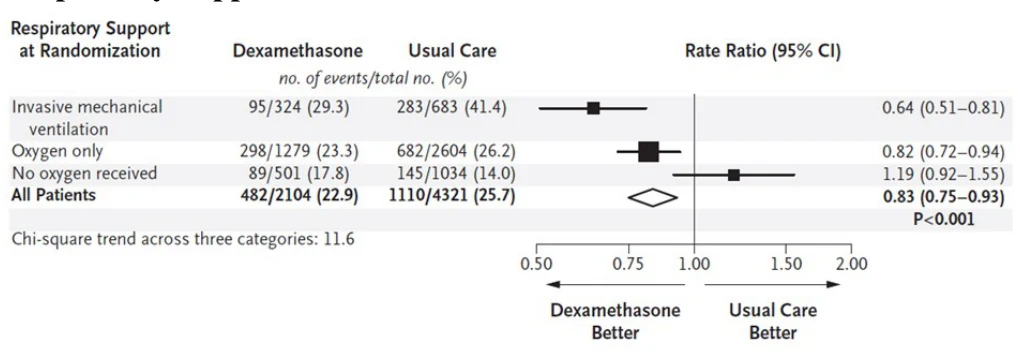
Shown are subgroup-specific rate ratios for all the patients and for those who were receiving no oxygen, receiving oxygen with or without non-invasive ventilation, or undergoing invasive mechanical ventilation at the time of randomization. Rate ratios are plotted as squares, with the size of each square proportional to the amount of statistical information that was available; the horizontal lines represent 95% confidence intervals.
Source: Dexamethasone in Hospitalized Patients with Covid-19, N Engl J Med 2021;384:693-704
5.2 Pharmacokinetic properties
Absorption and distribution
After oral administration, dexamethasone is rapidly and almost completely absorbed in the stomach and small intestine. Its bioavailability is 80–90%. Maximum blood levels are reached between 60 and 120 minutes. The binding of dexamethasone to plasma albumins is dose-dependent. At very high doses, the largest portion circulates freely in the blood. In hypoalbuminaemia the proportion of the unbound (active) corticoid rises.
Biotransformation
The average (serum) elimination half-life of dexamethasone in adults is 250 minutes (+ 80 minutes). Due to its long biological half-life of more than 36 hours, daily continuous administration of dexamethasone can lead to accumulation and overdosing.
Elimination
The elimination is largely renal in the form of free dexamethasone alcohol. Dexamethasone is partly metabolised, the metabolites are excreted as glucuronates or sulfates, also mainly by the kidneys.
Renal and hepatic impairment
Renal function impairment has no relevant effect on the clearance of dexamethasone. However, the elimination half-life is prolonged in severe liver disease.
5.3 Preclinical safety data
Acute toxicity:
In mice and rats, the LD50 for dexamethasone after a single oral dose is 16 g/kg body and over 3 g/kg body weight, respectively, within the first 7 days.
Following a single subcutaneous dose, the LD50 in mice is more than 700 mg/kg body weight and in rats about 120 mg/kg body weight, within the first 7 days.
Over a period of 21 days, these values become lower, which is interpreted as a consequence of serious infectious diseases caused by the hormone-induced immunosuppression.
Chronic toxicity:
There are no data on chronic toxicity in humans and animals. Corticoidinduced intoxications are not known. In longer-term treatment with doses above 1.5 mg/day, pronounced undesirable effects can be expected (see section 4.8).
Mutagenic and tumorigenic potential:
The available study findings for glucocorticoids show no evidence of clinically relevant genotoxic properties.
Reproductive toxicity:
In animal studies, cleft palate was observed in rats, mice, hamsters, rabbits, dogs and primates, but not in horses and sheep. In some cases these divergences were combined with defects of the central nervous system and of the heart. In primates, effects in the brain were seen after exposure. Moreover, intra-uterine growth can be delayed. All these effects were seen at high dosages.
6 PHARMACEUTICAL PARTICULARS
6.1 List of excipients
Lactose monohydrate
Maize starch
Magnesium stearate
6.2 Incompatibilities
Not applicable.
6.3 Shelf life
36 months
Bottle once opened: 75 days
6.4 Special precautions for storage
Do not store above 25 °C. Store in the original container to protect from light and moisture.
6.5 Nature and contents of container
Blister pack: Opaque PVC film and Al foil
Container pack: HDPE container and HDPE lid
Pack sizes:
28, 30, 50, 100 tablets in blister pack
28, 30, 50, 100 tablets in container
Not all pack sizes may be marketed.
6.6 Special precautions for disposal
No special requirements.
7 MARKETING AUTHORISATION HOLDER
Activase Pharmaceuticals Limited
11 Boumpoulinas Street
Nicosia 1060 Cyprus
8 MARKETING AUTHORISATION NUMBER(S)
PL 28444/0237
9 DATE OF FIRST AUTHORISATION/RENEWAL OF THE
AUTHORISATION
11/02/2022
10 DATE OF REVISION OF THE TEXT
03/06/2024