

Patient leaflet - Deponit 10 mg/24H patches
1. WHAT DEPONIT IS AND WHAT IT IS USED FOR
Deponit belongs to a group of medicines called ‘nitrates’. These are used to widen your blood vessels and reduce the workload of your heart.
Deponit is used to prevent angina pectoris. Angina attacks feel like a tight pain in your chest, neck or arm and are a sign that your heart is not getting enough oxygen for the amount of work it is doing.
2. WHAT YOU NEED TO KNOW BEFORE YOU USE DEPONIT
Do not use Deponit:
- If you are allergic to glyceryl trinitrate, to other nitro compounds or to any of the other ingredients of this medicine (listed in section 6)
- If you are taking medicines for failure to achieve an erection such as Viagra or any other phosphodiesterase inhibitors. Using Deponit with these medicines could cause a severe drop in blood pressure and could lead to collapse and unconsciousness, and may be fatal
- If you have a condition in which your heart does not pump enough blood around your body due to obstruction of the arteries in the heart as in a condition called aortic or mitral stenosis.
- If you suffer from a heart condition which is associated with low blood pressure leading to shock.
- If you suffer from low blood pressure
- If you suffer from low blood volume
- If you suffer from anaemia (low iron levels in your blood)
- If you have an eye disease called glaucoma
- If you have a heart valve disorder
- If you suffer from inflammation of the heart lining
- If you suffer from increased fluid around the heart (cardiac tamponade)
- If you suffer from a heart condition called hypertrophic obstructive cardiomyopathy
- If you have ever had a serious head injury, cerebral haemorrhage (bleeding in the brain) or a disease which is accompanied by increased pressure on the brain
- If you have an acute angina attack. Your doctor will give you a different medicine such as a GTN spray for this.
- If you are using riociguat, a medicine used in treating pulmonary hypertension
Warnings and precautions
Talk to your doctor or pharmacist before using Deponit:
- If have an underactive thyroid gland
- If have any diseases of the lungs, liver or kidneys
- If have recently had a heart attack or you suffer from heart failure
- If suffer from hypoxaemia (insufficient oxygen in your blood) due to lung disease, heart failure or severe anaemia (low haemoglobin)
- If have hypothermia (very low body temperature)
- If are malnourished (severe lack of food)
- If have a condition called Angina pectoris (chest pain)
- If have had a heart attack
- If have a condition in which there is insufficient blood flow to the brain (cerebral ischemia)
Other medicines and Deponit
- Do not take Deponit with medicines for failure to achieve an erection such as Viagra. Using Deponit with these medicines could cause a severe drop in blood pressure and could lead to collapse and unconsciousness, and may be fatal
Tell your doctor or pharmacist if you are taking, have recently taken or might take any other medicines:
- Medicines which are used to treat angina, heart failure, or an irregular heartbeat. A blood condition (methaemoglobinaemia) can occur when other nitrate treatments are given at the same time. This can result in breathing problems, anxiety, loss of consciousness and heart attack.
- Medicines which reduce blood pressure (e.g. beta-blockers, calcium channel blockers, vasodilators, ACE inhibitors, monoamine oxidase inhibitors)
- Diuretics (water tablets)
- Tricyclic antidepressants (used to treat depression)
Neuroleptics (used to treat anxiety)
- Dihydroergotamine (used to treat migraine)
- Amifostine (drug used along with anticancer drugs) and Aspirin should not be taken together as they increase the blood pressure lowering effect of Deponit.
- Sapropterine (Tetrahydrobiopterine, BH4)
- Any other medicine, including medicines obtained without a prescription.
If any of the above applies to you, do not take Deponit. Talk to your doctor.
Deponit with alcohol
Do not drink alcohol whilst using Deponit as it can cause your blood pressure to drop. This may make you may feel dizzy or faint.
Pregnancy and breast-feeding
If you are pregnant or breast-feeding, think you may be pregnant or are planning to have a baby, ask your doctor or pharmacist for advice before using this medicine.
Driving and using machines
Deponit may make you feel dizzy, tired or have blurred vision. If this happens to you, do not drive a vehicle or operate machinery.
3. HOW TO USE DEPONIT
Always use Deponit exactly as your doctor or pharmacist has told you. Check with your doctor or pharmacist if you are not sure.
Important:
Your doctor will choose the dose that is right for you. Your dose will be shown clearly on the label that your pharmacist puts on your medicine. If it does not, or you are not sure, ask your doctor or pharmacist.
Use in children
Deponit is not suitable for children.
Adults and the Elderly
- Normally one patch per day is enough
- Your doctor may increase this to two patches depending on how you respond to the medicine
- Each morning put on a new patch
- Remove the patch before you go to bed
You must have 10 to 12 hours each day without a patch on. This will prevent you from becoming tolerant to the medicine.
If you do this it will ensure the treatment remains effective.
When applying the patch you should always:
- Place the new patch on a different area of skin
- Allow several days to pass before applying a fresh patch to the same area of skin.
Things to remember:
- Do not stretch the skin when putting a patch on
- Do not put the patch on a cut or reddened area of skin
- Do not pull the patch off the skin and then stick it back on again.
How and where to apply the patch
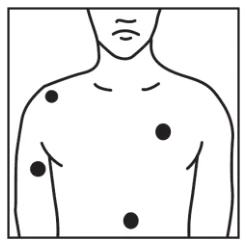
- Choose a smooth area of skin to apply the patch. The area should be hairless, to ensure good contact of the patch with the skin. The chest, upper abdomen, upper arm, shoulder or thigh is suitable.
- Your hands and the skin where you will apply the patch should be clean and dry. Do not use powder or moisturiser.
- Tear open the wrapper across the top, take out the patch and hold it with the writing facing away from you.
- Fold the patch along the S-shaped cut so the sides of the backing come apart.
- Hold the patch on one side and peel off the backing on the other side to expose the sticky patch. Place the sticky side of the patch directly onto the skin.
- Peel off the remainder of the backing and press down firmly with the palm of your hand.
If you use more Deponit than you should
If you accidentally use more Deponit than you should, remove the patches straight away and immediately go to your doctor or the nearest hospital casualty department.
If you use more Deponit than you should, you may have a fall in blood pressure. This may make you feel dizzy, weak and light-headed on standing. You may also be pale, sweat a lot, have a weak pulse, rapid heartbeats (tachycardia), flushed skin, headache, feel sick or be sick, methaemoglobinaemia.
In severe cases of overdose you may get an increase of the pressure of the fluid around the brain.
If you forget to use Deponit
- If you forget to change your patch: Take the old one off and put a new one on as soon as you remember, then carry on as before.
- If you forget to apply a patch: Put a new one on as soon as possible, then carry on as before.
Do not take a double dose to make up for a forgotten dose.
If you stop using Deponit
Do not stop using Deponit even if you feel better. If you stop taking your medicine your condition may get worse. Keep using Deponit until your doctor tells you to stop.
If your doctor thinks you should stop taking Deponit your dose will gradually be reduced.
Also if you are being transferred to another treatment, your dose will be gradually reduced or withdrawn and the overlapping treatment will be started.
If you have any further questions on the use of this medicine, ask your doctor or pharmacist.
4. POSSIBLE SIDE EFFECTS
Like all medicines, Deponit can cause side effects, although not everybody gets them.
Stop using Deponit and seek immediate medical help if you have an allergic reaction. This includes any of the following symptoms:
- Sudden wheeziness
- Difficulties in breathing
- Swelling of your eyelids, face or lips
- Rash or itching especially those covering your whole body.
Very common side effects (may affect more than 1 in 10 people)
- Headaches at the start of treatment. These usually disappear after a few days of continuing to use the patches. If necessary you can take mild painkillers e.g. paracetamol.
Common side effects (may affect up to 1 in 10 people)
- Low blood pressure (hypotension) and light-headedness upon standing which you may notice as dizziness, drowsiness, rapid heart beat (reflex tachycardia) and a feeling of weakness at the start of treatment or when the dosage is increased.
Uncommon side effects (may affect up to 1 in 100 people)
- Collapse sometimes with a slow heart beat and fainting
- Very low blood pressure (severe hypotension) where you are being sick, feeling sick, are restless, have a pale skin and sweat a great deal. This may lead to a worsening of the chest pain you often get with angina
- Temporary low oxygen level in the blood (temporary hypoxaemia). For people with heart disease this may lead to low oxygen level in the tissue surrounding the heart (myocardial hypoxia)
- A slight reddening, slight itching or burning sensation on the skin where you have applied the patch. This usually disappears after the patch has been removed. Be sure to put your patch in a different place each day.
- Allergic skin rash, which may be severe
- Feeling sick
- Being sick
Very rare side effects (may affect up to 1 in 10,000 people)
Heartburn.
Not known (frequency cannot be estimated from the available data)
- Palpitations
- Flushing of the face
- Low blood pressure
- Very red skin with scaling and thickened itchy skin (exfoliative dermatitis)
- Rash
- Heart rate increase
Reporting of side effects
If you get any side effects, talk to your doctor or pharmacist. This includes any possible side effects not listed in this leaflet. You can also report side effects directly via the Yellow Card Scheme at: www.mhra.gov.uk/yellowcard or search for MHRA Yellow Card in the Google Play or Apple App Store. By reporting side effects, you can help provide more information on the safety of this medicine.
5. HOW TO STORE DEPONIT
- KEEP OUT OF THE SIGHT AND REACH OF CHILDREN.
- Do not store above 25°C. Store in the original package.
- Do not use after the expiry date printed on the carton or patch label.
- Do not throw away any medicines via wastewater or household waste. Ask your pharmacist how to throw away medicines you no longer use. These medicines will help protect the environment.
- If the medicine becomes discoloured or shows any other signs of deterioration, you should seek the advice of your pharmacist who will tell you what to do.
6. CONTENTS OF THE PACK AND OTHER INFORMATION
What Deponit contains
- Each patch contains 37.4mg of glyceryl trinitrate and is designed to release 10mg of glyceryl trinitrate in 24 hours.
- Deponit also contains the following inactive ingredients: acrylate/ vinyl acetate copolymer, polypropylene, polyethylene.
What Deponit looks like and contents of the pack
The patch is a self-adhesive transdermal patch.
Deponit is available as packs of 15 or 28 or 30 patches.
Product Licence holder
Procured from within the EU and repackaged by the Product Licence holder: S&M Medical Ltd, Chemilines House, Alperton Lane, Wembley, HA0 1DX.
Manufacturer
This product is manufactured by
- UCB Pharma GmbH, Monheim, Germany.
- Aesica Pharmaceuticals GmbH, Alfred-Nobel-Strasse 10, Monheim, Germany.
P PL: 19488/0609
Leaflet revision date: 24 October 2019
Blind or partially sighted? Is this leaflet hard to see or read? Call 02087997607 to obtain the leaflet in large print, tape, CD or Braille.
Deponit® is a registered trademark of Merus Labs Luxco ll S.à r.l., Luxembourg.
S609 LEAFLET Deponit 20191024