

Summary of Product Characteristics (SmPC) - Decitabine 50 mg powder for concentrate for solution for infusion
1 NAME OF THE MEDICINAL PRODUCT
Decitabine 50 mg powder for concentrate for solution for infusion.
2 QUALITATIVE AND QUANTITATIVE COMPOSITION
Each vial of powder for concentrate for solution for infusion contains 50 mg decitabine.
After reconstitution with 10 ml of water for injections, each ml of concentrate contains 5 mg of decitabine.
For the full list of excipients, see section 6.1.
3 PHARMACEUTICAL FORM
Powder for concentrate for solution for infusion (powder for infusion).
White to almost white lyophilized powder.
4 CLINICAL PARTICULARS
4.1 Therapeutic indications
Decitabine is indicated for the treatment of adult patients with newly diagnosed de novo or secondary acute myeloid leukaemia (AML), according to the World Health Organisation (WHO) classification, who are not candidates for standard induction chemotherapy.
4.2 Posology and method of administration
Decitabine administration must be initiated under the supervision of physicians experienced in the use of chemotherapeutic medicinal products.
Posology
In a treatment cycle, Decitabine is administered at a dose of 20 mg/m2 body surface area by intravenous infusion over 1 hour repeated daily for 5 consecutive days (i.e., a total of 5 doses per treatment cycle).
The total daily dose must not exceed 20 mg/m2 and the total dose per treatment cycle must not exceed 100 mg/m2. If a dose is missed, treatment should be resumed as soon as possible.
The cycle should be repeated every 4 weeks depending on the patient's clinical response and observed toxicity. It is recommended that patients be treated for a minimum of 4 cycles; however, a complete or partial remission may take longer than 4 cycles to be obtained. Treatment may be continued as long as the patient shows response, continues to benefit or exhibits stable disease, i.e., in the absence of overt progression.
If after 4 cycles, the patient’s haematological values (e.g., platelet counts or absolute neutrophil count), have not returned to pre-treatment levels or if disease progression occurs (peripheral blast counts are increasing or bone marrow blast counts are worsening), the patient may be considered to be a non-responder and alternative therapeutic options to Decitabine should be considered.
Pre-medication for the prevention of nausea and vomiting is not routinely recommended but may be administered if required.
Management of myelosuppression and associated complications
Myelosuppression and adverse events related to myelosuppression (thrombocytopaenia, anaemia, neutropenia, and febrile neutropenia) are common in both treated and untreated patients with AML. Complications of myelosuppression include infections and bleeding. Treatment may be delayed at the discretion of the treating physician, if the patient experiences myelosuppression-associated complications, such as those described below:
Febrile neutropenia (temperature ≥ 38.5 °C and absolute neutrophil count <
1,000/µL)
- Active viral, bacterial or fungal infection (i.e., requiring intravenous anti-infectives or extensive supportive care)
Haemorrhage (gastrointestinal, Genito-urinary, pulmonary with platelets <
25,000/µL or any central nervous system haemorrhage)
Treatment with Decitabine may be resumed once these conditions have improved or have been stabilised with adequate treatment (anti-infective therapy, transfusions, or growth factors).
In clinical studies, approximately one-third of patients receiving decitabine required a dose-delay. Dose reduction is not recommended.
Paediatric population
The efficacy of Decitabine in children with AML aged < 18 years has not been established. Currently available data are described in sections 4.8, 5.1, and 5.2.
Hepatic impairment
Studies in patients with hepatic impairment have not been conducted. The need for dose adjustment in patients with hepatic impairment has not been evaluated. If worsening hepatic function occurs, patients should be carefully monitored (see sections 4.4 and 5.2).
Renal impairment
Studies in patients with renal impairment have not been conducted. The need for dose adjustment in patients with renal impairment has not been evaluated (see section 4.4 and 5.2).
Method of administration
Decitabine is administered by intravenous infusion. A central venous catheter is not required.
For instructions on reconstitution and dilution of the medicinal product before administration, see section 6.6.
4.3 Contraindications
Hypersensitivity to active substance or to any of the excipients, listed in section 6.1.
Breast-feeding (see section 4.6)
4.4 Special warnings and precautions for use
Myelosuppression
Myelosuppression and complications of myelosuppression, including infections and bleeding that occur in patients with AML may be exacerbated with decitabine treatment. Therefore, patients are at increased risk for severe infections (due to any pathogen such as bacterial, fungal and viral), with potentially fatal outcome (see section 4.8). Patients should be monitored for signs and symptoms of infection and treated promptly.
In clinical studies, the majority of patients had baseline Grade 3/4 myelosuppression. In patients with baseline Grade 2 abnormalities, worsening of myelosuppression was seen in most patients and more frequently than in patients with baseline Grade 1 or 0 abnormalities. Myelosuppression caused by Decitabine is reversible. Complete blood and platelet counts should be performed regularly, as clinically indicated and prior to each treatment cycle. In the presence of myelosuppression or its complications, treatment with decitabine may be interrupted and/or supportive measures instituted (see sections 4.2 and 4.8).
Respiratory, thoracic and mediastinal disorders
Cases of interstitial lung disease (ILD) (including pulmonary infiltrates, organising pneumonia and pulmonary fibrosis) without signs of infectious aetiology have been reported in patients receiving decitabine. Careful assessment of patients with an acute onset or unexplained worsening of pulmonary symptoms should be performed to exclude ILD. If ILD is confirmed, appropriate treatment should be initiated (see section 4.8).
Hepatic impairment
Use in patients with hepatic impairment has not been established. Caution should be exercised in the administration of Decitabine to patients with hepatic impairment and in patients who develop signs or symptoms of hepatic impairment. Liver function tests should be performed prior to initiation of therapy and prior to each treatment cycle, and as clinically indicated (see sections 4.2 and 5.2).
Renal impairment
Use in patients with severe renal impairment has not been studied. Caution should be exercised in the administration of Decitabine to patients with severe renal impairment (Creatinine Clearance [CrCl] < 30 ml/min). Renal function tests should be performed prior to initiation of therapy and prior to each treatment cycle, and as clinically indicated (see section 4.2).
Cardiac disease
Patients with a history of severe congestive heart failure or clinically unstable cardiac disease were excluded from clinical studies and therefore, the safety and efficacy of decitabine in these patients has not been established. Cases of cardiomyopathy with cardiac decompensation, in some cases reversible after treatment discontinuation, dose reduction or corrective treatment, have been reported in the postmarketing setting. Patients, especially those with cardiac disease history, should be monitored for signs and symptoms of heart failure.
Differentiation syndrome
Cases of differentiation syndrome (also known as retinoic acid syndrome) have been reported in patients receiving decitabine. Differentiation syndrome may be fatal (see section 4.8). Treatment with high-dose IV corticosteroids and haemodynamic monitoring should be considered at first onset of symptoms or signs suggestive of differentiation syndrome. Temporary discontinuation of Decitabine should be considered until resolution of symptoms and if resumed, caution is advised.
Excipients
This medicine contains potassium, less than 1 mmol (39 mg) per vial, i.e. essentially ‘potassium-free.
This medicine contains less than 1 mmol sodium (23 mg) per vial, that is to say essentially ‘sodium-free.
4.5 Interaction with other medicinal products and other forms of interaction
No formal clinical drug interaction studies with decitabine have been conducted.
There is the potential for a drug-drug interaction with other agents which are also activated by sequential phosphorylation (via intracellular phosphokinase activities) and/or metabolised by enzymes implicated in the inactivation of decitabine (e.g., cytidine deaminase). Therefore, caution should be exercised if these active substances are combined with decitabine.
Impact of co-administered medicinal products on decitabine
Cytochrome (CYP) 450-mediated metabolic interactions are not anticipated as decitabine metabolism is not mediated by this system but by oxidative deamination.
Impact of decitabine on co-administered medicinal products
Given its low in vitro plasma protein binding (< 1%), decitabine is unlikely to displace co-administered medicinal products from their plasma protein binding. Decitabine has been shown to be a weak inhibitor of P-gp mediated transport in vitro and is therefore, also not expected to affect P-gp mediated transport of co-administered medicinal products (see section 5.2).
4.6 Fertility, pregnancy and lactation
Women of childbearing potential/Contraception in men and women
Due to the genotoxic potential of decitabine (see section 5.3), women of childbearing potential must use effective contraceptive measures and avoid becoming pregnant while being treated with Decitabine and for 6 months following completion of treatment. Men should use effective contraceptive Measures and be advised to not father a child while receiving Decitabine, and for 3 months following completion of treatment (see section 5.3).
The use of decitabine with hormonal contraceptives has not been studied.
Pregnancy
There are no adequate data on the use of decitabine in pregnant women. Studies have shown that decitabine is teratogenic in rats and mice (see section 5.3). The potential risk for humans is unknown. Based on results from animal studies and its mechanism of action, Decitabine should not be used during pregnancy and in women of childbearing potential not using effective contraception. A pregnancy test should be performed on all women of childbearing potential before treatment is started. If Decitabine is used during pregnancy, or if a patient becomes pregnant while receiving this medicinal product, the patient should be apprised of the potential hazard to the foetus.
Breast-feeding
It is not known whether decitabine or its metabolites are excreted in breast milk. Decitabine is contraindicated during breast-feeding; therefore, if treatment with this medicine is required, breast-feeding must be discontinued (see section 4.3).
Fertility
No human data on the effect of decitabine on fertility are available. In non-clinical animal studies, decitabine alters male fertility and is mutagenic. Because of the possibility of infertility as a consequence of decitabine therapy, men should seek advice on conservation of sperm and female patients of childbearing potential should seek consultation regarding oocyte cryopreservation prior to initiation of treatment.
4.7 Effects on ability to drive and use machines
Decitabine has moderate influence on the ability to drive and use machines. Patients should be advised that they may experience undesirable effects such as anaemia during treatment. Therefore, caution should be recommended when driving a car or operating machines.
4.8 Undesirable effects
Summary of the safety profile
The most common adverse drug reactions (≥ 35%) reported are pyrexia, anaemia and thrombocytopaenia.
The most common Grade 3/4 adverse drug reactions (≥ 20%) included pneumonia, thrombocytopaenia, neutropenia, febrile neutropenia and anaemia.
In clinical studies, 30% of patients treated with decitabine and 25% of patients treated in the comparator arm had adverse events with an outcome of death during treatment or within 30 days after the last dose of study drug.
In the decitabine treatment group, there was a higher incidence of treatment discontinuation due to adverse events in women compared to men (43% versus 32%).
Tabulated list of adverse drug reactions
Adverse drug reactions reported in 293 AML patients treated with decitabine are summarised in Table 1. The following table reflects data from AML clinical studies and from post-marketing experience. The adverse drug reactions are listed by frequency category. Frequency categories are defined as follows: Very common (≥ 1/10), common (≥ 1/100 to < 1/10), uncommon (≥ 1/1,000 to < 1/100), rare (≥ 1/10,000 to < 1/1,000), very rare (< 1/10,000), not known (frequency cannot be estimated from the available data).
Within each frequency grouping, adverse drug reactions are presented in order of decreasing seriousness.
Table 1: Adverse drug reactions identified with decitabine
| System Organ Class | Frequency (all Grades) | Adverse Drug Reaction | Frequency | |
All Gradesa (%) | Grades 3-4a (%) | |||
| Infections and infestations | Very common | pneumonia* | 24 | 20 |
| urinary tract infection* | 15 | 7 | ||
| All other infections (viral, bacterial, fungal)*, b, c, d | 63 | 39 | ||
| Common | septic shock* | 6 | 4 | |
| sepsis* | 9 | 8 | ||
| sinusitis | 3 | 1 | ||
| Neoplasms benign, malignant and unspecified (incl. cysts and polyps) | Not known | differentiation syndrome | Not known | Not known |
| Blood and lymphatic disorders | Very common | febrile neutropenia* | 34 | 32 |
| neutropenia* | 32 | 30 | ||
| thrombocytopaenia*, e | 41 | 38 | ||
| anaemia | 38 | 31 | ||
| leukopenia | 20 | 18 | ||
| Uncommon | pancytopenia* | < 1 | < 1 | |
| Immune system disorders | Common | hypersensitivity including anaphylactic reactionf | 1 | < 1 |
| Metabolism and nutrition disorders | Very common | hyperglycaemia | 13 | 3 |
| Nervous system disorders | Very common | headache | 16 | 1 |
| Cardiac disorders | Uncommon | cardiomyopathy | < 1 | < 1 |
| Respiratory, thoracic and mediastinal disorders | Very common | epistaxis | 14 | 2 |
| Not known | interstitial lung disease | Not known | Not known | |
| Gastrointestinal disorders | Very common | diarrhoea | 31 | 2 |
| vomiting | 18 | 1 | ||
| nausea | 33 | < 1 | ||
| Common | stomatitis | 7 | 1 | |
| Not known | enterocolitis, including neutropenic colitis, caecitis* | Not known | Not known | |
| Hepatobiliary disorders | Very common | hepatic function abnormal | 11 | 3 |
| Common | Hyperbilirubinemia | 5 | <1 | |
| Skin and subcutaneous tissue disorders | Uncommon | acute febrile neutrophilic dermatosis (Sweet’s syndrome) | < 1 | NA |
| General disorders and administration site conditions | Very common | pyrexia | 48 | 9 |
a Worst National Cancer Institute Common Terminology Criteria for Adverse Events Grade.
b Excluding pneumonia, urinary tract infection, sepsis, septic shock and sinusitis.
c The most frequently reported "other infections" in study DACO-016 were: oral herpes, oral candidiasis, pharyngitis, upper respiratory tract infection, cellulitis, bronchitis, nasopharyngitis.
d Including enterocolitis infectious.
e Including haemorrhage associated with thrombocytopaenia, including fatal cases.
f Including preferred terms hypersensitivity, drug hypersensitivity, anaphylactic reaction, anaphylactic shock, anaphylactoid reaction, anaphylactoid shock.
g In clinical studies in AML and myelodysplastic syndrome (MDS), the reporting frequency for hyperbilirubinemia was 11% for All Grades and 2% for Grade 3-4.
* Includes events with a fatal outcome.
NA = Not applicable
Description of selected adverse drug reactions
Haematologic adverse drug reactions
The most commonly reported haematologic adverse drug reactions associated with decitabine treatment included febrile neutropenia, thrombocytopaenia, neutropenia, anaemia and leukopenia.
Serious bleeding-related adverse drug reactions, some of which lead to a fatal outcome, such as central nervous system (CNS) haemorrhage (2%) and gastrointestinal (GI) haemorrhage (2%), in the context of severe thrombocytopaenia, were reported in patients receiving decitabine.
Haematological adverse drug reactions should be managed by routine monitoring of complete blood counts and early administration of supportive treatments as required. Supportive treatments include administration of prophylactic antibiotics and/or growth factor support (e.g., G-CSF) for neutropenia and transfusions for anaemia or thrombocytopaenia according to institutional guidelines. For situations where decitabine administration should be delayed, see section 4.2.
Infections and infestations adverse drug reactions
Serious infection-related adverse drug reactions, with potentially fatal outcome, such as septic shock, sepsis, pneumonia, and other infections (viral, bacterial and fungal) were reported in patients receiving decitabine.
Gastrointestinal disorders
Occurrences of enterocolitis, including neutropenic colitis, caecitis have been reported during treatment with decitabine. Enterocolitis may lead to septic complications and may be associated with fatal outcome.
Respiratory, thoracic and mediastinal disorders
Cases of interstitial lung disease (including pulmonary infiltrates, organising pneumonia and pulmonary fibrosis) without signs of infectious aetiology have been reported in patients receiving decitabine.
Differentiation syndrome
Cases of differentiation syndrome (also known as retinoic acid syndrome) have been reported in patients receiving decitabine. Differentiation syndrome may be fatal and symptoms and clinical findings include respiratory distress, pulmonary infiltrates, fever, rash, pulmonary oedema, peripheral oedema, rapid weight gain, pleural effusions, pericardial effusions, hypotension and renal dysfunction. Differentiation syndrome may occur with or without concomitant leucocytosis. Capillary leak syndrome and coagulopathy can also occur (see section 4.4).
Paediatric population
The safety assessment in paediatric patients is based on the limited safety data from a Phase I/II study to evaluate pharmacokinetics, safety and efficacy of decitabine in paediatric patients (aged 1 to 14 years) with relapsed or refractory AML (n = 17) (see section 5.1). No new safety signal was observed in this paediatric study.
Reporting of suspected adverse reactions
Reporting suspected adverse reactions after authorisation of the medicinal product is important. It allows continued monitoring of the benefit/risk balance of the medicinal product. Healthcare professionals are asked to report any suspected adverse reactions via the Yellow Card Scheme Website: www.mhra.gov.uk/yellowcard or search for MHRA Yellow Card in the Google Play or Apple App Store.
4.9 Overdose
There is no direct experience of human overdose and no specific antidote. However, early clinical study data in published literature at doses greater than 20 times higher than the current therapeutic dose, reported increased myelosuppression including prolonged neutropenia and thrombocytopaenia. Toxicity is likely to manifest as exacerbations of adverse drug reactions, primarily myelosuppression. Treatment for overdose should be supportive.
5 PHARMACOLOGICAL PROPERTIES
5.1 Pharmacodynamic properties
Pharmacotherapeutic group: Antineoplastic agents, antimetabolites, pyrimidine analogues;
ATC Code: L01BC08
Mechanism of action
Decitabine (5-aza-2’-deoxycytidine) is a cytidine deoxynucleoside analogue that selectively inhibits DNA methyltransferases at low doses, resulting in gene promoter hypomethylation that can result in reactivation of tumour suppressor genes, induction of cellular differentiation or cellular senescence followed by programmed cell death.
Clinical experience
The use of decitabine was studied in an open-label, randomised, multicentre Phase III study (DACO-016) in subjects with newly diagnosed de novo or secondary AML according to the WHO classification.
Decitabine (n = 242) was compared to treatment choice (TC, n = 243) which consisted of patient’s choice with physician’s advice of either supportive care alone (n = 28, 11.5%) or 20 mg/m2 cytarabine subcutaneously once daily for 10 consecutive days repeated every 4 weeks (n = 215, 88.5%).
Decitabine was administered as a 1-hour intravenous infusion of 20 mg/m2 once daily for 5 consecutive days repeated every 4 weeks.
Subjects who were considered candidates for standard induction chemotherapy were not included in the study as shown by the following baseline characteristics. The median age for the intent-to-treat (ITT) population was 73 years (range 64 to 91 years). Thirty-six percent of subjects had poor-risk cytogenetics at baseline. The remainder of the subjects had intermediate-risk cytogenetics. Patients with favourable cytogenetics were not included in the study. Twenty-five percent of subjects had an ECOG performance status ≥ 2. Eighty-one percent of subjects had significant comorbidities (e.g., infection, cardiac impairment, pulmonary impairment). The number of patients treated with decitabine by racial group was White 209 (86.4%) and Asian 33 (13.6%).
The primary endpoint of the study was overall survival. The secondary endpoint was complete remission rate that was assessed by independent expert review.
Progression-free survival and Event-free survival were tertiary endpoints.
The median overall survival in the --ITT population was 7.7 months in subjects treated with decitabine compared to 5.0 months for subjects in the TC arm (hazard ratio 0.85; 95% CI: 0.69, 1.04, p = 0.1079). The difference did not reach statistical significance, however, there was a trend for improvement in survival with a 15% reduction in the risk of death for subjects in the decitabine arm (Figure 1). When censored for potentially disease modifying subsequent therapy (i.e., induction chemotherapy or hypomethylating agent) the analysis for overall survival showed a 20% reduction in the risk of death for subjects in the decitabine arm [HR = 0.80, (95% CI: 0.64, 0.99), p-value = 0.0437)].
Figure 1. Overall survival (ITT population). 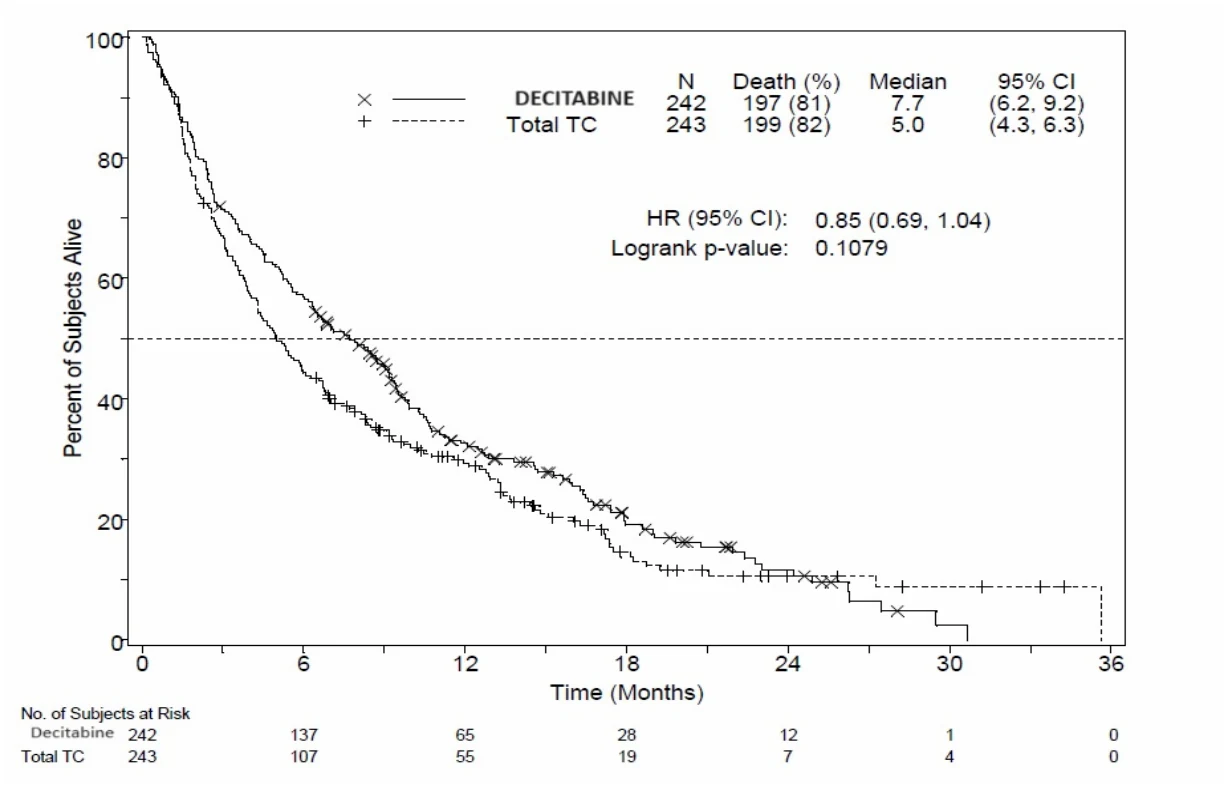
In an analysis with an additional 1 year of mature survival data, the effect of decitabine on overall survival demonstrated a clinical improvement compared to the TC arm (7.7 months vs. 5.0 months, respectively, hazard ratio = 0.82, 95% CI: 0.68, 0.99, nominal p-value = 0.0373, Figure 2).
Figure 2. Analysis of mature overall survival data (ITT population)
Based on the initial analysis in the ITT population, a statistically significant difference in complete remission rate (CR + CRp) was achieved in favour of subjects in the decitabine arm, 17.8% (43/242) compared to the TC arm, 7.8% (19/243); treatment difference 9.9% (95% CI: 4.07; 15.83), p = 0.0011.
The median time to best response and median duration of best response in patients who achieved a CR or CRp were 4.3 months and 8.3 months, respectively. Progression-free survival was significantly longer for subjects in the decitabine arm, 3.7 months (95% CI: 2.7, 4.6) compared with subjects in the TC arm, 2.1 months (95% CI: 1.9, 3.1); hazard ratio 0.75 (95% CI: 0.62, 0.91), p = 0.0031.
These results as well as other endpoints are shown in Table 2.
Table 2: Other efficacy endpoints for Study DACO-016 (ITT population)
| Outcomes | Decitabine n = 242 | TC (combined group) n = 243 | p-value |
| CR + CRp | 43 (17.8%) | 19 (7.8%) | 0.0011 |
| OR = 2.5 (1.40, 4.78)b | |||
| CR | 38 (15.7%) | 18 (7.4%) | - |
| EFSa | 3.5 (2.5, 4.1)b | 2.1 (1.9, 2.8)b | 0.0025 |
| HR = 0.75 (0.62, 0.90)b | |||
| PFSa | 3.7 (2.7, 4.6)b | 2.1 (1.9, 3.1)b | 0.0031 |
| HR = 0.75 (0.62, 0.91)b | |||
CR = complete remission; CRp = complete remission with incomplete platelet recovery,
EFS = event-free survival,
PFS = progression-free survival, OR = odds ratio, HR = hazard ratio
- = Not evaluable
a Reported as median months
b 95% confidence intervals
Overall survival and complete remission rates in pre-specified disease-related sub-groups (i.e., cytogenetic risk, Eastern Cooperative Oncology Group [ECOG] score, age, type of AML, and baseline bone marrow blast count) were consistent with results for the overall study population.
The use of decitabine as initial therapy was also evaluated in an open-label, single-arm, Phase II study (DACO-017) in 55 subjects > 60 years with AML according to the WHO classification. The primary endpoint was complete remission (CR) rate that was assessed by independent expert review. The secondary endpoint of the study was overall survival. Decitabine was administered as a 1-hour intravenous infusion of 20 mg/m2 once daily for 5 consecutive days repeated every 4 weeks. In the ITT analysis, a CR rate of 23.6% (95% CI: 13.2, 37) was observed in 13/55 subjects treated with decitabine. The median time to CR was 4.1 months, and the median duration of CR was 18.2 months. The median overall survival in the ITT population was 7.6 months (95% CI: 5.7, 11.5).
The efficacy and safety of decitabine has not been evaluated in patients with acute promyelocytic leukaemia or CNS leukaemia.
Paediatric population
A Phase I/II open-label, multicentre study evaluated the safety and efficacy of decitabine in sequential administration with cytarabine in children aged 1 month to < 18 years with relapsed or refractory AML. A total of 17 subjects were enrolled and received decitabine 20 mg/m2 in this study, of which 9 subjects received cytarabine 1 g/m2 and 8 subjects received cytarabine administered at the maximum tolerable dose of 2 g/m2. All subjects discontinued the study treatment. The reasons for treatment discontinuation included disease progression (12 [70.6%] subjects), subjects proceeding to transplant (3 [17.6%]), investigator decision (1 [5.9%]), and “other” (1 [5.9%]). Reported adverse events were consistent with the known safety profile of decitabine in adults (see section 4.8). Based on these negative results, decitabine should not be used in children with AML aged < 18 years, because efficacy was not established (see section 4.2).
5.2 Pharmacokinetic properties
The population pharmacokinetic (PK) parameters of decitabine were pooled from 3 clinical studies in 45 patients with AML or myelodysplastic syndrome (MDS) utilizing the 5-Day regimen. In each study, decitabine PK was evaluated on the fifth day of the first treatment cycle.
Distribution
The pharmacokinetics of decitabine following intravenous administration as a 1-hour infusion were described by a linear two-compartment model, characterised by rapid elimination from the central compartment and by relatively slow distribution from the peripheral compartment. For a typical patient (weight 70 kg/body surface area 1.73 m2) the decitabine pharmacokinetic parameters are listed in the Table 3 below.
Table 3: Summary of population PK analysis for a typical patient receiving daily 1-hour infusions of Decitabine 20 mg/m2 over 5 days every 4 weeks
| Parameter a | Predicted Value | 95% CI |
| Cmax (ng/ml) | 107 | 88.5 - 129 |
| AUCcum (ng.h/ml) | 580 | 480 - 695 |
| t1/2 (min) | 68.2 | 54.2 - 79.6 |
| Vdss (L) | 116 | 84.1 - 153 |
| CL (L/h) | 298 | 249 - 359 |
a The total dose per cycle was 100 mg/m2
Decitabine exhibits linear PK and following the intravenous infusion, steady-state concentrations are reached within 0.5 hour. Based on model simulation, PK parameters were independent of time (i.e., did not change from cycle to cycle) and no accumulation was observed with this dosing regimen.
Plasma protein binding of decitabine is negligible (< 1%). Decitabine Vdss in cancer patients is large indicating distribution into peripheral tissues. There was no evidence of dependencies on age, creatinine clearance, total bilirubin, or disease.
Biotransformation
Intracellularly, decitabine is activated through sequential phosphorylation via phosphokinase activities to the corresponding triphosphate, which is then incorporated by the DNA polymerase. In vitro metabolism data and the human mass balance study results indicated that the cytochrome P450 system is not involved in the metabolism of decitabine. The primary route of metabolism is likely through deamination by cytidine deaminase in the liver, kidney, intestinal epithelium and blood. Results from the human mass-balance study showed that unchanged decitabine in plasma accounted for approximately 2.4% of total radioactivity in plasma.
The major circulating metabolites are not believed to be pharmacologically active. The presence of these metabolites in urine together with the high total body clearance and low urinary excretion of unchanged decitabine in the urine (~4% of the dose) indicate that decitabine is appreciably metabolised in vivo.
In vitro studies show that decitabine does not inhibit nor induce CYP 450 enzymes up to more than 20-fold of the therapeutic maximum observed plasma concentration (Cmax). Thus, CYP-mediated metabolic drug interactions are not anticipated, and decitabine is unlikely to interact with agents metabolised through these pathways. In addition, in vitro data show that decitabine is a poor P-gp substrate.
Elimination
Mean plasma clearance following intravenous administration in cancer subjects was > 200 L/h with moderate inter-subject variability (coefficient of variation [CV] is approximately 50%). Excretion of unchanged drug appears to play only a minor role in the elimination of decitabine.
Results from a mass balance study with radioactive 14C-decitabine in cancer patients showed that 90% of the administered dose of decitabine (4% unchanged drug) is excreted in the urine.
Additional information on special populations
The effects of renal or hepatic impairment, gender, age or race on the pharmacokinetics of decitabine have not been formally studied. Information on special populations was derived from pharmacokinetic data from the 3 studies noted above, and from one Phase I study in MDS subjects, (N = 14;15 mg/m2 x 3-hours q8h x 3 days).
Elderly
Population pharmacokinetic analysis showed that decitabine pharmacokinetics are not dependent on age (range studied 40 to 87 years; median 70 years).
Paediatric population
Population PK analysis of decitabine showed that after accounting for body size, there is no difference between decitabine PK parameters in paediatric AML patients versus adults with AML or MDS.
Gender
Population pharmacokinetic analysis of decitabine did not show any clinically relevant difference between men and women.
Race
Most of the patients studied were Caucasian. However, the population pharmacokinetic analysis of decitabine indicated that race had no apparent effect on the exposure to decitabine.
Hepatic impairment
The PK of decitabine have not been formally studied in patients with hepatic impairment. Results from a human mass-balance study and in vitro experiments mentioned above indicated that the CYP enzymes are unlikely to be involved in the metabolism of decitabine. In addition, the limited data from the population PK analysis indicated no significant PK parameter dependencies on total bilirubin concentration despite a wide range of total bilirubin levels. Thus, decitabine exposure is not likely to be affected in patients with impaired hepatic function.
Renal impairment
The PK of decitabine have not been formally studied in patients with renal insufficiency. The population PK analysis on the limited decitabine data indicated no significant PK parameter dependencies on normalised creatinine clearance, an indicator of renal function. Thus, decitabine exposure is not likely to be affected in patients with impaired renal function.
5.3 Preclinical safety data
Formal carcinogenicity studies have not been performed with decitabine. Evidence from the literature indicates that decitabine has carcinogenic potential. The available data from in vitro and in vivo studies provide sufficient evidence that decitabine has genotoxic potential. Data from the literature also indicate that decitabine has adverse effects on all aspects of the reproductive cycle, including fertility, embryo-foetal development and post-natal development. Multi-cycle repeat-dose toxicity studies in rats and rabbits indicated that the primary toxicity was myelosuppression, including effects on bone marrow, which was reversible on cessation of treatment. Gastrointestinal toxicity was also observed and in males, testicular atrophy which did not reverse over the scheduled recovery periods. Decitabine administration to neonatal/juvenile rats showed a comparable general toxicity profile as in older rats. Neurobehavioural development and reproductive capacity were unaffected when neonatal/juvenile rats were treated at dose levels inducing myelosuppression. See section 4.2 for information on paediatric use.
6 PHARMACEUTICAL PARTICULARS
6.1 List of excipients
Potassium dihydrogen phosphate (E340)
Sodium hydroxide (E524)
Hydrochloric acid (for pH adjustment)
6.2 Incompatibilities
This medicinal product must not be mixed with other medicinal products except those mentioned in section 6.6.
6.3 Shelf life
Unopened vial 3 years.
Reconstituted and diluted solution
Within 15 minutes of reconstitution, the concentrate (in 10 ml of sterile water for injections) must be further diluted with cold (2 °C – 8 °C) infusion fluids. This prepared diluted solution for intravenous infusion can be stored at 2 °C – 8 °C for up to a maximum of 3 hours, followed by up to 1 hour at room temperature (20 °C – 25 °C) before administration.
From a microbiological point of view, the product should be used within the time period recommended above. It is the responsibility of the user to follow the recommended storage times and conditions and ensure that reconstitution has taken place in aseptic conditions.
6.4 Special precautions for storage
Do not store above 25 °C.
For storage conditions after reconstituition and dilution of the medicinal product, see section 6.3.
6.5 Nature and contents of container
50 ml clear colourless Type I glass vial sealed with a butyl rubber stopper and an aluminium seal with plastic flip-off cap containing 50 mg decitabine.
Pack size: 1 vial.
6.6 Special precautions for disposal
Recommendations for safe handling
Skin contact with the solution should be avoided and protective gloves must be worn. Standard procedures for dealing with cytotoxic medicinal products should be adopted.
Reconstitution procedure
The powder should be aseptically reconstituted with 10 ml of water for injections. Upon reconstitution, each ml contains approximately 5 mg of decitabine at pH 6.7 to 7.3. Within 15 minutes of reconstitution, the solution must be further diluted with cold infusion fluids (sodium chloride 9 mg/ml [0.9%] solution for injection or 5% glucose solution for injection) to a final concentration of 0.15 to 1.0 mg/ml. For the shelf-life and the precaution for storage after reconstitution, see section 6.3.
Decitabine should not be infused through the same intravenous access/line with other medicinal products.
Disposal
This medicinal product is for single use only. Any unused medicinal product or waste material should be disposed of in accordance with local requirements.
7 MARKETING AUTHORISATION HOLDER
Hikma Farmacêutica (Portugal), S.A.
Estrada do Rio da Mó n.º 8, 8A e 8B – Fervença
2705-906 Terrugem SNT
Portugal
8 MARKETING AUTHORISATION NUMBER(S)
PL 15413/0188
9 DATE OF FIRST AUTHORISATION/RENEWAL OF THE
AUTHORISATION
03/07/2026
10 DATE OF REVISION OF THE TEXT
03/07/2026