


Patient leaflet - Celluvisc 1% eye drops solution
1. What Celluvisc is and what it is used for
Celluvisc is a tear substitute and contains the lubricant called carmellose sodium. It is used for the treatment of the symptoms of dry eye (such as soreness, burning, irritation or dryness).
You must talk to a doctor if you do not feel better or if you feel worse.
2. What you need to know before you use Celluvisc
Do not use Celluvisc
- If you are allergic (hypersensitive) to carmellose sodium or any of the other ingredients of this medicine (listed in section 6).
Warnings and precautions
- If you wear contact lenses, these should be removed before using Celluvisc. The lenses can be put back again 15 minutes after you have applied your drops.
Other medicines and Celluvisc
Please tell your doctor or pharmacist if you are using, have recently used or might use any other medicines, including medicines obtained without a prescription.
If you are using other eye drops, leave at least 15 minutes before putting in Celluvisc.
Pregnancy and breast-feeding
Celluvisc can be used during pregnancy and breast-feeding.
Driving and using machines
Celluvisc may cause short-lasting blurring of vision typically lasting 1 - 15 minutes. If you do experience temporary blurring, do not drive or use machines until your sight is clear.
3. How to use Celluvisc
Celluvisc is for ocular use (applied on the eye).
Always use this medicine exactly as described in this leaflet or as your doctor, pharmacist or nurse has told you. Check with your doctor, pharmacist or nurse if you are not sure.
The recommended dose is 1-2 drops of Celluvisc in the affected eyes as needed.
Make sure that the single-dose container is intact before use. The solution should be used immediately after opening.
To avoid contamination or possible eye injury, do not let the open-end of the single-dose container touch your eye or anything else. Wash your hands before use.
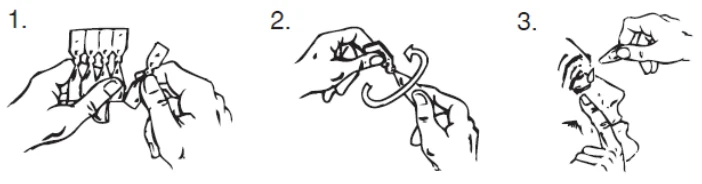
- 1. Tear one single-dose container from the strip.
- 2. Hold the single-dose container upright (with the cap uppermost) and twist off the cap.
- 3. Gently pull down the lower eyelid to form a pocket. Turn the single-dose container upside down and squeeze it to release one drop into each eye. Blink your eyes a few times.
Do not re-use the single-dose container even if there is some solution left. It is most important that you throw it away and do not keep it.
If irritation, pain, redness or changes in vision occur or if you feel your condition is getting worse, stop taking this medicine and consult your doctor or pharmacist.
If you use more Celluvisc than you should
It will not cause you any harm. If you are worried, talk to your doctor or pharmacist.
If you forget to use Celluvisc
Apply your next dose as required or at the normal time as directed by your pharmacist or doctor. Do not take a double dose to make up for forgotten individual doses.
If you have any further questions on the use of this medicine, ask your doctor, pharmacist or nurse.
4. Possible side effects
Like all medicines, this medicine can cause side effects, although not everybody gets them.
The following adverse reactions or medically relevant adverse events were reported during clinical trials:
Common side effects (occurring in between 1 and 10 patients in every 100) are:
Eye irritation (including burning and discomfort), eye pain, itchy eyes, visual disturbance.
Post-Marketing Data
The following adverse reactions or medically relevant adverse events have been reported since the drug has been marketed:
Uncommon side effects (occurring in between 1 and 10 patients in every 1000) are:
Allergic reactions (including eye or eyelid swelling), blurring of vision, increase in tear production (also known as tearing), sticky eye, crusting of the eyelid and/or drug residue, a feeling that something is in your eye, redness of the eye/eyelid, eyesight worsening, eye injury to the surface of the eye due to the tip of the vial touching the eye during use.
If any of the side effects gets serious, or if you notice any side effects not listed in this leaflet, please tell your doctor or pharmacist.
Reporting of side effects
If you get any side effects, talk to your doctor, pharmacist or nurse. This includes any possible side effects not listed in this leaflet. You can also report side effects directly via the Yellow Card Scheme at: www.mhra.gov.uk/yellowcard or search for MHRA Yellow Card in the Google Play or Apple App Store. By reporting side effects, you can help provide more information on the safety of this medicine.
5. How to store Celluvisc
Keep out of the sight and reach of children.
Do not store above 25°C.
Do not use after the expiry/use before date on the vial tab/carton.
Do not use this medicine if you notice that the packaging is damaged.
Do not use if the solution has changed colour or has become cloudy.
Keep the single dose containers in the pouch and place the pouch back in the outer carton. Pouch is required to prevent moisture loss.
If the product shows any signs of deterioration or discolouration consult your pharmacist for advice.
Medicines should not be disposed of via wastewater or household waste. Ask your pharmacist how to dispose of medicines no longer required. These measures will help to protect the environment.
6. Contents of the pack and other information
What Celluvisc contains
- The active substance is carmellose sodium 10 mg/ml.
- The other ingredients are sodium chloride, sodium lactate, potassium chloride, calcium chloride and purified water.
The ingredients in Celluvisc were designed to match your natural tear composition.
Celluvisc 1% Eye Drops are available in pack sizes of 30 or 60 foil-pouched single-dose containers.
Each foil pouch contains 10 single-dose containers.
The single-dose container has a twist-off cap. Each single-dose container contains 0.4 ml of solution.
Celluvisc 1% Eye Drops are manufactured by: Allergan Pharmaceuticals Ireland, Castlebar Road, Westport, Co. Mayo, Ireland. Procured from within the EU. Product Licence Holder: Quadrant Pharmaceuticals Ltd. Lynstock House, Lynstock Way, Lostock, Bolton, BL6 4SA. Repackaged by: Maxearn Limited, Unit 29, Oakhill Trading Estate, Devonshire Road, Worsley, Manchester, M28 3PT.
PL 20774/0948 CELLUVISC 1% Eye Drops Solution
Leaflet revised 13th July 2022
CELLUVISC is a registered trademark of Allergan Inc
Blind or partially sighted?
Is this leaflet hard to see or read?
Contact Quadrant
Pharmaceuticals Ltd,
Tel: 01204 471 269
L-02-0948-01
P