

Patient leaflet - Geltears
1. What GelTears is and what it is used for?
GelTears is a clear colourless liquid gel and contains a lubricant that is used as a substitute for natural tears. Your eyes will normally produce just enough natural tears to allow them to move easily and comfortably. If your eyes do not produce enough tears they can become dry and irritated. It can also be used in patients who suffer from sore eyes because their tear film is unstable. GelTears will help keep your eyes comfortable.
2. What you need to know before you use GelTears
Do not use GelTears if you are allergic to any of the ingredients of this medicine (listed in section 6).
Other medicines and GelTears
If GelTears is used at the same time with other eye drops/eye ointments, there should be an application time interval of approximately 15 minutes between use of such other medications and GelTears should always be the last medication to be applied. Tell your doctor or pharmacist if you are taking, have recently or might take any other medicines.
Warnings and Precautions
Your vision may become blurred if too much gel is added at one time, or if you use your medicine more often than is required. This effect can last for up to an hour. If you are affected you may be able to speed up recovery of normal vision by blinking vigorously for a few seconds. If this does not work, try gently rubbing the eyelid. This should help the gel to collect in the conjunctival sac beneath the eye where it will no longer interfere with your vision.
Children and adolescents aged to 18 years:
The safety and efficacy of GelTears in children and adolescents at the posology recommended in adults has been established by clinical experience, but no clinical trial data are available.
Pregnancy, breast-feeding and fertility
Do not use GelTears if you are pregnant, may be pregnant, or are breastfeeding. Ask your doctor or pharmacist for advice.
Contact lenses
Take special care with GelTears if you wear contact lenses. Contact lenses should be removed during treatment with GelTears. And then wait for 15 minutes after application before putting them back in.
Benzalkonium chloride is used as a preservative in GelTears, and is known to be absorbed by soft contact lenses. Over time benzalkonium chloride can collect in soft contact lenses, and therefore may cause irritation, or discolour the lenses. Therefore use of Geltears while using soft contact lenses is not recommended. GelTears can, however, be used with daily disposable lenses because a new pair is used each day. Driving and using machines
As with all eye preparations, you may have blurred vision for a little while after putting the gel in. Wait until your vision is clear before driving or using machines.
3. How to use GelTears
Always use this medicine exactly as described in this leaflet or as your doctor or pharmacist has told you. Check with your doctor or pharmacist if you are not sure. You should take care not to touch the end of the dropper nozzle onto your eyes, fingers or any other surface. Remember to replace the cap after use. The recommended dose is to place one drop of gel in the corner of the eye, nearest the nose, 3 to 4 times each day and approximately 30 minutes before going to bed. Children and adolescents aged to 18 years
The safety and efficacy of GelTears in children and adolescents at the posology recommended in adults has been established by clinical experience, but no clinical trial data are available.
The amount of gel used should be enough to cover the eye properly. Follow these instructions carefully.
- 1. Wash hands thoroughly.
- 2. Twist off the cap.
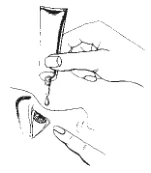 3. Look upwards and gently pull down the lower eyelid.
 - 4. Hold the GelTears tube just above your eye and gently squeeze until some gel falls into the gap between your eyeball and lower eyelid.
- 5. Release the lower eyelid, and move your eye while open to ensure the gel covers the eye completely.
- 6. Repeat the process in the other eye if necessary.
If you use more GelTears than you should it is very unlikely that you will suffer an overdose, but if you suddenly feel unwell after using the gel, tell your doctor or eye specialist.
If you forget to use your medicine, use it as soon as you remember and then continue as before.
4. Possible side effects
Like all medicines, this medicine can cause side effects, although not everybody gets them. Your eyes may sting a little when the drops are put in. These effects will wear off within a few minutes.
Regulatory
Bausch + Lomb ULOTKA PIL
Nazwa produktu
Product Name
GelTears
Carbomer 0,2% w/w
eye gel
Kolor nadruku Colours
Kraj
Country (ISO) United Kingdom (UK) Nr wykrojnika
Spec No 12036
Opracowane przez
Designed by
Kod Wytwórcy
Manufacturer code 49202PB574/8-UK
PIL size 120 x 360 mm
Krój czcionki
Font used
Frutiger Neue LT W1G
Condensed
Frutiger Neue LT W1G
Bold Condensed
Gramatura papieru
Paper weight
up to manufacturer
Komentarze Comments (Reason for the change)
- PMR_BNL-24-0141-A
- Carton: Update pack codes to remove Ireland, delete/update MA holder details, insert UK Only text. Leaflet: Update pack codes to remove Ireland, update reporting information text, update MA holder section, remove trademark statement, update revision date. Label: Update pack codes to remove Ireland, delete license no. text
- Manufacturing site: DMP Berlin
Akceptacja Techniczna Technical Approval
Akceptacja Działu ds. Rejestracji Regulatory Affairs Dept. Approval
Visual disturbance, blurred vision and irritation with prolonged use may occur. A few reports of allergy have been received following use of GelTears eye gel. This is due to one of the ingredients in the formulation. If you develop pain, swelling or redness in or around the eyes, you should stop using your medicine and consult your doctor or pharmacist.
- If you experience any other undesirable effects whilst using this medicine, please talk to your doctor or pharmacist.
Reporting of side effects
If you get any side effects, talk to your doctor, pharmacist or nurse. This includes any possible side effects not listed in this leaflet. You can also report side effects directly via the Yellow Card Scheme. Website: www.mhra.gov.uk/yellowcard or search for MHRA Yellow Card in the Google Play or Apple App Store.
By reporting side effects you can help provide more information on the safety of this medicine.
5. How to store GelTears
Keep this medicine out of the sight and reach of children.
- Do not use the eye gel after the expiry date which is stated on the tube and the carton after the letters “EXP”. The expiry date refers to the last day of that month.
- Store GelTears eye gel below 25ºC (normal room temperature).
- GelTears is sterile until first opened. It is important to keep the tube as clean as possible during use.
- The tube has a flat cap, which allows it to stand in an upright position.
- Dispose of any remaining contents 28 days after first opening the tube. It may be helpful to make a written record on the tube of the date on which you opened it.
- Remember this medicine is for you. Do not give it to someone else.
- Do not throw away any medicines via wastewater or household waste. Ask your pharmacist how to throw away medicines you no longer use. These measures will help protect the environment.
6. Contents of the pack and other information
What GelTears contains
- The active substance is Carbomer. Each tube contains 2.0mg of carbomer in each 1g of gel.
- The other ingredients are benzalkonium chloride, sorbitol, sodium hydroxide (for pH adjustment) and water for injection.
What GelTears looks like and contents of the pack
GelTears is a clear colourless gel. Each tube contains 10 g of eye gel. Marketing Authorisation Holder
Bausch & Lomb UK Ltd.,
106 London Road, Kingston-upon-Thames, Surrey, KT2 6TN, United Kingdom Manufacturer
Dr. Gerhard Mann, Chem.-pharm. Fabrik GmbH
Brunsbuetteler Damm 165/173
13581 Berlin, Germany
FURTHER INFORMATION
GelTears is used for the symptomatic treatment of ‘dry eye’, which is a dehydration of the surface of the eye resulting from disturbances in tear secretion or tear quality. The dry eye condition can also be caused when it is not possible to close your eyelids either partly or completely.
This condition is so common that one in five patients who go to see an ophthalmologist suffers from a dry eye condition. There are many causes, such as reduced tear production in old age, air-conditioned rooms, computer work, hormonal changes during menopause, etc. Environmental and climatic effects can also play a role in the development of dry eye conditions.
What do we understand by the term “dry eye”?
During the course of the day we blink 14,000 times on an average. With each blinking motion of the eye, a very thin tear film is distributed over the surface of the eyeball, which keeps it smooth, clean and moist, and protects the eye from pollutants. When the volume or the composition of the tear film is disturbed, desiccation phenomena (drying out) of the cornea and conjunctiva occur and the patient experiences symptoms such as burning, dry eye sensation, gritty feeling, feeling of pressure, and sensitivity to light.
Geltears is a soothing gel solution which moistens the eye and provides tear-like lubrication to the eyes and eyelids. The carbomer in GelTears increases the thickness of the gel which assists the gel in remaining in contact with the eye for a longer period of time.
Your ophthalmologist prescribed a tear substitute for the alleviation of your complaints. In addition to using the preparation consistently as directed, you should follow the recommendations below:
- Let fresh air into your apartment or house several times a day
- Take care that you drink sufficiently
- Go out into the fresh air frequently
- Do not direct air vents towards your eyes
- Take breaks when working in front of a computer screen.
It is, however, also important that you consult your ophthalmologist regularly for follow-up examinations, because dry eye conditions may lead to a serious disease if they are treated incorrectly or inadequately.
This was last revised in: March 2024
P1UK04
49202PB574/8-UK