

Patient leaflet - Bimatoprost/timolol 0.3 mg/ml + 5 mg/ml eye, drops solution
WHAT BIMATOPROST/TIMOLOL IS AND WHAT IT IS USED FOR
Bimatoprost/Timolol contains two different active substances (bimatoprost and timolol) that both reduce pressure in the eye. Bimatoprost belongs to a group of medicines called prostamides, a prostaglandin analogue. Timolol belongs to a group of medicines called beta-blockers. Your eye contains a clear, watery liquid that feeds the inside of the eye. Liquid is constantly being drained out of the eye and new liquid is made to replace this. If the liquid cannot drain out quickly enough, the pressure inside the eye builds up and could eventually damage your sight (an illness called glaucoma). Bimatoprost/Timolol works by reducing the production of liquid and also increasing the amount of liquid that is drained. This reduces the pressure inside the eye. Bimatoprost/Timolol eye drops are used to treat high pressure in the eye in adults, including the elderly. This high pressure can lead to glaucoma. Your doctor will prescribe you Bimatoprost/Timolol when other eye drops containing beta-blockers or prostaglandin analogues have not worked sufficiently on their own.
WHAT YOU NEED TO KNOW BEFORE YOU USE BIMATOPROST/TIMOLOL
Do not use Bimatoprost/Timolol
- if you are allergic to bimatoprost, timolol, beta-blockers or any of the other ingredients of Bimatoprost/Timolol (listed in section 6)
if you have now or have had in past respiratory problems such as asthma and/or severe chronic obstructive pulmonary disease (lung disease which may cause wheeziness, difficulty in breathing and/ or long-standing cough) or other types of breathing problems
- if you have heart problems such as low heart rate, heart block, or heart failure.
Warnings and precautions
Talk to your doctor, pharmacist or nurse before using Bimatoprost/Timolol if you have now or have had in the past
- coronary heart disease (symptoms can include chest pain or tightness,
 breathlessness or choking), heart failure, low blood pressure,
  - disturbances of heart rate such as slow heartbeat
 - breathing problems, asthma or chronic obstructive pulmonary disease
- poor blood circulation disease (such as Raynaud’s disease or Raynaud’s syndrome)
- overactivity of the thyroid gland as timolol may mask signs and symptoms of thyroid disease
- diabetes as timolol may mask signs and symptoms of low blood sugar
- severe allergic reactions
- liver or kidney problems
- eye surface problems
- separation of one of the layers within the eyeball after surgery to reduce the pressure in the eye
- known risk factors for macular oedema (swelling of the retina within the eye leading to worsening vision), for example, cataract surgery.
Tell your doctor before surgical anaesthesia that you are using
Bimatoprost/Timolol as timolol may change effects of some medicines used during anaesthesia.
Bimatoprost/Timolol may cause your eyelashes to darken and grow and cause the skin around the eyelid to darken too. The colour of your iris may also go darker over time.
These changes may be permanent. The change may be more noticeable if you are only treating one eye. Bimatoprost/Timolol may cause hair growth when in contact with the skin surface.
Children and adolescents
Bimatoprost/Timolol should not be used in children and teenagers under 18.
Other medicines and Bimatoprost/Timolol
Tell your doctor or pharmacist if you are taking, have recently taken or might take any other medicines.
Bimatoprost/Timolol can affect or be affected by other medicines you are using, including other eye drops for the treatment of glaucoma. Tell your doctor if you are using or intend to use medicines to lower blood pressure, heart medicine, medicines to treat diabetes, quinidine (used to treat heart conditions and some types of malaria) or medicines to treat depression known as fluoxetine and paroxetine.
Pregnancy and breast-feeding
If you are pregnant or breast-feeding, think you may be pregnant or are planning to have a baby, ask your doctor or pharmacist for advice before taking this medicine. Do not use Bimatoprost/Timolol if you are pregnant unless your doctor still recommends it.
Do not use Bimatoprost/Timolol if you are breast-feeding.
Timolol may get into your breast milk.
Ask your doctor for advice before taking any medicine during breast-feeding.
Driving and using machines
Bimatoprost/Timolol may cause blurred vision in some patients. Do not drive or use machines until the symptoms have cleared.
Bimatoprost/Timolol contains benzalkonium chloride
Bimatoprost/Timolol contains a preservative called benzalkonium chloride. This medicine contains 0.15 mg benzalkonium chloride in each 3 ml of solution which is equivalent to 0.05 mg/ml.
Benzalkonium chloride may be absorbed by soft contact lenses and may change the colour of the contact lenses. You should remove contact lenses before using this medicine and put them back 15 minutes afterwards. Benzalkonium chloride may also cause eye irritation, especially if you have dry eyes or disorders of the cornea (the clear layer at the front of the eye).
If you feel abnormal eye sensation, stinging or pain in the eye after using this medicine, talk to your doctor.
HOW TO USE BIMATOPROST/TIMOLOL
Always use Bimatoprost/Timolol exactly as your doctor or pharmacist has told you. Check with your doctor or pharmacist if you are not sure.
The usual dose is one drop once a day, either in the morning or in the evening in each eye that needs treatment. Use at the same time each day.
Instructions for use
You must not use the bottle if the tamper-proof seal on the
bottle neck is broken before you first use it. After the cap is
removed, if the tamper-proof seal collar is loose, remove it
before using the product.
- 1. Wash your hands. Tilt your head back and look at the ceiling.
- 2. Gently pull down the lower eyelid until there is a small pocket. As shown in image 2.
- 3. Turn the bottle upside down and squeeze it to release one drop into each eye that needs treatment. As shown in image 3.
- 4. Let go of the lower lid and close your eye. As shown in image 4.
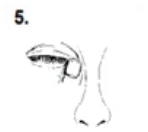
- 5. Whilst keeping the eye closed, press your finger against the corner of the closed eye (the site where the eye meets the nose) and hold for 2 minutes, as shown in image 5. This helps to stop Bimatoprost/Timolol getting into the rest of the body.
If a drop misses your eye, try again.
To avoid contamination, do not let the tip of the bottle touch your eye or anything else. Put the cap back on and close the bottle straight after you have used it.
2.
1.
3.
If you use Bimatoprost/Timolol with another eye medicine, leave at least 5 minutes between putting in Bimatoprost/Timolol and the other medicine. Use any eye ointment or eye gel last.
If you use more Bimatoprost/Timolol than you should
If you use more Bimatoprost/Timolol than you should, it is unlikely to cause you any serious harm. Put your next dose in at the usual time. If you are worried, talk to your doctor or pharmacist.
If you forget to use Bimatoprost/Timolol
If you forget to use Bimatoprost/Timolol, use a single drop as soon as you remember, and then go back to your regular routine. Do not use a double dose to make up for a forgotten dose.
If you stop using Bimatoprost/Timolol
Bimatoprost/Timolol should be used every day to work properly.
If you have any further questions on the use of this medicine, ask your doctor, pharmacist or nurse.
POSSIBLE SIDE EFFECTS
Like all medicines, this medicine can cause side effects, although not everybody gets them. You can usually carry on taking the drops, unless the effects are serious. If you’re worried, talk to a doctor or pharmacist. Do not stop using Bimatoprost/Timolol without speaking to your doctor.
The following side effects may be seen with Bimatoprost/Timolol:
Very common side effects
May affect more than 1 in 10 people
Affecting the eye
redness.
Common side effects
May affect up to 1 in 10 people
Affecting the eye
burning, itching, stinging, irritation of the conjunctiva (see-through layer of the eye), sensitivity to light, eye pain, sticky eyes, dry eyes, a feeling of something in the eye, small breaks in the surface of the eye with or without inflammation, difficulty in seeing clearly, redness and itching of the eyelids, hair growing around the eye, darkening of the eyelids, darker skin colour around the eyes, longer eyelashes, eye irritation, watery eyes, swollen eyelids, reduced vision.
Affecting other parts of the body
runny nose, headache.
Uncommon side effects
May affect up to 1 in 100 people
Affecting the eye
abnormal sensation in the eye, iris inflammation, swollen conjunctiva (see-through layer of the eye), painful eyelids, tired eyes, in-growing eyelashes, darkening of iris colour, eyes appear sunken, eyelid drooping, eyelid shrinking (moving away from the surface of the eye leading to incomplete closure of the eyelids),skin tightness of the eyelids, darkening of eyelashes.
Affecting other parts of the body
shortness of breath.
Side effects where the frequency is not known
Affecting the eye
cystoid macular oedema (swelling of the retina within the eye leading to worsening vision), eye swelling, blurred vision, ocular discomfort.
Affecting other parts of the body
difficulty breathing / wheezing, symptoms of allergic reaction (swelling, redness of the eye and rash of the skin), changes in your taste sensation, dizziness, slowing of heart rate, high blood pressure, difficulty sleeping, nightmare, asthma, hair loss, skin discolouration (periocular), tiredness.
Additional side effects have been seen in patients using eye drops containing timolol or bimatoprost and so may possibly be seen with Bimatoprost/Timolol. Like other medicines applied into eyes, timolol is absorbed into the blood. This may cause similar side effects as seen with “intravenous” and /or “oral” beta-blocking agents. The chance of having side effects after using eye drops is lower than when medicines are for example, taken by mouth or injected. Listed side effects include reactions seen within bimatoprost and timolol when used for treating eye conditions:
- Severe allergic reactions with swelling and difficulty breathing which could be life-threatening.
- Low blood sugar.
- Depression; memory loss; hallucination.
- Fainting; stroke; decreased blood flow to the brain; worsening of myasthenia gravis (increased muscle weakness); tingling sensation.
- Decreased sensation of your eye surface; double vision; drooping eyelid; separation of one of the layers within the eyeball after surgery to reduce the pressure in the eye; inflammation of the surface of the eye, bleeding in the back of the eye (retinal bleeding), inflammation within the eye, increased blinking.
- Heart failure; irregularity or stopping of the heartbeat; slow or fast heartbeat; too much fluid, mainly water, accumulating in the body; chest pain.
- Low blood pressure, swelling or coldness of your hands, feet and extremities, caused by constriction of your blood vessels.
- Cough, worsening of asthma, worsening of the lung disease called chronic obstructive pulmonary disease (COPD).
- Diarrhoea; stomach pain; feeling and being sick; indigestion; dry mouth.
- Red scaly patches on skin; skin rash.
- Muscle pain.
- Reduced sexual urge; sexual dysfunction.
- Weakness.
- An increase in blood test results that show how your liver is working.
Other side effects reported with eye drops containing phosphates This medicine contains 2.68 mg phosphates in each 3 ml of solution which is equivalent to 0.89 mg/ml. If you suffer from severe damage to the clear layer at the front of the eye (the cornea), phosphates may cause in very rare cases cloudy patches on the cornea due to calcium build-up during treatment.
Reporting of side effects
If you get any side effects, talk to your doctor, pharmacist, or nurse. This includes any possible side effects not listed in this leaflet. You can also report side effects directly via the Yellow Card Scheme Website: www.mhra.gov.uk/yellowcard or search for MHRA Yellow Card in the Google Play or Apple App Store. By reporting side effects you can help provide more information on the safety of this medicine.
HOW TO STORE BIMATOPROST/TIMOLOL
Keep this medicine out of the sight and reach of children.
Do not use this medicine after the expiry date which is stated on the label and carton after EXP. The expiry date refers to the last day of that month.
Store below 25°C. Discard 28 days after first opening.
Do not throw away any medicines via wastewater or household waste. Ask your pharmacist how to throw away medicines you no longer use. These measures will help protect the environment.
CONTENTS OF THE PACK AND OTHER
INFORMATION
What Bimatoprost/Timolol contains
- The active substances are bimatoprost 0.3 mg/ml and timolol 5 mg/ml (as maleate).
- The other excipients are benzalkonium chloride, citric acid monohydrate (E 330), sodium phosphate dibasic
heptahydrate (E 339), sodium chloride, hydrochloric acid
(E 507) or sodium hydroxide (E 524) (to adjust the pH) and water for injection.
What Bimatoprost/Timolol looks like and contents of the pack
Clear, colourless to slightly yellow coloured solution in a opaque plastic bottle with opaque nozzle and blue coloured cap, containing 3 ml of solution.
Marketing Authorisation Holder
Kent Pharma UK Limited, 2nd Floor, Connect 38, 1 Dover Place, Ashford, Kent, England, TN23 1FB.
Manufacturer
Kent Pharmaceuticals Limited, Unit 200, Westminster 42,
Westminster Industrial Estate, Repton Road, Measham, Swadlincote, DE12 7DT, United Kingdom.
This leaflet was last revised in August 2026
6.
4.
246 mm
Back
5.
STSXP221KPA