

Patient leaflet - Bevespi Aerosphere 7.2 micrograms / 5 micrograms pressurised inhalation suspension
1. What Bevespi Aerosphere is and what it is used for
Bevespi Aerosphere contains two active substances called glycopyrronium and formoterol fumarate dihydrate. These belong to a group of medicines called long-acting bronchodilators.
Bevespi Aerosphere is used to make breathing easier for adults who have a lung disease called chronic obstructive pulmonary disease (COPD). COPD is a long-term disease of the airways in the lungs, which is often caused by smoking. In COPD, the muscles around the airways tighten which makes breathing difficult.
The medicine prevents the tightening of the muscles around the airways, making it easier for air to get in and out of the lungs.
Bevespi Aerosphere delivers the active substances directly to the airways in your lungs as you breathe in. It will help to reduce the effects of COPD on your everyday life.
2. What you need to know before you use Bevespi Aerosphere
Do not use Bevespi Aerosphere if
- you are allergic to glycopyrronium, formoterol fumarate dihydrate or any of the other ingredients of this medicine (listed in section 6). If you are not sure, talk to your doctor or pharmacist before using Bevespi Aerosphere.
Warnings and precautions
Bevespi Aerosphere is used regularly for long-term treatment of COPD. Do not use this medicine to treat a sudden attack of breathlessness or wheezing.
Immediate breathing difficulties
If you get tightness of the chest, coughing, wheezing or breathlessness immediately after using Bevespi Aerosphere:
Stop using this medicine and seek medical help immediately, as you may have a serious condition called paradoxical bronchospasm.
Talk to your doctor or pharmacist before using Bevespi Aerosphere if
- you have asthma. Do not use this medicine for asthma
- you have heart problems
- you have diabetes
- you have low levels of potassium in the blood
- you have thyroid gland problems (called ‘thyrotoxicosis’)
- you have an eye problem called narrow-angle glaucoma (also called angle-closure glaucoma) • you have prostate problems, or difficulty passing urine
- you have kidney or liver problems
Always tell your doctor about other health problems.
Children and adolescents
Bevespi Aerosphere is not for use in children or adolescents below 18 years of age.
Other medicines and Bevespi Aerosphere
Tell your doctor or pharmacist if you are using, have recently used or might use any other medicines. Some medicines may affect how this medicine works, or make it more likely that you will have side effects. These include:
any medicines that work in the same way as Bevespi Aerosphere, such as medicines containing active substances such as tiotropium, ipratropium, aclidinium, umeclidinium, salmeterol, vilanterol, olodaterol, or indacaterol. Ask your doctor or pharmacist if you are not sure. It is not recommended to use Bevespi Aerosphere together with these medicines; • medicines that lower potassium in your blood. These include:
- corticosteroids that you take by mouth (such as prednisolone), o diuretics (such as furosemide or hydrochlorothiazide) used for high blood pressure, o some medicines used to treat breathing conditions called methylxanthines (such as theophylline);
medicines called beta-blockers that may be used to treat high blood pressure or other heart problems (such as atenolol or propranolol) or to treat glaucoma (such as timolol) • medicines which can prolong ‘QT interval’ (a change in the electrical activity of the heart).
These include medicines for the treatment of:
- depression (such as monoamine oxidase inhibitors or tricyclic antidepressants), o bacterial infections (such as erythromycin, clarithromycin, telithromycin), o allergic reactions (anti-histamines).
If any of the above applies to you, or if you are not sure, talk to your doctor or pharmacist before using Bevespi Aerosphere.
Pregnancy and breast-feeding
If you are pregnant or breast-feeding, think you may be pregnant or are planning to have a baby, ask your doctor or pharmacist for advice before taking Bevespi Aerosphere.
Do not use Bevespi Aerosphere if you are pregnant unless your doctor tells you that you can.
Do not use Bevespi Aerosphere if you are breast-feeding unless your doctor tells you that you can.
Driving and using machines
It is unlikely that this medicine will affect your ability to drive and use machines. However, dizziness and nausea are common side effects which may occur. If this occurs, do not drive or use machines.
3. How to use Bevespi Aerosphere
Always take this medicine exactly as your doctor has told you. Check with your doctor or pharmacist if you are not sure.
How much to use
The recommended dose is two puffs twice a day.
It is important to use Bevespi Aerosphere every day, even if you have no COPD symptoms at the time.
How to use
Bevespi Aerosphere is for inhalation use.
Please read the instructions for use at the end of this leaflet. If you are not sure of how to use Bevespi Aerosphere, contact your doctor or pharmacist.
Using Bevespi Aerosphere with a spacer
If you find it difficult breathing in and pressing the inhaler at the same time talk to your doctor or pharmacist. You may be able to use a ‘spacer’ with your inhaler.
If you use more Bevespi Aerosphere than you should
If you have used more Bevespi Aerosphere than you should, talk to a doctor or pharmacist immediately. You may need medical attention. You may notice that your heart is beating faster than usual, you feel shaky, you have visual disturbances, have a dry mouth, or have a headache or feel nauseous (sick).
If you forget to use Bevespi Aerosphere
Do not take a double dose to make up for a forgotten dose. Take it as soon as you remember. However, if it is nearly time for your next dose, skip the missed dose. Do not take more than two puffs twice a day.
If you stop using Bevespi Aerosphere
This medicine is for long-term use. It will only be effective as long as you are using it. Do not stop unless your doctor tells you to, even if you feel better, as your symptoms may get worse. If you want to stop treatment, first talk to your doctor.
If you have any further questions on the use of this medicine, ask your doctor or pharmacist.
4. Possible side effects
Like all medicines, this medicine can cause side effects, although not everybody gets them.
Serious side effects
Stop using Bevespi Aerosphere and seek immediate medical care if you notice any of the following symptoms:
Uncommon (may affect up to 1 in 100 people)
- swelling of your face, particularly around your mouth (swelling of your tongue or throat may make it difficult to swallow);
- rash or hives together with difficulty breathing
- suddenly feeling faint.
These symptoms may be signs of an allergic reaction which may become serious.
Other possible side effects
Common (may affect up to 1 in 10 people)
- headache
- dry mouth
- feeling sick (nausea)
- painful and frequent urination (may be signs of urinary tract infection) • muscle cramps
- chest pain
- anxiety
- feeling dizzy
Uncommon (may affect up to 1 in 100 people)
- shaking or tremor
- high blood sugar levels
- agitation
- feeling restless
- difficulty sleeping
- fast or irregular heart beat
- difficulty passing urine (urinary retention)
Reporting of side effects
If you get any side effects, talk to your doctor or pharmacist. This includes any possible side effects not listed in this leaflet. You can also report side effects directly via the Yellow Card website: www.mhra.gov.uk/yellowcard or search for MHRA Yellow Card in the Google Play or Apple App Store. By reporting side effects you can help provide more information on the safety of this medicine.
5. How to store Bevespi Aerosphere
Keep this medicine out of the sight and reach of children.
Do not use this medicine after the expiry date which is stated on the carton, pouch and pressurised container after ‘EXP’. The expiry date refers to the last day of that month.
The inhaler can be used for up to 3 months after first opening the pouch. Write the date the pouch is opened on the inhaler label in the space provided.
Do not store above 30oC.
Warning: Do not break, puncture or burn the pressurised container, even when apparently empty. Do not expose to temperatures higher than 50oC.
Do not throw away any medicines via wastewater or household waste. Ask your pharmacist how to throw away medicines you no longer use. These measures will help protect the environment.
6. Contents of the pack and other information
What Bevespi Aerosphere contains
The active substances are glycopyrronium and formoterol fumarate dihydrate.
Each single puff delivers a dose of 9 micrograms glycopyrronium bromide (equivalent to 7.2 micrograms of glycopyrronium), and 5 micrograms of formoterol fumarate dihydrate.
This corresponds to a metered dose (i.e. the dose leaving the valve) of glycopyrronium bromide 10.4 micrograms equivalent to 8.3 micrograms of glycopyrronium, and 5.8 micrograms of formoterol fumarate dihydrate.
The other ingredients are norflurane, 1,2- distearoyl-sn-glycero-3-phosphocholine and calcium chloride.
What Bevespi Aerosphere looks like and contents of the pack
Bevespi Aerosphere is a pressurised inhalation, suspension.
Bevespi Aerosphere comes as a pressurised container with a dose indicator, supplied with a white plastic actuator body and mouthpiece (see Figure 1 of the Instructions for Use at the end of this leaflet). The mouthpiece is covered with an orange protective cap. Bevespi Aerosphere is supplied in a foil pouch that contains a drying packet (desiccant) and packed into a carton.
The active ingredients are present in a pressurised suspension inside the pressurised container.
Bevespi Aerosphere is available in packs containing 1 inhaler with 120 puffs and in multipacks comprising 3 inhalers, each containing 120 puffs.
Not all pack sizes may be marketed.
Marketing Authorisation Holder
AstraZeneca UK Limited,
1 Francis Crick Avenue,
Cambridge,
CB2 0AA,
UK
Manufacturer
AstraZeneca Dunkerque Production
224 Avenue de la Dordogne
59640 Dunkerque
France
This leaflet was last revised in July 2023
© AstraZeneca 2023
BEVESPI AEROSPHERE is a registered trademark of the AstraZeneca group of companies.
RSP 23 0028
Other sources of information
To listen to or request a copy of this leaflet in Braille, large print or audio please call, free of charge:
0800 198 5000
Please be ready to give the following information:
Product name Reference number
Bevespi Aerosphere 17901/0309 7.2 micrograms /5 micrograms
pressurised inhalation, suspension.
This is a service provided by the Royal National Institute of the Blind.
Instructions for use
Bevespi Aerosphere 7.2 micrograms/5 micrograms pressurised inhalation, suspension glycopyrronium/formoterol fumarate dihydrate
Read this instructions for use and the package leaflet before you start using Bevespi Aerosphere and each time you get a new inhaler. There may be new information. This information should be used alongside a discussion with your doctor about your medical condition and treatment.
Important Information:
- For inhalation use only.
- Use Bevespi Aerosphere exactly as your doctor tells you to.
- Talk to your doctor or pharmacist if you have any questions about the use of your inhaler.
The parts of your Bevespi Aerosphere inhaler (See Figure 1):
Bevespi Aerosphere comes as a pressurised container with a dose indicator that fits into an actuator.
- Do not use the Bevespi Aerosphere actuator with any other medicine. o Do not use the Bevespi Aerosphere pressurised container with an actuator from any other
inhaler.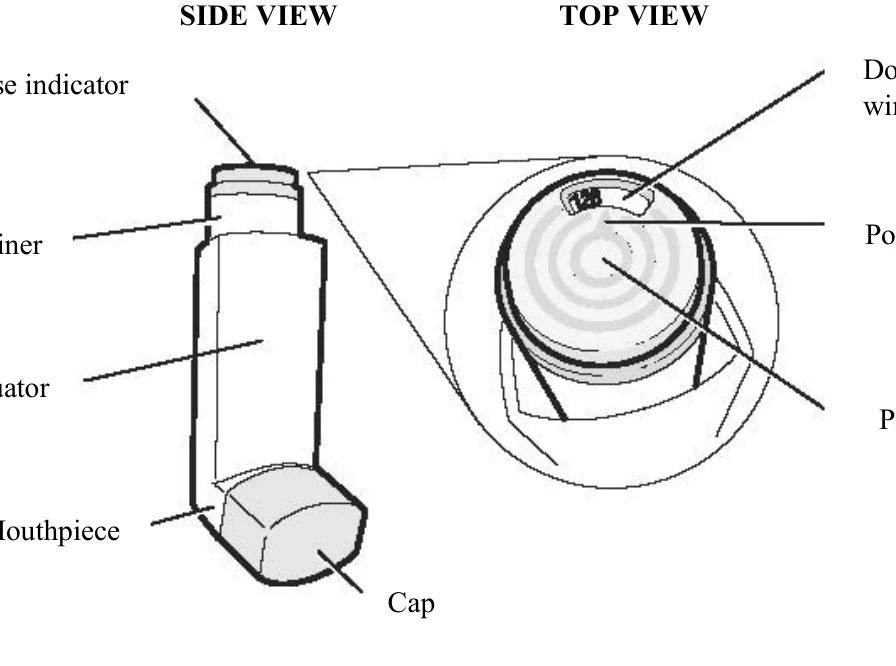
Figure 1
| Dose indicator |
Dose indicator display window
Pointer
Press here
Cap Pressurised container
Actuator
Mouthpiece
TOP VIEW
| SIDE VIEW |
Bevespi Aerosphere comes with a dose indicator on the top of the pressurised container (See
Figure 1). The dose indicator display window shows how many puffs of medicine you have left. A puff of medicine is released each time you press the centre of the dose indicator.
Before you use Bevespi Aerosphere for the first time
Before you use Bevespi Aerosphere for the first time, make sure that the pointer on the dose indicator is pointing to the right of the “120” inhalation mark in the dose indicator display window (See Figure 1).
- The pointer points to 120 after 10 puffs are delivered from Bevespi Aerosphere. This means that there are 120 puffs of medicine left in the pressurised container (See Figure 2a).
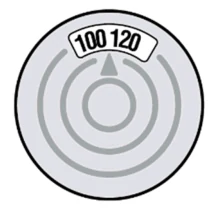
The pointer points between 100 and 120 after you use 10 more puffs. This means that there are
110 puffs of medicine left in the pressurised container (See Figure 2b).
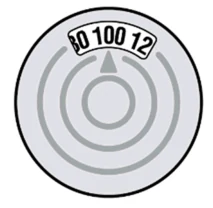
- The pointer points to 100 after you take 10 more puffs. This means that there are 100 puffs of
medicine left in the pressurised container (See Figure 2c).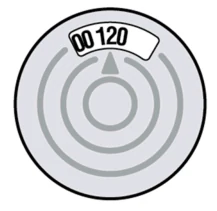
- The dose indicator display window will move after every 10 puffs. The number in the dose
indicator display window will change after every 20 puffs.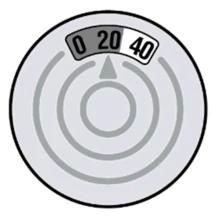
Figure 2d
- The colour in the dose indicator display window will change to red, as shown in the shaded area, when there are only 20 puffs of medicine left in your inhaler (See Figure 2d). • When the arrow reaches ‘0’, you must stop using your inhaler. Your inhaler may not feel empty and it may seem as though it still works. However, you will not get the right amount of medicine if you keep using it.
Preparing your Bevespi Aerosphere inhaler for use:
Your Bevespi Aerosphere inhaler comes in a foil pouch that contains a drying packet
(desiccant).
- Take the Bevespi Aerosphere inhaler out of the foil pouch.
Throw away the pouch and the drying packet. Do not use the inhaler if the drying agent has leaked out of its packet.
Figure 2b
110 puffs
Figure 2a 120 puffs
Figure 2c 100 puffs 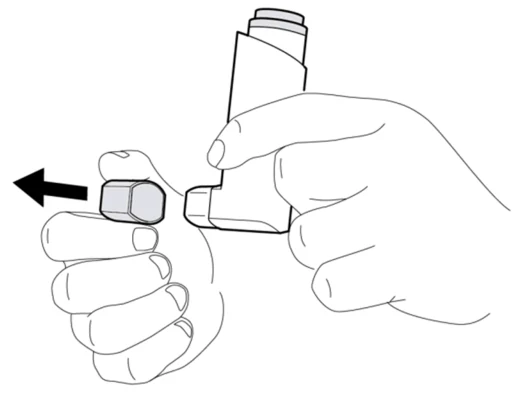 Figure 3
Priming your Bevespi Aerosphere inhaler:
Before you use Bevespi Aerosphere for the first time, you must prime the inhaler.
- Remove the cap from the mouthpiece (See Figure 3). Check inside the mouthpiece before you use the inhaler to make sure it is clear.
Hold the inhaler upright, away from your face and shake it well (See Figure 4).
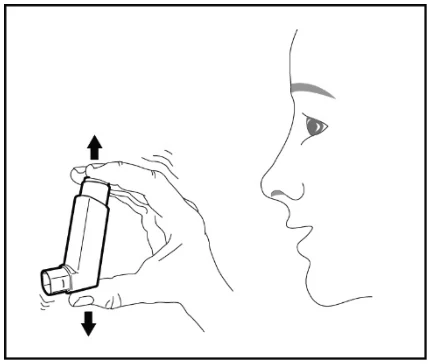
Figure 4
- Press down firmly on the centre of the dose indicator until the pressurised container stops
moving in the actuator. This will release a puff of medicine from the mouthpiece (See Figure 5). You may hear a soft click from the dose indicator as it counts down during use.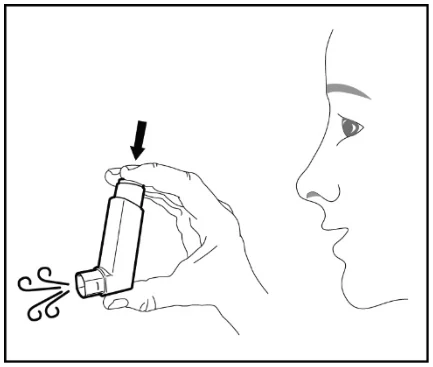
Figure 5
- Repeat the priming steps 3 more times (See Figure 4 and Figure 5). Shake the inhaler well before each priming puff.
- After priming 4 times, the dose indicator should be pointing to the right of “120” and your inhaler is now ready to use.
Using your Bevespi Aerosphere inhaler:
Step 1: Remove the cap from the mouthpiece (See Figure 6).
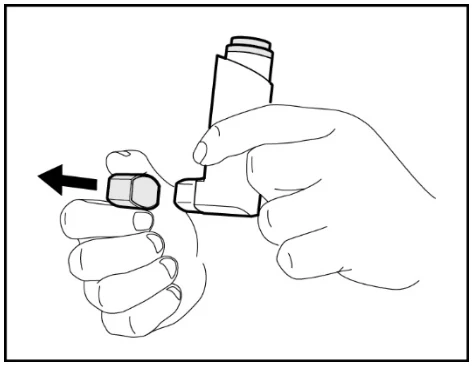 Figure 6
Step 2: Shake the inhaler well before each use (See Figure 7).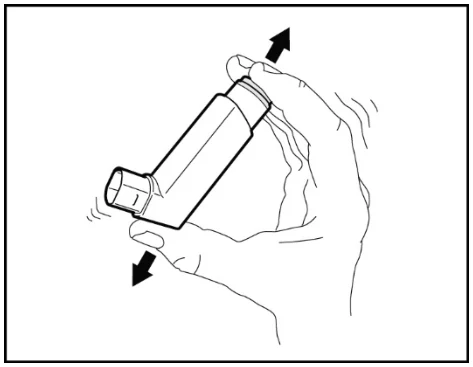
Figure 7
Step 3: Hold the inhaler with the mouthpiece pointing towards you and breathe out as fully as you
comfortably can through your mouth (See Figure 8). 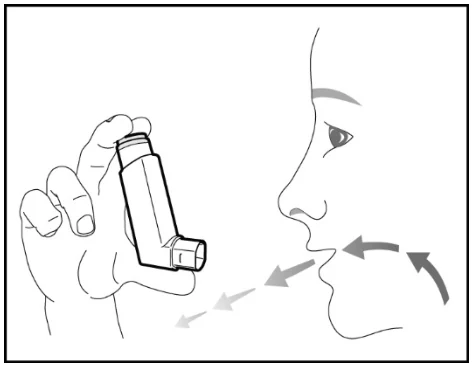
Figure 8
Step 4: Close your lips around the mouthpiece and tilt your head back, keeping your tongue below
the mouthpiece (See Figure 9).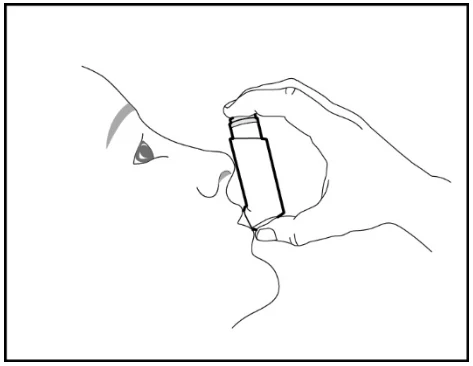
Figure 9 Step 5: While breathing in deeply and slowly, press down on the centre of the dose indicator until the
pressurised container stops moving in the actuator and a puff of medicine has been released (See Figure 10). Then stop pressing the dose indicator.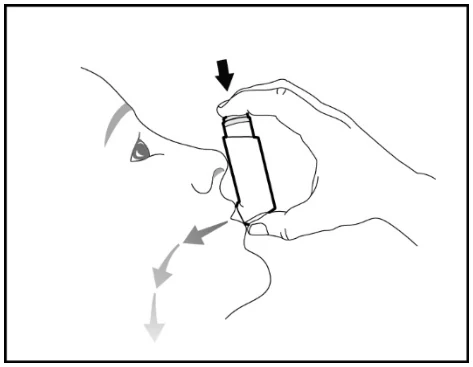
Figure 10
Step 6: When you have finished breathing in, remove the mouthpiece from your mouth. Hold your
breath as long as you comfortably can, up to 10 seconds (See Figure 11). 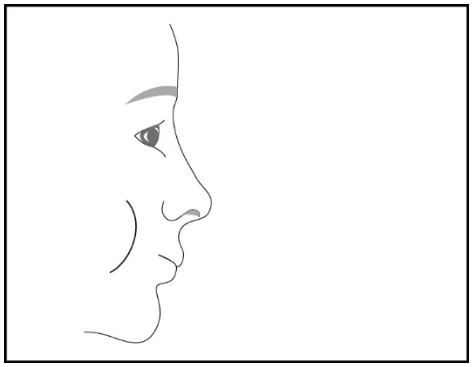
Figure 11
Step 7: Breathe out gently (See Figure 12). Repeat steps 2 to 7 to take your second puff of Bevespi
Aerosphere.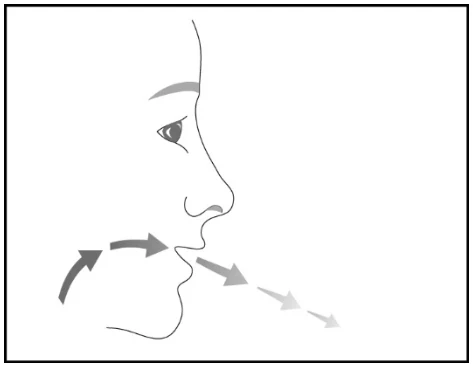
Figure 12 Step 8: Replace the cap over the mouthpiece right away after use (See Figure 13).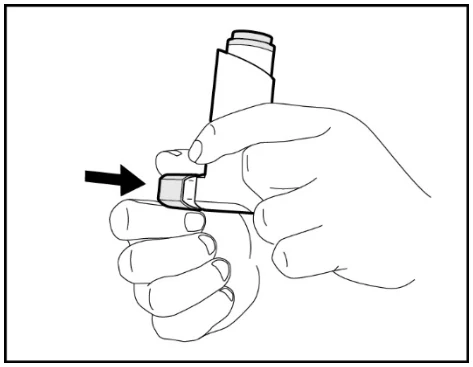
Figure 13
How to clean your Bevespi Aerosphere inhaler:
Clean the inhaler once each week for the first 3 weeks. It is very important to keep your inhaler clean so that medicine does not build-up and block the spray through the mouthpiece (See Figure 14).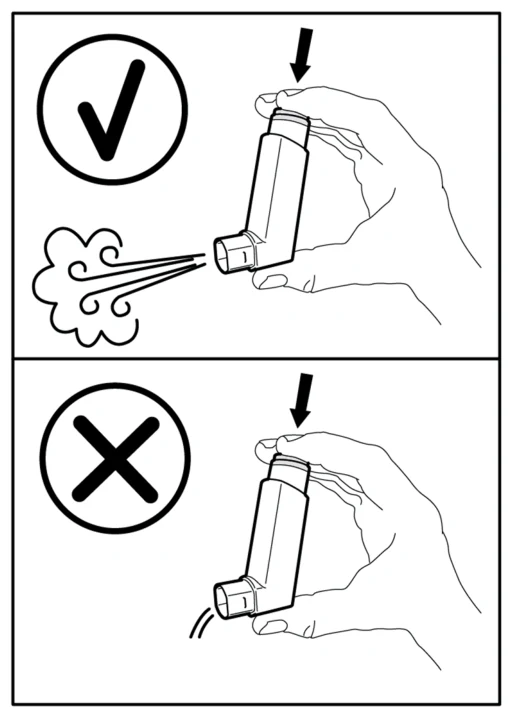
Figure 14 Step 1: Take the pressurised container out of the actuator (See Figure 15). Do not clean the pressurised container or let it get wet.
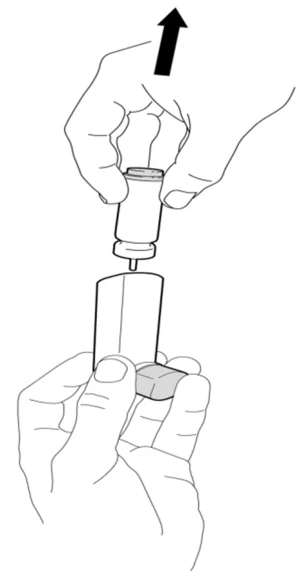 Figure 15 Step 2: Take the cap off the mouthpiece.
Step 3: Hold the actuator under the tap and run warm water through it for about 30 seconds. Turn the
actuator upside down and rinse the actuator again through the mouthpiece for about 30 seconds (See Figure 16). 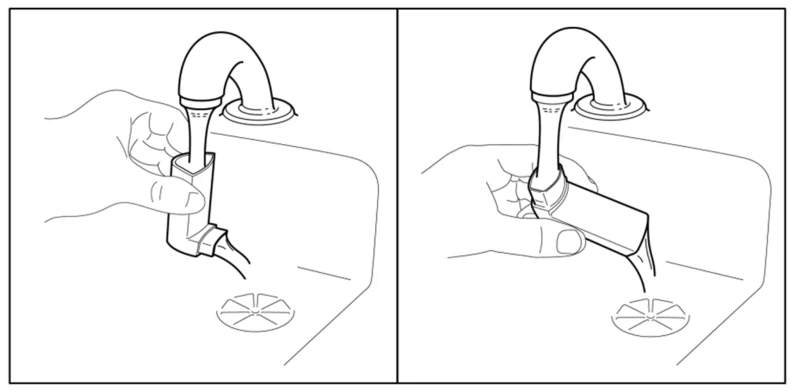
Figure 16
Step 4: Shake off as much water from the actuator as you can.
Step 5: Look into the actuator and the mouthpiece to make sure any medicine build-up has been completely washed away. If there is any built-up medicine, repeat Steps 3 to 5 in the section.
Step 6: Let the actuator air-dry overnight (See Figure 17). Do not put the pressurised container back into the actuator if it is still wet.
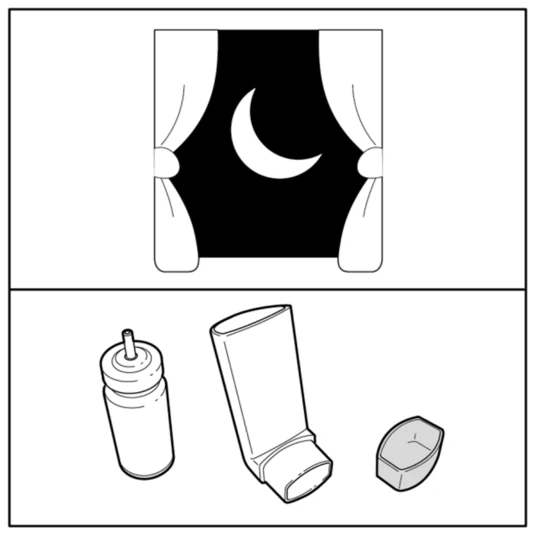 Figure 17 Step 7: When the actuator is dry, gently press the pressurised container down in the actuator (See
Figure 18). Do not press down too hard on the pressurised container. This could cause a puff of medicine to be released.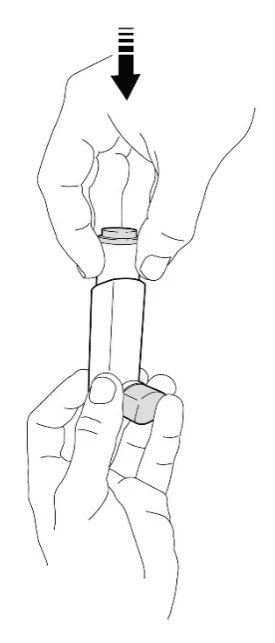
Figure 18
Step 8: Re-prime your Bevespi Aerosphere inhaler after each cleaning. To re-prime the inhaler, shake the inhaler well and press down on the centre of the dose indicator twice to release a total of 2 puffs into the air away from your face. Your inhaler is now ready to use.
| If you do not use your Bevespi Aerosphere for more than 7 days or if exposed to low | |
| temperatures or is dropped: | |
If you do not use your Bevespi Aerosphere for more than 7 days, or if the inhaler is exposed to low temperatures or has been dropped, you will need to re-prime it before use.
To re-prime the inhaler, shake the inhaler well and press down on the centre of the dose indicator twice to release a total of 2 puffs into the air away from your face. Your inhaler is now ready to use.