

Summary of Product Characteristics (SmPC) - Beovu 120 mg/ml solution for injection
1 NAME OF THE MEDICINAL PRODUCT
Beovu 120 mg/ml solution for injection
2 QUALITATIVE AND QUANTITATIVE COMPOSITION
One ml solution for injection contains 120 mg of brolucizumab*.
* Brolucizumab is a humanised monoclonal single-chain Fv (scFv) antibody fragment produced in Escherichia coli cells by recombinant DNA technology.
Beovu 120 mg/ml solution for injection
Each vial contains 27.6 mg brolucizumab in 0.23 ml solution. This provides a usable amount to deliver a single dose of 0.05 ml solution containing 6 mg of brolucizumab.
Excipient with known effect
Each vial contains 0.05 mg polysorbate 80 in 0.23 ml solution. This corresponds to 0.01 mg polysorbate 80 per dose (0.05 ml).
For the full list of excipients, see section 6.1.
3 PHARMACEUTICAL FORM
Solution for injection (injection).
Clear to slightly opalescent, colourless to slightly brownish-yellow aqueous solution.
4 CLINICAL PARTICULARS
4.1 Therapeutic indications
Beovu is indicated in adults for the treatment of
- neovascular (wet) age-related macular degeneration (AMD) (see section 5.1),
- visual impairment due to diabetic macular oedema (DME) (see section 5.1).
4.2 Posology and method of administration
Beovu must be administered by a qualified ophthalmologist experienced in intravitreal injections.
Posology
Wet AMD
Treatment initiation - loading
The recommended dose is 6 mg brolucizumab (0.05 ml solution) administered by intravitreal injection every 4 weeks (monthly) for the first 3 doses.. A disease activity assessment is suggested 16 weeks (4 months) after treatment start.
Alternatively, 6 mg brolucizumab (0.05 ml solution) may be administered every 6 weeks for the first 2 doses. A disease activity assessment is suggested 12 weeks (3 months) after treatment start. A third dose may be administered based on disease activity as assessed by visual acuity and/or anatomical parameters at week 12.
Maintenance treatment
After the last loading dose, the physician may individualise treatment intervals based on disease activity as assessed by visual acuity and/or anatomical parameters. In patients without disease activity, treatment every 12 weeks (3 months) should be considered. In patients with disease activity, treatment every 8 weeks (2 months) should be considered. If patients are being treated according to a treat-and-extend regimen and there are no signs of disease activity, the treatment intervals could be extended stepwise until signs of disease activity recur. The treatment interval should be extended or shortened by no more than 4 weeks (1 month) at a time (see section 5.1). There are limited data on treatment intervals longer than 20 weeks (5 months). The treatment interval between two doses of Beovu should not be less than every 8 weeks (2 months) (see sections 4.4).
If visual and anatomical outcomes indicate that the patient is not benefiting from continued treatment, Beovu should be discontinued.
DME
The recommended dose is 6 mg brolucizumab (0.05 ml solution) administered by intravitreal injection every 6 weeks for the first 5 doses. Thereafter, the physician may individualise treatment intervals based on disease activity as assessed by visual acuity and/or anatomical parameters. In patients without disease activity, treatment every 12 weeks (3 months) should be considered. In patients with disease activity, treatment every 8 weeks (2 months) should be considered. After 12 months of treatment, in patients without disease activity, treatment intervals up to 16 weeks (4 months) could be considered (see sections 4.4 and 5.1).
If visual and anatomical outcomes indicate that the patient is not benefiting from continued treatment, Beovu should be discontinued.
Special populations
Elderly
No dose adjustment is required in patients aged 65 years or above (see section 5.2).
Renal impairment
No dose adjustment is required in patients with renal impairment (see section 5.2).
Hepatic impairment
Brolucizumab has not been studied in patients with hepatic impairment. No dose adjustment is required in patients with hepatic impairment (see section 5.2).
Paediatric population
The safety and efficacy of brolucizumab in children and adolescents below 18 years of age have not been established. No data are available.
Method of administration
Beovu is for intravitreal use only.
The solution for injection should be inspected visually prior to administration (see section 6.6).
The intravitreal injection procedure should be carried out under aseptic conditions, which includes the use of surgical hand disinfection, sterile gloves, a sterile drape and a sterile eyelid speculum (or equivalent). Sterile paracentesis equipment should be available as a precautionary measure. The patient’s medical history for hypersensitivity reactions should be carefully evaluated prior to performing the intravitreal procedure (see section 4.3). Adequate anaesthesia and a broad-spectrum topical microbicide to disinfect the periocular skin, eyelid and ocular surface should be administered prior to the injection.
The injection needle should be inserted 3.5 to 4.0 mm posterior to the limbus into the vitreous cavity, avoiding the horizontal meridian and aiming towards the centre of the globe. The injection volume of 0.05 ml is then delivered slowly; a different scleral site should be used for subsequent injections.
Immediately following the intravitreal injection, patients should be monitored for elevation in intraocular pressure. Appropriate monitoring may consist of a check for perfusion of the optic nerve head or tonometry. If required, sterile equipment for paracentesis should be available.
Following intravitreal injection patients should be instructed to report any symptoms suggestive of endophthalmitis (e.g. eye pain, redness of the eye, photophobia, blurring of vision) without delay.
Pre-filled syringe
The pre-filled syringe is for single use only. Each pre-filled syringe should only be used for the treatment of a single eye.
Since the volume contained in the pre-filled syringe (0.165 ml) is greater than the recommended dose (0.05 ml), a portion of the volume contained in the pre-filled syringe must be discarded prior to administration.
Injecting the entire volume of the pre-filled syringe could result in overdose. To expel the air bubble along with excess medicinal product, the plunger should be slowly depressed until the edge below the dome of the rubber stopper is aligned with the 0.05 ml dose mark (equivalent to 50 µl, i.e. 6 mg brolucizumab).
4.3 Contraindications
Hypersensitivity to the active substance or to any of the excipients listed in section 6.1.
Patients with active or suspected ocular or periocular infections.
Patients with active intraocular inflammation.
4.4 Special warnings and precautions for use
Traceability
In order to improve the traceability of biological medicinal products, the name and the batch number of the administered product should be clearly recorded.
Endophthalmitis, intraocular inflammation, traumatic cataract, retinal detachment, retinal tear, retinal vasculitis, and/or retinal vascular occlusion
Intravitreal injections, including those with Beovu, have been associated with endophthalmitis, intraocular inflammation, traumatic cataract, retinal detachment and retinal tear (see section 4.8). Proper aseptic injection techniques must always be used when administering Beovu.
Patients should be instructed to report any symptoms suggestive of the above-mentioned events without delay.
Intraocular inflammation, including retinal vasculitis and/or retinal vascular occlusion
Intraocular inflammation, including retinal vasculitis and/or retinal vascular occlusion, has been reported with the use of Beovu (see sections 4.3 and 4.8). A higher number of intraocular inflammation events were observed among patients with treatment-emergent antibodies. After investigation, retinal vasculitis and/or retinal vascular occlusion were found to be immune-mediated events. Intraocular inflammation, including retinal vasculitis and/or retinal vascular occlusion, may occur following the first intravitreal injection and at any time of treatment. These events were observed more frequently at the beginning of the treatment.
Based on clinical studies these events were more frequent in female patients treated with Beovu than male patients (e.g. 5.3% females vs. 3.2% males in HAWK and HARRIER) and in Japanese patients.
In patients developing these events, treatment with Beovu should be discontinued and the events should be promptly managed. Patients treated with Beovu with a medical history of intraocular inflammation and/or retinal vascular occlusion (within 12 months prior to the first brolucizumab injection) should be closely monitored, since they are at increased risk of developing retinal vasculitis and/or retinal vascular occlusion.
The interval between two Beovu doses during maintenance treatment should not be less than 8 weeks considering that a higher incidence of intraocular inflammation (including retinal vasculitis) and retinal vascular occlusion was reported in patients with nAMD who received Beovu every 4 week maintenance dosing in a clinical study compared to patients who received Beovu every 8 or 12 week maintenance dosing in the pivotal Phase III clinical studies.
Intraocular pressure increases
Transient increases in intraocular pressure have been seen within 30 minutes of intravitreal injection with vascular endothelial growth factor (VEGF) inhibitors, including brolucizumab (see section 4.8). Special precaution is needed in patients with poorly controlled glaucoma (do not inject Beovu while the intraocular pressure is ≥30 mmHg). Both intraocular pressure and perfusion of the optic nerve head must be monitored and managed appropriately.
Bilateral treatment
The safety and efficacy of brolucizumab administered in both eyes concurrently have not been studied.
Immunogenicity
As this is a therapeutic protein, there is a potential for immunogenicity with brolucizumab (see section 4.8). Patients should be instructed to inform their physician if they develop symptoms such as eye pain or increased discomfort, worsening eye redness, blurred or decreased vision, an increased number of small particles in their vision, or increased sensitivity to light (see section 4.8).
Concomitant use of other anti-VEGF
There are no data available on the concomitant use of Beovu with other anti-VEGF medicinal products in the same eye. Brolucizumab should not be administered concurrently with other anti-VEGF medicinal products (systemic or ocular) (see section 4.5).
Withholding treatment
In intravitreal anti-VEGF treatments, the dose should be withheld and treatment should not be resumed earlier than the next scheduled treatment in the event of:
- a decrease in best-corrected visual acuity (BCVA) of ≥30 letters compared with the last assessment of visual acuity;
- a retinal break;
- a subretinal haemorrhage involving the centre of the fovea, or, if the size of the haemorrhage is ≥50% of the total lesion area;
- performed or planned intraocular surgery within the previous or next 28 days.
Retinal pigment epithelial tear
Risk factors associated with the development of a retinal pigment epithelial tear after anti-VEGF therapy for wet AMD include a large and/or high pigment epithelial retinal detachment. When initiating brolucizumab therapy, caution should be used in patients with these risk factors for retinal pigment epithelial tears.
Rhegmatogenous retinal detachment or macular holes
Treatment should be discontinued in subjects with rhegmatogenous retinal detachment or stage 3 or 4 macular holes.
Systemic effects following intravitreal use
Systemic adverse events, including non-ocular haemorrhages and arterial thromboembolic events, have been reported following intravitreal injection of VEGF inhibitors and there is a theoretical risk that these may relate to VEGF inhibition. There are limited data on safety in the treatment of patients with AMD and DME with a history of stroke, transient ischaemic attacks or myocardial infarction within the last 3 months. Caution should be exercised when treating such patients.
Populations with limited data
There is limited experience with Beovu treatment in diabetic patients with HbA1c greater than 10% or with proliferative diabetic retinopathy. There is also no experience of treatment with Beovu in diabetic patients with uncontrolled hypertension. This lack of information should be considered by the physician when treating such patients.
Sodium content
This medicinal product contains less than 1 mmol sodium (23 mg) per dose, that is to say essentially “sodium-free”.
Polysorbate 80 content
This medicinal product contains 0.01 mg polysorbate 80 per dose (0.05 ml). Polysorbates may cause allergic reactions. Patients need to be instructed to tell their doctor if they have any known allergies.
4.5 Interaction with other medicinal products and other forms of interaction
No interaction studies have been performed.
4.6 Fertility, pregnancy and lactation
Women of childbearing potential
Women of childbearing potential should use effective contraception during treatment with brolucizumab and for at least one month after the last dose when stopping treatment with brolucizumab.
Pregnancy
There are no or limited amount of data from the use of brolucizumab in pregnant women. A study in pregnant cynomolgus monkeys did not indicate any harmful effects with respect to reproductive toxicity. Animal studies are insufficient with respect to reproductive toxicity (see section 5.3). Although the systemic exposure after ocular administration is very low due to its mechanism of action, there is a potential risk to embryofoetal development. Therefore, brolucizumab should not be used during pregnancy unless the potential benefit outweighs the potential risk to the foetus.
Breast-feeding
It is unknown whether brolucizumab is excreted in human milk. In a reproductive toxicity study, brolucizumab was not detected in the maternal milk or infant serum of cynomolgus monkeys (see section 5.3). A risk to the breast-fed newborn/infant cannot be excluded. Brolucizumab is not recommended during breast-feeding and breast-feeding should not be started for at least one month after the last dose when stopping treatment with brolucizumab. A decision must be made whether to discontinue breast-feeding or to abstain from brolucizumab therapy, taking into account the benefit of breast-feeding for the child and the benefit of therapy for the woman.
Fertility
No reproductive or fertility studies have been conducted. VEGF inhibition has been shown to affect follicular development, corpus luteum function and fertility. Based on the mechanism of action of VEGF inhibitors, there is a potential risk for female reproduction.
4.7 Effects on ability to drive and use machines
Beovu has a minor influence on the ability to drive and use machines due to possible temporary visual disturbances following the intravitreal injection and the associated eye examination. Patients should not drive or use machines until visual function has recovered sufficiently.
4.8 Undesirable effects
Summary of the safety profile
Wet AMD
For wet AMD, a total of 1 088 patients treated with brolucizumab constituted the safety population in two Phase III studies. Of these, 730 patients were treated with the recommended dose of 6 mg.
The most frequently reported adverse reactions were reduced visual acuity (7.3%), cataract (7.0%), conjunctival haemorrhage (6.3%) and vitreous floaters (5.1%).
The most serious adverse reactions were blindness (0.8%), endophthalmitis (0.7%), retinal artery occlusion (0.8%) and retinal detachment (0.7%).
DME
For DME, a total of 558 patients treated with brolucizumab constituted the safety population in two Phase III studies. Of these, 368 patients were treated with the recommended dose of 6 mg.
The most frequently reported adverse reactions were cataract (9.0%), conjunctival haemorrhage (6.5%) and intraocular pressure increased (5.4%).
The most serious adverse reactions were cataract (9.0%), , retinal vascular occlusion (1.1%), retinal artery occlusion (0.8%) and endophthalmitis (0.5%).
Tabulated list of adverse reactions
The adverse reactions experienced following administration of Beovu in clinical studies are summarised in Table 1 below.
Adverse reactions (Table 1) are listed according to the MedDRA system organ class. Within each system organ class, the adverse reactions are ranked by frequency, with the most frequent reactions first. Frequency categories for each adverse reaction are based on the following convention: very common (≥1/10), common (≥1/100 to <1/10), uncommon (≥1/1 000 to <1/100), rare (≥1/10 000 to <1/1 000), very rare (<1/10 000), not known (cannot be estimated from the available data). Within each frequency grouping, adverse reactions are presented in order of decreasing seriousness.
Table 1 Frequencies of adverse reactions in clinical studies
| MedDRA System organ class | Frequency category* |
| Immune system disorders | |
| Hypersensitivity (including urticaria, rash, pruritus, erythema) | Common |
| Eye disorders | |
| Visual acuity reduced | Common |
| Retinal haemorrhage | Common |
| Uveitis | Common |
| Iridocyclitis | Common |
| Iritis | Common |
| Retinal vascular occlusion | Common |
| Vitreous haemorrhage | Common |
| Vitreous detachment | Common |
| Retinal tear | Common |
| Cataract | Common |
| Conjunctival haemorrhage | Common |
| Vitreous floaters | Common |
| Eye pain | Common |
| Intraocular pressure increase | Common |
| Conjunctivitis | Common |
| Retinal pigment epithelial tear | Common |
| Vision blurred | Common |
| Corneal abrasion | Common |
| Punctate keratitis | Common |
| Blindness | Uncommon |
| Endophthalmitis | Uncommon |
| Retinal detachment | Uncommon |
| Conjunctival hyperaemia | Uncommon |
| Lacrimation increased | Uncommon |
| Abnormal sensation in eye | Uncommon |
| Detachment of retinal pigment epithelium | Uncommon |
| Vitritis | Uncommon |
| Anterior chamber inflammation | Uncommon |
| Anterior chamber flare | Uncommon |
| Corneal oedema | Uncommon |
| Retinal vasculitis | Uncommon |
| Scleritis** | Uncommon |
*The frequency category for each adverse reaction is based on the most conservative incidence rate from either pooled nAMD or pooled DME Phase III pivotal studies. **including episcleritis | |
Description of selected adverse reactions
Immunogenicity
There is a potential for an immune response in patients treated with Beovu.
Wet AMD
After dosing with Beovu for 88 weeks, treatment-emergent anti-brolucizumab antibodies were detected in 23–25% of patients.
DME
After dosing with Beovu for 96 weeks, treatment-emergent anti-brolucizumab antibodies were detected in 16-23% of patients.
Among AMD and DME patients with treatment-emergent antibodies, a higher number of intraocular inflammation adverse reactions were observed. After investigation, retinal vasculitis and/or retinal vascular occlusion, typically in the presence of intraocular inflammation, were found to be immune-mediated adverse events related to exposure to Beovu (see section 4.4). Anti-brolucizumab antibodies were not associated with an impact on clinical efficacy.
Product-class-related adverse reactions
There is a theoretical risk of arterial thromboembolic events, including stroke and myocardial infarction, following intravitreal use of VEGF inhibitors. A low incidence rate of arterial thromboembolic events was observed in the brolucizumab clinical studies in patients with AMD and DME. There were no major notable differences between the groups treated with brolucizumab and comparator.
Reporting of suspected adverse reactions
Reporting suspected adverse reactions after authorisation of the medicinal product is important. It allows continued monitoring of the benefit/risk balance of the medicinal product. Healthcare professionals are asked to report any suspected adverse reactions via the Yellow Card Scheme at: www.mhra.gov.uk/yellowcard or search for MHRA Yellow Card in the Google Play or Apple App Store.
4.9 Overdose
Overdosing with greater than recommended injection volume may increase intraocular pressure. In the event of overdose, intraocular pressure should therefore be monitored and, if deemed necessary by the treating physician, appropriate treatment should be initiated.
5 PHARMACOLOGICAL PROPERTIES
5.1 Pharmacodynamic properties
Pharmacotherapeutic group: Ophthalmologicals, antineovascularisation agents, ATC code: S01LA06
Mechanism of action
Brolucizumab is a humanised monoclonal single chain Fv (scFv) antibody fragment with a molecular weight of ~26 kDa.
Increased levels of signalling through the vascular endothelial growth factor A (VEGF-A) pathway are associated with pathological ocular angiogenesis and retinal oedema. Brolucizumab binds with high affinity to VEGF-A isoforms (e.g. VEGF110, VEGF121, and VEGF165), thereby preventing binding of VEGF-A to its receptors VEGFR-1 and VEGFR-2. By inhibiting VEGF-A binding, brolucizumab suppresses endothelial cell proliferation, thereby reducing pathological neovascularisation and decreasing vascular permeability.
Pharmacodynamic effects
Wet AMD
In the HAWK and HARRIER studies, anatomical parameters related to leakage of
| blood and fluid that characterise choroidal neovascularisation (CNV) were part of the | |
| disease activity assessments guiding treatment decisions. | |
Reductions in central subfield thickness (CST) and in presence of intraretinal/subretinal fluid (IRF/SRF) or sub-retinal pigment epithelium (sub-RPE) fluid were observed in patients treated with Beovu as early as 4 weeks after treatment initiation and up to week 48 and week 96.
At week 16, the reduction in CST was statistically significant on Beovu versus aflibercept in both studies (HAWK: -161 vs. -134 microns; HARRIER: -174 vs. -134 microns). This decrease from baseline in CST was also statistically significant at week 48 (HAWK: -173 vs. -144 microns; HARRIER: -194 vs. -144 microns), and maintained to the end of each study at week 96 (HAWK: -175 vs. -149 microns; HARRIER: -198 vs. -155 microns).
At week 16, the percentage difference in patients with IRF and/or SRF fluid was statistically significant on Beovu versus aflibercept in both studies (HAWK: 34% vs. 52%; HARRIER: 29% vs. 45%). This difference was also statistically significant at week 48 (HAWK: 31% vs. 45%; HARRIER: 26% vs. 44%), and maintained to the end of each study at week 96 (HAWK: 24% vs. 37%; HARRIER: 24% vs. 39%).
At week 16, the percentage difference in patients with sub-RPE fluid was statistically significant on Beovu versus aflibercept in both studies (HAWK: 19% vs. 27%; HARRIER: 16% vs. 24%). This difference was also statistically significant at week 48 (HAWK: 14% vs. 22%; HARRIER: 13% vs. 22%), and maintained to the end of each study at week 96 (HAWK: 11% vs. 15%; HARRIER: 17% vs. 22%).
In these studies, for patients treated with Beovu, reductions in CNV lesion size were observed as early as 12 weeks, and at weeks 48 and 96 after treatment initiation.
DME
In the KESTREL and KITE studies, related anatomical parameters were part of the disease activity assessments guiding treatment decisions. Reductions in CST and in presence of IRF/SRF were observed in patients treated with Beovu as early as 4 weeks after treatment initiation and up to week 52. These reductions were maintained up to week 100.
Clinical efficacy and safety
Wet AMD
The efficacy and safety of Beovu were assessed in two randomised, multicentre, double-masked, active-controlled Phase III studies (HAWK and HARRIER) in patients with neovascular (wet) AMD. A total of 1,817 patients were treated in these studies for two years (1 088 on Beovu and 729 on comparator aflibercept). Patient ages ranged from 50 to 97 years, with a mean age of 76 years.
In both studies, after the first three monthly doses (weeks 0, 4 and 8), brolucizumab patients were treated every 12 weeks, with the option of adjusting to a dosing interval every 8 weeks based on disease activity. Disease activity was assessed by a physician during the first 12-week interval (at weeks 16 and 20) and at each subsequent scheduled 12-weekly treatment visit. Patients who showed disease activity (e.g. decreased visual acuity, increased CST and/or presence of IRF/SRF or sub-RPE fluid) at any of these visits were adjusted to an 8-weekly treatment interval. The comparator aflibercept was administered every 8 weeks after the first 3 monthly doses.
Results
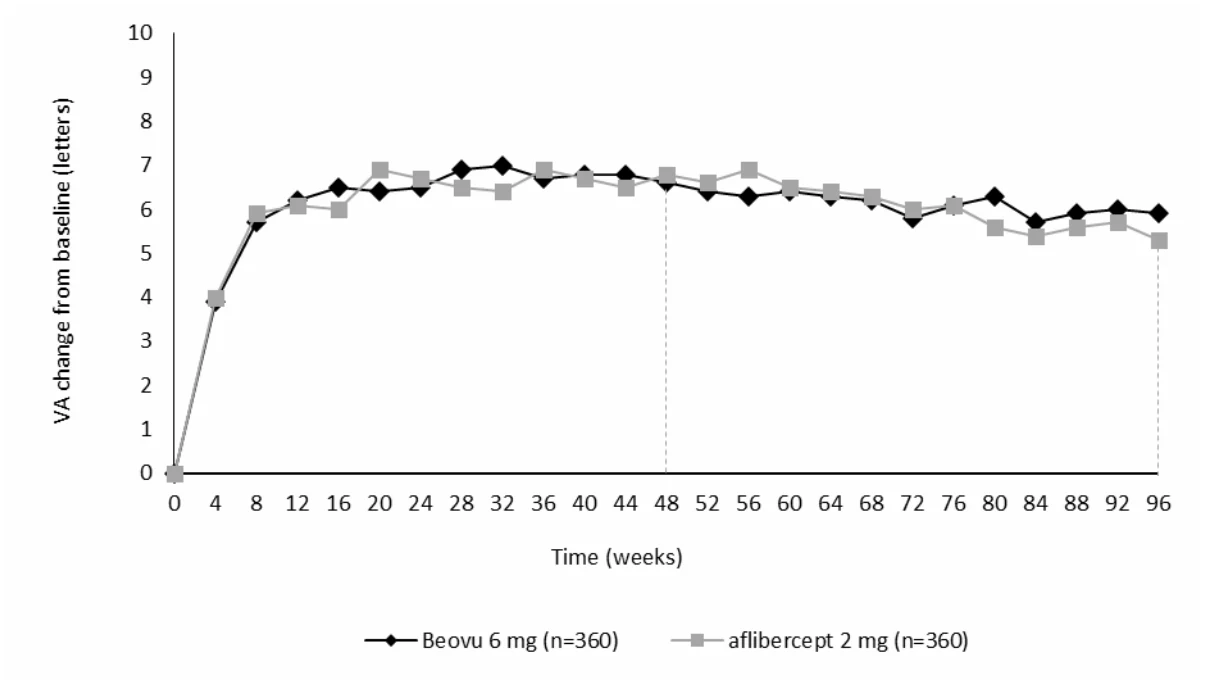
The primary efficacy endpoint for the studies was the change from baseline in best corrected visual acuity (BCVA) to week 48, as measured by the early treatment diabetic retinopathy study (ETDRS) letter score, with the primary objective being to demonstrate non-inferiority of Beovu versus aflibercept. In both studies, Beovu (administered in an every 12 weeks or an every 8 weeks regimen) demonstrated non-inferior efficacy to aflibercept 2 mg (administered every 8 weeks). The visual acuity gains observed in the first year were maintained in the second year.
Detailed results of both studies are shown in Table 2 and in Figure 1 below.
Table 2 Visual acuity outcomes at weeks 48 and 96 in Phase III - HAWK and
HARRIER studies
| HAWK | ||||
HARRIER
| Efficacy outcome | Week | Beovu (n=360) | Aflibercept 2 mg (n=360) | Difference (95% CI) brolucizumab
| Beovu (n=370) | Aflibercept 2 mg (n=369) |
Difference (95% CI) brolucizumab
- aflibercept
| 48 | 6.6 (SE=0.71) | 6.8 (SE=0.71) | -0.2 (-2.1, 1.8) P<0.0001 a) | 6.9 (SE=0.61) | 7.6 (SE=0.61) |
-0.7
(-2.4, 1.0) P <0.0001 a)
| 36 – 48 b) | 6.7 (SE=0.68) | 6.7 (SE=0.68) | 0.0 (-1.9, 1.9) P<0.0001 a) | 6.5 (SE=0.58) | 7.7 (SE=0.58) |
-1.2
(-2.8, 0.4) P=0.0003 a)
Mean change from baseline in BCVA (measured by ETDRS letters score) | ||||||
| 96 | 5.9 (SE=0.78) | 5.3 (SE=0.78) | 0.5 (-1.6, 2.7) | 6.1 (SE=0.73) | 6.6 (SE=0.73) |
-0.4
(-2.5,1.6)
| 48 | 33.6 | 25.4 | 8.2 (2.2, 15.0) | 29.3 | 29.9 |
-0.6
(-7.1, 5.8)
| % of patients who gained at least 15 letters of vision | ||||||
| 96 | 34.2 | 27.0 | 7.2 (1.4, 13.8) | 29.1 | 31.5 |
-2.4
(-8.8, 4.1)
| 48 | 6.4 | 5.5 | 0.9 (-2.7, 4.3) | 3.8 | 4.8 |
-1.0
(-3.9, 2.2)
| % of patients who lost visual acuity (%) (≥15 letters of BCVA loss) | ||||||
| 96 | 8.1 | 7.4 | 0.7 (-3.6, 4.6) | 7.1 | 7.5 |
-0.4
(-3.8, 3.3) BCVA: best corrected visual acuity; missing data are imputed using last observation carried forward (LOCF) method ETDRS: early treatment diabetic retinopathy study
SE: standard error
- a) P-value referring to the non-inferiority hypothesis with a non-interiority margin of 4.0 letters.
- b) Key secondary endpoint, accounting for differences in timing of Beovu and aflibercept treatments.
Figure 1 Mean change in visual acuity from baseline to week 96 in HAWK and
HARRIER studies
HAWK
HARRIER
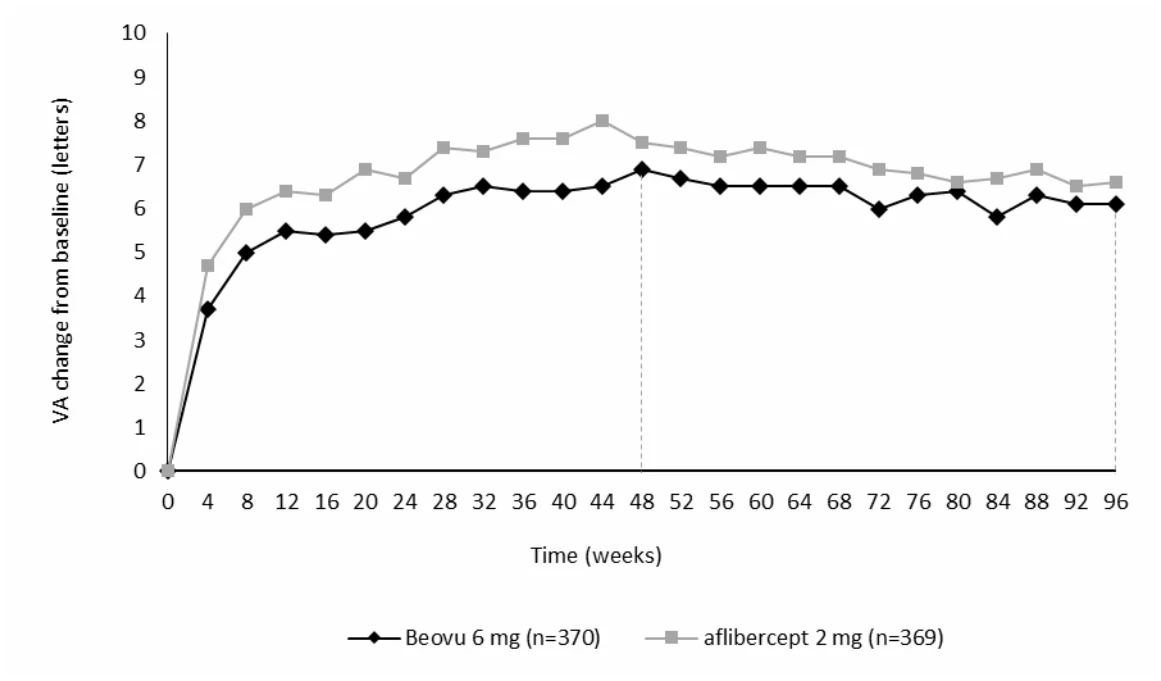
These visual acuity gains were achieved with 56% and 51% of patients treated with Beovu on a 12-weekly dosing interval at week 48, and with 45% and 39% of patients at week 96 in HAWK and HARRIER, respectively. Among patients identified as eligible for the 12-weekly regimen during the first 12-week interval, 85% and 82% remained on the 12-weekly dosing interval up to week 48. Of patients on the 12-weekly interval at week 48, 82% and 75% remained on the 12-weekly dosing interval up to week 96.
Treatment effects in evaluable subgroups (e.g. age, gender, race, baseline visual acuity, baseline retinal thickness, lesion type, lesion size, fluid status) in each study were generally consistent with the results in the overall populations.
Disease activity was assessed by changes in visual acuity and/or anatomical parameters, including CST and/or presence of IRF/SRF or sub-RPE. Disease activity was assessed throughout the studies. Anatomical parameters of disease activity were decreased at week 48 and at week 96 for Beovu compared to aflibercept (see “Pharmacodynamic effects”).
The percentage difference in patients with disease activity at week 16 was statistically significant on Beovu versus aflibercept (24% vs 35% in HAWK, p=0.0013; 23% vs 32% in HARRIER, p=0.0021).
In both studies, Beovu demonstrated clinically meaningful increases from baseline in the pre-specified secondary efficacy endpoint of patient-reported outcomes, reported through the National Eye Institute Visual Function Questionnaire (NEI VFQ-25). The magnitude of these changes was similar to that seen in published studies, which corresponded to a 15-letter gain in BCVA. Patient-reported outcome benefits were maintained in the second year.
No clinically meaningful differences were found between Beovu and aflibercept in changes from baseline to week 48 in NEI VFQ-25 total score and subscales (general vision, ocular pain, near activities, distance activities, social functioning, mental health, role difficulties, dependency, driving, colour vision and peripheral vision).
The results of the Beovu arms of the HAWK and HARRIER studies, where Beovu was administered every 4 weeks (monthly) for the first 3 doses (loading) followed by maintenance dosing every 12 or 8 weeks, were replicated in a population pharmacokinetic/pharmacodynamic model simulation study where Beovu was administered every 6 weeks for the first 2 or 3 doses (loading) followed by maintenance dosing every 12 or 8 weeks.
A treat-and-extend dosing regimen for the maintenance phase was examined in the TALON study, which was a 64-week, two-arm, randomised, double-masked, multicentre, Phase IIIb study assessing the efficacy and safety of Beovu compared to aflibercept 2 mg in patients with nAMD.
737 patients were randomised in a 1:1 ratio to one of the two treatment arms, either brolucizumab 6 mg or aflibercept 2 mg. Patients in both treatment arms were dosed once every 4 weeks for the first 3 injections and then one injection after 8 weeks. Thereafter, treatment intervals were either every 8 weeks, every 12 weeks, or every 16 weeks up to week 60 or 62.
The average change in BCVA from baseline at week 64 was +4.7 ETDRS letters vs. +4.9 ETDRS letters for Beovu and aflibercept 2 mg, respectively.
Results of treatment intervals at week 64 are presented in Table 3.
Table 3 Last treatment interval with no disease activity: proportion of patients at week 64
| Study arm | ||
| Interval (weeks) | Brolucizumab 6 mg n=366 | Aflibercept 2 mg n=368 |
| 4 | 23.2% | 41.8% |
| 8 | 26.0% | 22.0% |
| 12 | 22.4% | 23.9% |
| 16 | 28.4% | 12.2% |
255 subjects who completed the TALON study were enrolled into a 56-week open-label, one-arm extension study of TALON and treated with a brolucizumab treat-and-extend dosing regimen without a loading phase and with a maximum treatment interval of up to 20 weeks.
At week 56, more than 50% of 237 subjects who had received at least 2 injections were on a treatment interval of 16 weeks (24.9%) or 20 weeks (28.7%) and had no disease activity, while visual acuity was maintained throughout the study.
DME
The efficacy and safety of Beovu were assessed in two randomised, multicentre, double-masked, active-controlled Phase III studies (KESTREL and KITE) in patients with visual impairment due to diabetic macular oedema. A total of 926 patients were treated in these studies for two years (558 on brolucizumab and 368 on aflibercept 2 mg). Patient ages ranged from 23 to 87 years, with a mean age of 63 years.
In both studies, after the first five doses (weeks 0, 6, 12, 18 and 24), brolucizumab patients were treated every 12 weeks, with the option of adjusting to a dosing interval every 8 weeks based on disease activity. Disease activity was assessed by a physician during the first 12-week interval (at weeks 32 and 36) and at each subsequent scheduled treatment visit. Patients who showed disease activity (e.g. decreased visual acuity, increased CST) at any of these visits were adjusted to an every 8 weeks treatment interval. In year 2 of KITE, patients who showed no disease activity could be extended to a 16-week treatment interval. The comparator aflibercept was administered every 8 weeks after the first 5 monthly doses.
Results
The primary efficacy endpoint for the studies was the change from baseline in BCVA to week 52, as measured by the ETDRS letter score, with the primary objective being to demonstrate non-inferiority of Beovu versus aflibercept 2 mg. In both studies, Beovu (administered in an every 12 weeks or an every 8 weeks regimen) demonstrated non-inferior efficacy to aflibercept 2 mg (administered every 8 weeks).
The results of KESTREL and KITE also demonstrated non-inferiority of Beovu versus aflibercept 2 mg for the key secondary endpoint (average change from baseline in BVCA over the period week 40 to week 52).
The visual acuity gains observed in the first year were maintained in the second year.
Detailed results of both studies are shown in Table 4 and in Figure 2 below.
Table 4 Visual acuity outcomes at weeks 52 and 100 in Phase III - KESTREL and KITE studies
| KESTREL | KITE | ||||||
| Efficacy outcome | Week | Beovu (n=189) | Aflibercept 2 mg (n=187) | Difference (95% CI) brolucizumab
| Beovu (n=179) | Aflibercept 2 mg (n=181) | Difference (95% CI) brolucizumab– aflibercept |
| Change from baseline in BCVA (measured by ETDRS letters score) – LS mean (SE) | 52 | 9.2 (0.57) | 10.5 (0.57) | -1.3 (-2.9, 0.3) P <0.001a | 10.6 (0.66) | 9.4 (0.66) | 1.2 (-0.6, 3.1) P <0.001a |
| 40-52 | 9.0 (0.53) | 10.5 (0.53) | -1.5 (-3.0, 0.0) P <0.001a | 10.3 (0.62) | 9.4 (0.62) | 0.9 (-0.9, 2.6) P <0.001a | |
| 100 | 8.8 (0.75) | 10.6 (0.75) | -1.7 (-3.8, 0.4) | 10.9 (0.85) | 8.4 (0.85) | 2.6 (0.2, 4.9) | |
Gain of at least 15 letters in BCVA from baseline or BCVA ≥84 letters (%) | 52 | 36.0 | 40.1 | -4.1 (-13.3, 5.9) | 46.8 | 37.2 | 9.6 (-0.4, 20.2) |
| 100 | 39.2 | 42.2 | -3.0 (-12.5, 6.3) | 50.4 | 36.9 | 13.6 (3.3, 23.5) | |
BCVA: best corrected visual acuity; BCVA assessments after start of alternative DME treatment in the study eye were censored and replaced by the last value prior to start of this alternative treatment. ETDRS: early treatment diabetic retinopathy study LS: least-square SE: standard error a P-value referring to the non-inferiority hypothesis with a non-inferiority margin of 4.0 letters | |||||||
Figure 2 Mean change in visual acuity from baseline to week 100 in KESTREL and
KITE studies
KESTREL 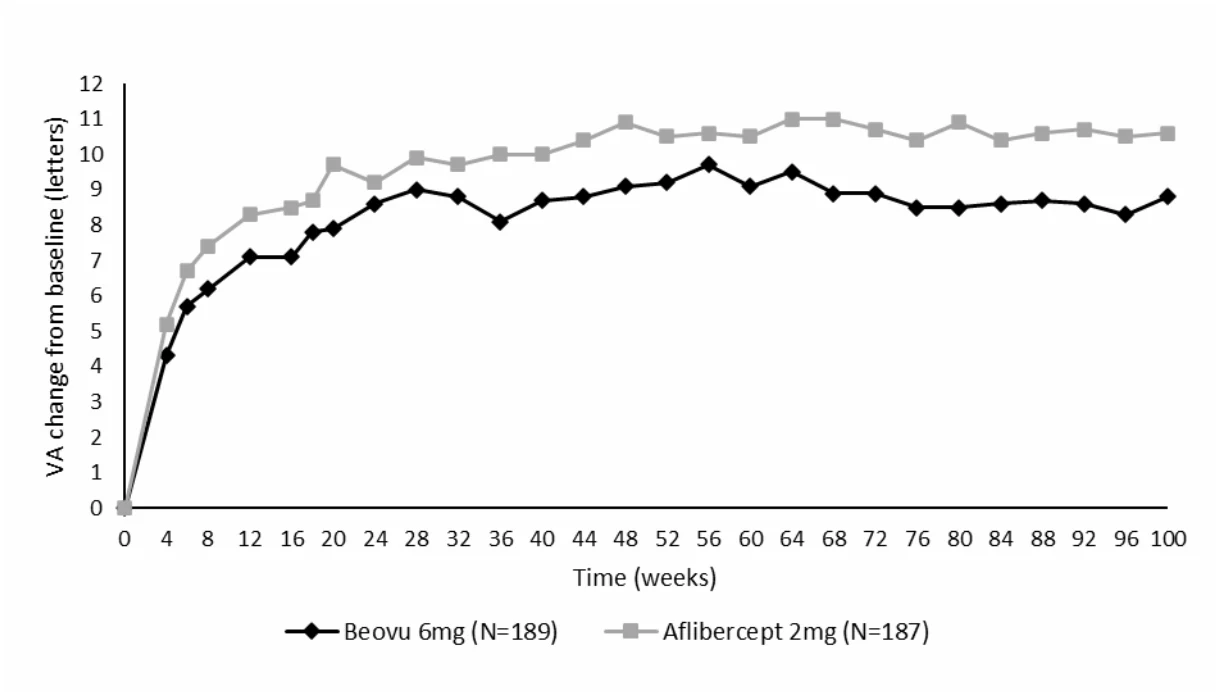
KITE 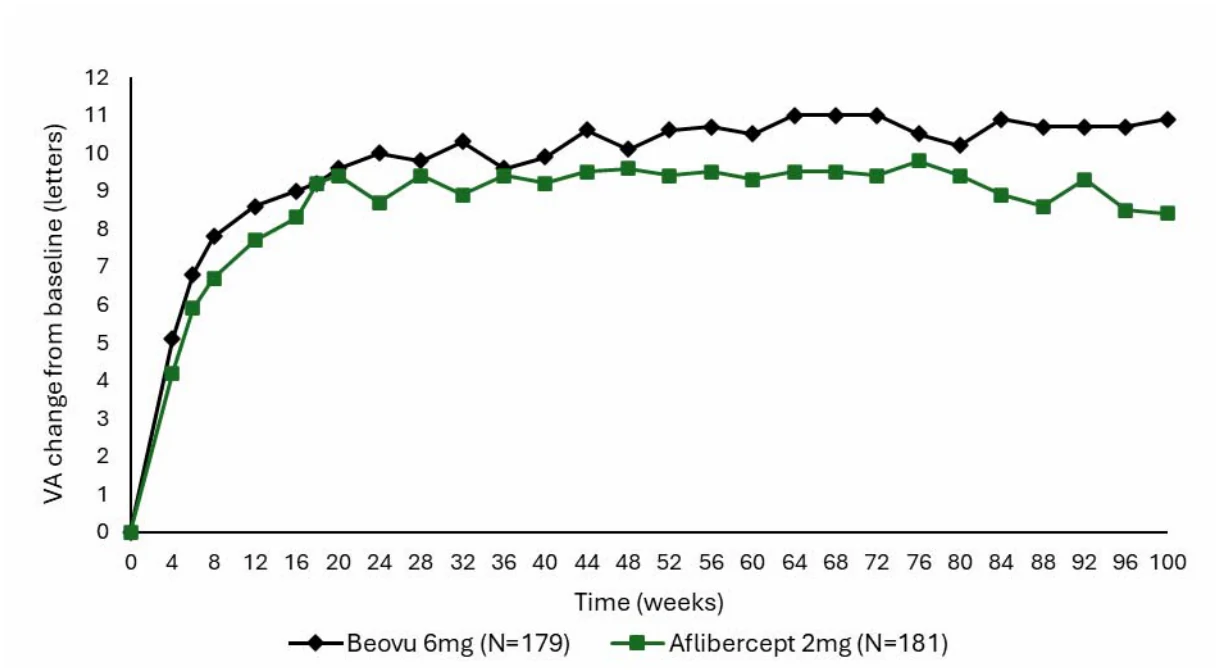
These visual acuity gains were achieved with 55% and 50% of patients treated with Beovu on a 12-weekly dosing interval at week 52, and and 44% and 37% of patients treated with Beovu on a 12-weekly or 12-weekly/16-weekly dosing interval at week 100 in KESTREL and KITE, respectively. Among patients identified as eligible for the 12-weekly regimen during the first 12-week interval, approximately 70% remained on at least the 12-weekly interval at week 100 in both studies. In KITE, 25% of patients were treated with Beovu on a 16-weekly dosing interval at week 100.
Treatment effects in evaluable subgroups (e.g. age, gender, baseline HbA1c, baseline visual acuity, baseline central subfield thickness, DME lesion type, duration of DME since diagnosis, retinal fluid status) in each study were generally consistent with the results in the overall populations.
In KESTREL and KITE, disease activity was assessed throughout the studies by changes in visual acuity and/or anatomical parameters, including CST and/or presence of IRF/SRF. The reduction in CST from baseline was maintained up to week 100. At week 100, the proportion of patients with IRF/SRF was lower in patients treated with Beovu (42% KESTREL and 41% KITE) compared to patients treated with aflibercept 2 mg (54% KESTREL and 57% KITE).
Diabetic retinopathy severity score (DRSS) was assessed in the KESTREL and KITE studies. At baseline, 98.1% of patients in both KESTREL and KITE had gradable DRSS scores. Based on the pooled analysis, Beovu showed non-inferiority to aflibercept 2 mg in the proportion of subjects with at least a 2-step improvement from baseline in DRSS at week 52, using a non-inferiority margin of 10%. Estimated proportions were 28.9% and 24.9% in Beovu and aflibercept 2 mg, respectively, resulting in a treatment difference of 4.0% (95% CI: [-0.6, 8.6]). At week 100, the proportion of patients with a ≥2-step improvement from baseline to week 100 in the DRSS score was 32.8% with Beovu and 29.3% with aflibercept 2 mg in KESTREL and 35.8% with Beovu and 31.1% with aflibercept 2 mg in KITE.
Paediatric population
The European Medicines Agency has waived the obligation to submit the results of studies with Beovu in all subsets of the paediatric population in neovascular AMD and DME (see section 4.2 for information on paediatric use).
5.2 Pharmacokinetic properties
Beovu is administered directly into the vitreous to exert local effects in the eye.
Absorption and distribution
After intravitreal administration of 6 mg brolucizumab per eye to patients with nAMD, the geometirc mean Cmax of free brolucizumab in the plasma was 49.0 ng/ml (range: 8.97 to 548 ng/ml) and was attained in 1 day.
Biotransformation and elimination
Brolucizumab is a monoclonal antibody fragment and no metabolism studies have been conducted. As a single-chain antibody fragment, free brolucizumab is expected to undergo elimination through both target-mediated disposition via binding to free endogenous VEGF, passive renal elimination and metabolism via proteolysis.
After intravitreal injections, brolucizumab was eliminated with an apparent systemic half-life of 4.3 ± 1.9 days. Concentrations were generally near or below the quantitation limit (<0.5 ng/ml) approximately 4 weeks after dosing in most patients. Brolucizumab did not accumulate in the serum when administered intravitreally every 4 weeks.
Special populations
Elderly
There were no relevant differences in systemic pharmacokinetics following intravitreal injection in a study with 22 patients aged 65 to 74 years, 18 patients aged 75 to 84 years and 3 patients aged ≥85 years.
Renal impairment
The systemic pharmacokinetics of brolucizumab was evaluated in nAMD patients with normal renal function (≥90 ml/min [n=21]), with mild (60 to <90 ml/min [n=22]) or moderate (30 to <60 ml/min [n=7]) renal impairment. While the mean systemic clearance values for patients with mild or moderate renal impairment were generally lower than patients with normal renal function, no significant impact of mild and moderate renal impairment on the overall systemic exposure to brolucizumab was observed. No patients with severe (<30 ml/min) renal impairment were studied.
Hepatic impairment
Brolucizumab has not been studied in patients with hepatic impairment. Mild to severe hepatic impairment should have no impact on the overall systemic exposure to brolucizumab, because metabolism occurs via proteolysis and does not depend on hepatic function.
5.3 Preclinical safety data
No studies have been conducted on the carcinogenic or mutagenic potential of brolucizumab.
In pregnant cynomolgus monkeys, brolucizumab was administered once every 4 weeks by intravitreal injection at dose levels resulting in maximal systemic exposures 6-fold higher than those in humans at the maximum recommended dose (based on serum Cmax). There was no impact on embryofoetal development, pregnancy or parturition, or on the survival, growth or postnatal development of offspring. Nevertheless, based on its pharmacological effect, brolucizumab should be regarded as potentially teratogenic and embryo-foetotoxic.
6 PHARMACEUTICAL PARTICULARS
6.1 List of excipients
Sodium citrate
Sucrose
Polysorbate 80
Sodium hydroxide (for pH adjustment) Water for injections
6.2 Incompatibilities
In the absence of compatibility studies, this medicinal product must not be mixed with other medicinal products.
6.3 Shelf life
Vial: 2 years
6.4 Special precautions for storage
Vial
Store in a refrigerator (2°C - 8°C). Do not freeze.
Keep the vial in the outer carton in order to protect from light. Prior to use, the unopened vial may be kept at room temperature (below 25°C) for up to 24 hours.
6.5 Nature and contents of container
Vial
0.23 ml sterile solution in a 2 ml glass vial with a coated rubber stopper sealed with an aluminium cap with a purple plastic flip-off disk.
Pack size of 1 vial and 1 blunt filter needle (18G x 1½″, 1.2 mm x 40 mm, 5 μm).
Not all pack sizes may be marketed.
6.6 Special precautions for disposal
Vial
The vial contains more than the recommended dose of 6 mg. The extractable volume of the vial (0.23 ml) is not to be used in total. The excess volume should be expelled prior to injection. Injecting the entire volume of the vial could result in overdose. The injection dose must be set to the 0.05 ml dose mark, i.e. 6 mg brolucizumab.
The solution should be inspected visually upon removal from the refrigerator and prior to administration. If particulates or cloudiness are visible, the vial must not be used, and appropriate replacement procedures must be followed.
The content of the vial and the filter needle are sterile and for single use only. Do not use if the packaging, vial and/or filter needle are damaged or expired. Detailed instructions for use are provided in the package leaflet.
Any unused medicinal product or waste material should be disposed of in accordance with local requirements.
7 MARKETING AUTHORISATION HOLDER
Novartis Pharmaceuticals UK Limited
2nd Floor, The West Works Building, White City Place
195 Wood Lane
London
W12 7FQ
United Kingdom
8 MARKETING AUTHORISATION NUMBER(S)
PLGB 00101/1211
9 DATE OF FIRST AUTHORISATION/RENEWAL OF THE
AUTHORISATION
01/01/2021
9 DATE OF FIRST AUTHORISATION/RENEWAL OF THE
AUTHORISATION
22/11/2024
10 DATE OF REVISION OF THE TEXT
21/07/2025