


Patient leaflet - Beovu 120 mg/ml solution for injection
1. What Beovu is and what it is used for
What Beovu is
Beovu contains the active substance brolucizumab, which belongs to a group of medicines called antineovascularisation agents. Beovu is injected into the eye by your doctor to treat eye conditions which may impact your vision.
What Beovu is used for
Beovu is used to treat eye conditions in adults which occur when abnormal blood vessels form and grow underneath the macula. The macula, which is at the back of the eye, is responsible for clear vision. The abnormal blood vessels may leak fluid or blood into the eye and interfere with the macula’s function, resulting in diseases which may cause decreased vision such as:
- wet age-related macular degeneration (wet AMD)
- diabetic macular oedema (DME)
How Beovu works
Beovu may slow down disease progression and thereby maintain, or even improve, your vision.
2. What you need to know before you are given Beovu
You must not be given Beovu:
- if you are allergic to brolucizumab or any of the other ingredients of this medicine (listed in section 6).
- if you have an active or suspected infection in or around the eye.
- if you have pain or redness in your eye (eye inflammation).
If any of these applies to you, tell your doctor. You should not be given Beovu.
Warnings and precautions
Talk to your doctor before you are given Beovu if any of the following applies to you:
- if you have glaucoma (an eye condition usually caused by high pressure in the eye).
- if you have a history of seeing flashes of light or floaters (dark floating spots) and if you have a sudden increase in the size and number of floaters.
- if you have had eye surgery in the last 4 weeks or if eye surgery is planned in the next four weeks.
- if you have ever had any eye diseases or eye treatments.
- if you have a history of sudden vision loss due to blockage of blood vessels in the back of the eye (retinal vascular occlusion) or inflammation of blood vessels in the back of the eye (retinal vasculitis) in the last year.
Tell your doctor immediately if you:
- develop redness of the eye, eye pain, increased discomfort, worsening eye redness, blurred or decreased vision, an increased number of small particles in your vision, increased sensitivity to light.
- develop sudden vision loss, which could be a sign of retinal vascular occlusion. Any of the above symptoms may result in your doctor discontinuing your treatment with Beovu.
Furthermore it is important for you to know that:
- the safety and efficacy of Beovu when administered to both eyes at the same time has not been studied and use in this way may lead to an increased risk of experiencing side effects.
- injections with Beovu may cause an increase in eye pressure (intraocular pressure) in some patients within 30 minutes of the injection. Your doctor will monitor this after each injection.
- your doctor will check whether you have other risk factors that may increase the chance of a tear or detachment of one of the layers at the back of the eye (retinal detachment or tear, and retinal pigment epithelial detachment or tear), in which case Beovu must be given with caution.
The systemic use of VEGF inhibitors, substances similar to those contained in Beovu, is potentially related to the risk of blood clots blocking blood vessels (arterial thromboembolic events), which may lead to heart attack or stroke. There is a theoretical risk of such events following injection of Beovu into the eye.
Children and adolescents
Beovu is not used in children and adolescents under 18 years of age.
Other medicines and Beovu
Tell your doctor if you are using, have recently used or might use any other medicines.
Pregnancy and breast-feeding
If you are pregnant or breast-feeding, think that you may be pregnant or are planning to have a baby, ask your doctor for advice before this medicine is given to you.
Breast-feeding is not recommended during treatment with Beovu and for at least one month after stopping treatment with Beovu because it is not known whether Beovu passes into human milk.
Women who could become pregnant must use an effective method of birth control during treatment and for at least one month after stopping treatment with Beovu. If you become pregnant or think you are pregnant during treatment, tell your doctor right away. Beovu should not be used during pregnancy unless the potential benefit outweighs the potential risk to the unborn child.
Driving and using machines
After your injection with Beovu, you may have temporary vision problems (for example blurred vision). Do not drive or use machines as long as these last.
Beovu contains sodium
The medicine contains less than 1 mmol sodium (23 mg) per dose, that is to say essentially “sodium-free”.
Beovu contains polysorbates
The medicine contains 0.01 mg polysorbate 80 per dose (0.05 ml). Polysorbates may cause allergic reactions. Tell your doctor if you have any known allergies.
3. How Beovu is given
How much and how often Beovu is given
The recommended dose is 6 mg brolucizumab.
Wet AMD
Starting treatment (also called loading treatment)
- You will be treated with one injection every month for the first 3 months.
Alternatively, you could be treated with one injection every 6 weeks for the first two doses.
Your doctor will determine if a third injection is needed 12 weeks after treatment start based on the condition of your eye(s).
Maintenance treatment
- After that, you may get one injection every 3 months. Your doctor will determine your
treatment interval based on the condition of your eye; some patients may need treatment every 2 months. Depending on the condition of your eye, your doctor could extend or shorten your treatment interval by no more than 1 month at a time. There are limited data on treatment intervals longer than 5 months. The treatment interval between two doses of Beovu should not be less than every 2 months. 



















DME
- You will be treated with one injection every six weeks for the first five injections.
- After that, you may get one injection every 3 months. Your doctor will determine your treatment interval based on the condition of your eye. Some patients may need treatment every 2 months. Some patients may receive treatment every 4 months.
Method of administration
Beovu is given as an injection into your eye (intravitreal use) by an eye doctor.
Before the injection, your doctor will clean your eye carefully, to prevent infection. Your doctor will also give you an eye drop (local anaesthetic) to numb the eye to reduce or prevent pain from the injection.
How long does Beovu treatment last for
Beovu is used to treat chronic eye diseases which require long-term treatment, possibly continuing for months or years. Your doctor will check that the treatment is working during your regular scheduled visits. Your doctor may also check on your eyes between injections. If you have questions about how long you will receive Beovu, talk to your doctor.
Before stopping Beovu treatment
Speak with your doctor before stopping treatment. Stopping treatment may increase your risk of vision loss and your vision may worsen.
If you have any further questions on the use of this medicine, ask your doctor.
4. Possible side effects
Like all medicines, this medicine can cause side effects, although not everybody gets them. The side effects with Beovu injection are either from the medicine itself or from the injection procedure and they mostly affect the eye.
Some side effects could be serious
Get immediate medical help if you have any of the following, which are signs of allergic reactions, inflammations or infections:
- a sudden decrease or change in vision
- pain, increased discomfort, worsening eye redness
If you have any serious side effects, tell your doctor immediately.
Other possible side effects
Other side effects which may occur after Beovu treatment include those listed below.
| 1 injection every |
Most of the side effects are mild to moderate and will generally disappear within a week after each injection.
If these side effects become severe, please tell your doctor.
Common: may affect up to 1 in every 10 people
- inflammation of the middle layer of the eye wall (uveitis)
- detachment of the gel-like substance inside the eye (vitreous detachment)
- tearing of the retina (the part at the back of the eye that detects light) or one of its layers (retinal pigment epithelial tear)
- reduced sharpness of vision (reduced visual acuity)
- bleeding in the retina (retinal haemorrhage)
- inflammation of the iris, the coloured part of the eye (iritis)
- inflammation in the iris and its adjacent tissue in the eye (iridocyclitis)
- sudden vision loss due to blockage of blood vessels in the back of the eye (retinal vascular occlusion)
- bleeding in the eye (vitreous haemorrhage)
- clouding of the lens of the eye (cataract)
- bleeding from small blood vessels in the outer layer of the eye (conjunctival haemorrhage)
- moving spots in your vision (vitreous floaters)
- eye pain
- increase in pressure inside the eye (intraocular pressure increase)
- redness in the white part of the eye (conjunctivitis)
- blurred or unclear vision
- scratched cornea, damage to the clear layer of the eyeball that covers the iris (corneal abrasion)
- damage to the clear layer of the eyeball that covers the iris (punctuate keratitis)
- allergic reactions (hypersensitivity)
Uncommon: may affect up to 1 in every 100 people
- severe inflammation inside the eye (endophthalmitis)
- blindness
- sudden vision loss due to blockage of an artery in the eye (retinal artery occlusion)
- detachment of the retina (retinal detachment)
- redness of the eye (conjunctival hyperaemia)
- increased tear production (lacrimation increased)
- abnormal feeling in the eye
- detachment of one of the layers of the retina (detachment of retinal pigment epithelium)
- inflammation of the gel-like substance inside the eye (vitritis)
- inflammation of the front of the eye (anterior chamber inflammation or flare)
- swelling of the cornea, the clear layer of the eyeball (corneal oedema)
- inflammation of blood vessels in the back of the eye (retinal vasculitis)
- inflammation of the white outer coating of the eye (scleritis)
Reporting of side effects
If you get any side effects, talk to your doctor. This includes any possible side effects not listed in this leaflet. You can also report side effects directly (see details below). By reporting side effects you can help provide more information on the safety of this medicine.
United Kingdom:
Yellow Card Scheme
Website: www.mhra.gov.uk/yellowcard or search for MHRA Yellow Card in the Google Play or Apple App Store.
5. How to store Beovu
Keep this medicine out of the sight and reach of children.
Do not use this medicine after the expiry date which is stated on the carton and label after EXP. The expiry date refers to the last day of that month.
Store in a refrigerator (2°C - 8°C).
Do not freeze.
Keep the vial in the outer carton in order to protect from light.
Prior to use, the unopened vial may be kept at room temperature (below 25°C) for up to 24 hours.
6. Contents of the pack and other information
What Beovu contains
- The active substance is brolucizumab. One ml solution for injection contains 120 mg brolucizumab.Each vial contains 27.6 mg brolucizumab in 0.23 ml solution. This provides a usable amount to deliver a single dose of 0.05 ml solution containing 6 mg of brolucizumab.
- The other ingredients are: sodium citrate, sucrose, polysorbate 80, sodium hydroxide (for pH adjustment), water for injections (see section 2).
What Beovu looks like and contents of the pack
Beovu 120 mg/ml solution for injection (injection) is a clear to slightly opalescent, colourless to slightly brownish-yellow aqueous solution.
Pack size of 1 vial and 1 blunt filter needle (18G x 1½″, 1.2 mm x 40 mm, 5 μm) for single use only.
Marketing Authorisation Holder and Manufacturer
Novartis Pharmaceuticals UK Limited
2nd Floor, The WestWorks Building
White City Place, 195 Wood Lane
London, W12 7FQ
United Kingdom
For any information about this medicine, please contact the local representative of the Marketing Authorisation Holder:
United Kingdom (Northern Ireland)
Novartis Ireland Limited
Tel: +44 1276 698370
This leaflet was last revised in 01/2025
Other sources of information
Detailed information on this medicine is available on the European Medicines Agency web site: https://www.ema.europa.eu
The following information is intended for healthcare professionals only:
Instructions for use of vial
Storage and inspection
Store Beovu in the refrigerator (2°C - 8°C). Do not freeze. Keep the vial in the outer carton in order to protect from light.
Prior to use, the unopened vial of Beovu may be kept at room temperature (below 25°C) for up to 24 hours. After opening the vial, proceed under aseptic conditions.
Beovu is a clear to slightly opalescent and colourless to slightly brownish-yellow aqueous solution.
The solution should be inspected visually upon removal from the refrigerator and prior to administration. If particulates or cloudiness are visible, the vial must not be used and appropriate replacement procedures followed.
The contents of the vial and the filter needle are sterile and for single use only. Do not use if the packaging, vial and/or filter needle are damaged or expired.
How to prepare and administer Beovu
The vial contains more than the recommended dose of 6 mg. The extractable volume of the vial (0.23 ml) is not to be used in total. The excess volume should be expelled prior to injection. Injecting the entire volume of the vial could result in overdose.
The intravitreal injection procedure must be carried out under aseptic conditions, which includes the use of surgical hand disinfection, sterile gloves, a sterile drape and a sterile eyelid speculum (or equivalent) and the availability of sterile paracentesis equipment (if required).
Adequate anaesthesia and a broad-spectrum topical microbicide to disinfect the periocular skin, eyelid and ocular surface should be administered prior to the injection.
For preparation and intravitreal injection, the following single-use medical devices are needed:
- A 30G x ½” injection needle, sterile.
- A 1 ml syringe with a 0.05 ml dose mark, sterile.
- The 5 μm blunt filter needle (18G x 1½”, 1.2 mm x 40 mm), sterile.
The injection needle and the syringe are not included in the Beovu pack.
Ensure that the injection is given immediately after preparation of the dose (step 8).
Note: The dose must be set to 0.05 ml.
Injection procedure
| 1. | Remove the vial cap and clean the vial septum (e.g. with 70% alcohol swab). |
| 2. | Assemble the filter needle onto a 1 ml syringe using aseptic technique. |
| 3. | Push the filter needle into the centre of the vial septum until the needle touches the bottom of the vial. |
| 4. | To withdraw the liquid, hold the vial slightly inclined and slowly withdraw all the liquid from the vial and filter needle. Ensure that the plunger rod is drawn sufficiently back when emptying the vial in order to completely empty the filter needle. |
| 5. | Disconnect the filter needle from the syringe in an aseptic manner and dispose of it. The filter needle is not to be used for intravitreal injection. |
| 6. | Aseptically and firmly assemble a 30G x ½” injection needle onto the syringe. |
| 7. | To check for air bubbles, hold the syringe with the needle pointing up. If there are any air bubbles, gently tap the syringe with your finger until the bubbles rise to the top. |
| 8. | Hold the syringe at eye level and carefully push the plunger to expel the air along with the excess solution from the syringe and adjust the dose to the 0.05 ml mark. The syringe is ready for the injection. |
| 9. | Inject slowly until the rubber stopper reaches the end of the syringe to deliver the volume of 0.05 ml. Confirm delivery of the full dose by checking that the rubber stopper has reached the end of the syringe barrel. |
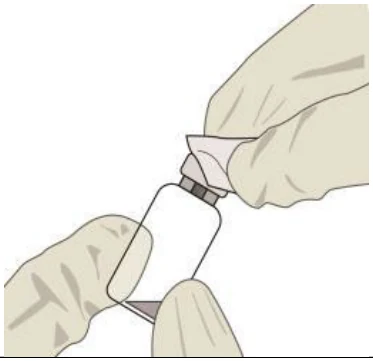
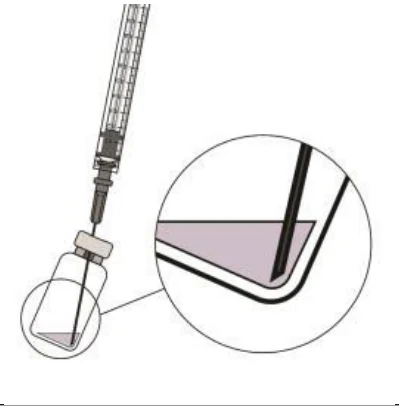
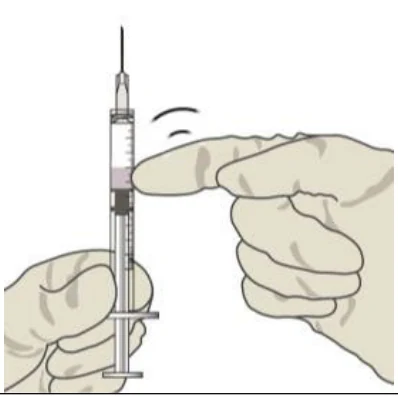
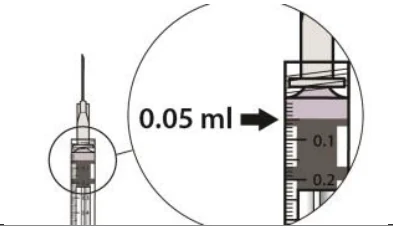
Note: Any unused medicinal product or waste material should be disposed of in accordance with local requirements.
Commonly asked questions and answers
Q: What if I have difficulty withdrawing sufficient liquid from the vial?
A: Do not shake the vial before withdrawal but let the liquid settle to the bottom of the vial. Ensure the vial is in an upright, slightly inclined position. Slowly withdraw the plunger and wait for the liquid to appear in the syringe barrel. Continue to withdraw slowly to completely empty the vial and the filter needle.
Q: What if I cannot remove all the air bubbles from the liquid?
A: It is important that the liquid is air free. However, tiny air bubbles that are attached to the stopper usually do not detach from the stopper during the injection and therefore do not affect the dose volume.