

Patient leaflet - Arixtra 2.5 mg / 0.5 ml solution for injection Pre-filled syringe
1. What Arixtra is and what it is used for
Arixtra is a medicine that helps prevent blood clots from forming in the blood vessels (an antithrombotic agent).
Arixtra contains a synthetic substance called fondaparinux sodium. This stops a clotting factor Xa (“ten-A”) from working in the blood, and so prevents unwanted blood clots (thromboses) from forming in the blood vessels.
Arixtra is used to:
prevent the formation of blood clots in the blood vessels
of the legs or lungs after orthopaedic surgery (such as hip or knee surgery) or abdominal surgery
prevent the formation of blood clots during and shortly after
a period of restricted mobility due to acute illness
treat some types of heart attack and severe angina
(pain caused by narrowing of the arteries in the heart).
treat blood clots in blood vessels that are near the surface
of the skin of the legs (superficial-vein thrombosis).
2. What you need to know before you use Arixtra
Do not use Arixtra:
if you are allergic to fondaparinux sodium or to any
of the other ingredients of this medicine (listed in section 6)
- if you are bleeding excessively
- if you have a bacterial heart infection
- if you have very severe kidney disease.
→ Tell your doctor if you think any of these applies to you.
If they do, you must not use Arixtra.
Take special care with Arixtra:
Talk to your doctor or pharmacist before taking Arixtra:
- if you have previously had complications during treatment with heparin or heparin-like medicines causing a fall in the number of blood platelets (heparin-induced thrombocytopenia)
if you have a risk of uncontrolled bleeding
(haemorrhage) including:
- stomach ulcer
- bleeding disorders
- recent bleeding into the brain (intracranial bleeding)
- recent surgery on the brain, spine or eye
- if you have severe liver disease
- if you have kidney disease
- if you are 75 years old or older
- if you weigh less than 50 kg.
→ Tell your doctor if any of these applies to you.
Children and adolescents
Arixtra has not been tested in children and adolescents under the age of 17 years.
Other medicines and Arixtra
Tell your doctor or pharmacist if you are taking, have recently taken or might take any other medicines. This includes medicines you bought without a prescription. Some other medicines may affect the way that Arixtra works or be affected by Arixtra.
Pregnancy and breast-feeding
Arixtra should not be prescribed to pregnant women unless clearly necessary. Breast-feeding is not recommended during Package Leaflet: Information for the user UK6100112P99-A1.0
Arixtra® 2.5 mg/0.5 ml solution for injection
(fondaparinux sodium)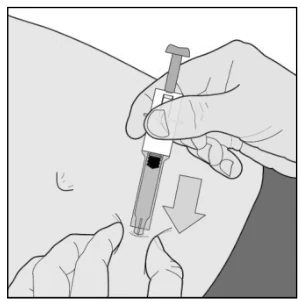
Picture B1
Picture A
Picture B2
Picture C
Picture D
Picture E Syringe automatic system
- 9. Release the plunger and
the needle will automatically
withdraw from the skin and
go back into the security
sleeve where it will be locked
permanently (picture F).
Syringe manual system
- 9. After the injection hold
the syringe in one hand by
gripping the security sleeve,
use the other hand to hold the
finger grip and pull firmly
back. This unlocks the
sleeve. Slide the sleeve up
the body of the syringe until
it locks into position over the
needle. This is shown in
Picture 3 at the beginning
of these instructions.
Do not dispose of the used syringe in the household waste.
Dispose of it as your doctor or pharmacist has instructed.
Blind or partially sighted? Is this leaflet hard to see or read? Call 02036301310 or write to
info@abacusmedicine.com to obtain the leaflet in a format suitable for you.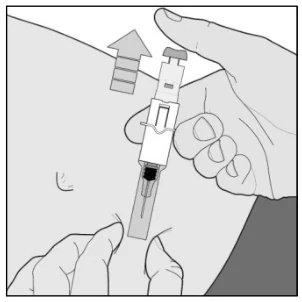
Picture F
treatment with Arixtra. If you are pregnant, or breast-feeding, think you may be pregnant or are planning to have a baby, ask your doctor or pharmacist for advice before taking this medicine.
Arixtra contains sodium
This medicinal product contains less than 23 mg of sodium in each dose and therefore is essentially sodium-free.
Arixtra syringe may contain latex
The syringe needle shield may contain latex that has the potential to cause allergic reactions in latex sensitive individuals.
→ Tell your doctor if you are allergic to latex before being
treated with Arixtra.
3. How to use Arixtra
Always use this medicine exactly as your doctor or pharmacist has told you. Check with your doctor or pharmacist if you are not sure.
The recommended dose is 2.5 mg once a day, injected at about the same time each day.
If you have kidney disease, the dose may be reduced to 1.5 mg once a day.
How Arixtra is given
Arixtra is given by injection under the skin (subcutaneously)
into a skin fold of the lower abdominal area. The syringes are pre-filled with the exact dose you need. There are different syringes for the 2.5 mg and 1.5 mg doses. For step-by-step instructions please see over the page. To treat some types of heart attack, a health professional may give the first dose into a vein (intravenously).
- Do not inject Arixtra into muscle.
How long should Arixtra be taken for
You should continue Arixtra treatment for as long as your doctor has told you, since Arixtra prevents development of a serious condition.
If you inject too much Arixtra
Contact your doctor or pharmacist for advice as soon as possible, because of the increased risk of bleeding.
If you forget to take Arixtra
- Take the dose as soon as you remember. Do not inject a double dose to make up for a forgotten dose.
If you are not sure what to do, ask your doctor
or pharmacist.
Don’t stop using Arixtra without advice
If you stop the treatment before your doctor told you to, you are at risk of developing a blood clot in a vein of your leg or lung. Contact your doctor or pharmacist before stopping.
If you have any further questions on the use of this medicine, ask your doctor or pharmacist.
4. Possible side effects
Like all medicines, this medicine can cause side effects, although not everybody gets them.
Conditions you need to look out for
Severe allergic reactions (anaphylaxis): These are very rare in people (up to 1 in 10,000) taking Arixtra. Signs include:
- swelling, sometimes of the face or mouth (angioedema), causing difficulty in swallowing or breathing • collapse.
→ Contact a doctor immediately if you get these symptoms.
Stop taking Arixtra.
Common side effects
These may affect more than 1 in 100 people treated with Arixtra. • bleeding (for example from an operation site, an existing
stomach ulcer, nosebleed, gums, blood in urine, coughing up blood, bleeding from eyes, bleeding in joint spaces, internal bleeding in uterus)
- localised collection of blood (in any organ/body tissue) • anaemia (a reduction in the number of red blood cells) • bruising
Uncommon side effects
These may affect up to 1 in 100 people treated with Arixtra • swelling (oedema)
- feeling sick or being sick (nausea or vomiting) • headache
- pain
- chest pain
breathlessness
- rash or itchy skin
- oozing from operation wound site
- fever
reduction or increase in the number of platelets
(blood cells necessary for blood clotting)
- increase in some chemicals (enzymes) produced by the liver.
Rare side effects
These may affect up to 1 in every 1000 people treated with Arixtra.
- allergic reaction (including itching, swelling, rash) • internal bleeding in the brain, liver or abdomen • anxiety or confusion
- fainting or dizziness, low blood pressure
- drowsiness or tiredness
- flushing
- coughing
- leg pain or stomach pain
- diarrhoea or constipation
- indigestion
- pain and swelling at injection site
- wound infection
increase in bilirubin (a substance produced by the liver)
in the blood
- increase in the amount of non-protein nitrogen in the blood • reduction in potassium in your blood
- pain around the upper part of the stomach or heartburn.
Reporting of side effects
If you get any side effects, talk to your doctor or pharmacist. This includes any possible side effects not listed in this leaflet. You can also report side effects directly via the Yellow Card Scheme at: www.mhra.gov.uk/yellowcard or search for MHRA Yellow Card in the Google Play or Apple App Store.
By reporting side effects you can help provide more information on the safety of this medicine.
5. How to store Arixtra
- Keep this medicine out of the sight and reach of children
- Store below 25°C. Do not freeze
- Arixtra does not need to be kept in the fridge.
Do not use this medicine:
- after the expiry date shown on the label and carton
if you notice any particles in the solution,
or if the solution is discoloured
- if you notice that the syringe is damaged
if you have opened a syringe and you do not use
it straightaway.
Disposal of syringes:
Do not throw away any medicines or syringes via wastewater or household waste. Ask your pharmacist how to throw away medicines you no longer use. This will help protect the environment.
If the medicine becomes discolored or shows any other signs of deterioration, you should seek the advice of your pharmacist who will tell you what to do.
6. Contents of the pack and other information
What Arixtra contains
The active substance is 2.5 mg fondaparinux sodium
in 0.5 ml solution for injection
The other ingredient(s) are sodium chloride, water for
injections, and hydrochloric acid and/or sodium hydroxide to adjust the pH (see section 2).
Arixtra does not contain any animal products.
What Arixtra looks like and contents of the pack
Arixtra is a clear and colourless solution for injection. It is supplied in a pre-filled, single-use syringe fitted with a safety system to help prevent needle stick injuries after use. It is available in packs of 2, 7, 10 and 20 pre-filled syringes (not all pack sizes may be marketed).
Manufacturer:
Aspen Notre Dame de Bondeville, 1 rue de l’Abbaye, F-76960 Notre Dame de Bondeville, France.
Procured from within the EU and repackaged for the PL Holder:
Abacus Medicine Ltd., Abbey House, 282 Farnborough Road, Farnborough, GU14 7NA, United Kingdom
Arixtra 2.5 mg/0.5 ml solution for injection
PL 45763/0569
POM
For any information about this medicinal product, please contact the local representative of the Product Licence Holder: Abacus Medicine Ltd. tel: +44(0)2036301244,
email: MedInfo@abacusmedicine.co.uk or
drugsafetyuk@abacusmedicine.co.uk
Arixtra® is a registered trademark of Mylan Ireland Limited
This leaflet was last revised approved on 13.02.2025.
Types of safety syringe
There are two types of safety syringes used for Arixtra, designed to protect you from needle stick injuries following injection. One type of syringe has an automatic needle protection system and the other type has a manual needle protection system.
Parts of the syringes:
1 Needle shield
2 Plunger
3 Finger-grip
4 Security sleeve
Picture 1. Syringe with an automatic needle protection system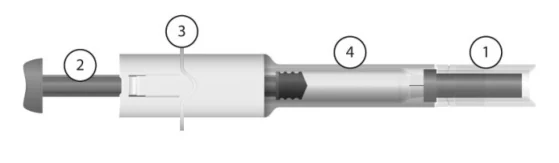
Syringe with a manual needle protection system
Picture 2. Syringe with a manual needle protection system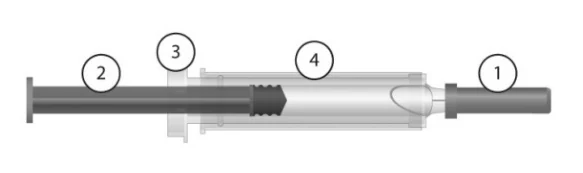
Picture 3. Syringe with a manual needle protection system showing security sleeve being pulled over needle AFTER USE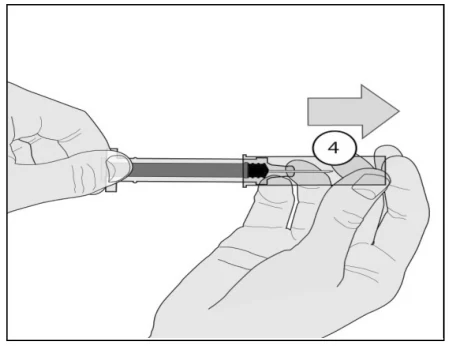
STEP BY STEP GUIDE TO USING ARIXTRA
Instructions for use
These instructions are for both types of syringes (automatic and manual needle protection system). Where the instruction for a syringe is different this is clearly stated.
- 1. Wash your hands thoroughly with soap and water and dry them with a towel.
- 2.
Remove the syringe from the carton and check that:
- the expiry date has not passed
the solution is clear and colourless and doesn’t
contain particles
- the syringe has not been opened or damaged
- 3. Sit or lie down in a comfortable position.
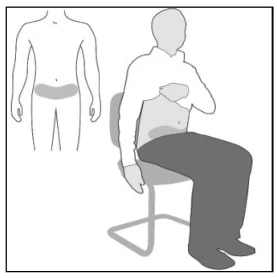
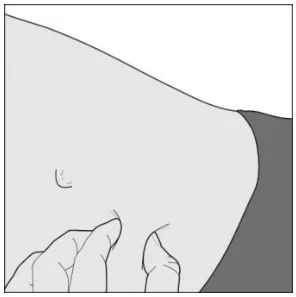
Choose a place in the lower
abdominal (tummy) area, at
least 5 cm below your belly
button (picture A).
Alternate the left and right
side of the lower abdominal
area at each injection. This will
help to reduce the discomfort at
the injection site.
If injecting in the lower abdominal
area is not possible, ask your
nurse or doctor for advice.
- 4. Clean the injection area with an alcohol wipe.
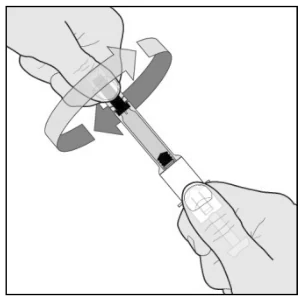
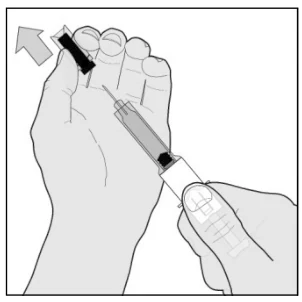
- 5. Remove the needle shield, by first twisting it (picture B1) and then pulling it in a straight line away from the body of the syringe (picture B2).
Discard the needle shield.
Important note
- Do not touch the needle or allow it to touch any surface before the injection.
- It is normal to see a small air bubble in this syringe. Do not try to remove this air bubble before making the injection - you may lose some of the medicine if you do.
- Gently pinch the skin that has been cleaned to make a fold.
Hold the fold between the thumb and the forefinger during the entire injection (picture C).
- 7. Hold the syringe firmly by the finger grip.
Insert the full length of the needle at right angles into the skin fold (picture D).
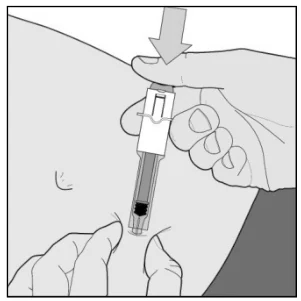
- 8. Inject ALL of the contents of the syringe by pressing down on the plunger as far as it goes
(picture E).