


Patient leaflet - Alfacalcidol 0.5 micrograms capsules soft
1. WHAT ALFACALCIDOL CAPSULES IS AND WHAT IT IS USED FOR
Alfacalcidol Capsules contains the active substance Alfacalcidol. Alfacalcidol belongs to a group of medicines called vitamin D analogues. It is a type of vitamin D. Vitamin D controls the levels of two substances in your body. These substances are called calcium and phosphate. Your body needs both of these substances for healthy bones and teeth. Alfacalcidol works by increasing the amount of vitamin D in your body. This means the levels of calcium and phosphate in your body will increase too.
Alfacalcidol is used to treat diseases where the amount of calcium in your body needs changing.
It is used to treat:
- Changes in bone caused by kidney failure (osteodystrophy).
Changes to your parathyroid glands. These are small glands found in your neck. They make a substance called the parathyroid hormone. This changes the amount of calcium in your body.
o The glands may make the amount of calcium in your blood too high (hyperparathyroidism).
o The glands may make the amount of calcium in your blood too low (hypoparathyroidism).
- Low levels of calcium in the blood of newborn babies (hypocalcaemia).
- Softening and deformity of the bones due to lack of calcium (rickets or osteomalacia).
2. WHAT YOU NEED TO KNOW BEFORE YOU TAKE ALFACALCIDOL CAPSULES
Do not take Alfacalcidol
If you are allergic to alfacalcidol, soya or any of the other ingredients of this medicine (listed in section 6).
- If you know you have a condition called hypercalcaemia. This means you have high levels of calcium in your blood.
- If you know that you have a condition called calcification. This means you have high levels of calcium in your body tissues.
- If you are unsure if any of the above apply to you, talk to your doctor before taking Alfacalcidol.
Warnings and precautions
Talk to your doctor, pharmacist, or nurse before taking Alfacalcidol
- If you are taking any of the medicines in the ‘Taking other medicines” section below.
- If you have any problems with your kidneys. This includes if you have kidney stones.
- If you have granulomas or sarcoidosis. You may be more sensitive to Alfacalcidol
You may get too much calcium or phosphate in your blood when you take this medicine. Please read section 4 of this leaflet so you can spot any signs this may be happening to you. Your doctor may need to change your dose.
While you are taking Alfacalcidol your doctor will take regular blood tests. This is very important in children, patients with kidney problems, or patients on a high dose of medicine. This is to check the level of calcium and phosphate in your blood while you take your medicine.
- Your doctor may prescribe another medicine called a phosphate binding agent to take as well as Alfacalcidol. This will help to keep the right amount of phosphate in your blood.
Your doctor may also prescribe a calcium supplement to take as well as Alfacalcidol. This is to maintain the right amount of calcium in your blood.
Other medicines and Alfacalcidol
Tell your doctor or pharmacist if you are taking, have recently taken or might take any other medicines.
This includes any medicines which you have bought without a prescription.
You must tell your doctor or pharmacist if you are taking any of the following medicines:
- Anticonvulsants (for example, barbiturates, phenytoin, carbamazepine, or primidone): for epilepsy or fits. You may need a larger dose of Alfacalcidol Cardiac glycosides, such as digoxin: for heart problems. You may get too much calcium in your blood. This may cause an abnormal heart beat.
- Thiazide diuretics, often called “water pills”: for increasing the amount of water (urine) that your body makes. You may get too much calcium in your blood.
- Calcium-containing medicines. You may get too much calcium in your blood.
- Other medicines that contain vitamin D. You may get too much calcium in your blood.
- Antacids containing magnesium: for heartburn or indigestion. You may get too much magnesium in your blood.
- Medicines containing aluminium. Too much aluminium is toxic.
- Bile acid sequestrants such as cholestyramine: for lowering your cholesterol level, or to help stop some types of diarrhoea or itching. Your Alfacalcidol may not enter your blood as usual.
Pregnancy and breast-feeding
If you are pregnant or breast-feeding, think you may be pregnant or are planning to have a baby, ask your doctor or pharmacist for advice before taking this medicine.
Driving and using machines
Usually, your medicine may have very little effect on your ability to drive or use machines. Check with your doctor if you feel any side effect, for example dizziness, that may stop you from driving or using machines.
Alfacalcidol 0.25 microgram ,0.5 microgram and 1 microgram Capsules contain:
- Sesame oil: This may rarely cause severe allergic reactions.
- Soyabean oil: Alfacalcidol Capsules contain soya oil. If you are allergic to peanut or soya, do not use this medicinal product.
Please ask your doctor if you are worried about any of the ingredients in this medicine.
3. HOW TO TAKE ALFACALCIDOL CAPSULES
Always take this medicine exactly as your doctor or pharmacist has told you. Check with your doctor or pharmacist if you are not sure.
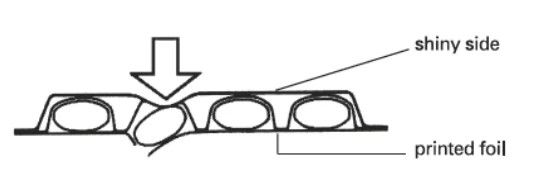
How to take the capsule out of the blister
Press on the shiny side of the blister. The capsule will come out through the printed side of the foil. Please see the diagram.
How much Alfacalcidol Capsules to take
Your doctor will tell you how many capsules to take, or to give your child.
At first you will have weekly blood tests to check the levels of some substances in your blood. These tests are to check the levels of calcium, an enzyme called alkaline phosphatase or the parathyroid hormone. This is so your doctor knows that you are taking the dose that is right for you. When you are getting the correct dose, you will not need blood tests so often.
You may also have other tests such as X-rays. This is also so your doctor knows that the dose is right for you.
Your doctor may adjust your dose. Your doctor may ask you to take more or less capsules depending on your test results.
You may get too much calcium or phosphate in your blood when you take this medicine. Please read section 4 of this leaflet so you can spot any signs this may be happening to you. Your doctor will tell you not to take any more medicine. You will need to have some blood tests. When the blood tests are normal you can start your medicine again. It is important that you only take half the dose you had before.
Package leaflet: Information for the patient Alfacalcidol 0.25 microgram capsules, soft Alfacalcidol 0.5 microgram capsules, soft Alfacalcidol 1 microgram capsules, soft
alfacalcidol
Adults and children weighing more than 20 kilograms:
The usual starting dose is 1 microgram each day. This is either 1 brown capsule, 2 red capsules or 4 cream colored capsules. People usually take between 1 and 3 micrograms each day.
Most people take between 0.25 and 1 microgram each day once the blood test results show the medicine is working. This is usually one cream capsule, or one red capsule or one brown capsule.
If you have very low levels of calcium in your blood, your doctor may prescribe between 3 and 5 micrograms each day. Your doctor may prescribe another medicine called a calcium supplement to take as well as Alfacalcidol Capsules. This will help to keep the right amount of calcium level in your blood.
Elderly:
The usual starting dose is 0.5 microgram each day. This is either 1 red or 2 cream colored capsules.
Children:
The dose depends on the weight of the child (called bodyweight).
- Newborn and premature babies:
The usual starting dose is 0.05 to 0.1 microgram per kilogram of bodyweight each day.
If the level of calcium in their blood is very low, up to 2 micrograms per kilogram of bodyweight may be needed each day.
A dose of 0.1 microgram per kilogram bodyweight each day is used to stop low blood calcium levels in premature babies.
- Children weighing less than 20 kilograms:
The usual starting dose is 0.05 microgram per kilogram bodyweight each day.
If you take more Alfacalcidol Capsules than you should
Tell your doctor straight away. You may need to stop taking this medicine.
You may get too much calcium or phosphate in your blood. Please read section 4 of this leaflet so you can spot any signs this may be happening to you.
If you forget to take Alfacalcidol Capsules
If you forget to take your medicine, take it as soon as you remember. Then take the next dose at the usual time. Do not take a double dose to make up for a forgotten capsule. If you have any further questions on the use of this medicine, ask your doctor, pharmacist, or nurse.
4. POSSIBLE SIDE EFFECTS
Like all medicines, this medicine can cause side effects, although not everybody gets them.
Important side effects to look out for:
You must get urgent medical help if you have any of the following symptoms. You may be having an allergic reaction:
- You have difficulty breathing
- Your face or throat swell
- Your skin develops a severe rash.
You should tell your doctor straight away if you spot any of the following signs which may be due to too much calcium or phosphate in your blood.
These side effects may affect up to 1 in 10 people:
- You feel weak or have pain in your muscles or bones
- You need to pass water (urine) more often
- You feel thirsty
- You feel fatigue
- You feel sick, vomit, have constipation or have lost your appetite
- You are sweating a lot
- You are having headaches
- You feel confused
- You feel drowsy.
You should tell your doctor as soon as possible if you spot any of the following signs which may be due to problems developing with your kidneys.
The frequency of these side effects is not known (cannot be estimated from the available data):
Kidney problems:
o Needing to pass water (urine) less often
o Swelling of any parts of your body
o Fever with a pain in your side.
Kidney stones may be forming. Kidney stones may cause a sharp spasm in one side of your lower back.
Other possible side effects which may affect up to 1 in 10 people are:
- Abdominal/stomach pain or discomfort
- Rash
- Itch.
Uncommon possible side effects which may affect up to 1 in 100 people are:
Headache
- Diarrhoea, vomiting, constipation, nausea
- Muscle pain
- Fatigue
- Calcinosis (deposits of calcium in the body)
- Feeling weak or unwell.
Rare possible side effects which may affect up to 1 in 1,000 people are:
- Dizziness.
Side effects with unknown frequency (cannot be estimated from the available data):
- Confusion
- Hives (urticaria).
Reporting of side effects
If you get any side effects, talk to your doctor, pharmacist, or nurse. This includes any possible side effects not listed in this leaflet. You can also report side effects directly via the Yellow Card Scheme Website: www.mhra.gov.uk/yellowcard or search for MHRA Yellow Card in the Google Play or Apple App Store. By reporting side effects, you can help provide more information on the safety of this medicine.
5. HOW TO STORE ALFACALCIDOL CAPSULES
Keep this medicine out of the sight and reach of children.
- Do not take this medicine after the expiry date which is stated on the carton and foil blister (EXP). The expiry date refers to the last day of that month.
- This medicine does not require any special storage conditions.
Do not throw away any medicines via wastewater or household waste. Ask your pharmacist how to throw away medicines you no longer use. These measures will help protect the environment.
6. CONTENTS OF THE PACK AND OTHER INFORMATION
What Alfacalcidol Capsules contains
The active ingredient is Alfacalcidol.
- Alfacalcidol 0.25 microgram Capsules contain 0.25 microgram of Alfacalcidol in each capsule.
Alfacalcidol 0.5 microgram Capsules contain 0.5 microgram of Alfacalcidol in each capsule.
Alfacalcidol 1 microgram Capsules contain 1 microgram of Alfacalcidol in each capsule. The other ingredients are Sesame oil refined, Vitamin E Preparation (D-Alpha-tocopherol and Soyabean oil), Gelatin, Glycerol, Potassium Sorbate and Purified water.
- The 0.25 microgram capsules also contain titanium dioxide
- The 0.5 microgram capsules also contain titanium dioxide and red iron oxide.
- The 1 microgram capsules also contain black iron oxide and red iron oxide.
- You can find important information about some of the ingredients in your medicine near the end of section 2 of this leaflet.
What Alfacalcidol Capsules looks like and contents of the pack
Alfacalcidol 0.25 microgram Capsules are Cream coloured oval opaque, soft gelatin capsules containing oily solution and bearing the designation “A25” on one side of the Capsule.
Alfacalcidol 0.5 microgram Capsules are Reddish coloured, oval shaped, opaque, soft gelatin capsules containing oily solution and bearing the designation “A5”
Alfacalcidol 1 microgram Capsules are Brown coloured, oval opaque, soft gelatin capsules containing oily solution and bearing the designation “A1” on one side of the capsule.
Capsules are packed in blisters and are subsequently packed into pouch and carton. The pouch contains 30 capsules packed in 3 blister strips.
Marketing Authorisation Holder and Manufacturer Marketing Authorisation Holder
Euro-Link Pharma Ltd
110 Butterfield,
Great Marlings, Luton,
Bedfordshire, LU2 8DL,
United Kingdom
Manufacturer
Ascenders consulting Services limited
110 Butterfield,
Great Marlings,
Luton, LU2 8DL,
United Kingdom
This leaflet was last revised in 01/2026.
For information in large print, audio CD or Braille, please telephone +44 1582 439706 or email info@euro-linkpharma.co.uk
XXXX XXXX
| JOB | Alfacalcidol Capsules PIL | |
| 160 x 350mm | ||
| FOLDING SIZE | ||
| DATE | 20 June 2025 | |
| BOH APPROVAL DATE | ||
| SAVED AS | XXXXX-01 Alfacalcidol Capsules PIL Farmak | |
| PRINTS | 1 colour - black |