

Patient leaflet - Zithromax suspension 200 mg/5 ml
1. What Zithromax is and what it is used for
This medicine contains azithromycin, which is one of a group of antibiotics called macrolides. It is used to treat infections caused by certain bacteria and other micro-organisms which include:
- chest, throat or nasal infections (such as bronchitis, pneumonia, tonsillitis, sore throat (pharyngitis) and sinusitis)
- ear infections
- skin and soft tissue infections (such as an abscess or boil)
- sexually-transmitted diseases caused by organisms called Chlamydia trachomatis or Neisseria gonorrhoea.
You must talk to a doctor if you do not feel better or if you feel worse.
2. What you need to know before you take Zithromax
Do not take Zithromax:
- if you/your child are allergic to azithromycin or any other macrolide antibiotic such as erythromycin or clarithromycin or any of the ingredients listed in section 6. An allergic reaction may cause skin rash or wheezing.
Warnings and precautions
Talk to your doctor or pharmacist before taking Zithromax if you/your child have or have had any of the following:
- kidney problems
- heart conditions
diabetes
- liver problems: your doctor may need to monitor your liver function or stop the treatment
- myasthenia gravis (a condition that causes certain muscles to become weak)
- or if you are taking any ergot derivatives such as ergotamine (used to treat migraine) as these medicines should not be taken together with Zithromax.
Tell your doctor immediately
- if you feel your heart beating in your chest or have an abnormal heartbeat, or get dizzy or faint or suffer from any muscle weakness when taking Zithromax.
- if you are giving this medicine to an infant (less than 6 weeks of age) and they vomit or become irritable when fed.
If you develop diarrhoea or loose stools during or after treatment, tell your doctor at once. Do not take any medicine to treat your diarrhoea without first checking with your doctor. If your diarrhoea continues, please inform your doctor.
Other medicines and Zithromax
Tell your doctor or pharmacist if you/your child are taking, have recently taken or might take any other medicines.
In particular, Zithromax may interact with the medicines listed below:
- ergot or ergotamine, see ‘Warnings and precautions’ section
- warfarin or any similar medicine to prevent blood clots
- ciclosporin (used to suppress the immune system to prevent and treat rejection of a transplanted organ or bone marrow)
- antacids (for indigestion)
- digoxin (used to treat heart failure)
- colchicine (used for gout and familial Mediterranean fever)
- terfenadine (for hay fever or a skin allergy).
- Hydroxychloroquine or chloroquine (used to treat autoimmune diseases including rheumatoid arthritis, or to treat or prevent malaria): Taking these medicines at the same time as azithromycin may increase the chance of you getting side effects that affect your heart.
Zithromax with food and drink
Please refer to section 3.
Pregnancy, breast-feeding and fertility
If you are pregnant or breast-feeding, think you may be pregnant or are planning to have a baby, ask your doctor or pharmacist for advice before taking this medicine.
Driving and using machines
Zithromax is not expected to affect your ability to drive or use machines.
Zithromax contains sucrose, a type of sugar (3.87g in 5ml). If you have been told by your doctor that you have an intolerance to some sugars contact your doctor before taking this medicine. If you are diabetic, you may need to take this into account in your diet.
Information on sodium content
Zithromax contains less than 1mmol sodium (23mg) per 5ml of reconstituted suspension, that is to say essentially ‘sodium free’.
3. How to take Zithromax
Always take or give this medicine exactly as your doctor has told you. Check with your doctor or pharmacist if you are not sure.
The pharmacist should have advised you whether to measure the medicine using the multi-dosing spoon or the oral dosing syringe (15ml pack only).
Zithromax is generally used for children under 7 stones (45kg). It may also be used in adults and older children who have difficulty swallowing capsules.
Zithromax is not affected by food or drink.
Children under 45kg
The recommended dose in children is 10mg for each kg of bodyweight, given as a single daily dose for 3 days.
Adults and children over 45kg
The recommended dose in adults and in children over 7 stones (45kg) is 500mg taken as a single dose, for 3 days. For some diseases such as Chlamydia the recommended dose is 1g daily taken as a single dose. For gonorrhoea the recommended dose is 1g or 2g of azithromycin in combination with 250 or 500mg of ceftriaxone.
You should tell your doctor if you/your child have kidney or liver problems as your doctor may need to alter the normal dose.
Doctors sometimes prescribe different doses to the recommended dose. The label on the pack will tell you which dose you/your child should take. If you are still not sure, ask your doctor or pharmacist.
Always continue with the course of treatment even if you/your child feel better. If your infection gets worse or you do not start to feel better within a few days or a new infection develops, go back and see your doctor.
How to give Zithromax in children less than 3 years of age
If your child is under three years of age or weighs up to 15kg in bodyweight, you should measure the dose as clearly as possible using the 10ml oral dosing syringe provided. The syringe is graduated in 0.25ml divisions, providing 10mg of azithromycin (the active ingredient) in every graduation.
- A. Instructions for the syringe
Filling the syringe with medicine
- 1.
Shake the bottle
- before use and
- remove the child-
- proof cap.
- 2.
An adaptor for the
- syringe should have
- been fitted into the
- neck of the bottle of
- medicine by the
- pharmacist. If this
- has not been done,
- take off the adaptor
- from the syringe and
- fit to the neck of the
- bottle as shown. The
- adaptor is so that
- you can fill the
- syringe with
- medicine from the
- bottle.
- 3.
Check the
- dispensing label
- attached by your
- pharmacist to see
- how much medicine
- needs to be taken.
- 4.
While the bottle is
- sitting on a firm, flat
- surface, hold it
- steady with one
- hand. With the other
- hand insert the tip of
- the syringe into the
- adaptor.
- 5.
Turn the bottle
- upside down while
- holding the syringe in place.
- 6. Slowly pull back the plunger of the syringe so that the top edge is level with the graduation mark corresponding to the quantity in the millilitres (ml) prescribed by your doctor.
- 7. If large bubbles can be seen in the syringe, slowly push the plunger back into the syringe. This will force the medicine back into the bottle. Repeat step 6 again.
- 8. Hold the syringe and bottle firmly. Turn the bottle upright, with the syringe still in place.
- 9. Remove syringe from bottle.
Giving the medicine using the syringe
- 1. Make sure your child is supported in an upright position.
- 2. Put the tip of the syringe carefully into your child’s mouth. Point the tip of the syringe towards the inside of your child’s cheek.
- 3. Slowly push down the plunger of the syringe: Do not squirt it out quickly. The medicine will trickle into your child’s mouth.
- 4. Allow your child some time to swallow the medicine.
- 5. Replace the child-proof cap on the bottle. Wash the syringe as instructed below.
- 6. Where daily doses of less than 5ml have been given for three days, some suspension will remain in the bottle. This remaining suspension should be discarded.
Cleaning and storing the syringe
- 1. Pull the plunger out of the syringe and wash both parts by holding under warm running water or by immersing in sterilising solution used for baby’s feeding bottles, etc.
- 2. Dry the two parts. Push the plunger back into the syringe. Keep it in a clean safe place with the medicine. After you have given your child the final dose of medicine, wrap the syringe in a sheet of newspaper and put it in the rubbish bin.
How to give Zithromax in children between 3 and 14 years of age
| Bodyweight and age | Dose and duration |
15-25kg bodyweight (3-7 years): (Between 2½ and 4 stones) | 5ml (200mg), given as 1 x 5ml spoonful, once daily for 3 days. |
26-35kg bodyweight (8-11 years): (Between 4 and 5½ stones) | 7.5ml (300mg), given as 1 x 7.5ml spoonful, once daily for 3 days. |
36-45kg bodyweight (12-14 years): (Between 5½ and 7 stones) | 10ml (400mg), given as 1 x 10ml spoonful, once daily for 3 days. |
B. Instructions for the plastic spoon
The spoon should not be used for children less than 3 years of age (less than 2½ stones).
Giving the medicine using the spoon.
- A plastic double-ended spoon is provided with the medicine. Check which end of the spoon and to which level gives you your required dose. If you are unsure, check with your doctor or pharmacist. This multi-dosing spoon delivers doses as follows:
| 2.5ml | (100mg) | Small end to graduation | |
| 5ml | (200mg) | Small end brimful | |
| 7.5ml | (300mg) | Large end to graduation | |
| 10ml | (400mg) | Large end brimful |
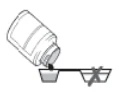
- 2. Shake the bottle well and then remove the child-proof cap.
- 3. Gently pour the medicine into the spoon as required to give the correct dose.
- 4. Allow the patient to swallow the medicine slowly.
- 5. Wash the spoon under warm, running water. Dry and store it with the medicine in a safe place.
Warning: if giving this medicine to a child, ensure that while receiving the medicine he/she is supported in an upright position to avoid the risk of choking.
If you/your child takes more Zithromax than they should
If you/your child take too much Zithromax they may feel unwell.
Tell your doctor or contact your nearest hospital casualty department immediately. Take any remaining medicine with you.
If you forget to take or give Zithromax
If you forget to take Zithromax take it as soon as you can. Take your next dose at the right time. Do not take a double dose to make up for a forgotten dose.
If you stop taking Zithromax
If you/your child stop taking Zithromax too soon, the infection may return. Take Zithromax for the full time of treatment, even when you/your child begin to feel better.
If you have any further questions on the use of this medicine, ask your doctor or pharmacist.
4. Possible side effects
Like all medicines, this medicine can cause side effects although not everybody gets them.
Tell your doctor immediately if you experience any of the following symptoms after taking this medicine as the symptoms can be severe.
- sudden wheeziness, difficulty in breathing, swelling of eyelids, face or lips, rash or itching (especially affecting the whole body)
- severe or prolonged diarrhoea, which may have blood or mucus in it, during or after treatment with Zithromax as this may be a sign of serious bowel inflammation
- severe skin rash causing redness and flaking
- rapid or irregular heartbeat
- low blood pressure.
Serious skin reactions:
- blistering of the skin, mouth, eyes, and genitals (Stevens-Johnson Syndrome (SJS))
- blistering of the skin, severe skin reaction (Toxic Epidermal Necrosis (TEN))
- skin rash accompanied by other symptoms such as fever, swollen glands and an increase of eosinophils (a type of white blood cell). A rash appears as small, itchy red bumps (Drug Reaction with Eosinophilia and Systemic Symptoms (DRESS))
- skin eruption that is characterised by the rapid appearance of areas of red skin studded with small pustules (small blisters filled with white/yellow fluid) (Acute Generalised Exanthematous Pustulosis (AGEP)).
Stop taking azithromycin if you develop these skin symptoms and contact your doctor or seek medical attention immediately.
The most common side effects that occur when taking Zithromax are listed below. These may go away during treatment as your body adjusts to the medicine. Tell your doctor if any of these side effects continue to bother you:
Very common: may affect more than 1 in 10 people
- stomach cramps, feeling sick, diarrhoea, wind.
Common: may affect up to 1 in 10 people
- dizziness, headache
numbness or pins and needles
- being sick, indigestion
- loss of appetite, taste disturbance
- visual disturbances, deafness
- skin rash and /or itching
- joint pain
- low numbers of lymphocytes (a type of white blood cell), higher number of eosinophils (type of white blood cells)
- low blood bicarbonate
- tiredness or weakness.
Uncommon: may affect up to 1 in 100 people
- yeast infections of the mouth and vagina (thrush)
- low numbers of leukocytes (a type of white blood cell), low number of neutrophils (a type of white blood cell)
- allergic reactions of various severity
- skin more sensitive to sunlight than normal
- feeling nervous
- reduced sense of touch or sensation (hypoesthesia)
- sleepiness or sleeplessness (insomnia)
- poor hearing or ringing in the ears
- heart palpitations, chest pain
- constipation, stomach pain associated with diarrhoea and fever
- inflammation of the liver (hepatitis), changes in liver enzymes.
- general loss of strength
- swelling
- general discomfort
- abnormal laboratory test values (e.g. blood or liver tests).
Rare: may affect up to 1 in 1,000 people
- agitation
- vertigo
- changes in liver function
Not known: frequency cannot be estimated from the available data
- fits or fainting
- aggression or anxiety
- feeling hyperactive
- localised muscle weakness
- loss of smell or altered sense of smell, loss of taste
- tongue discolouration
- inflammation of the pancreas (pancreatitis)
- inflammation of the kidney or kidney failure
- yellowing of the skin or eyes (jaundice) or liver failure (rarely life-threatening)
- bruising or prolonged bleeding after injury
- abnormal electrocardiogram (ECG)
- reduction in red blood cells which can make the skin pale and cause weakness or breathlessness.
Reporting of side effects
If you get any side effects, talk to your doctor or pharmacist. This includes any possible side effects not listed in this leaflet. You can also report side effects directly via the Yellow Card Scheme at: www.mhra.gov.uk/yellowcard or search for MHRA Yellow Card in the Google Play or Apple App Store. By reporting side effects, you can help provide more information on the safety of this medicine.
5. How to store Zithromax
Keep out of the sight and reach of children.
This medicine does not require any special storage conditions.
Do not refrigerate.
Store in the original package.
Any remaining suspension should be discarded after 5 days.
Do not take the suspension after the expiry date which is stated on the carton and bottle labels after 'Exp'. The expiry date refers to the last day of that month.
If the suspension becomes discolored or shows any signs of deterioration, seek the advice of your pharmacist.
Remember if your doctor tells you to stop taking this medicine, return any unused medicine to your pharmacist for safe disposal. Only keep this medicine if your doctor tells you to.
Medicines should not be disposed of via wastewater or household waste. Ask your pharmacist how to dispose of medicines no longer required. These measures will help to protect the environment.
6. Contents of the pack and other information
What Zithromax contains
The active ingredient is azithromycin.
15ml bottle: Each 5ml of suspension contains 200mg azithromycin (as dihydrate).
30ml bottle: Each 10ml of suspension contains 400mg azithromycin (as dihydrate).
The other ingredients are sucrose, hydroxypropyl cellulose, sodium phosphate tribasic anhydrous, xanthan gum cherry flavor (contains pregelatinised cornstarch (E1450)), vanilla flavor (contains glucose, pregelatinised cornstarch (E1450) and ethanol) and banana flavor (contains pregelatinised maize starch (E1450)).
What Zithromax looks like and contents of the pack
Zithromax is a dry powder which reconstitutes with water to give a cherry/banana flavoured suspension with a slight vanilla odour and comes in
15ml (600mg) and 30ml (1200mg) amber glass bottles.
Each pack contains a multi-dosing spoon and the 15ml pack contains an oral dosing syringe with a bottle neck adaptor.
Manufactured by: Farmasierra Manufacturing S.L., Ctra. N-1, Km 26,200. 28709 San Sebastian de los Reyes, Madrid, Spain.
Procured from within the EU and repackaged by the Product Licence holder: B&S Healthcare, Unit 4, Bradfield Road, Ruislip, Middlesex,
HA4 0NU, UK.
Zithromax® 200mg/5ml suspension;
PL 18799/2544
POM
Leaflet date: 25.11.2024
Zithromax is the registered trademark of Pfizer Products lnc.
Blind or partially sighted?
Is this leaflet hard to see or read?
Call 0208 515 3763 to obtain the leaflet in a format suitable for you.
 | |||
 | |||
 | |||
 |