Patient leaflet - Yorvipath 294 micrograms/0.98 ml solution for injection in Pre Filled pen
1. What Yorvipath is and what it is used for
Yorvipath contains the active substance palopegteriparatide. Palopegteriparatide is changed into teriparatide, also called parathyroid hormone (PTH), in the body. PTH naturally occurs in the body and is needed to keep the amount of calcium and phosphate in your body within the normal range.
Yorvipath is used to treat chronic hypoparathyroidism in adults. In people with hypoparathyroidism, the body produces no or too little PTH. Because of this, they cannot keep the levels of calcium and phosphate within a normal range, and this leads to the symptoms of the condition, such as muscle spasms, twitching, and tingling in your fingertips, toes and lips. Yorvipath replaces the missing PTH to help control the levels of calcium and phosphate.
2. What you need to know before you use Yorvipath
Do not use Yorvipath
- if you are allergic to palopegteriparatide or any of the other ingredients of this medicine (listed in section 6)
- if you have pseudohypoparathyroidism, a condition in which the body does not adequately respond to the parathyroid hormone produced by the body
Warnings and precautions
Talk to your doctor, pharmacist or nurse before using Yorvipath.
If you are treated with Yorvipath, you may have side effects related to low or high levels of calcium in your blood (see section 4 for more information). These effects are more likely to occur when starting treatment or when changing the dose. Your doctor will check your calcium levels (see ‘Tests and checks’ in section 3). You may be given medicines to treat or help prevent these side effects, or your doctor may change your dose.
High levels of calcium in your blood can cause problems if you take medicines that contain cardiac glycosides (such as digoxin or digitoxin) (see ‘Other medicines and Yorvipath'). Your doctor will check your calcium (see ‘Tests and checks’ in section 3) and glycoside levels and monitor you for signs and symptoms.
If you take Yorvipath and have severe kidney or liver impairment, your doctor will check your calcium more often (see ‘Tests and checks’ in section 3).
Tell your doctor if you are at higher risk of a type of bone cancer called osteosarcoma. This is especially important:
- if you are having or have had radiation therapy to the skeleton
- if you have cancer of the bones or other cancer that has spread to your bones
- if you have a bone disease that increases your risk of developing osteosarcoma (for instance, if you have Paget’s disease)
- if a blood test shows that you have unexplained increases in bone alkaline phosphatase
If you are at risk for bone fractures, your doctor will check you for osteoporosis.
Children and adolescents
Yorvipath should not be used in children or adolescents under 18 years old because it has not been studied in this age group.
Other medicines and Yorvipath
Tell your doctor, pharmacist or nurse if you are using, have recently used, or might use any other medicines. In particular, tell your doctor if you are using or have recently used any of the following:
- Heart medicines that contain cardiac glycosides (such as digoxin or digitoxin)
- Medicines used to treat osteoporosis, such as bisphosphonates, denosumab, or romosozumab
- Medicines that can affect calcium levels in your blood, such as diuretics (‘water tablets’, such as hydrochloride thiazide or furosemide), systemic corticosteroids (medicines used to treat inflammation), and lithium (medicine used to treat mood disorders)
Your doctor may need to adjust the dose of these medicines or the dose of Yorvipath.
Pregnancy, breast-feeding and fertility
If you are pregnant or breast-feeding, think you may be pregnant or are planning to have a baby, ask your doctor or pharmacist for advice before taking this medicine.
Pregnancy
If you think you may be pregnant or are planning to have a baby, talk to your doctor. If you become pregnant during treatment, talk to your doctor immediately.
There is limited information on the safety of Yorvipath in pregnant women. Your doctor will decide whether you should be treated with Yorvipath during pregnancy. If you are pregnant or planning to become pregnant your doctor may check your calcium levels.
Breast-feeding
If you are breast-feeding or intend to breast-feed, ask your doctor for advice before using Yorvipath. Your doctor will decide whether you should be treated with Yorvipath during breast-feeding. If you are breast-feeding, your doctor may check your calcium levels.
Fertility
It is not known if Yorvipath has effects on fertility.
Driving and using machines
Yorvipath has no or very minor effects on your ability to drive or use machines. However, if you experience dizziness, fainting or light-headedness when standing up, do not drive or use machines until you feel better.
Yorvipath contains sodium
This medicine contains less than 1 mmol sodium (23 mg) per dose, that is to say essentially ‘sodium-free’.
3. How to use Yorvipath
Always use this medicine exactly as your doctor or nurse has told you. Check with your doctor if you are not sure.
Yorvipath is given as an injection under the skin (subcutaneous injection). This means that it is injected with a short needle into the fatty tissue under the skin. The medicine should be injected into the belly (abdomen) or front of the thigh, and it is important to inject into a different area every day to help avoid damaging your skin. You can change between the left and right side of the belly and between the left and right front of the thigh.
Before you use the pen for the first time, your doctor, pharmacist or nurse will show you how to inject Yorvipath. Additional help with using Yorvipath is provided in the instructions for use at the end of this leaflet.
You should always use the pen as described in the instructions for use.
Starting, changing dose, and maintenance of Yorvipath
Your doctor will do a blood test to check your calcium and vitamin D levels before you start treatment with Yorvipath.
The recommended starting dose of Yorvipath is 18 micrograms once daily. Your doctor may advise you to gradually change your dose based on your response to the medicine, until you are using a dose that keeps the amount of calcium in your body within the normal range without the need for active vitamin D or therapeutic doses of calcium. Your doctor may tell you to keep taking daily calcium supplementation to meet dietary requirements. Your dose may be increased if at least 7 days have passed since your last change in dose. Your dose may be decreased no more often than every 3 days when the level of calcium in your body is too high.
Tests and checks
Your doctor will check how you respond to the treatment:
- 7 days after starting treatment and
- 7 to 14 days after your dose is changed
This will be done using tests to measure the level of calcium in your blood or urine. Your doctor may tell you to change the amount of calcium or vitamin D you take (in any form, including foods rich in calcium).
Directions for use
If your dose is above 30 micrograms per day:
- Administer two injections, one after the other, in separate injection sites.
- It is recommended to use a different Yorvipath pen for the second daily injection, even if the two pens have the same-coloured push button (same strength).
The table below explains how to administer your dose. Check with your doctor if you are not sure.
Recommended scheme for Yorvipath dosing above 30 micrograms/day
| Dose | Dosing scheme | Which pen to use? | ||
| 33 micrograms/day | 15 micrograms/day + 18 micrograms/day | |||
First injection with Yorvipath 294 micrograms/0.98 mL pen (with orange push button)
+ Second injection with Yorvipath 294 micrograms/0.98 mL pen (with orange push button)
| 36 micrograms/day | 18 micrograms/day + 18 micrograms/day | |||
| 39 micrograms/day | 18 micrograms/day + 21 micrograms/day | |||
| 42 micrograms/day | 21 micrograms/day + 21 micrograms/day | |||
| 45 micrograms/day | 21 micrograms/day + 24 micrograms/day | First injection with Yorvipath 294 micrograms/0.98 mL | ||
| pen (with orange push button) | ||||
| + | ||||
| Second injection with Yorvipath 420 micrograms/1.4 mL | ||||
| pen (with burgundy push button) | ||||
| 48 micrograms/day | 24 micrograms/day + 24 micrograms/day | First injection with Yorvipath 420 micrograms/1.4 mL pen (with burgundy push button) + Second injection with Yorvipath 420 micrograms/1.4 mL pen (with burgundy push button) | ||
| 51 micrograms/day | 24 micrograms/day + 27 micrograms/day | |||
| 54 micrograms/day | 27 micrograms/day + 27 micrograms/day | |||
| 57 micrograms/day | 27 micrograms/day + 30 micrograms/day | |||
| 60 micrograms/day | 30 micrograms/day + 30 micrograms/day | |||
Yorvipath 294 micrograms/0.98 mL pen delivers doses of 15, 18, or 21 micrograms (with orange push button) Yorvipath 420 micrograms/1.4 mL pen delivers doses of 24, 27, or 30 micrograms (with burgundy push button)
If you use more Yorvipath than you should
Immediately contact your doctor or nurse and describe any symptoms you get.
An overdose may lead to high levels of calcium in the blood. Symptoms may include but are not limited to being sick (vomiting), dizziness, feeling thirsty, confusion, muscle weakness, and irregular heartbeat. See section 4 for more information.
If you forget to use Yorvipath
If you forget to inject a dose of Yorvipath, you can use the medicine as soon as you remember if less than 12 hours have passed. For example, if you normally inject the medicine at 8 o’clock in the morning, you can inject the missed dose before 8 o’clock in the evening.
If you only remember to use your dose within 12 hours of your next planned dose, skip the missed dose and continue injecting your next dose as you normally would. For example, if you remember at 10 o’clock in the evening that you forgot to inject Yorvipath, and your next dose is planned at 8 o’clock in the morning, you should not inject the missed dose.
Never take a second dose to make up for a missed dose.
If you stop using Yorvipath
Do not stop using Yorvipath without talking to your doctor. If you stop using Yorvipath the levels of calcium in your blood may decrease and you may develop the symptoms described below (see section 4).
If you have any further questions on the use of Yorvipath, ask your doctor or nurse.
4. Possible side effects
Like all medicines, this medicine can cause side effects, although not everybody gets them.
Some side effects could be considered serious
Tell your doctor immediately if you experience any of the following symptoms:
Not known (frequency cannot be estimated from the available data):
Allergic reactions (anaphylaxis)
- Symptoms may include, but are not limited to, wheezing and breathing difficulty, swelling of your face, mouth, or tongue, fast heartbeat, hives, rash, itching, flushing, fever, severe vomiting or diarrhoea, lightheadedness or loss of consciousness. These symptoms may occur suddenly, and may be serious, and potentially life-threatening.
Common side effects (may affect up to 1 in 10 people):
High levels of calcium in the blood (hypercalcaemia)
- Symptoms may include, but are not limited to, being sick (vomiting), dizziness, feeling thirsty, confusion, muscle weakness, and irregular heartbeat.
- Hypercalcaemia is more likely to occur within the first 3 months of starting treatment or if you change your Yorvipath dose.
Low levels of calcium in the blood (hypocalcaemia)
Symptoms may include, but are not limited to, tingling in your fingertips, toes and lips
(paraesthesia), muscle spasms and cramps, oral numbness, and seizures.
- Hypocalcaemia is more likely to occur if you stop taking Yorvipath for a short time or altogether, or if you change your Yorvipath dose.
Your doctor will check your calcium levels. You may need to change your Yorvipath dose or stop the injections for a short time. You may be given medicines to treat or help prevent these side effects, or you may be asked to stop some of the medicines you are taking. These medicines include calcium or vitamin D. You may be asked to have some laboratory tests.
Other side effects include:
Very common side effects (may affect more than 1 in 10 people)
- Headache
- Tingling in your fingertips, toes and lips (paraesthesia)
- Feeling sick (nausea)
- Feeling tired (fatigue)
- Redness, bruising, pain, bleeding, rash or swelling where you injected the medicine (injection site reactions)
Common side effects (may affect up to 1 in 10 people)
- Feeling like your heart is fluttering or beating too fast (palpitations)
- Dizziness
- Feeling you are about to faint (pre-syncope)
- Fainting (syncope)
- Dizziness, lightheadedness or fainting when you sit up or stand up (orthostatic hypotension)
- Dizziness, lightheadedness or fainting and increased heart rate when you sit up or stand up (postural orthostatic tachycardia syndrome)
- Sore mouth or sore throat (oropharyngeal pain)
- Diarrhoea
- Constipation
- Being sick (vomiting)
- Abdominal pain
- Abdominal discomfort
- Joint pain (arthralgia)
- Muscle pain (myalgia)
- Weakness (asthenia)
- Thirst
- Rash
- Skin reaction to sunlight (photosensitivity reaction)
- The need to pass urine at night (nocturia)
- Muscle twitching
- Pain in the muscles and bones (musculoskeletal pain)
Uncommon side effects (may affect up to 1 in 100 people)
- Allergic reactions (hypersensitivity)
- Chest pain
- Chest discomfort
- High blood pressure (hypertension)
Not known (Frequency cannot be estimated from the available data)
- Bone density decreased
- The need to pass urine often (polyuria)
If you get any side effects or any symptoms that concern you, tell your doctor or nurse.
Reporting of side effects
If you get any side effects, talk to your doctor, pharmacist or nurse. This includes any possible side effects not listed in this leaflet. You can also report side effects directly via the Yellow Card Scheme Website: www.mhra.gov.uk/yellowcard or search for MHRA Yellow Card in the Google Play or Apple App Store. By reporting side effects you can help provide more information on the safety of this medicine.
5. How to store Yorvipath
Keep this medicine out of the sight and reach of children.
Do not use this medicine after the expiry date which is stated on the carton after EXP. The expiry date refers to the last day of that month.
Before first use:
Store in a refrigerator (2 °C – 8 °C). Do not freeze.
Store in the original package with the pen cap on in order to protect from light.
After first use:
Store below 30 °C.
Keep the pen cap on the pre-filled pen in order to protect from light.
Discard each pen 14 days after first use.
Do not use this medicine if you notice that the solution is cloudy, coloured, or has visible particles in it.
Do not throw away any medicines via wastewater or household waste. Ask your pharmacist how to throw away medicines you no longer use. These measures will help protect the environment.
6. Contents of the pack and other information
What Yorvipath contains
- The active substance is palopegteriparatide.
- The excipients are succinic acid, mannitol, metacresol, sodium hydroxide (see section 2, “Yorvipath contains sodium”), hydrochloric acid (for pH adjustment), and water for injections.
Yorvipath is a solution for subcutaneous injections in a pre-filled pen available in three presentations:
Yorvipath 168 micrograms/0.56 mL
Each pre-filled pen contains palopegteriparatide equivalent to 168 micrograms of PTH(1-34) in 0.56 mL of solvent. The concentration based on PTH(1-34) is 0.3 mg/mL.
Yorvipath 294 micrograms/0.98 mL
Each pre-filled pen contains palopegteriparatide equivalent to 294 micrograms of PTH(1-34) in 0.98 mL of solvent. The concentration based on PTH(1-34) is 0.3 mg/mL.
Yorvipath 420 micrograms/1.4 mL
Each pre-filled pen contains palopegteriparatide equivalent to 420 micrograms of PTH(1-34) in 1.4 mL of solvent. The concentration based on PTH(1-34) is 0.3 mg/mL.
What Yorvipath looks like and contents of the pack
Yorvipath is a clear and colourless solution free of particles for injection in a pre-filled pen. Yorvipath is available in pack sizes containing 2 pre-filled pens (with 30 disposable needles or without needles) for 28 days of treatment. Each pre-filled pen is for 14 days of treatment.
Not all pack sizes may be marketed.
Strength colours are indicated on the outer and inner cartons, on the label and push button of the pre-filled pen, as follows:
| Presentation | |
| Blue | Yorvipath 168 micrograms/0.56 mL |
| Orange | Yorvipath 294 micrograms/0.98 mL |
| Burgundy | Yorvipath 420 micrograms/1.4 mL |
Marketing Authorisation Holder
Ascendis Pharma Bone Diseases A/S Tuborg Boulevard 12
DK-2900 Hellerup
Denmark
Manufacturer
Ascendis Pharma A/S
Tuborg Boulevard 12
DK-2900 Hellerup
Denmark
This leaflet was last revised in 08/2026.
The Instructions for Use with information on how to inject Yorvipath is shown on the other side of this leaflet.
INSTRUCTIONS FOR USE
Yorvipath
294 micrograms/0.98 mL
For doses of 15, 18 or 21 micrograms only
Solution for injection in pre-filled pen palopegteriparatide
For subcutaneous use
This instructions for use contains information on how to inject
Yorvipath
Additional information
If you do not understand or are unable to complete a step that is described in this instructions for use, contact your doctor or nurse.
Important information you need to know before using your Yorvipath pen
Read and follow the package leaflet and these instructions for use carefully so that you inject Yorvipath the right way.
Make sure you have received training from your doctor or nurse before injecting. This is important to make sure that you get the correct treatment.
For correct use
- By failing to follow these instructions, you may not get the right dose, and may therefore not get the full effect of your medicine.
- If you are blind or visually impaired or if you have lack of concentration, do not use your pen without help. Instead get help from a person who is trained to use the Yorvipath pen.
- Keep out of the sight and reach of children.
- The pen and needles are for single-patient use only.
Do not share your pen or needles with other people. It might lead to infection
(cross-contamination).
Always throw away your pen after 14 days of use, even if it still has medicine left inside.
This is important to make sure that you get the right effect of your medicine.
- Always use the needles that come with the Yorvipath pen for your injections. If needles are not included, they must be obtained separately. Needles with a length of 5 mm and 31 gauge should be used. Talk to your doctor or nurse about the right needle for you.
- Instructions regarding needle handling do not replace instructions accompanying needles obtained separately.
- Remove the needle after every use. Do not store the pen with the needle on.
- Avoid bending or breaking off the pen needle.
- Do not change the injection angle after the needle has been inserted into the skin. Changing the angle can cause the needle to bend or break off. A bent or broken needle can remain stuck in the body or remain completely under the skin. If a broken needle remains stuck in the body or remains under the skin, seek medical help right away.
- Do not use needles if the needle cover or needle foil are damaged.
Special instructions for doses larger than 30 micrograms/day
If your dose is above 30 micrograms/day:
- Administer two injections, one after the other, in separate injection sites (see table with recommended scheme in section 3 of Package leaflet).
- It is recommended to use a different Yorvipath pen for the second daily injection, even if the two pens have the same-coloured push button (same strength).
- Follow the steps in the instructions for use for each injection.
Caring for your pen
- Handle your pen with care.
- Keep your pen dry.
- Use a moist cloth to clean your pen.
Do not drop or knock your pen against hard surfaces. If you do, test the pen flow again
(section 2, steps A - C) before next use.
- Do not apply extra force to your pen. It might be empty, damaged and no longer work properly.
- Do not attempt to repair a damaged pen yourself.
- Never use a damaged pen.
Troubleshooting
- 1. How often must I test the pen flow?
You should only test the pen flow (section 2) the first time you use a new pen (or if you think it might be damaged) to not waste medicine. The test checks to make sure the medicine flows through the pen so that you get the right doses of medicine.
- 2. I do not see drops appear after I have tested the pen flow 5 times. What should I do?
If you see no drop on the needle tip after 5 attempts, it might be because there is no flow through the pen and needle.
Change the needle (see section 5, step 12) and test the pen flow again (see section 2, steps A - C). You can be sure the flow works correctly when you see the drop of medicine. If it still does not work discard the pen and contact your health care provider.
- 3. How do I know I have completed the injection?
Your injection is only completed after you have pressed the push button all the way in and the dose selector has rotated back to the “●” and you have kept the needle in the skin for 5 seconds.
- 4. Why do I have to keep holding the pen in the skin for 5 seconds?
Some medicine might flow back into the pen or flow backward from the injection site and be left on the skin. Holding the pen in the skin for 5 seconds helps to make sure that all the medicine has been injected.
- 5. I cannot dial the dose selector to the required dose. What should I do?
The pen does not allow a larger dose to be set than what is left in the pen.
If your dose is larger than the amount of medicine left in the pen you will not be able to dial a full dose. You must throw away your pen and take the full dose of medicine with a new pen.
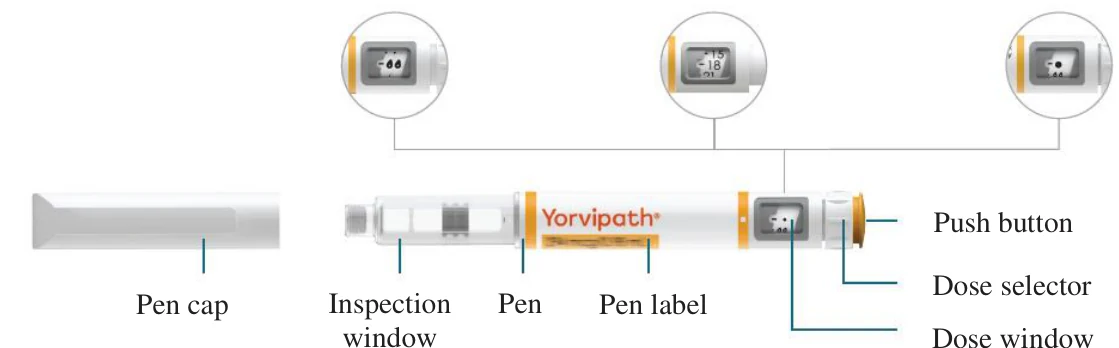
Parts overview
Figure A
Symbols:
Droplets Doses (15, 18 or 21 micrograms) End-of-dose
You will also need
Figure B 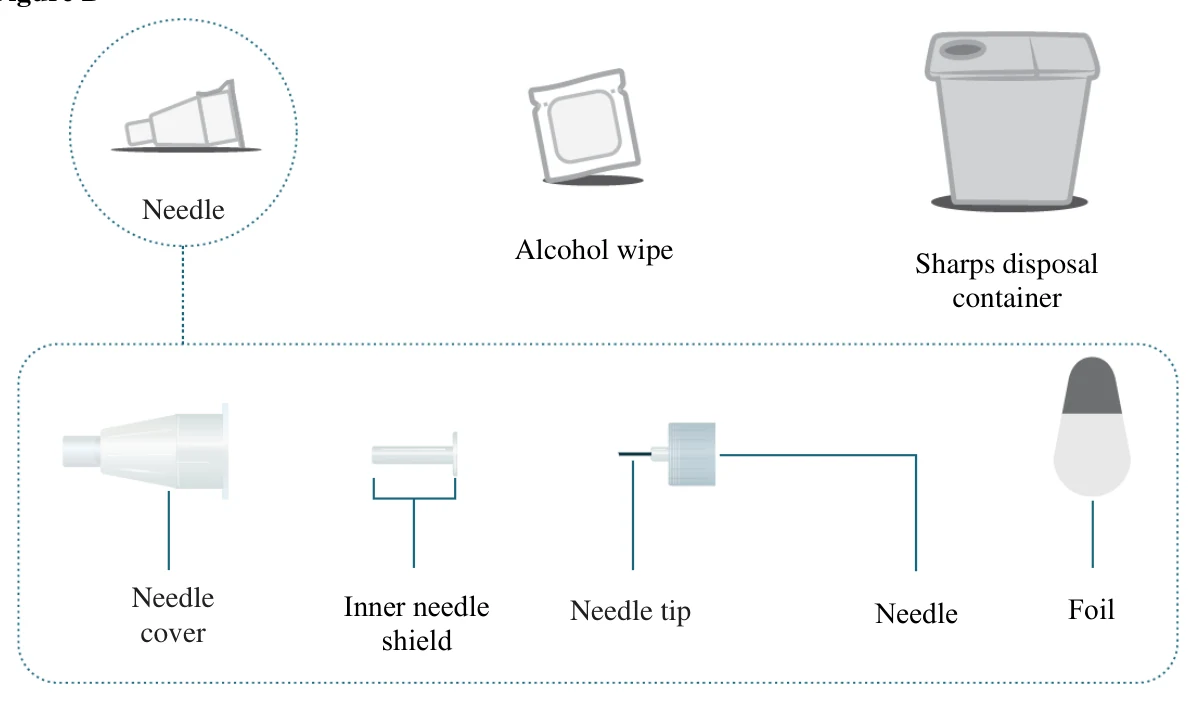
Alcohol wipe Sharps disposal container
Needle
Needle
cover
Needle tip
Needle
Foil Inspection
window
(medicine inside)
Dose window
Dose selector
Push button
Pen cap
Pen label
Pen
Inner needle
shield
| 1 Prepare pen and needle | |
Step 1 Take your Yorvipath pen. Make sure it is the correct strength and check the expiry date. Take a needle and check the expiry date on the needle (figure C). Note: Take your pen out of the refrigerator 20 minutes before first use. | Figure C Expiry date OK? |
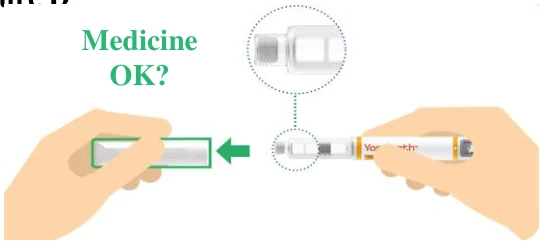
Step 2 Pull off the pen cap and check the inspection window to make sure the medicine inside the pen is clear and colourless (figure D). Important: If the medicine has visible particles in it do not use the pen. Use a new pen. | Figure D Medicine OK? |
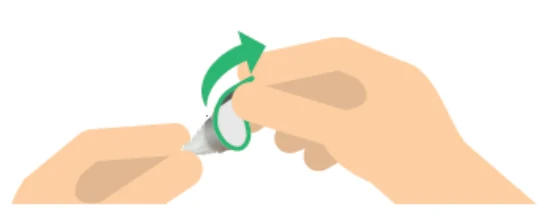
Step 3 Pull the foil off the needle (figure E). This needle can only be used 1 time. Always use a new needle for each injection. | Figure E |
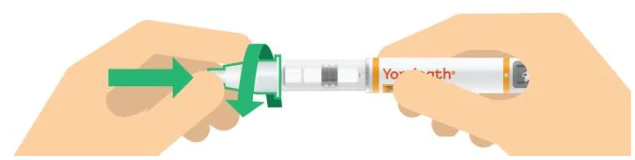
Step 4 Attach the needle straight onto your pen, then screw the needle onto the pen until secure (figure F). | Figure F |
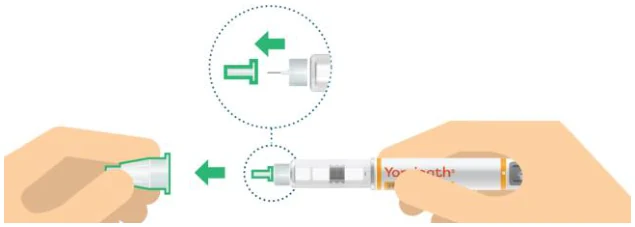
Step 5 Pull off the needle cover and the inner needle shield (figure G). Throw away the inner needle shield and keep the needle cover for later. | Figure G |
2 If new pen, test pen flow Only test pen flow (steps A - C) the first time you use a new pen. If your pen is already in use, go to section "3 Prepare injection and select dose". Day 1 | |
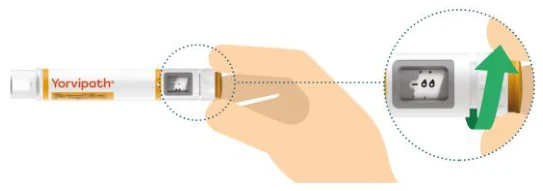
Step A Turn the dose selector clockwise (to the right) 2 clicks until you see the droplet symbol “ ” in the dose window (figure H). Note: You can always correct the selection by turning the dose selector. | Figure H |
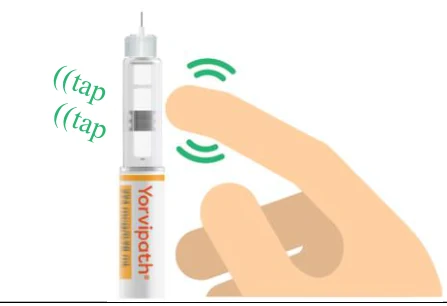
Step B Make any air bubbles rise to the top of the pen by tapping the inspection window (figure I). Keep the pen with the needle tip pointed up. Note: Tiny air bubbles are ok. | Figure I |
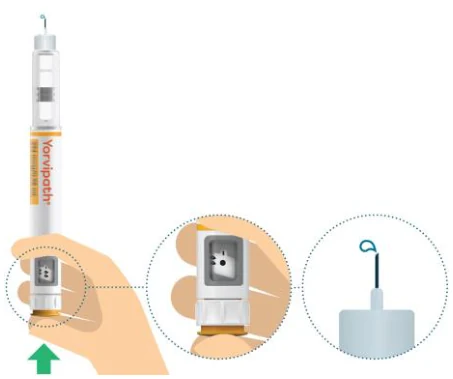
Step C Press the push button and watch drops of medicine come out of the needle tip. When you press, make sure that the dose selector rotates back to the symbol “●” (figure J). Important: If you do not see drops of medicine, repeat this test (steps A - C) up to 5 times. If drops are still not seen, change the needle and repeat the test. | Figure J |
| 3 Prepare injection and select dose | |
Step 6 Choose injection site. There are two regions of your body you can inject into (figure K). Avoid injecting where skin is red, swollen or scarred. Choose a different injection site each time you inject. | Figure K Belly (abdomen) at least 5 centimetres away from the navel Front of the thighs Front |
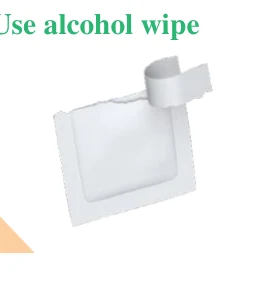
Step 7 Wash your hands and clean the injection site with an alcohol wipe (figure L). | Figure L Use alcohol wipe |
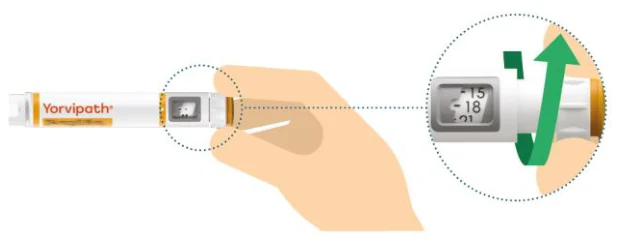
Step 8 Select your dose as prescribed by your doctor (15, 18 or 21 micrograms) by turning the dose selector clockwise (to the right) (figure M). Important: Make sure not to press the push button while selecting your dose to not spill medicine. Note: Always throw away your pen and use another pen if you cannot dial a full dose. | Figure M |
4 Inject dose Use the injection technique recommended by your doctor or nurse. Read this whole section (steps 9 - 11) before you start to inject. | |
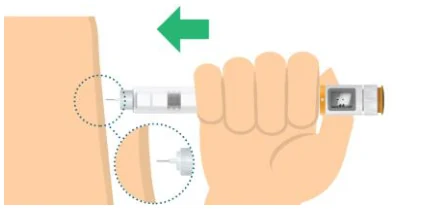
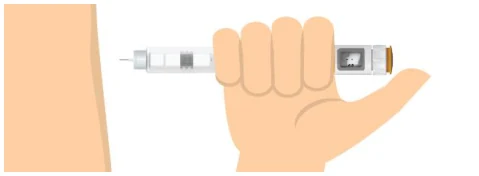
Step 9 Make sure you can see the dose window. Insert the needle into the skin (figure N). | Figure N |
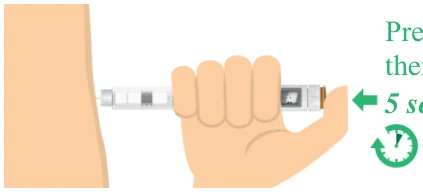
Step 10 Press the push button all the way in and hold steady for 5 seconds. Make sure the dose selector rotates back to the symbol “●”. This means that you have given the full dose (figure O). | Figure O Press… then hold 5 seconds |
Step 11 Slowly remove the pen from the injection site (figure P). | Figure P |
| 5 Throw away used needle | |
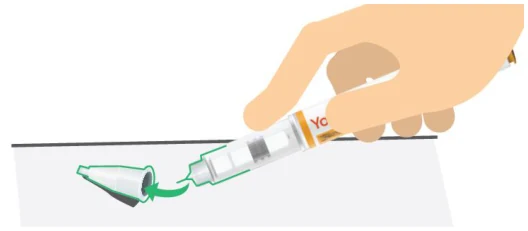
Step 12 Reattach the needle cover to carefully remove the needle. Lead the needle tip into the needle cover and secure the needle cover onto the needle (figure Q). Important: Always reattach the needle cover before removing the needle to reduce the risk of needle stick and cross-contamination. | Figure Q |
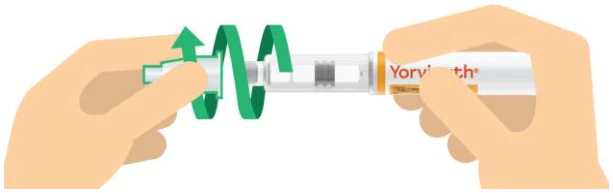
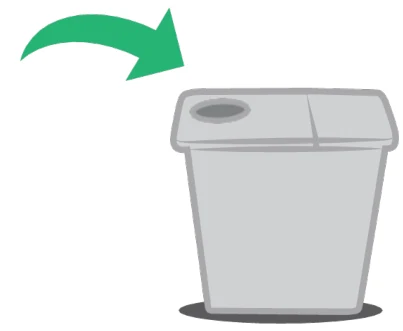
Step 13 Unscrew the needle. Safely throw away the needle according to local regulations (figure R). | Figure R |
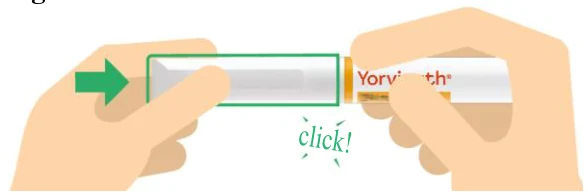
Step 14 Click the pen cap firmly onto the pen to protect it between injections and to protect the medicine from light (figure S). | Figure S |
6 Throw away used pen Day 14 | |
Important: Always throw away the pen 14 days after first use according to local regulations. It is recommended to fill out the 'Open date:' field on the carton, in order to know when 14 days has passed. Always throw away your pen after 14 days of use, even if it still has medicine inside (figure T). This is important to make sure that you get the full effect of your medicine. Note: If needles are supplied in the package with your pen, remember to throw away the extra needle when you throw away your pen. | Figure T |