


Summary of Product Characteristics (SmPC) - Voke 0.45 mg inhaler
1 NAME OF THE MEDICINAL PRODUCT
Voke 0.45 mg Inhaler
2 QUALITATIVE AND QUANTITATIVE COMPOSITION
Each refill canister contains 9 mg nicotine and provides approximately 20 charges of the inhaler device. Each charge contains approximately 0.45 mg nicotine, equivalent to a delivered dose of 0.43 mg nicotine, except for the first charge, which delivers less than 0.43 mg (range 0.10 – 0.30 mg) due to inhaler design.
Excipient(s) with known effect
Ethanol (alcohol) - contains less than 10 mg of ethanol per charged inhaler.
For a full list of excipients, see section 6.1.
3 PHARMACEUTICAL FORM
Pressurised inhalation solution
4 CLINICAL PARTICULARS
4.1 Therapeutic indications
Voke relieves and/or prevents craving and nicotine withdrawal symptoms associated with tobacco dependence. It is indicated to aid smokers wishing to quit or reduce prior to quitting, to assist smokers who are unwilling or unable to smoke, and as a safer alternative to smoking for smokers and those around them.
Voke is indicated in pregnant and lactating women making a quit attempt.
4.2 Posology and method of administration
Voke is for oral inhalation use only.
Posology
Adults over 18 years of age:
Voke should be used whenever the urge to smoke is felt or to prevent cravings in situations where these are likely to occur.
Smokers willing or able to stop smoking immediately should initially replace all their cigarettes with the Inhaler and as soon as they are able, reduce the number of charges used until they have stopped completely.
Smokers aiming to reduce cigarettes should use the Inhaler, as needed, between smoking episodes to prolong smoke-free intervals and with the intention to reduce smoking as much as possible.
As soon as they are ready, smokers should aim to quit smoking completely. Maximum daily dose: 2 refill canisters
When making a quit attempt, behavioural therapy, advice and support will normally improve the success rate. Those who have quit smoking, but are having difficulty discontinuing their Inhaler are recommended to contact their pharmacist or doctor for advice.
Each refill canister lasts for 20 charges. Each charge apart from the first one (see Section 2) provides a comparable number of inhalations to a conventional cigarette, although frequency, puffing/inhalation time and technique vary between individuals.
Paediatric population
Voke is contraindicated in children and adolescents under the age of 18 years (see Section 4.3).
Method of administration
Step 1. Filling Voke:
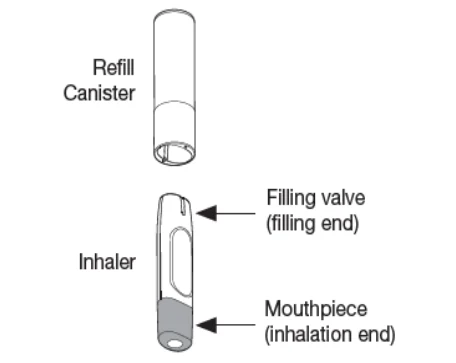
Check the expiry date of the refill canister and the inhaler and refill canister for any damage. If you have a new inhaler that has not been used before or you have not used the inhaler for more than 2 days, repeat the filling process again - steps (a) to (d) before using to ensure it works properly and gives you the correct dose. You should only fill the inhaler immediately before you intend to use it.
(a) Hold the inhaler and the refill canister in separate hands.
(b) Hold the refill canister vertically above the inhaler, with the refill canister valve pointing downwards, above the inhaler.
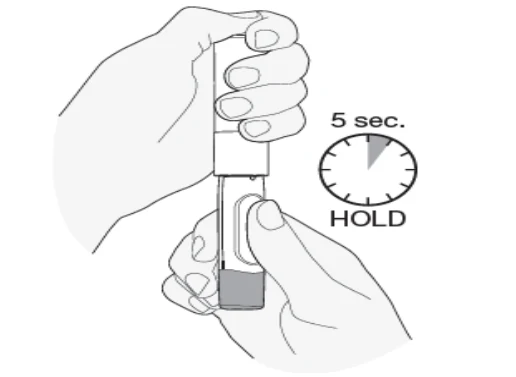
(c) To start the filling process, insert the white end of the inhaler into the refill canister firmly and hold it in place for 5 seconds to initiate the filling process. You may hear a short hissing sound as you insert it.
(d) Remove the inhaler from the refill canister as it is now filled. (e) If this is a new inhaler, repeat steps (a) to (d).
If spray comes into contact with skin or eyes, rinse gently with water.
Step 2. Using Voke:
(f) Hold the inhaler away from your mouth with the Voke logo facing upwards.
(g) Breathe out as far as is comfortable, away from the device (h) Hold the inhaler horizontally and place the grey mouthpiece between your lips and close your lips firmly around the mouthpiece to form a good seal.
(i) Inhale forcibly through your mouth until you feel the spray from the inhaler release into your mouth. Take as much or as little aerosol spray to your mouth as you like or feel comfortable with.
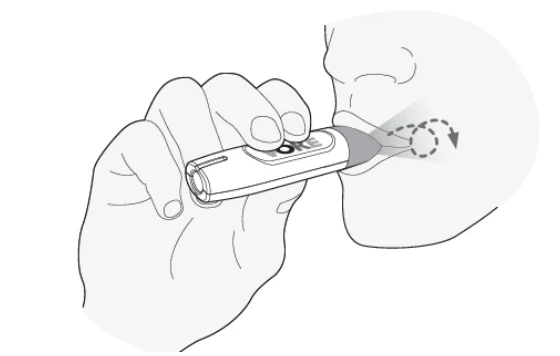
At first, it might take you a few attempts to get the inhaler to release the aerosol spray. Don’t worry, it isn’t broken, it just needs a stronger sharp puff to open the pressure sensitive valve inside the inhaler. You will quickly get used to controlling the strength of puff and the amount of aerosol spray released.
(j) Gently remove the inhaler from your mouth whilst continuing to
breathe in to inhale the aerosol spray from your mouth into your lungs. 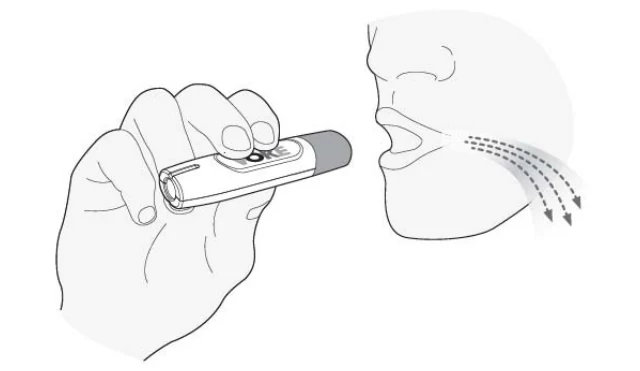
(k) Breathe out slowly
You may see some spray escape as you breathe out, but this can occasionally happen so don’t worry.
(l) Repeat steps (f) to (k) several times until you no longer feel spray coming from the inhaler. You have now completed taking 1 full charge. A fully filled inhaler contains enough liquid to give you several ‘puffs’ depending on how hard you inhale.When you no longer feel spray coming from the inhaler it means it is empty and you will need to refill it from the refill canister before using it again. The maximum daily dose is 2 full refill canisters
As with most inhaled medications, the therapeutic effect of this medication may decrease when the pack is cold.
Step 3. Refilling Voke:
(m) To refill the inhaler, use the refill canister supplied, following the relevant instructions in Step 1.
(n) Wipe the mouthpiece of the inhaler gently with a dry tissue after each refill canister. Do not
clean the inhaler with any chemicals or cleaning agents. Do not immerse the inhaler in any
liquids.
(o) Dispose of the refill canister with household rubbish or at an appropriate recycling facility.
Each refill canister contains 20 charges and each inhaler can be used with up to 30 refill canisters.
4.3 Contraindications
Hypersensitivity to any component of Voke.
Voke is contraindicated in children and adolescents under the age of 18 years
4.4 Special warnings and precautions for use
Any risks that may be associated with the use of nicotine are substantially outweighed by the well-established dangers of continued smoking.
Underlying cardiovascular disease: In stable cardiovascular disease, Voke presents a lesser hazard than continuing to smoke. However, dependent smokers currently hospitalised as a result of myocardial infarction, unstable or worsening angina including Prinzmetal’s angina, severe dysrhythmia or CVA and who are considered to be haemodynamically unstable and/or who have uncontrolled hypertension should be encouraged to stop smoking with non-pharmacological interventions. If this fails, Voke may be considered, but as data on safety in this patient group are limited, initiation should only be under medical supervision.
Diabetes mellitus: Patients with diabetes mellitus should be advised to monitor their blood sugar levels more closely than usual when nicotine replacement therapy (NRT) is initiated, as catecholamines released by nicotine can affect carbohydrate metabolism.
GI disease: Swallowed nicotine may exacerbate symptoms in patients suffering from oesophagitis, gastritis or peptic ulcers and oral NRT preparations should be used with caution in these conditions. Ulcerative stomatitis has been reported.
Renal or hepatic impairment: Use with caution in patients with moderate to severe hepatic impairment and/or severe renal impairment as the clearance of nicotine or its metabolites may be decreased with the potential for increased adverse effects.
Danger in children: Doses of nicotine tolerated by adult and adolescent smokers can produce severe toxicity in children that may be fatal. Products containing nicotine should not be left where they may be misused, handled or ingested by children. If a child chews or sucks on Voke that contains any nicotine, there is a risk of poisoning in the child.
Phaeochromocytoma and uncontrolled hyperthyroidism: As nicotine causes release of catecholamines, Voke should be used with caution in patients with uncontrolled hyperthyroidism or phaeochromocytoma.
Seizures: Potential risks and benefits of nicotine should be carefully evaluated before use in subjects taking anticonvulsant therapy or with a history of epilepsy, as cases of convulsions have been reported in association with nicotine.
Transferred dependence: Transferred dependence is rare and is both less harmful and easier to break than smoking dependence.
Stopping smoking: Polycyclic aromatic hydrocarbons in tobacco smoke induce the metabolism of drugs metabolised by CYP 1A2 (and possibly by CYP 1A1). When a smoker stops smoking, this may result in slower metabolism and a consequent rise in blood levels of such drugs. This is of potential clinical importance for products with a narrow therapeutic window, e.g. theophylline, clozapine and ropinirole.
Lung Disease: Patients with obstructive lung disease may find use of the inhaler difficult. Nicotine gum, patches, nasal spray, or sublingual tablets may be preferred in such patients. Voke should be used with caution in patients with chronic throat disease and bronchospastic disease.
Allergic Reactions: Susceptibility to angioedema and urticaria.
Potential choking hazard: When not in use, the stick should be kept in the pack. This reduces the potential for contamination with dirt or fluff which, if inhaled, may cause choking.
Excipients: This medicinal product contains small amounts of ethanol (alcohol), less than 10 mg per charged inhaler. The amount in one charge of Voke is equivalent to less than 1 ml beer or 1 ml wine. The small amount of alcohol in Voke will not have any noticeable effects. This medicine contains 54mg propylene glycol (E1520) in each pack, equivalent to 2.7mg in each full charge of the stick.
4.5 Interaction with other medicinal products and other forms of interaction
No clinically relevant interactions between nicotine replacement therapy (NRT) and other drugs have definitely been established. However nicotine may possibly enhance the haemodynamic effects of adenosine i.e. increase in blood pressure and heart rate and also increase pain response (angina-pectoris type chest pain) provoked by adenosine administration.
4.6 Fertility, Pregnancy and lactation
Pregnancy
Stopping smoking is the single most effective intervention for improving the health of both the pregnant smoker and her baby, and the earlier abstinence is achieved the better. Ideally smoking cessation during pregnancy should be achieved without NRT. However, if the mother cannot (or is considered unlikely to) quit without pharmacological support, NRT may be used as the risk to the foetus is lower than that expected with smoking tobacco. Stopping completely is by far the best option but if this is not achievable Voke may be used in pregnancy as a safer alternative to smoking. Because of the potential for nicotine-free periods, intermittent dose forms are preferable, but patches may be necessary if there is significant nausea and/or vomiting. If patches are used they should, if possible, be removed at night when the foetus would not normally be exposed to nicotine.
Lactation
The relatively small amounts of nicotine found in breast milk during NRT use are less hazardous to the infant than second-hand smoke. Intermittent dose forms would minimise the amount of nicotine in breast milk and permit feeding when levels were at their lowest.
Fertility
In females, tobacco smoking delays time to conception, decreases in-vitro fertilization success rates, and significantly increases the risk of infertility.
In males, tobacco smoking reduces sperm production, increases oxidative stress, and DNA damage. Spermatozoa from smokers have reduced fertilizing capacity.
The specific contribution of nicotine to these effects in humans is unknown.
4.7 Effects on ability to drive and use machines
Voke has no or negligible influence on the ability to drive and use machines.
4.8 Undesirable effects
Effects of smoking Cessation
Some symptoms may be related to nicotine withdrawal associated with stopping smoking. These can include: irritability/aggression, dysphoria/depressed mood, anxiety, restlessness, poor concentration, increased appetite/weight gain, urges to smoke (cravings), night-time awakenings/sleep disturbance and decreased heart rate.
Increased frequency of aphthous ulcer may occur after abstinence from smoking. The causality is unclear.
Adverse Drug Reactions
Voke may cause adverse reactions similar to those associated with nicotine given by other means, including smoking, and these are mainly dose-dependent. At recommended doses, nicotine has not been found to cause any serious adverse effects. Excessive use of nicotine by those who have not been in the habit of inhaling tobacco smoke could possibly lead to nausea, faintness or headaches.
Most of the undesirable effects reported by the patient occur during the first weeks after starting treatment. About 40% of users experience mild local reactions such as cough and irritation in the mouth and throat.
Allergic reactions (including symptoms of anaphylaxis) occur rarely during use of this product.
The adverse reactions below are listed by system organ class (SOC).
Frequencies are defined in accordance with current guidance, as: Very common (≥1/10); common (≥1/100, <1/10); uncommon (≥1/1 000, <1/100); rare (≥1/10 000, <1/1 000); very rare (<1/10 000), Not known - cannot be estimated from the available data.
Reported adverse events associated with inhaled nicotine include:
| System Organ Class | Incidence | Reported Adverse Event | ||||||
| Immune System Disorders | Common Not known | Hypersensitivitya Anaphylactic reactiona | ||||||
| Psychiatric disorders | Uncommon | Abnormal dreamsc | ||||||
| Nervous System Disorders | Very Common Common Common Common Common Not known | Headachea# Burning sensationb Dizziness Dysgeusia Paraesthesiaa Seizures | ||||||
| Eye Disorders | Not known Not known | Blurred Vision Lacrimation increased | ||||||
| Cardiac Disorders | Uncommon Uncommon Very Rare | Palpitationsa Tachycardiaa Reversible atrial fibrillation | ||||||
| Vascular Disorders | Uncommon Uncommon | Flushinga Hypertensiona | ||||||
| Respiratory, Thoracic and Mediastinal Disorders | Very Common Very Common Common Uncommon Uncommon Uncommon Uncommon Uncommon | Cough* Throat irritation Nasal Congestion Bronchospasm Dysphonia Dyspnoeaa Sneezing Throat tightness | ||||||
| Gastrointestinal Disorders | Very Common Very Common Very Common Common Common Common Common Common Common Common Uncommon Uncommon Uncommon Uncommon Rare Rare Rare Not known | Nauseaa Stomatitis Hiccups Abdominal pain Diarrhoea** Dry mouth Dyspepsia Flatulence Salivary hypersecretion Vomitinga Eructation Glossitis Oral mucosal blistering and exfoliation Paraesthesia oral** Dysphagia Hypoaesthesia oral** Retching | ||||||
| System Organ Class | Incidence | Reported Adverse Event | ||||||
| Not known Not known | Dry throat Gastrointestinal discomforta Lip pain | |||||||
| Skin and Subcutaneous Tissue Disorders | Uncommon Uncommon Uncommon Uncommon Not known Not known | Hyperhidrosisa Pruritusa Rasha Urticariaa Angioedemaa Erythemaa | ||||||
| General Disorders and Administration Site Conditions | Common Uncommon Uncommon Uncommon | Fatiguea Astheniaa Chest discomfort and paina Malaisea | ||||||
a Systemic effects;
b At the application site
c Identified if formulation was used at night
*Higher frequency observed in clinical studies with inhaler formulation. **Reported the same or less frequently than placebo
# Although the frequency in the active group is less than that of the placebo group, the frequency in the specific formulation in which the preferred term was identified as a systemic ADR was greater in the active group than the placebo group.
Reporting of suspected adverse reactions
Reporting suspected adverse reactions after authorisation of the medicinal product is important. It allows continued monitoring of the benefit/risk balance of the medicinal product. Healthcare professionals are asked to report any suspected adverse reactions via the Yellow Card Scheme
(www.mhra.gov.uk/yellowcard), or to search for MHRA Yellow Card in the Google Play or Apple App Store.
4.9 Overdose
The minimum lethal dose of nicotine in a non-tolerant man has been estimated to be 40 to 60 mg.
Symptoms: Symptoms of acute nicotine poisoning include nausea, salivation, abdominal pain, diarrhoea, sweating, headache, dizziness, disturbed hearing and marked weakness. In extreme cases, these symptoms may be followed by hypotension, rapid or weak or irregular pulse, breathing difficulties, prostration, circulatory collapse, and convulsions (including terminal convulsions).
Management of an overdose: All nicotine intake should stop immediately and the patient should be treated symptomatically. Artificial respiration should be instituted if necessary. Activated charcoal reduces the gastro-intestinal absorption of nicotine.
5 PHARMACOLOGICAL PROPERTIES
5.1 Pharmacodynamic properties
Pharmacotherapeutic Group: Drugs used in nicotine dependence.
ATC code: N07B A01
Voke facilitates the rapid uptake of nicotine into the systemic circulation. The amount taken up alleviates the craving symptoms caused by the absence of nicotine from smoking.
Clinical data demonstrate a rapid reduction in craving following use of the Voke. After inhaling the contents of a single charge, the reduction in craving lasts for several hours.
Increased appetite is a recognised symptom of nicotine withdrawal and post-cessation weight gain is common. Clinical trials have demonstrated that NRT can help control weight following a quit attempt.
5.2 Pharmacokinetic properties
Nicotine given intravenously (i.v.) has a volume of the distribution of 2 or 3 l/kg with a half-life of 1-2 hours. Average plasma clearance is about 1-2 l/min mainly in the liver. More than 20 metabolites are known, all less active than nicotine: cotinine, with a half-life of 15-20 hours and concentrations ten times that of nicotine is the main one.
Plasma binding of nicotine below 5% means significant displacement of drugs or nicotine is unlikely. Nicotine is excreted in the urine principally as cotinine (15%), 3-hydroxycotinine (45%), nicotine (10%).
After inhaling Voke at a rate of one puff every 15 seconds for up to 4 minutes, nicotine rapidly enters the arterial bloodstream. Arterial nicotine concentrations are expected to increase as early as 2 minutes after the start of inhalation, reaching a maximum concentration approximately 7 minutes after the start of inhalation. Venous concentrations would reach a peak approximately 18 minutes after the start of inhalation. After inhaling one complete charge of the Voke every hour for 12 hours, steady state plasma nicotine concentrations in the region of 8 ng/ml are expected. This is substantially less than the concentrations seen with cigarette smoking. The rapid appearance of nicotine in arterial blood after oral inhalation is consistent with pulmonary absorption. Aerosol impaction in the mouth and throat is also likely to result in some degree of oromucosal absorption.
Because the pattern of use is decided by the patient up to a limit of 2 refill canisters per day to relieve craving, therapeutic levels of nicotine are individual and dictated by the level of dependence.
5.3 Preclinical safety data
None stated
6 PHARMACEUTICAL PARTICULARS
6.1 List of excipients
Propylene glycol
Ethanol
Saccharin
Levomenthol
HFA134a
6.2 Incompatibilities
Not applicable.
6.3 Shelf life
24 Months.
Discard Voke when you have used up to 30 refill canisters, or within 15 days, whichever is sooner.
6.4 Special precautions for storage
Store below 25°C
Do not expose to temperatures higher than 50°C.
Store away from heat or direct sunlight.
As with most inhaled medications in aerosol canisters, the therapeutic effect of this medication may decrease when the canister is cold.
The canister contains a pressurised liquid, do not puncture, break or burn even when empty.
Store Voke, in between uses, in the carton.
6.5 Nature and contents of container
- Acrylonitrile butadiene styrene and polypropylene inhalation device with breath operated valve
- A pressurised aluminium refill canister with a continuous valve, fitted during assembly with a polypropylene canister collar (top)
Voke contains one inhaler and one pressurised aluminium refill canister (enclosed within the starter pack) containing 20 charges. The inhaler must be charged with the refill canister before using and the inhaler cannot be filled with any other formulations other than the Voke refill canister.
Pack sizes:
Starter pack: 1 inhaler and 1 refill canister, providing 20 charges Single refill pack: 1 refill canister, providing 20 charges
Twin refill pack: 2 refill canisters, providing 20 charges each
Five refill pack: 5 refill canisters, providing 20 charges each
Ten refill pack: 10 refill canisters, providing 20 charges each
Not all pack sizes may be marketed.
6.6 Special precautions for disposal and other handling
Because of residual nicotine and the potential choking hazard, used refill canisters and inhalers may be a hazard to children, animals and fish and so should never be left lying around. The inhaler and refill canister should be kept in their cartons and disposed of with household rubbish or at an appropriate recycling facility.
7 MARKETING AUTHORISATION HOLDER
Ayrton Saunders Ltd
Parliament Business Park, Ayrton House, 38 Commerce Way Liverpool, L8 7BA, United Kingdom
8 MARKETING AUTHORISATION NUMBER(S)
PL 16431/0207
9 DATE OF FIRST AUTHORISATION/RENEWAL OF THE
AUTHORISATION
11/09/2014 / 31/05/2019
10 DATE OF REVISION OF THE TEXT
29/04/2024