

Patient leaflet - Vigabatrin Zydus Pharmaceuticals UK 100 mg/ml oral solution
1. What Vigabatrin oral solution is and what it is used for
Vigabatrin oral solution is used to help control various forms of epilepsy.
It is used together with your current medication to treat “difficult to control” epilepsy. It will initially be prescribed by a specialist. Your response to the treatment will be monitored.
It is also used to control infantile spasms (West’s syndrome).
2. What you need to know before you take Vigabatrin Oral solution
Do not take Vigabatrin Oral solution
- if you are allergic to vigabatrin or any of the other ingredients of this medicine (listed in section 6).
Warnings and precautions
Talk to your doctor before taking Vigabatrin oral solution if:
- you are breast-feeding
- you are pregnant or plan to become pregnant
- you have or have had depression or any other psychiatric illness in the past
- you have had any kidney problems
- you have had any problems with your eyes
Visual field loss (loss of sight from the edges of your field of vision) may occur during treatment with Vigabatrin oral solution. You should discuss this possibility with your doctor before you begin treatment with this medicine. This visual field loss may be severe, up to tunnel vision or loss of vision, and irreversible, so it must be found early. A deterioration of this visual field loss after treatment is discontinued cannot be excluded. It is important that you inform your doctor promptly if you become aware of any change to your vision. Your doctor should perform a Visual field examination and visual acuity testing, before you start taking Vigabatrin oral solution and at regular intervals during the treatment. Vigabatrin may cause reduced vision due to eye problems such as retinal disorder, blurred vision, optic atrophy or optic neuritis (see section 4). If your vision changes consult your ophthalmologist.
If you develop symptoms like sleepiness, reduced consciousness and movements (stupor) or confusion consult your doctor who will decide upon a dose reduction or withdrawal.
A small number of people being treated with antiepileptics such as vigabatrin have had thoughts of harming or killing themselves. If at any time you have had these thoughts, immediately contact your
doctor.
Children
Movement disorders and abnormalities in magnetic resonance imaging (MRI) brain scans have been seen in young infants treated for infantile spasms (West’s syndrome). If you observe unusual movement disorders in the child, consult your doctor who will decide if it is necessary to consider changing the treatment.
Other medicines and Vigabatrin oral solution
Please tell your doctor if you are taking clonazepam as the concomitant use with Vigabatrin oral solution can increase the risk of sedation.
Please tell your doctor or pharmacist if you are taking, have recently taken or might take any other medicines. Vigabatrin oral solution should not be used in combination with other medicines that may have side effects related to the eye.
Pregnancy, breast-feeding and fertility
If you are pregnant, think you may be pregnant or are planning to have a baby, ask your doctor for advice before taking this medicine.
Do not take Vigabatrin oral solution during pregnancy unless your doctor tells you to. Vigabatrin may cause problems to unborn children. However, do not stop taking the medicine suddenly because this may risk the mother’s health as well as the baby’s health.
Vigabatrin passes into breast milk. If you are breast-feeding, ask your doctor for advice before taking this medicine. Breast-feeding should not be done during treatment.
Driving and using machines
Do not drive or operate machinery if your epilepsy is uncontrolled.
Vigabatrin oral solution sometimes causes symptoms like drowsiness or dizziness and your ability to concentrate and react may be reduced. If such symptoms occur whilst taking Vigabatrin oral solution, you should not do any hazardous tasks such as driving or operating machinery.
Visual disorders, which can affect your ability to drive and use machines, have been found in some patients taking this medicine. If you wish to continue driving you must be tested regularly (every six months) for the presence of visual disorders even if you do not notice any changes to your vision.
Excipient’s warning
Vigabatrin oral solution contains methyl para hydroxybenzoate (E 218) and propyl para hydroxybenzoate (E 216) which may cause allergic reactions (possibly delayed)
3. How to take Vigabatrin Oral solution
Always take this medicine exactly as your doctor has told you. Check with your doctor or pharmacist if you are not sure. It is important to follow your doctor’s instructions exactly. Never change the dose yourself. The doctor prescribes the dose and adjusts it individually for patients.
The usual starting dose for adults is 1 g (10 ml of solution) daily. However, your doctor may wish to increase or decrease the dose depending on your response; the usual adult daily dose is 2 to 3 g (20 to 30 ml of solution). The highest recommended dose is 3 g/day.
If you are elderly and/or have kidney problems, your doctor may wish to give you a smaller dose.
Use in children
Resistant partial epilepsy
For children, the dose is based on age and weight. The usual starting dose for children is 40 milligrams per kilogram bodyweight daily. The following table gives the volume (ml) to give to a child according to his/her bodyweight. Remember that this is just a guideline. The child’s doctor may wish to have slightly different doses.
Bodyweight: 10 to 15 kg: 0.5-1 g (5-10 ml of solution)/day
15 to 30 kg: 1-1.5 g (10-15ml of solution)/day
30 to 50 kg: 1.5-3 g (15-30 ml of solution)/day
greater than 50 kg: 2-3 g (20-30ml of solution) /day (adult dose) Children with infantile spasms (West’s Syndrome)
The recommended starting dose for infants with West’s Syndrome (infantile spasms) is 50 milligrams per kilogram bodyweight per day although higher doses may be used sometimes.
Method of administration
The route of administration is oral use (by mouth).
You can take Vigabatrin oral solution before or after meals.
The daily dose can be taken as a single dose or divided in two doses.
Instructions for use
- Open the bottle: press the cap and turn it anti clockwise (figure 1)
- Separate the adaptor from the syringe (figure 2). Insert the adaptor into the bottle neck (figure 3). Ensure it is well fixed.
- Take the syringe and put it in the adaptor opening (figure 4). Turn the bottle upside down (figure 5).
Fill the syringe with a small amount of oral solution by pulling the piston down (figure 5A), then push the piston upward in order to remove any possible bubble (figure 5B). Pull the piston down to the graduation mark corresponding to the quantity in milliliters (ml) prescribed by your doctor (figure 5C).
mm
15 mm
BACK SIDE
160 mm
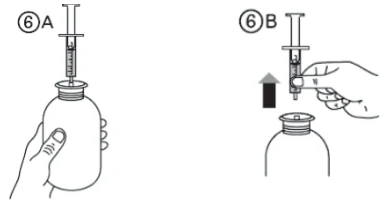
- Turn the bottle the right way up (figure 6A). Remove the syringe from the adaptor (figure 6B).
- Close the bottle with the plastic screw cap.
- To take volumes larger than 10 ml, repeat steps 4 - 6 until the complete dose is given
- After dosing, wash the syringe with water only (figure 7).
If you take more Vigabatrin oral solution than you should
If you or your child accidentally take too much Vigabatrin oral solution, tell your doctor immediately or go to your nearest hospital or Poison Information Centre.
Possible signs of overdose include drowsiness or loss/depressed level of consciousness.
If you forget to take Vigabatrin oral solution
If you forget to take a dose, take it as soon as you do remember. If it is almost time for your next dose, just take one dose. Do not take a double dose to make up for the missed dose.
If you stop taking Vigabatrin oral solution
Do not stop taking this medicine without talking to your doctor. If your doctor decides to stop your treatment you will be advised to gradually reduce the dose. Do not stop suddenly as this may cause your seizures to occur again. If you have any further questions on the use of this medicine, ask your doctor or pharmacist.
4. Possible side effects
Like all medicines, this medicine can cause side effects, although not everybody gets them. As with other antiepileptic medicines, some patients may experience an increase in the number of seizures (fits) whilst taking this medicine. If this happens to you, or to your child, contact your doctor immediately.
Talk to your doctor immediately if you experience:
Very common side effects (may affect more than 1 in 10 people)
Visual field changes – About ⅓ or 33 out of 100 patients treated with Vigabatrin may have changes in the visual field
(narrow visual field). This “visual field defect” can range from mild to severe. It is usually detected after months or years of treatment with Vigabatrin. The changes in the visual field may be irreversible, so it must be found early. If you or your child experience(s) visual disturbances, contact your doctor or hospital immediately.
Other side effects include:
Very common side effects (may affect more than 1 in 10 people)
- Tiredness and pronounced sleepiness
- Joint pain.
Common side effects (may affect up to 1 in 10 people)
- Headache
- Weight gain
- Shaking (tremor)
- Swelling (oedema)
- Dizziness
- Sensation of numbness or tingling (pins and needles)
- Disturbance of concentration and memory
- Psychological disturbances including agitation, aggression, nervousness, irritability, depression, thought disturbance and feeling suspicious without reason (paranoia), insomnia. These side effects are usually reversible when the dose is reduced or gradually discontinued. However, do not decrease your dose without first talking to your doctor. Contact your doctor if you experience these side effects.
- Nausea, vomiting and abdominal pain
- Blurred vision, double vision and uncontrolled movement of the eye, which may cause dizziness
- Speech disorder
- Decrease in the number of red blood cell count (anaemia)
- Unusual hair loss or thinning (alopecia).
Uncommon side effects (may affect up to 1 in 100 people)
- Lack of coordination in movements or fumbling
- More severe psychological disturbances such as feeling elated or over-excited, which causes unusual behaviour, and feeling detached from reality
- Skin rash.
Rare side effects (may affect up to 1 in 1,000 people)
- Serious allergic reaction, which causes swelling of the face or throat: If you experience these symptoms, you should tell your doctor immediately.
- Hives or nettle rash
- Marked sedation, stupor and confusion. These side effects are usually reversible when the dose is reduced or gradually discontinued. However, do not decrease your dose without first talking to your doctor. Contact your doctor if you experience these side effects.
- Suicide attempt
- Other eye problems such as retinal disorder, for example poor vision at night and difficulty adjusting from bright to dim areas, sudden or unexplained loss of vision, loss of sight from the edges of your field of vision, sensitivity to light. Very rare side effects (may affect up to 1 in 10,000 people)
- Other eye problems such as pain in your eyes (optic neuritis) and loss of vision, including colour vision (optic atrophy)
- Hallucinations (feeling, seeing or hearing things that are not there)
- Liver problems.
Not known frequency (frequency cannot be estimated from the available data)
- Decreased sharpness of vision
- Abnormal changes in brain pictures taken by MRI
- Swelling in the protective layer of nerve cells in part of the brain as observed in MRI pictures. Additional side effects in children
Very common side effects (may affect more than 1 in 10 people)
- Excitation or restless.
Not known frequency (frequency cannot be estimated from the available data)
- Movement disorders in young infants treated for infantile spasm
- Abnormal changes in brain pictures taken by MRI, particularly in infants.
- Swelling in the protective layer of nerve cells in part of the brain as observed in MRI pictures, particularly in infants.
Reporting of side effects
If you get any side effects, talk to your doctor, pharmacist or nurse. This includes any possible side effects not listed in this leaflet. You can also report side effects directly via the Yellow Card Scheme at: www.mhra.gov.uk/yellowcard or search for MHRA Yellow Card in the Google Play or Apple App Store.
By reporting side effects, you can help provide more information on the safety of this medicine.
5. How to store Vigabatrin oral solution
- Keep this medicine out of the sight and reach of children.
- Do not store above 25°C.Do not use this medicine after the expiry date which is stated on the carton and bottle label after EXP. The expiry date refers to the last day of that month.
- Discard after 90 days of first opening of the bottle.
Do not use this medicine if you notice that the oral solution becomes discoloured or shows any signs of deterioration.
Seek the advice of your pharmacist.
- Do not throw away any medicines via wastewater or household waste. Ask your pharmacist how to dispose of medicines you no longer use. These measures will help to protect the environment.
6. Contents of the pack and other information
What Vigabatrin oral solution contains
The active substance is vigabatrin.
Each ml contains 100 mg vigabatrin.
The other ingredients are methyl parahydroxybenzoate (E218), propyl parahydroxybenzoate (E216), sucralose, frozen peppermint (5015241T) (menthofuran, pulegone, estragole).
What Vigabatrin oral solution looks like and contents of the pack
Vigabatrin oral solution is a clear, colourless to light yellow solution.
Vigabatrin 100 mg/ml oral solution is packaged in a white opaque HDPE bottle with polypropylene 28 mm white child-resistant closures with induction seal liner containing 150 ml of the liquid.
The package also contains 10 ml oral syringe printed with markings at every 1.0 ml and graduated at every 0.25 ml together with an adaptor.
Marketing Authorisation Holder
Zydus Pharmaceuticals UK Limited
Sandretto Building, Cavalry Hill Industrial Park,
Weedon, Northampton, NN7 4PP, United Kingdom
Manufacturer
LM Manufacturing Limited,
Sandretto Building, Cavalry Hill Industrial Park,
Weedon, Northampton, NN7 4PP, United Kingdom
For any information about this medicine, please contact the Marketing Authorisation Holder.
This leaflet was last revised in June-26.
To request a copy of this leaflet in Braille, large print or audio format, contact the licence holder at the above address or telephone: 0800 9956034 / email: DrugSafety@ZydusUK.com
Material Code
Back Side