

Patient leaflet - Tresiba FlexTouch 100 units/ml solution for injection in Pre-filled pen
1. What Tresiba is and what it is used
for Tresiba is a long-acting basal insulin called insulin degludec. It is used to treat diabetes mellitus in adults, adolescents and children aged 1 year and above. Tresiba helps your body reduce your blood sugar level. It is used for once-daily dosing. On occasions when you cannot follow your regular dosing schedule, you can change the time of dosing because Tresiba has a long blood sugar-lowering effect (see section 3 for ‘Flexibility in dosing time’). Tresiba can be used with meal-related rapid-acting insulin products. In type 2 diabetes mellitus, Tresiba may be used in combination with tablets for diabetes or with injectable antidiabetic medicines, other than insulin.
In type 1 diabetes mellitus, Tresiba must always be used in combination with meal-related rapid-acting insulin medicines.
2. What you need to know before you use Tresiba
Do not use Tresiba
► if you are allergic to insulin degludec or any of the other ingredients of this medicine (listed in section 6). Warnings and precautions
Talk to your doctor, pharmacist or nurse before using Tresiba. Be especially aware of the following:
- Low blood sugar (hypoglycaemia) – if your blood sugar is too low, follow the guidance for low blood sugar in section 4.
- High blood sugar (hyperglycaemia) – if your blood sugar is too high, follow the guidance for high blood sugar in section 4.
- Switching from other insulin medicines – the insulin dose may need to be changed if you switch from another type, brand or manufacturer of insulin. Talk to your doctor.
- Pioglitazone used together with insulin, see ‘Pioglitazone’ below.
- Eye disorder – fast improvements in blood sugar control may lead to a temporary worsening of diabetic eye disorder. If you experience eye problems, talk to your doctor.
- Ensuring you use the right type of insulin – always check the insulin label before each injection to avoid accidental mix-ups between different strengths of Tresiba as well as other insulin products.
If you have poor eyesight, please see section 3. Skin changes at the injection site
The injection site should be rotated to help prevent changes to the fatty tissue under the skin, such as skin thickening, skin shrinking or lumps under the skin. The insulin may not work very well if you inject into a lumpy, shrunken or thickened area (see section 3 `How to use Tresiba®’). Tell your doctor if you notice any skin changes at the injection site. Tell your doctor if you are currently injecting into these affected areas before you start injecting in a different area. Your doctor may tell you to check your blood sugar more closely, and to adjust your insulin or your other antidiabetic medications dose.
Children and adolescents
Tresiba can be used in adolescents and children aged 1 year and above. There is no experience with the use of Tresiba in children below the age of 1 year.
Other medicines and Tresiba
Tell your doctor, pharmacist or nurse if you are taking, have recently taken or might take any other medicines. Some medicines affect your blood sugar level, this may mean your insulin dose has to be changed.
Listed below are the most common medicines which may affect your insulin treatment.
Your blood sugar level may fall (hypoglycaemia) if you take:
- other medicines for diabetes (oral and injectable)
- sulfonamides, for infections
- anabolic steroids, such as testosterone
- beta-blockers, for high blood pressure. They may make it harder to recognise the warning signs of too low blood sugar (see section 4 ‘Warning signs of too low blood sugar’)
- acetylsalicylic acid (and other salicylates), for pain and mild fever
- monoamine oxidase (MAO) inhibitors, for depression
- angiotensin converting enzyme (ACE) inhibitors, for some heart problems or high blood pressure.
Your blood sugar level may rise (hyperglycaemia) if you take:
- danazol, for endometriosis
- oral contraceptives (birth control pills)
- thyroid hormones, for thyroid problems
- growth hormone, for growth hormone deficiency
- glucocorticoids such as ‘cortisone’, for inflammation
- sympathomimetics such as epinephrine (adrenaline), salbutamol or terbutaline, for asthma
- thiazides, for high blood pressure or if your body keeps too much water (water retention).
Octreotide and lanreotide: used to treat a rare condition involving too much growth hormone (acromegaly). They may increase or decrease your blood sugar level. Pioglitazone: oral antidiabetic medicine used to treat type 2 diabetes mellitus. Some patients with long-standing type 2 diabetes mellitus and heart disease or previous stroke who were treated with pioglitazone and insulin experienced the development of heart failure. Inform your doctor immediately if you experience signs of heart failure such as unusual shortness of breath, rapid increase in weight or localised swelling (oedema).
If any of the above applies to you (or you are not sure), talk to your doctor, pharmacist or nurse.
Tresiba with alcohol
If you drink alcohol, your need for insulin may change. Your blood sugar level may either rise or fall. You should therefore monitor your blood sugar level more often than usual. Pregnancy and breast-feeding
If you are pregnant or breast-feeding,
think you may be pregnant or are planning to have a baby, ask your doctor or pharmacist for advice before taking this medicine. Your insulin dose may need to be changed during pregnancy and after delivery. Careful control of your diabetes is needed in pregnancy. Avoiding too low blood sugar (hypoglycaemia) is particularly important for the health of your baby.
Driving and using machines
Having too low or too high blood sugar can affect your ability to drive or use any tools or machines. If your blood sugar is too low or too high, your ability to concentrate or react might be affected. This could be dangerous to yourself or others. Ask your doctor whether you can drive if:
- you often get too low blood sugar
- you find it hard to recognise too low blood sugar. Important information about some of the ingredients of Tresiba
This medicine contains less than 1 mmol sodium (23 mg) per dose. This means that the medicine is essentially ‘sodium-free’.
3. How to use Tresiba
Always use this medicine exactly as your doctor has told you. Check with your doctor, pharmacist or nurse if you are not sure.
If you are blind or have poor eyesight and cannot read the dose counter on the pen, do not use this pen without help. Get help from a person with good eyesight who is trained to use the FlexTouch pre-filled pen.
Tresiba in a pre-filled pen is available in two strengths. “Tresiba 100 units/mL” or “Tresiba 200 units/mL” is clearly marked on the pen label and packaging. In addition, Tresiba 100 units/mL packaging and label are light green, and Tresiba 200 units/mL packaging and label are dark green with striping with a red box highlighting the formulation strength.
For both strengths, the needed dose is dialled in units. The dose steps, however, differ between the two strengths of Tresiba.
The pre-filled pen 100 units/mL can provide a dose of 1–80 units in one injection in steps of 1 unit. The dose counter of the pre-filled pen shows the number of units of insulin to be injected. Do not make any dose re-calculation. Your doctor will decide together with you:
- how much Tresiba you will need each day
- when to check your blood sugar level and if you need a higher or lower dose.
Flexibility in dosing time
- Always follow your doctor’s recommendation for dose.
- Use Tresiba once each day, preferably at the same time every day.
- On occasions when it is not possible to take Tresiba at the same time of the day, it can be taken at a different time of day. Make sure to have a minimum of 8 hours between the doses. There is no experience with flexibility in dosing time of Tresiba in children and adolescents.
If you want to change your usual diet, check with your doctor, pharmacist or nurse first as a change in diet may alter your need for insulin.
Based on your blood sugar level, your doctor may change your dose.
When using other medicines, ask your doctor if your treatment needs to be adjusted.
Use in elderly (≥65 years old)
Tresiba can be used in elderly, but if you are elderly, you may need to check your blood sugar level more often. Talk to your doctor about changes in your dose.
If you have kidney or liver problems
If you have kidney or liver problems, you may need to check your blood sugar level more often. Talk to your doctor about changes in your dose.
Injecting your medicine
Before you use Tresiba for the first time, your doctor or nurse will show you how to use the pre-filled pen. ► Check the name and strength on the label of the pen to make sure it is Tresiba 100 units/mL.
Do not use Tresiba
► in insulin infusion pumps.
► if the pen is damaged or has not been stored correctly (see section 5).
► if the insulin does not appear clear and colourless. How to inject
► Tresiba is given as an injection under the skin (subcutaneous injection). Do not inject it into a vein or muscle.
► The best places to inject are the front of your thighs, upper arms or the front of your waist (abdomen). ► Change the place within the area where you inject each day to reduce the risk of developing lumps and skin pitting (see section 4).
► Always use a new needle for each injection. Re-use of needles may increase the risk of blocked needles leading to inaccurate dosing. Dispose of the needle safely after each use.
► Do not use a syringe to remove the solution from the pen to avoid dosing errors and potential overdose. Detailed instructions for use are provided on the other side of this leaflet.
If you use more Tresiba than you should
If you use too much insulin, your blood sugar may get too low (hypoglycaemia), see advice in section 4 ‘Too low blood sugar’.
If you forget to use Tresiba
If you forget a dose, inject the missed dose when discovering the mistake, ensuring a minimum of 8 hours between doses. If you discover that you missed your previous dose when it is time to take your next regular scheduled dose, do not inject a double dose, but resume your once-daily dosing schedule.
If you stop using Tresiba
Do not stop using your insulin without talking to your doctor. If you stop using your insulin, this could lead to a very high blood sugar level and ketoacidosis (a condition with too much acid in the blood), see advice in section 4 ‘Too high blood sugar’.
4. Possible side effects
Like all medicines, this medicine can cause side effects, although not everybody gets them.
Hypoglycaemia (too low blood sugar) may occur very commonly with insulin treatment (may affect more than 1 in 10 people). It can be very serious. If your blood sugar level falls too much, you may become unconscious. Serious hypoglycaemia may cause brain damage and may be life-threatening. If you have symptoms of low blood sugar, take actions to increase your blood sugar level immediately. See advice in ‘Too low blood sugar’ below.
If you have a serious allergic reaction (seen rarely) to the
insulin or any of the ingredients in Tresiba, stop using this medicine and see a doctor straight away. The signs of a serious allergic reaction are:
- the local reactions spread to other parts of your body
- you suddenly feel unwell with sweating
- you start being sick (vomiting)
- you experience difficulty in breathing
- you experience rapid heartbeat or feeling dizzy. Skin changes at the injection site:
If you inject insulin at the same place, the fatty tissue may shrink (lipoatrophy) or thicken (lipohypertrophy) (may affect up to 1 in 100 people). Lumps under the skin may also be caused by build-up of a protein called amyloid (cutaneous amyloidosis; how often this occurs is not known). The insulin may not work very well if you inject into a lumpy, shrunken or thickened area. Change the injection site with each injection to help prevent these skin changes. Other side effects include:
Common (may affect up to 1 in 10 people)
Local reactions: Local reactions at the place you inject yourself may occur. The signs may include: pain, redness, hives, swelling and itching. The reactions usually disappear after a few days. See your doctor if they do not disappear after a few weeks. Stop using Tresiba and see a doctor straight away if the reactions become serious. For more information, see ‘serious allergic reaction’ above. Uncommon (may affect up to 1 in 100 people) Swelling around your joints: When you first start using your medicine, your body may keep more water than it should. This causes swelling around your ankles and other joints. This is usually only short-lasting.
Rare (may affect up to 1 in 1,000 people)
This medicine can cause allergic reactions such as hives, swelling of the tongue and lips, diarrhoea, nausea, tiredness and itching.
General effects from diabetes treatment
►Too low blood sugar (hypoglycaemia)
Too low blood sugar may happen if you:
drink alcohol; use too much insulin; exercise more than usual; eat too little or miss a meal.
Warning signs of too low blood sugar – these may come on suddenly:
Headache; slurred speech; fast heartbeat; cold sweat, cool pale skin; feeling sick, feeling very hungry; tremor or feeling nervous or worried; feeling unusually tired, weak and sleepy; feeling confused, difficulty in concentrating; short-lasting changes in your sight.
What to do if you get too low blood sugar
- Eat glucose tablets or another high sugar snack, like sweets, biscuits or fruit juice (always carry glucose tablets or a high sugar snack, just in case).
- Measure your blood sugar if possible and rest. You may need to measure your blood sugar more than once, as with all basal insulin products improvement from the period of low blood sugar may be delayed.
- Wait until the signs of too low blood sugar have gone or when your blood sugar level has settled. Then carry on with your insulin as usual.
What others need to do if you pass out
Tell everyone you spend time with that you have diabetes. Tell them what could happen if your blood sugar gets too low, including the risk of passing out.
Let them know that if you pass out, they must:
- turn you on your side
- get medical help straight away
- not give you any food or drink because you may choke. You may recover more quickly from passing out with an injection of glucagon. This can only be given by someone who knows how to use it.
- If you are given glucagon, you will need sugar or a sugary snack as soon as you come round.
- If you do not respond to a glucagon injection, you will have to be treated in a hospital.
- If severe low blood sugar is not treated over time, it can cause brain damage. This can be short or long-lasting. It may even cause death.
Talk to your doctor if:
► your blood sugar got so low that you passed out ► you have used an injection of glucagon
► you have had too low blood sugar a few times recently. This is because the dosing or timing of your insulin injections, food or exercise may need to be changed. ►Too high blood sugar (hyperglycaemia) Too high blood sugar may happen if you:
eat more or exercise less than usual; drink alcohol; get an infection or a fever; have not used enough insulin; keep using less insulin than you need; forget to use your insulin or stop using insulin without talking to your doctor.
Warning signs of too high blood sugar – these normally appear gradually:
Flushed, dry skin; feeling sleepy or tired; dry mouth, fruity (acetone) breath; urinating more often, feeling thirsty; losing your appetite, feeling or being sick (nausea or vomiting). These may be signs of a very serious condition called ketoacidosis. This is a build-up of acid in the blood because the body is breaking down fat instead of sugar. If not treated, this could lead to diabetic coma and eventually death. What to do if you get too high blood sugar
- Test your blood sugar level.
- Test your urine or blood for ketones.
- Get medical help straight away.
Reporting of side effects
If you get any side effects, talk to your doctor, pharmacist or nurse.This includes any possible side effects not listed in this leaflet. You can also report side effects directly via: Yellow Card Scheme at: www.mhra.gov.uk/yellowcard or search for MHRA Yellow Card in the Google Play or Apple App Store. By reporting side effects you can help provide more information on the safety of this medicine.
5. How to store Tresiba
Keep this medicine out of the sight and reach of children. Do not use this medicine after the expiry date which is stated on the pen label and carton, after ‘EXP’. The expiry date refers to the last day of that month.
Before first use
Store in a refrigerator (2°C to 8°C). Do not freeze. Keep away from the freezing element. Keep the cap on the pen in order to protect it from light.
After first opening or if carried as a spare
You can carry your Tresiba pre-filled pen (FlexTouch) with you and keep it at room temperature (not above 30°C) or in a refrigerator (2°C to 8°C) for up to 8 weeks.
Always keep the cap on the pen when you are not using it in order to protect it from light.
If your pen shows any signs of damage or does not seem to function properly, or you notice discolouration of the solution, you should seek the advice of your pharmacist who will tell you what to do.
Do not throw away any medicines via wastewater or household waste. Ask your pharmacist how to throw away medicines you no longer use. These measures will help protect the environment.
6. Contents of the pack and other information
What Tresiba contains
- The active substance is insulin degludec. Each mL of solution contains 100 units of insulin degludec. Each pre-filled pen contains 300 units of insulin degludec in 3 mL solution.
- The other ingredients are glycerol, metacresol, phenol, zinc acetate, hydrochloric acid and sodium hydroxide (for pH adjustment) and water for injections (see section 2). What Tresiba looks like and contents of the pack
Tresiba is presented as a clear and colourless solution for injection in a pre-filled pen (300 units per 3 mL). Pack size of 5 (without needles)
pre-filled pens of 3 mL.
PL 15643/0346 POM
Manufacturer
The manufacturer can be identified by the batch number printed on the slip of the carton and on the label:
- If the second and third characters are P5, ZF or FG, the manufacturer is Novo Nordisk A/S, Novo Allé, DK-2880 Bagsværd, Denmark.
- If the second and third characters are T6, the manufacturer is Novo Nordisk Production SAS, 45 Avenue d’Orléans, 28000 Chartres, France.
Procured from within the EU by Product Licence holder: A1 Pharmaceuticals Plc., Rainham RM13 9BP and repackaged by Community Pharmacy Supplies Ltd, Rainham, RM13 9BP.
Leaflet revision date: 14.02.2025
Tresiba® and FlexTouch® are trademarks owned by Novo Nordisk A/S, Denmark.
Blind or partially sighted? Is this leaflet hard to see or read? Call 01708 528 900 to obtain the leaflet in a format suitable for you. RML551 V1 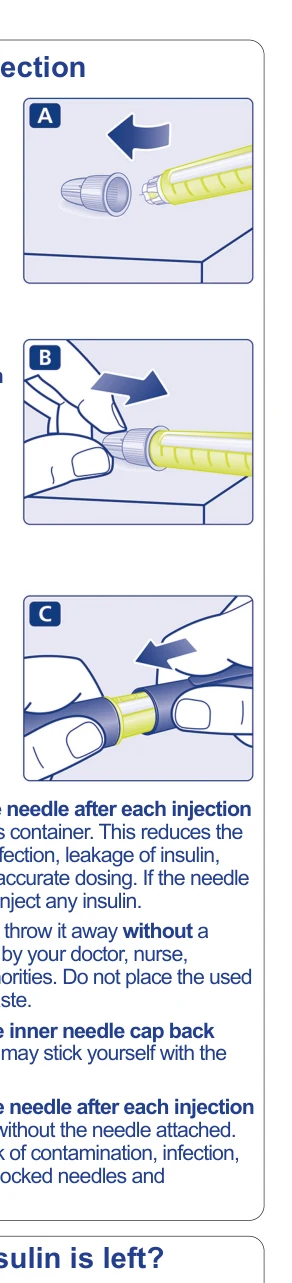


 Instructions on how to use
 Tresiba® 100 units/mL solution for injection in pre-filled pen (FlexTouch®)
Please read these instructions carefully before using your FlexTouch pre-filled pen. If you do not follow the instructions carefully, you may get too little or too much insulin, which can lead to too high or too low blood sugar level. Do not use the pen without proper training from your doctor or nurse.
Start by checking your pen to make sure that it contains Tresiba 100 units/mL, then look at the illustrations below to get to know the different parts of your pen and needle.
If you are blind or have poor eyesight and cannot read the dose counter on the pen, do not use this pen without help. Get help from a person with good eyesight who is trained to use the FlexTouch pre-filled pen.
Your pen is a pre-filled dial-a-dose insulin pen containing 300 units of insulin. You can select a maximum of 80 units per dose, in steps of 1 unit. Your pen is designed to be used with NovoTwist® or NovoFine® single-use disposable needles up to a length of 8 mm.
Important information
Pay special attention to these notes as they are important for correct use of the pen.
Tresiba pre-filled pen and needle (example)
(FlexTouch)
Check the name and strength on the label
of your pen to make sure
that it contains Tresiba
100 units/mL. This is
especially important if you
take more than one type
of insulin. If you take a
wrong type of insulin, your
blood sugar level may get
too high or too low.
- Pull off the pen cap.
Check that the insulin
in your pen is clear and
colourless.
Look through the insulin
window. If the insulin
looks cloudy, do not use
the pen.
Take a new needle and
tear off the paper tab.
Push the needle straight onto the pen.
Turn until it is on
tight.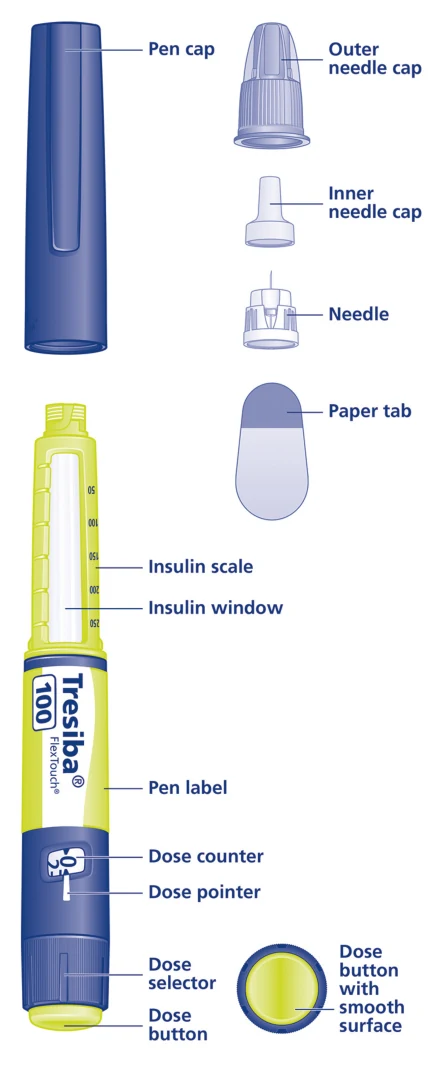 • Pull off the outer
needle cap and keep
it for later. You will
need it after the
injection to correctly 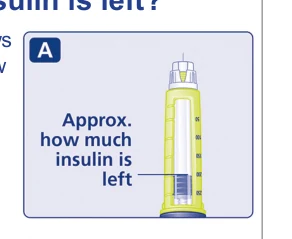 remove the needle
from the pen.
Pull off the inner needle cap and throw
it away. If you try to put
it back on, you may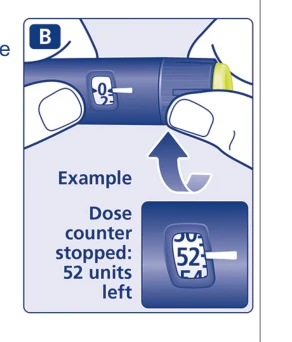 accidentally stick
yourself with the
needle.
A drop of insulin may
appear at the needle
tip. This is normal, but
you must still check the
insulin flow.
1 Prepare your pen 2 Check the insulin flow 3 select your dose 4 Inject your dose 5 After your injection
Always use a new needle for each injection.
This reduces the risk of contamination, infection, leakage of insulin, blocked needles and inaccurate dosing.
Never use a bent or damaged needle.
Always check the insulin flow before you start.
This helps you to ensure that you get your full insulin dose.
Turn the dose selector to
select 2 units. Make sure the dose counter shows 2.
Hold the pen with the
needle pointing up.
Tap the top of the pen
gently a few times to let
any air bubbles rise to
the top.
Press and hold in the
dose button until the
dose counter returns
to 0.
The 0 must line up with
the dose pointer.
A drop of insulin should
appear at the needle tip
A small air bubble may remain at the needle tip, but it will not be injected.
If no drop appears, repeat steps 2A to 2C up to 6 times. If there is still no drop, change the needle and repeat steps 2A to 2C once more.
If a drop of insulin still does not appear, dispose of the pen and use a new one.
Always make sure that a drop appears at the needle tip before you inject. This makes sure that the insulin flows.
If no drop appears, you will not inject any insulin, even though the dose counter may move. This may indicate a blocked or damaged needle.
Always check the flow before you inject. If you do not check the flow, you may get too little insulin or no insulin at all. This may lead to too high blood sugar level.
Make sure the dose counter shows 0 before you start.
The 0 must line up with
the dose pointer.
Turn the dose selector to select the dose you
need, as directed by your
doctor or nurse.
If you select a wrong
dose, you can turn the
dose selector forwards or
backwards to the correct
dose.
The pen can dial up to
a maximum of 80 units.
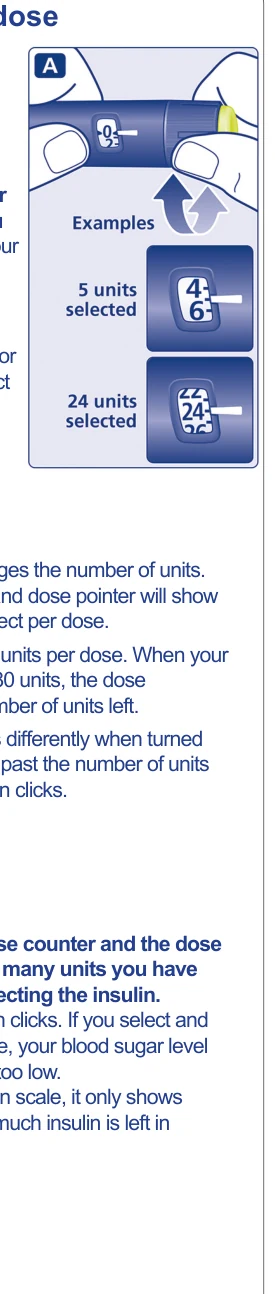
The dose selector changes the number of units. Only the dose counter and dose pointer will show how many units you select per dose.
You can select up to 80 units per dose. When your pen contains less than 80 units, the dose counter stops at the number of units left. The dose selector clicks differently when turned forwards, backwards or past the number of units left. Do not count the pen clicks.
Always use the dose counter and the dose pointer to see how many units you have selected before injecting the insulin.
Do not count the pen clicks. If you select and inject the wrong dose, your blood sugar level may get too high or too low.
Do not use the insulin scale, it only shows approximately how much insulin is left in your pen.
Insert the needle into
your skin as your doctor
or nurse has shown you.
Make sure you can see the dose counter.
Do not touch the dose
counter with your fingers.
This could interrupt the
injection.
Press and hold down the dose button until the dose counter
returns to 0.
The 0 must line up with
the dose pointer.
You may then hear or
feel a click.
Leave the needle under the skin for at least 6
seconds to make sure
you get your full dose.
Pull the needle and pen straight up from your skin.
If blood appears at the
injection site, press lightly
with a cotton swab. Do
not rub the area.
You may see a drop of insulin at the needle tip after injecting. This is normal and does not affect your dose.
Always watch the dose counter to know how many units you inject.
The dose counter will show the exact number of units. Do not count the pen clicks. Hold the dose button down until the dose counter returns to 0 after the injection. If the dose counter stops before it returns to 0, the full dose has not been delivered, which may result in too high blood sugar level.
6 How much insulin is left?
Further important information Caring for your pen
- Lead the needle tip into the outer needle cap on a flat surface without touching the needle or the outer needle cap.
- Once the needle is covered, carefully push the outer needle cap completely on.
- Unscrew the needle and dispose of it carefully.
Put the pen cap on your pen after each use to protect the insulin from light.
Always dispose of the needle after each injection in an appropriate sharps container. This reduces the risk of contamination, infection, leakage of insulin, blocked needles and inaccurate dosing. If the needle is blocked, you will not inject any insulin. When the pen is empty, throw it away without a needle on as instructed by your doctor, nurse, pharmacist or local authorities. Do not place the used needle in household waste.
Never try to put the inner needle cap back on the needle. You may stick yourself with the needle.
Always remove the needle after each injection and store your pen without the needle attached. This reduces the risk of contamination, infection, leakage of insulin, blocked needles and inaccurate dosing.
- The insulin scale shows you approximately how much insulin is left in your pen.
To see precisely how much insulin is left, use the dose counter:
Turn the dose selector until the dose counter stops.
If it shows 80, at least
80 units are left in your pen.
If it shows less than
80, the number shown is the number of units left in your pen.
- Turn the dose selector back until the dose counter shows 0.
If you need more insulin than the units left in your pen, you can split your dose between two pens.
Be very careful to calculate correctly if splitting your dose.
If in doubt, take the full dose with a new pen. If you split the dose wrong, you will inject too little or too much insulin, which can lead to too high or too low blood sugar level.
- Always keep your pen with you.
- Always carry an extra pen and new needles with you in case of loss or damage.
- Always keep your pen and needles out of sight and reach of others, especially children.
- Never share your pen or your needles with other people. It might lead to cross-infection.
- Never share your pen with other people. Your medicine might be harmful to their health.
Caregivers must be very careful when handling used needles to reduce the risk of needle injury and cross-infection.
Treat your pen with care. Rough handling or misuse may cause inaccurate dosing, which can lead to too high or too low blood sugar level.
- Do not leave the pen in a car or other place where it can get too hot or too cold.
- Do not expose your pen to dust, dirt or liquid.
- Do not wash, soak or lubricate your pen. If necessary, clean it with mild detergent on a moistened cloth.
- Do not drop your pen or knock it against hard surfaces. If you drop it or suspect a problem, attach a new needle and check the insulin flow before you inject.
- Do not try to refill your pen. Once empty, it must be disposed of.
- Do not try to repair your pen or pull it apart.