

Patient leaflet - Trelema 10 mg / ml syrup
1. What Trelema is and what it is used for
What Trelema is
Trelema contains lacosamide. This belongs to a group of medicines called ‘antiepileptic medicines’. These medicines are used to treat epilepsy.
You have been given this medicine to lower the number of fits (seizures) you have.
What Trelema is used for
Trelema is used:
- on its own and in association with other antiepileptic medicines in adults, adolescents and children aged 2 years and older to treat a certain type of epilepsy characterised by the occurrence of partial-onset seizure with or without secondary generalisation. In this type of epilepsy, fits first affect only one side of your brain. However, these may then spread to larger areas on both sides of your brain;
- in association with other antiepileptic medicines in adults, adolescents and children aged 4 years and older to treat primary generalised tonic-clonic seizures (major fits, including loss of consciousness) in patients with idiopathic generalised epilepsy (the type of epilepsy that is thought to have a genetic cause).
2. What you need to know before you take Trelema
Do not take Trelema
- if you are allergic to lacosamide or any of the other ingredients of this medicine (listed in section 6). If you are not sure whether you are allergic, please discuss with your doctor.
- if you have a certain type of heart beat problem called second or third degree AV block.
Do not take Trelema if any of the above apply to you. If you are not sure, talk to your doctor or pharmacist before taking this medicine.
Warnings and precautions
Talk to your doctor before taking Trelema if:
- you have thoughts of harming or killing yourself. A small number of people being treated with antiepileptic medicinal products such as lacosamide have had thoughts of harming or killing themselves. If you have any of these thoughts at any time, tell your doctor straight away.
- you have a heart problem that affects the beat of your heart and you often have a particularly slow, fast or irregular heart beat (such as AV block, atrial fibrillation or atrial flutter).
- you have severe heart disease such as heart failure or have had a heart attack.
- you are often dizzy or fall over. Trelema may make you dizzy – this could increase the risk of accidental injury or a fall. This means that you should take care until you are used to the effects of this medicine.
If any of the above apply to you (or you are not sure), talk to your doctor or pharmacist before taking Trelema.
If you are taking Trelema, talk to your doctor if you are experiencing a new type of seizure or worsening of existing seizures.
If you are taking Trelema and you are experiencing symptoms of abnormal heartbeat (such as slow, rapid or irregular heartbeat, palpitations, shortness of breath, feeling lightheaded, fainting), seek medical advice immediately (see section 4).
Children
Trelema is not recommended for children aged under 2 years with epilepsy characterised by the occurrence of partial-onset seizure and not recommended for children aged under 4 years with primary generalised tonic-clonic seizures. This is because we do not yet know whether it will work and whether it is safe for children in this age group.
Other medicines and Trelema
Tell your doctor or pharmacist if you are taking, have recently taken or might take any other medicines.
In particular, tell your doctor or pharmacist if you are taking any of the following medicines that affect your heart - this is because Trelema can also affect your heart:
- medicines to treat heart problems;
- medicines which can increase the ‘PR interval’ on a scan of the heart (ECG or electrocardiogram) such as medicines for epilepsy or pain called carbamazepine, lamotrigine or pregabalin;
- medicines used to treat certain types of irregular heart beat or heart failure.
If any of the above apply to you (or you are not sure), talk to your doctor or pharmacist before taking Lacosamide].
Also tell your doctor or pharmacist if you are taking any of the following medicines. This is because they may increase or decrease the effect of Trelema on your body:
- medicines for fungal infections such as fluconazole, itraconazole or ketoconazole;
- a medicine for HIV such as ritonavir;
- medicines used to treat bacterial infections such as clarithromycin or rifampicin;
- a herbal medicine used to treat mild anxiety and depression called St. John’s Wort.
If any of the above apply to you (or you are not sure), talk to your doctor or pharmacist before taking Trelema.
Trelema with alcohol
As a safety precaution do not take Trelema with alcohol.
Pregnancy and breast-feeding
Fertile women should discuss the use of contraceptives with the doctor.
If you are pregnant or breast-feeding, think you may be pregnant or are planning to have a baby, ask your doctor or pharmacist for advice before taking this medicine.
It is not recommended to take Trelema if you are pregnant, as the effects of Trelema on pregnancy and the unborn baby are not known.
It is not recommended to breast-feed your baby while taking Trelema, as Trelema passes into breast milk.
Seek advice immediately from your doctor if you get pregnant or are planning to become pregnant. They will help you decide if you should take Trelema or not.
Do not stop treatment without talking to your doctor first as this could increase your fits (seizures). A worsening of your disease can also harm your baby.
Driving and using machines
Do not drive, cycle or use any tools or machines until you know how this medicine affects you. This is because Trelema may make you feel dizzy or cause blurred vision.
Trelema syrup contains
- one ingredient called methyl hydroxybenzoate (E 218) which may cause allergic reactions (possibly delayed).
- sorbitol (E 420). Sorbitol is a source of fructose. If your doctor has told you that you (or your child) have an intolerance to some sugars or if you have been diagnosed with hereditary fructose intolerance (HFI), a rare genetic disorder in which a person cannot break down fructose, talk to your doctor before you (or your child) take or receive this medicine. Sorbitol may cause gastrointestinal discomfort and mild laxative effect.
- 1.35 mg sodium (main component of cooking/table salt) in each ml, which is 81 mg sodium per 60 ml (the maximum recommended daily dose). This is equivalent to 4% of the recommended maximum daily dietary intake of sodium for an adult.
- Propylene glycol (E 1520): This medicine contains 0.93 mg propylene glycol in each ml.
3. How to take Trelema
Always take this medicine exactly as your doctor has told you. Check with your doctor or pharmacist if you are not sure.
Taking Trelema
- Take Trelema twice each day - approximately 12 hours apart.
- Try to take it at about the same time each day.
- You may take Trelema with or without food.
You will usually start by taking a low dose each day and your doctor will slowly increase this over a number of weeks. When you reach the dose that works for you, this is called the ‘maintenance dose’, you then take the same amount each day. Trelema is used as a long term treatment. You should continue to take Trelema until your doctor tells you to stop.
How much to take
Listed below are the normal recommended doses of Trelema for different age groups and weights. Your doctor may prescribe a different dose if you have problems with your kidneys or with your liver. Use the 12.5 ml oral syringe (black graduation marks) or the 30 ml measuring cup provided in the carton box, as appropriate, according to the dosage required. See instructions for use below.
Adolescents and children weighing 50 kg or more and adults
When you take Trelema on its own
The usual starting dose of Trelema is 50 mg (5 ml) twice a day.
Your doctor may also prescribe a starting dose of 100 mg (10 ml) of Trelema twice a day.
Your doctor may increase your twice daily dose every week by 50 mg (5 ml). This will be until you reach a maintenance dose between 100 mg (10 ml) and 300 mg (30 ml) twice a day.
When you take Trelema with other antiepileptic medicines
The usual starting dose of Trelema is 50 mg (5 ml) twice a day.
Your doctor may increase your twice daily dose every week by 50 mg (5 ml). This will be until you reach a maintenance dose between 100 mg (10 ml) and 200 mg (20 ml) twice a day.
If you weigh 50 kg or more, your doctor may decide to start Trelema treatment with a single ‘loading’ dose of 200 mg (20 ml). You would then start your ongoing maintenance dose 12 hours later.
Children and adolescents weighing less than 50 kg
- In the treatment of partial-onset seizure: Observe that Trelema is not recommended for children under 2 years of age.
- In the treatment of primary generalised tonic-clonic seizures: Observe that Trelema is not recommended for children under 4 years of age.
When you take Trelema on its own
Your doctor will decide the dose of Trelema based on your body weight.
The usual starting dose is 1 mg (0.1 ml), for each kilogram (kg) of body weight, twice a day.
Your doctor may then increase your twice daily dose every week by 1 mg (0.1 ml), for each kg of your body weight. This will be until you reach a maintenance dose.
Dosing charts including the maximum recommended dose are provided below This is for information only. Your doctor will work out the right dose for you.
To be taken twice daily for children from 2 years of age weighing from 10 kg to less than 40 kg
| Weight | Week 1 Starting dose: 0.1 ml/kg | Week 2 0.2 ml/kg | Week 3 0.3 ml/kg | Week 4 0.4 ml/kg | Week 5 0.5 ml/kg | Week 6 Maximum recommended dose: 0.6 ml/kg | |
|---|---|---|---|---|---|---|---|
Use the 12.5 ml syringe (black graduation marks) for volume between 1 ml and 20 ml * Use the 30 ml measuring cup (black graduation marks) for volume more than 20 ml | |||||||
| 10 kg | 1 ml | 2 ml | 3 ml | 4 ml | 5 ml | 6 ml | |
| 15 kg | 1.5 ml | 3 ml | 4.5 ml | 6 ml | 7.5 ml | 9 ml | |
| 20 kg | 2 ml | 4 ml | 6 ml | 8 ml | 10 ml | 12 ml | |
| 25 kg | 2.5 ml | 5 ml | 7.5 ml | 10 ml | 12.5 ml | 15 ml | |
| 30 kg | 3 ml | 6 ml | 9 ml | 12 ml | 15 ml | 18 ml | |
| 35 kg | 3.5 ml | 7 ml | 10.5 ml | 14 ml | 17.5 ml | 21 ml* | |
To be taken twice daily for children and adolescents weighing from 40 kg to less than 50 kg
| Weight | Week 1 Starting dose: 0.1 ml/kg | Week 2 0.2 ml/kg | Week 3 0.3 ml/kg | Week 4 0.4 ml/kg | Week 5 Maximum recommended dose: 0.5 ml/kg | |
|---|---|---|---|---|---|---|
Use the 12.5 ml syringe (black graduation marks) for volume between 1 ml and 20 ml * Use the 30 ml measuring cup (black graduation marks) for volume more than 20 ml | ||||||
| 40 kg | 4 ml | 8 ml | 12 ml | 16 ml | 20 ml | |
| 45 kg | 4.5 ml | 9 ml | 13.5 ml | 18 ml | 22.5 ml* | |
When you take Trelema with other antiepileptic medicines
Your doctor will decide the dose of Trelema based on your body weight.
The usual starting dose is 1 mg (0.1 ml), for each kilogram (kg) of body weight, twice a day.
Your doctor may then increase your twice daily dose every week by 1 mg (0.1 ml) for each kg of body weight. This will be until you reach a maintenance dose. Dosing charts including the maximum recommended dose are provided below. This is for information only. Your doctor will work out the right dose for you:
To be taken twice daily for children from 2 years of age weighing from 10 kg to less than 20 kg
| Weight | Week 1 Starting dose: 0.1 ml/kg | Week 2 0.2 ml/kg | Week 3 0.3 ml/kg | Week 4 0.4 ml/kg | Week 5 0.5 ml/kg | Week 6 Maximum recommended dose: 0.6 ml/kg |
|---|---|---|---|---|---|---|
| Use the 12.5 ml syringe (black graduation marks) for volume between 1 ml and 20 ml | ||||||
| 10 kg | 1 ml | 2 ml | 3 ml | 4 ml | 5 ml | 6 ml |
| 12 kg | 1.2 ml | 2.4 ml | 3.6 ml | 4.8 ml | 6 ml | 7.2 ml |
| 14 kg | 1.4 ml | 2.8 ml | 4.2 ml | 5.6 ml | 7 ml | 8.4 ml |
| 15 kg | 1.5 ml | 3 ml | 4.5 ml | 6 ml | 7.5 ml | 9 ml |
| 16 kg | 1.6 ml | 3.2 ml | 4.8 ml | 6.4 ml | 8 ml | 9.6 ml |
| 18 kg | 1.8 ml | 3.6 ml | 5.4 ml | 7.2 ml | 9 ml | 10.8 ml |
To be taken twice daily for children and adolescents weighing from 20 kg to less than 30 kg
| Weight | Week 1 Starting dose: 0.1 ml/kg | Week 2 0.2 ml/kg | Week 3 0.3 ml/kg | Week 4 0.4 ml/kg | Week 5 Maximum recommended dose: 0.5 ml/kg |
|---|---|---|---|---|---|
| Use the 12.5 ml syringe (black graduation marks) for volume between 1 ml and 20 ml | |||||
| 20 kg | 2 ml | 4 ml | 6 ml | 8 ml | 10 ml |
| 22 kg | 2.2 ml | 4.4 ml | 6.6 ml | 8.8 ml | 11 ml |
| 24 kg | 2.4 ml | 4.8 ml | 7.2 ml | 9.6 ml | 12 ml |
| 25 kg | 2.5 ml | 5 ml | 7.5 ml | 10 ml | 12.5 ml |
| 26 kg | 2.6 ml | 5.2 ml | 7.8 ml | 10.4 ml | 13 ml |
| 28 kg | 2.8 ml | 5.6 ml | 8.4 ml | 11.2 ml | 14 ml |
To be taken twice daily for children and adolescents weighing from 30 kg to less than 50 kg
| Weight | Week 1 Starting dose: 0.1 ml/kg | Week 2 0.2 ml/kg | Week 3 0.3 ml/kg | Week 4 Maximum recommended dose: 0.4 ml/kg |
|---|---|---|---|---|
| Use the 12.5 ml syringe (black graduation marks) for volume between 1 ml and 20 ml | ||||
| 30 kg | 3 ml | 6 ml | 9 ml | 12 ml |
| 35 kg | 3.5 ml | 7 ml | 10.5 ml | 14 ml |
| 40 kg | 4 ml | 8 ml | 12 ml | 16 ml |
| 45 kg | 4.5 ml | 9 ml | 13.5 ml | 18 ml |
Instructions for use
It is important that you use the correct device to measure your dose. Your doctor or pharmacist will let you know which device to use depending on the dose that has been prescribed.
| 12.5 ml oral dosing syringe | 30 ml measuring cup |
The 12.5 ml oral syringe has black graduations in steps of 0.25 ml. If the required dose is below 20 ml, you should use the 12.5 ml oral syringe provided in this pack. | The 30 ml measuring cup has black graduations in steps of 5 ml. If the required dose is above 20 ml, you should use the 30 ml measuring cup provided in this pack. |
Instructions for use: measuring cup
- 1. Shake the bottle well before use.
- 2. Fill the measuring cup to the millilitre (ml) dose marker prescribed by your doctor.
- 3. Swallow the dose of syrup.
- 4. Then drink some water.
Instructions for use: oral syringe
Your doctor will show you how to use the oral syringe, before you use it for the first time. If you have any questions, please go back to your doctor or pharmacist.
Shake the bottle well before use.
Open the bottle by pressing the cap while turning it anti-clockwise (figure 1).
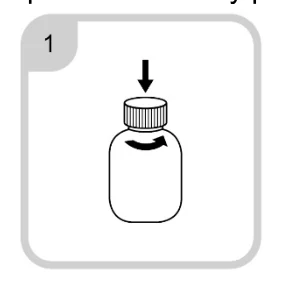
Follow these steps the first time you take Trelema:
- Take off the adaptor from the oral syringe (figure 2).
- Put the adaptor into the top of the bottle (figure 3). Make sure it is fixed well in place. You do not need to remove the adaptor after use.
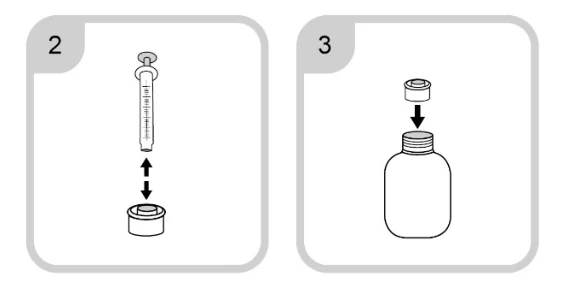
Follow these steps each time you take Trelema:
- Put the oral syringe into the adaptor opening (figure 4).
- Turn the bottle upside down (figure 5).
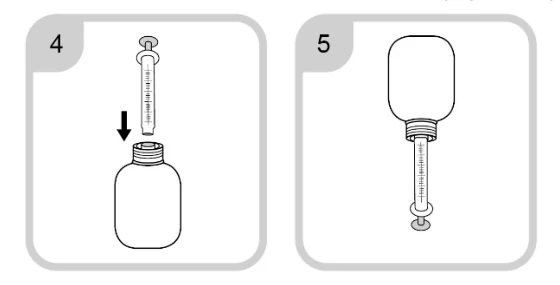
- Hold the bottle upside down in one hand and use the other hand to fill the oral syringe.
- Pull the piston down to fill the oral syringe with a small amount of solution (figure 6).
- Push the piston up to get rid of any bubbles (figure 7).
- Pull the piston down to the millilitre (ml) dose marker prescribed by your doctor (figure 8).
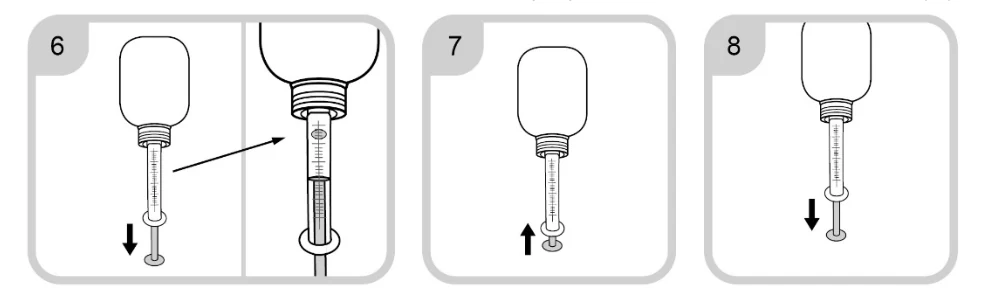
- Turn the bottle the right way up (figure 9).
- Take the oral syringe out of the adaptor (figure 10).
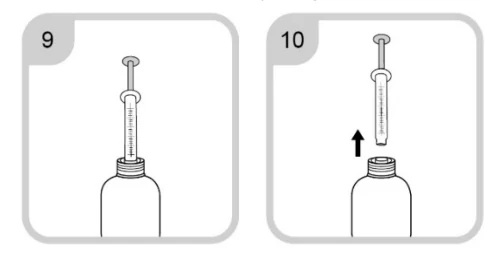
There are two ways in which you can choose to drink the medicine:
- Empty the contents of the oral syringe into a little water by pushing the piston to the bottom of the oral syringe (figure 11) – you will then need to drink all of the water (add just enough to make it easy to drink) or
- Drink the solution directly from the oral syringe without water (figure 12) – drink the whole content of the oral syringe.
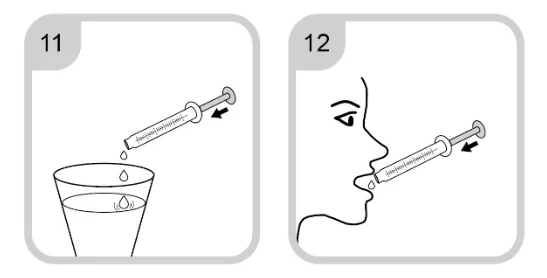
- Close the bottle with the plastic screw cap (you do not need to remove the adaptor).
- Wash the oral syringe with water only (figure 13).
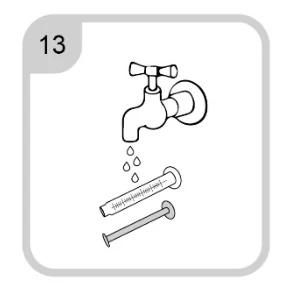
You may take Trelema with or without food.
If you take more Trelema than you should
If you have taken more Trelema than you should, contact your doctor immediately. Do not try to drive.
You may experience:
- Dizziness
- Feeling sick (nausea) or being sick (vomiting)
- Fits (seizures), heart beat problems such as a slow, fast or irregular heart beat, coma or a fall in blood pressure with rapid heartbeat and sweating.
If you forget to take Trelema
- If you have missed a dose within the first 6 hours of the scheduled dose, take it as soon as you remember.
- If you have missed a dose beyond the first 6 hours of the scheduled dose, do not take the missed syrup anymore. Instead take Trelema at the next time that you would normally take it.
- Do not take a double dose to make up for a forgotten dose.
If you stop taking Trelema
- Do not stop taking Trelema without talking to your doctor, as your epilepsy may come back again or become worse.
- If your doctor decides to stop your treatment with Trelema, he/she will instruct you about how you should decrease the dose step by step.
If you have any further questions on the use of this medicine, ask your doctor or pharmacist.
4. Possible side effects
Like all medicines, this medicine can cause side effects, although not everybody gets them.
Nervous system side effects such as dizziness may be higher after a single “loading” dose.
Talk to your doctor or pharmacist if you get any of the following:
Very common: may affect more than 1 in 10 people
- Headache;
- Feeling dizzy or sick (nausea);
- Double vision (diplopia).
Common: may affect up to 1 in 10 people
- Short jerks of a muscle or group of muscles (myoclonic seizures);
- Difficulties in coordinating your movements or walking;
- Problems in keeping your balance, shaking (tremor), tingling (paresthesia) or muscle spasms, falling easily and getting bruises;
- Trouble with your memory, thinking or finding words, confusion;
- Rapid and uncontrollable movements of the eyes (nystagmus), blurred vision;
- A spinning sensation (vertigo), feeling drunk;
- Being sick (vomiting), dry mouth, constipation, indigestion, excessive gas in the stomach or bowel, diarrhoea;
- Decreased feeling or sensitivity, difficulty in articulating words, disturbance in attention;
- Noise in the ear such as buzzing, ringing or whistling;
- Irritability, trouble sleeping depression;
- Sleepiness, tiredness or weakness (asthenia);
- Itching, rash.
Uncommon: may affect up to 1 in 100 people
- Slow heart rate, palpitations, irregular pulse or other changes in the electrical activity of your heart (conduction disorder);
- Exaggerated feeling of wellbeing, seeing and/or hearing things which are not there;
- Allergic reaction to medicine intake, hives;
- Blood tests may show abnormal liver function, liver injury;
- Thoughts of harming or killing yourself or attempting suicide: tell your doctor straight away;
- Feeling angry or agitated;
- Abnormal thinking or losing of touch with reality;
- Serious allergic reaction which causes swelling of the face, throat, hand, feet, ankles, or lower legs;
- Fainting;
- Abnormal involuntary movements (dyskinesia).
Not known: (frequency cannot be estimated from the available data)
- Abnormal rapid heartbeat (ventricular tachyarrhythmia);
- A sore throat, high temperature and getting more infections than usual. Blood tests may show a severe decrease in a specific class of white blood cells (agranulocytosis).
- A serious skin reaction which may include a high temperature and other flu-like symptoms, a rash on the face, extended rash, swollen glands (enlarged lymph nodes). Blood tests may show increased levels of liver enzymes and a type of white blood cell (eosinophilia).
- A widespread rash with blisters and peeling skin, particularly around the mouth, nose, eyes and genitals (Stevens-Johnson syndrome), and a more severe form causing skin peeling in more than 30% of the body surface (toxic epidermal necrolysis).
- Convulsion
Additional side effects in children
The additional side effects in children were fever (pyrexia), runny nose (nasopharyngitis), sore throat (pharyngitis), eating less than usual (decreased appetite), changes in behaviour, not acting like themselves (abnormal behaviour) and lacking in energy (lethargy). Feeling sleepy (somnolence) is a very common side effect in children and may affect more than 1 in 10 children.
Reporting of side effects
If you get any side effects, talk to your doctor or pharmacist. This includes any possible side effects not listed in this leaflet. You can also report side effects directly via the Yellow Card Scheme,
Website: www.mhra.gov.uk/yellowcard
or search for MHRA Yellow Card in the Google Play or Apple App Store.
By reporting side effects, you can help provide more information on the safety of this medicine.
5. How to store Trelema
Keep this medicine out of the sight and reach of children.
Do not use this medicine after the expiry date which is stated on the carton and bottle after EXP. The expiry date refers to the last day of that month.
Once you have opened the syrup bottle, you must not use it longer than a maximum of 2 months.
This medicine does not require any special storage conditions.
Do not throw away any medicines via wastewater or household waste. Ask your pharmacist how to throw away medicines you no longer use. These measures will help protect the environment.
6. Contents of the pack and other information
What Trelema contains
The active substance is lacosamide.
1 ml Trelema syrup contains 10 mg lacosamide.
The other ingredients are:
Glycerol, methyl hydroxybenzoate (E 218), carmellose sodium, sorbitol liquid (E 420), Macrogol, sodium chloride, citric acid monohydrate, sodium citrate, sucralose, strawberry flavor (contains propylene glycol (E 1520)), maltol, purified water.
What Trelema looks like and contents of the pack
Trelema 10 mg/ml syrup is a slightly viscous clear, colourless to yellow-brown liquid with the smell and taste of strawberries.
Trelema is available in bottles of 100, 200, 300 or 500 ml.
Not all pack sizes may be marketed.
The carton boxes of Trelema syrup contain a 30 ml measuring cup (black graduation marks) and a 12.5 ml oral syringe (black graduation marks) with its adaptor.
- The measuring cup is suitable for doses above 20 ml. Each graduation mark (5 ml) of the measuring cup corresponds to 50 mg of lacosamide (for example 2 graduation marks correspond to 100 mg).
- The 12.5 ml oral syringe is suitable for doses between 1 ml and 20 ml. One full 12.5 ml oral syringe corresponds to 125 mg of lacosamide. The minimum extractable volume is 1 ml, which is 10 mg of lacosamide. After this, each graduation mark (0.25 ml) corresponds to 2.5 mg of lacosamide (for example 4 graduation marks corresponds to 10 mg).
Marketing Authorisation Holder and Manufacturer
G.L. Pharma GmbH, Schlossplatz 1, 8502 Lannach, Austria