

Patient leaflet - Trelegy Ellipta 92/ 55/ 22 mcg inhalation powder, Predispensed
1. What Trelegy Ellipta is and what it is used for
What Trelegy Ellipta is
Trelegy Ellipta contains three active substances called fluticasone furoate, umeclidinium bromide and vilanterol. Fluticasone furoate belongs to a group of medicines called corticosteroids, often simply called steroids. Umeclidinium bromide and vilanterol belong to a group of medicines called bronchodilators.
What Trelegy Ellipta is used for
Trelegy Ellipta is used to treat chronic obstructive pulmonary disease (COPD) in adults. COPD is a long-term condition characterised by breathing difficulties that slowly get worse.
In COPD the muscles around the airways tighten, making breathing difficult. This medicine widens these muscles in the lungs, reducing the swelling and irritation in the small air passages and making it easier for air to get in and out of the lungs. When used regularly, it can help to control your breathing difficulties and reduce the effects of COPD on your everyday life.
Trelegy Ellipta should be used every day and not only when you have breathing problems or other symptoms of COPD. It should not be used to relieve a sudden attack of breathlessness or wheezing.

If you get this sort of attack you must use a quick-acting inhaler (such as salbutamol). If you do not have a quick-acting inhaler contact your doctor.
2. What you need to know before you use Trelegy Ellipta
Do not use Trelegy Ellipta:
if you are allergic to fluticasone furoate, umeclidinium, vilanterol or any of the other ingredients of this medicine (listed in section 6).
Warnings and precautions
Talk to your doctor before using Trelegy Ellipta
- if you have asthma (Do not use Trelegy Ellipta to treat asthma)
- if you have heart problems or high blood pressure
- if you have liver problems
- if you have tuberculosis (TB) of the lung, or any long standing or untreated infections
- if you have an eye problem called narrow-angle glaucoma
- if you have an enlarged prostate, difficulty passing urine or a blocking in your bladder
- if you suffer from epilepsy
- if you have thyroid gland problems
- if you have low potassium in your blood
- if you have a history of diabetes
- if you experience blurred vision or other visual disturbances
- Check with your doctor if you think any of these may apply to you.
Immediate breathing difficulties
If you get tightness of the chest, coughing, wheezing or breathlessness immediately after using your Trelegy Ellipta inhaler:
- stop using this medicine and seek medical help immediately, as you may have a serious condition called paradoxical bronchospasm.
Eye problems during treatment with Trelegy Ellipta
If you get eye pain or discomfort, temporary blurring of vision, visual halos or coloured images as well as red eyes during treatment with Trelegy Ellipta:
- stop using this medicine and seek medical help immediately. These may be signs of an acute attack of narrow-angle glaucoma.
Infection of the lung
Because you are using this medicine for COPD, you may be at an increased risk of developing an infection of the lungs known as pneumonia. See section 4 ‘Possible side effects’ for information on symptoms to look out for while you are using this medicine.
- Tell your doctor as soon as possible if you develop any of these symptoms.
Children and adolescents
Do not give this medicine to children or adolescents below the age of 18 years.
Other medicines and Trelegy Ellipta
Tell your doctor or pharmacist if you are taking, have recently taken or might take any other medicines. If you are not sure what your medicine contains talk to your doctor or pharmacist.
Some medicines may affect how this medicine works, or make it more likely to have side effects. These include:
- medicines called beta blockers (such as propranolol), to treat high blood pressure or other heart problems
- ketoconazole or itraconazole, to treat fungal infections
- clarithromycin or telithromycin, to treat bacterial infections
- ritonavir or cobicistat, to treat HIV infection
- medicines that lower the amount of potassium in your blood, such as some diuretics (water tablets) or some medicines used to treat COPD and asthma (such as methylxanthine or steroids)
- other long-acting medicines similar to this medicine that are used to treat breathing problems, e.g. tiotropium, indacaterol. Do not use Trelegy Ellipta if you already use these medicines.
- Tell your doctor or pharmacist if you are taking any of these. Your doctor may wish to monitor you carefully if you are taking any of these medicines as they may increase the side effects of Trelegy Ellipta.
Pregnancy and breast-feeding
If you are pregnant or breast-feeding, think you may be pregnant or are planning to have a baby, ask your doctor for advice before taking this medicine.
Do not use this medicine if you are pregnant unless your doctor tells you that you can.
It is not known whether the ingredients of this medicine can pass into breast milk. If you are breast-feeding, you must check with your doctor before you use Trelegy Ellipta. Do not use this medicine if you are breast-feeding unless your doctor tells you that you can.
Driving and using machines
It is unlikely that this medicine will affect your ability to drive or use machines.
Trelegy Ellipta contains lactose
If you have been told by your doctor that you have an intolerance to some sugars, contact your doctor before using this medicine.
3. How to use Trelegy Ellipta
Always use this medicine exactly as your doctor has told you. Check with your doctor or pharmacist if you are not sure.
The recommended dose is one inhalation every day at the same time of day. You only need to inhale once a day because the effect of this medicine lasts for 24 hours.
Do not use more than your doctor tells you to use.
Use Trelegy Ellipta regularly
It is very important that you use Trelegy Ellipta every day, as instructed by your doctor. This will help to keep you free of
symptoms throughout the day and night.
Trelegy Ellipta should not be used to relieve a sudden attack of breathlessness or wheezing. If you get this sort of attack you must use a quick-acting reliever inhaler (such as salbutamol).
How to use the inhaler
See ‘Step-by-step instructions’ at the end of this leaflet for full information.
Trelegy Ellipta is for inhalation use.
Once the tray is opened Trelegy Ellipta is ready to use.
If your symptoms do not improve
If your COPD symptoms (breathlessness, wheezing, cough) do not improve or get worse, or if you are using your quick-acting inhaler more often:
- contact your doctor as soon as possible.
If you use more Trelegy Ellipta than you should
If you accidentally use too much of this medicine, contact your doctor or pharmacist for advice immediately as you may need medical attention. If possible, show them the inhaler, the package or this leaflet. You may notice that your heart is beating faster than usual, you feel shaky, you have visual disturbances, have a dry mouth, or have a headache.
If you forget to use Trelegy Ellipta
Do not inhale a double dose to make up for a forgotten dose. Just inhale your next dose at the usual time. If you become wheezy or breathless, use your quick-acting inhaler (such as salbutamol), then seek medical advice.
If you stop using Trelegy Ellipta
Use this medicine for as long as your doctor recommends. Do not stop unless your doctor advises you to, even if you feel better, as your symptoms may get worse.
If you have any further questions on the use of this medicine, ask your doctor, pharmacist or nurse.
4. Possible side effects
Like all medicines, this medicine can cause side effects, although not everybody gets them.
Allergic reactions
Allergic reactions to Trelegy Ellipta are rare (they may affect up to
1 in 1000 people).
If you have any of the following symptoms after taking Trelegy Ellipta, stop using it and tell your doctor immediately:
- skin rash or redness, hives (urticaria)
- swelling, sometimes of the face or mouth (angioedema)
- wheezing, coughing or having difficulty in breathing
- suddenly feeling weak or light headed (may lead to collapse or loss of consciousness)
Immediate breathing difficulties
If your breathing or wheezing gets worse straight after using this medicine, stop using it and get medical help immediately.
Pneumonia (infection of the lung) in COPD patients (common side effect)
Tell your doctor if you have any of the following while using Trelegy Ellipta – these could be symptoms of a lung infection:
- fever or chills
- increased mucus production, change in mucus colour
- increased cough or increased breathing difficulties
Other side effects
Common (may affect up to 1 in 10 people)
- sore, raised patches in the mouth or throat caused by a fungal infection (candidiasis). Rinsing your mouth out with water immediately after using Trelegy Ellipta may help prevent this side effect.
- infection of the nose, sinuses or throat
- infection of the upper airways
- itchy, runny or blocked nose
- pain in the back of the mouth and throat
- inflammation of the sinuses
- inflammation of the lungs (bronchitis)
- flu (influenza)
- common cold
- headache
- cough
- painful and frequent urination (may be signs of a urinary tract infection)
- joint pain
- back pain
- constipation.
Uncommon (may affect up to 1 in 100 people)
- irregular heart beat
- faster heart beat
- hoarseness
- weakening of the bones, leading to fractures
- dry mouth
- taste disturbance
- blurred vision
- increased eye pressure
- eye pain.
Rare (may affect up to 1 in 1,000 people)
- allergic reactions (see earlier in Section 4)
- difficulties passing urine (urinary retention)
- pain or discomfort passing urine (dysuria)
- awareness of heartbeat (palpitations)
- anxiety
- tremor
- muscle spasms
increased in blood sugar
(hyperglycaemia)
Reporting of side effects
If you get any side effects, talk to your doctor, pharmacist or nurse. This includes any possible side effects not listed in this leaflet. You can also report side effects directly via the Yellow Card Scheme at: www.mhra.gov.uk/yellowcard or search for MHRA Yellow Card in the Google Play or Apple App Store. By reporting side effects, you can help provide more information on the safety of this medicine.
L-02-2499-01
5. How to store Trelegy Ellipta
Keep out of the sight and reach of children
Do not use this medicine after the expiry date which is stated on the carton, tray, and inhaler after EXP. The expiry date is the last day of that month.
Do not store above 30°C. Keep the inhaler inside sealed tray to protect it from moisture and remove it only immediately before first use. Once the tray is opened, the inhaler can be used for up to
6 weeks, starting from the date the tray was opened. Write the date you should dispose of the inhaler in the space provided on the label. The date must be added as soon as the inhaler is removed from the tray.
If refrigerated, the inhaler should be allowed to return to room temperature for at least one hour before use.
If your medicine shows any signs of deterioration or discolouration, consult your pharmacist for advice. If damaged, please tell your doctor or pharmacist.
Do not throw away any medicines via wastewater or household waste. Ask your pharmacist how to dispose of medicines no longer required. These measures will help protect the environment.
6. Contents of the pack and other information
What Trelegy Ellipta contains
The active ingredients are fluticasone furoate, umeclidinium bromide and vilanterol (as trifenatate).
Each delivered dose (the dose leaving the mouthpiece)
contains 92 micrograms fluticasone furoate, 55 micrograms umec-lidinium (equivalent to 65 micrograms of umeclidinium
bromide) and 22 micrograms of vilanterol (as trifenatate).
The other ingredients are lactose monohydrate (see section 2 "Trelegy Ellipta contains lactose") and magnesium stearate.

What Trelegy Ellipta looks like and contents of the pack
Trelegy Ellipta is an inhalation powder in doses.
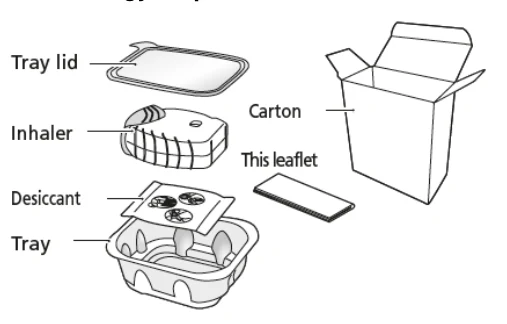
The Ellipta inhaler consists of a light grey plastic body, a beige mouthpiece cover and a dispenser. It is packaged in a foil tray with a removable aluminium cover. The tray contains a sachet of dehumidifier to reduce moisture in the package.
The active ingredients are supplied as a white powder in separate blister strips within the inhaler.
Each inhaler contains 30 doses (sufficient for 30 days).
PLGB 20774/2499 - Trelegy Ellipta 92 micrograms/ 55 micrograms /22 micrograms inhalation powder, pre-dispensed
Trelegy and Ellipta are registered trademarks.
Manufactured by: Glaxo Wellcome Production, Zone Industrielle No.2, 23 Rue Lavoisier, 27000 Evreux, France. Procured from within the EU. Product Licence Holder: Quadrant Pharmaceuticals Limited, Lynstock House, Lynstock Way, Lostock, Bolton, BL6 4SA. Repackaged by: Maxearn Limited, Unit 29, Oakhill Trading Estate, Devonshire Road, Worsley, Manchester, M28 3PT.
This leaflet was revised on 4th December 2023
Blind or partially sighted?
Is this leaflet hard to see or read?
Contact Quadrant Pharmaceuticals Ltd, Tel: 01204 471 269
Step-by-step instructions
Your Trelegy Ellipta inhaler carton contains
- 1 Read this before you start
If you open and close the cover without inhaling the medicine, you will lose the dose.
The lost dose will be securely held inside the inhaler, but it will no longer be available.
It is not possible to accidentally take extra medicine or a double dose in one inhalation.
For the 14-dose inhaler, the dose counter will also show half red when there are fewer than 10 doses left, and then will show half red with the number 0 after the last dose is used. The dose counter will appear completely red if the cover is opened again.
- 2
Prepare a dose
Wait to open the cover until you are ready to take your dose.
Do not shake the inhaler.
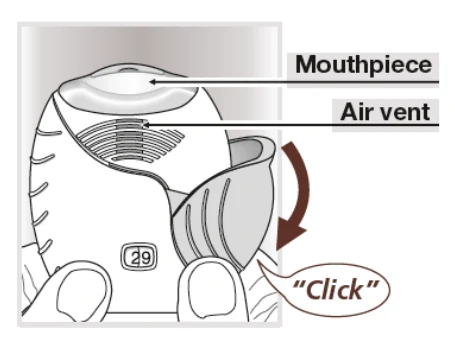
- Slide the cover down until you hear a “click”.
- 2
Your medicine is now ready to be inhaled.
The dose counter counts down by 1 to confirm.
- 3 Inhale your medicine
- ►
While holding the inhaler away from your mouth, breathe out as far as is comfortable.
Do not breathe out into the inhaler.
- ►
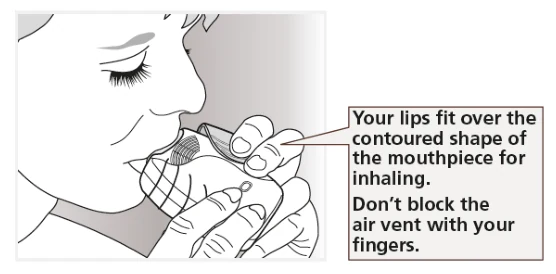
Put the mouthpiece between your lips, and close your lips firmly around it.
Do not block the air vent with your fingers.
- ► Take one long, steady, deep breath in. Hold this breath in for as long as possible (at least 3-4 seconds).
- ► Remove the inhaler from your mouth.
- ► Breathe out slowly and gently.
- 4 Close the inhaler and rinse your mouth
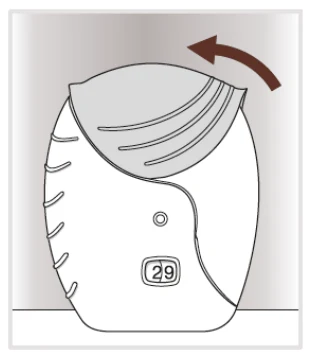
- ► Slide the cover upwards as far as it will go, to cover the mouthpiece.
- ► Rinse your mouth with water after you have used the inhaler, do not swallow.
This will make it less likely that you will develop a sore mouth or throat as side effects.
L-02-2499-01
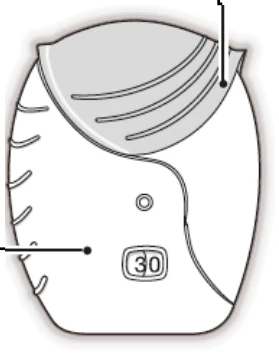
Dose counter
This shows how many doses of medicine are left in the inhaler.
Before the inhaler has been used, it shows exactly 30 doses.
It counts down by 1 each time you open the cover.
When fewer than 10 doses are left, half of the dose counter shows red.
After you have used the last dose, half of the dose counter shows red and the number 0 is displayed.
Your inhaler is now empty.
If you open the cover after this, the dose counter will change from half red to completely red.
Cover
Each time you open this, you prepare one dose of medicine.
What is the inhaler?
The first time you use Trelegy Ellipta you do not need to check that the inhaler is working properly; it contains previously measured doses and is ready to use straight away.
The inhaler is packaged in a tray. Do not open the tray until you are ready to inhale a dose of your medicine.
When you are ready to use your inhaler, peel back the lid
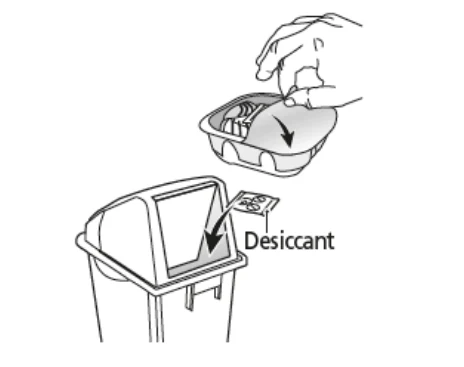
to open the tray. The tray contains a desiccant sachet, to
reduce moisture. Throw this desiccant sachet away – do not open, eat or inhale it.
When you take the inhaler out of the sealed tray, it will be in the ‘closed’ position. Do not open the inhaler until you are ready to inhale a dose of medicine. Write the “Discard by” date on the inhaler label and the carton in the space provided. The “Discard by” date is 6 weeks from the date you open the tray. After this date, the inhaler should no longer be used. The tray can be discarded after first opening.
If stored in a refrigerator, allow the inhaler to return to room temperature for at least one hour before use.
The step-by-step instructions for use of the inhaler provided below can be used for the 30-dose (30_day supply) Ellipta inhaler.
- If the dose counter does not count down as you hear the “click”, the inhaler will not deliver medicine. Take it back to your pharmacist for advice.
Do not shake the inhaler at any time.
- You may not be able to taste or feel the medicine, even when you are using the inhaler correctly.
- If you want to clean the mouthpiece, use a dry tissue, before you close the cover.
POM