

Summary of Product Characteristics (SmPC) - Temozolomide 140 mg hard capsules
1 NAME OF THE MEDICINAL PRODUCT
Temozolomide 140 mg hard capsules
2 QUALITATIVE AND QUANTITATIVE COMPOSITION
Each hard capsule contains 140 mg temozolomide.
Excipient(s) with known effect
Each hard capsule contains 246.0 mg of anhydrous lactose.
For the full list of excipients, see section 6.1.
3 PHARMACEUTICAL FORM
Hard capsule (capsule).
Size 0 hard gelatin capsules with a transparent light blue cap and an opaque white body imprinted with “140 mg”. The capsules are filled with white to light pink powder.
4 CLINICAL PARTICULARS
4.1 Therapeutic indications
Temozolomide is indicated for the treatment of:
- adult patients with newly-diagnosed glioblastoma multiforme concomitantly with radiotherapy (RT) and subsequently as monotherapy treatment.
- children from the age of three years, adolescents and adult patients with malignant glioma, such as glioblastoma multiforme or anaplastic astrocytoma, showing recurrence or progression after standard therapy.
4.2 Posology and method of administration
Temozolomide should only be prescribed by physicians experienced in the oncological treatment of brain tumours.
Anti-emetic therapy may be administered (see section 4.4).
Posology
Adult patients with newly-diagnosed glioblastoma multiforme
Temozolomide is administered in combination with focal radiotherapy (concomitant phase) followed by up to 6 cycles of temozolomide monotherapy (monotherapy phase).
Concomitant phase
Temozolomide is administered orally at a dose of 75 mg/m2 daily for 42 days concomitant with focal radiotherapy (60 Gy administered in 30 fractions). No dose reductions are recommended, but delay or discontinuation of temozolomide administration should be decided weekly according to haematological and non-haematological toxicity criteria. Temozolomide administration can be continued throughout the 42 day concomitant period (up to 49 days) if all of the following conditions are met:
- absolute neutrophil count (ANC) ≥ 1.5 x 10⁹/l
- thrombocyte count ≥ 100 x 109/l
common toxicity criteria (CTC) non-haematological toxicity ≤ Grade 1
(except for alopecia, nausea and vomiting). During treatment a complete blood count should be obtained weekly. Temozolomide administration should be temporarily interrupted or permanently discontinued during the concomitant phase according to the haematological and non-haematological toxicity criteria as noted in Table 1.
Table 1. Temozolomide dosing interruption or discontinuation during concomitant radiotherapy and temozolomide | ||
| Toxicity | Temozolomide interruption a ≥ | Temozolomide discontinuation |
| Absolute neutrophil count | 0.5 and < 1.5 x 10⁹/l ≥ | < 0.5 x 10⁹/l |
| Thrombocyte count | 10 and < 100 x 109/l | < 10 x 109/l |
| CTC non-haematological toxicity (except for alopecia, nausea, vomiting) | CTC Grade 2 | CTC Grade 3 or 4 |
a: Treatment with concomitant temozolomide can be continued when all of the following conditions are met: absolute neutrophil count ≥ 1.5 x 10⁹/l; thrombocyte count ≥ 100 x 109/l; CTC non-haematological toxicity ≤ Grade 1 (except for alopecia, nausea, vomiting).
Monotherapy phase
Four weeks after completing the temozolomide + RT concomitant phase, temozolomide is administered for up to 6 cycles of monotherapy treatment. Dose in Cycle 1 (monotherapy) is 150 mg/m2 once daily for 5 days followed by 23 days without treatment. At the start of Cycle 2, the dose is escalated to 200 mg/m2 if the CTC non-haematological toxicity for Cycle 1 is Grade ≤ 2 (except for alopecia, nausea and vomiting), absolute neutrophil count (ANC) is ≥ 1.5 x 10⁹/l, and the thrombocyte count is ≥ 100 x 109/l. If the dose was not escalated at Cycle 2, escalation should not be done in subsequent cycles. Once escalated, the dose remains at 200 mg/m2 per day for the first 5 days of each subsequent cycle except if toxicity occurs. Dose reductions and discontinuations during the monotherapy phase should be applied according to Tables 2 and 3.
During treatment a complete blood count should be obtained on Day 22 (21 days after the first dose of temozolomide). The dose should be reduced or administration discontinued according to Table 3.
| Table 2. Temozolomide dose levels for monotherapy treatment | ||
| Dose level | Temozolomide dose (mg/m2/day) | Remarks |
| –1 | 100 | Reduction for prior toxicity |
| 0 | 150 | Dose during Cycle 1 |
| 1 | 200 | Dose during Cycles 2-6 in absence of toxicity |
a: Temozolomide dose levels are listed in Table 2.
b: Temozolomide is to be discontinued if:
- dose level -1 (100 mg/m2) still results in unacceptable toxicity
- the same Grade 3 non-haematological toxicity (except for alopecia, nausea, vomiting) recurs after dose reduction.
Adult and paediatric patients 3 years of age or older with recurrent or progressive malignant glioma:
A treatment cycle comprises 28 days. In patients previously untreated with chemotherapy, temozolomide is administered orally at a dose of 200 mg/m2 once daily for the first 5 days followed by a 23 day treatment interruption (total of 28 days). In patients previously treated with chemotherapy, the initial dose is 150 mg/m2 once daily, to be increased in the second cycle to 200 mg/m2 once daily, for 5 days if there is no haematological toxicity (see section 4.4).
Special populations
Paediatric population
| Table 3. Temozolomide dose reduction or discontinuation during monotherapy treatment | ||
| Toxicity | Reduce temozolomide by 1 dose level a | Discontinue temozolomide |
| Absolute neutrophil count | < 1.0 x 10⁹/l | See footnote b |
| Thrombocyte count | < 50 x 109/l | See footnote b |
| CTC non-haematological Toxicity (except for alopecia, nausea, vomiting) | CTC Grade 3 | CTC Grade 4 b |
In patients 3 years of age or older, temozolomide is only to be used in recurrent or progressive malignant glioma. Experience in these children is very limited (see sections 4.4 and 5.1). The safety and efficacy of temozolomide in children under the age of 3 years have not been established. No data are available.
Patients with hepatic or renal impairment
The pharmacokinetics of temozolomide were comparable in patients with normal hepatic function and in those with mild or moderate hepatic impairment. No data are available on the administration of temozolomide in patients with severe hepatic impairment (Child’s Class C) or with renal impairment. Based on the pharmacokinetic properties of temozolomide, it is unlikely that dose reductions are required in patients with severe hepatic impairment or any degree of renal impairment. However, caution should be exercised when temozolomide is administered in these patients.
Elderly patients
Based on a population pharmacokinetic analysis in patients 19-78 years of age, clearance of temozolomide is not affected by age. However, elderly patients (> 70 years of age) appear to be at increased risk of neutropenia and thrombocytopenia (see section 4.4).
Method of administration
Temozolomide hard capsules should be administered in the fasting state.
The capsules must be swallowed whole with a glass of water and must not be opened or chewed.
If vomiting occurs after the dose is administered, a second dose should not be administered that day.
4.3 Contraindications
- Hypersensitivity to the active substance or to any of the excipients listed in section 6.1.
- Hypersensitivity to dacarbazine (DTIC).
- Severe myelosuppression (see section 4.4).
4.4 Special warnings and precautions for use
Opportunistic infections and reactivation of infections
Opportunistic infections (such as Pneumocystis jirovecii pneumonia) and reactivation of infections (such as HBV, CMV) have been observed during the treatment with temozolomide (see section 4.8).
Meningoencephalitis herpetic
In post marketing cases, meningoencephalitis herpetic (including fatal cases) has been observed in patients receiving temozolomide in combination with radiotherapy, including cases of concomitant steroids administration.
Pneumocystis jirovecii pneumonia
Patients who received concomitant temozolomide and RT in a pilot trial for the prolonged 42-day schedule were shown to be at particular risk for developing Pneumocystis jirovecii pneumonia (PCP). Thus, prophylaxis against PCP is required for all patients receiving concomitant temozolomide and RT for the 42-day regimen (with a maximum of 49 days) regardless of lymphocyte count. If lymphopenia occurs, they are to continue the prophylaxis until recovery of lymphopenia to grade ≤ 1.
There may be a higher occurrence of PCP when temozolomide is administered during a longer dosing regimen. However, all patients receiving temozolomide, particularly patients receiving steroids, should be observed closely for the development of PCP, regardless of the regimen. Cases of fatal respiratory failure have been reported in patients using temozolomide, in particular in combination with dexamethasone or other steroids.
HBV
Hepatitis due to hepatitis B virus (HBV) reactivation, in some cases resulting in death, has been reported. Experts in liver disease should be consulted before treatment is initiated in patients with positive hepatitis B serology (including those with active disease). During treatment patients should be monitored and managed appropriately.
Hepatotoxicity
Hepatic injury, including fatal hepatic failure, has been reported in patients treated with temozolomide (see section 4.8). Baseline liver function tests should be performed prior to treatment initiation. If abnormal, physicians should assess the benefit/risk prior to initiating temozolomide including the potential for fatal hepatic failure. For patients on a 42 day treatment cycle liver function tests should be repeated midway during this cycle. For all patients, liver function tests should be checked after each treatment cycle. For patients with significant liver function abnormalities, physicians should assess the benefit/risk of continuing treatment. Liver toxicity may occur several weeks or more after the last treatment with temozolomide.
Malignancies
Cases of myelodysplastic syndrome and secondary malignancies, including myeloid leukaemia, have also been reported very rarely (see section 4.8).
Anti-emetic therapy
Nausea and vomiting are very commonly associated with temozolomide.
Anti-emetic therapy may be administered prior to or following administration of temozolomide.
Adult patients with newly-diagnosed glioblastoma multiforme
Anti-emetic prophylaxis is recommended prior to the initial dose of concomitant phase and it is strongly recommended during the monotherapy phase.
Patients with recurrent or progressive malignant glioma
Patients who have experienced severe (Grade 3 or 4) vomiting in previous treatment cycles may require anti-emetic therapy.
Laboratory parameters
Patients treated with temozolomide may experience myelosuppression, including prolonged pancytopenia, which may result in aplastic anaemia, which in some cases has resulted in a fatal outcome. In some cases, exposure to concomitant medicinal products associated with aplastic anaemia, including carbamazepine, phenytoin, and sulfamethoxazole/trimethoprim, complicates assessment. Prior to dosing, the following laboratory parameters must be met: ANC ≥ 1.5 x 10⁹/l and platelet count ≥ 100 x 109/l. A complete blood count should be obtained on Day 22 (21 days after the first dose) or within 48 hours of that day, and weekly until ANC > 1.5 x 10⁹/l and platelet count > 100 x 109/l. If ANC falls to < 1.0 x 10⁹/l or the platelet count is < 50 x 109/l during any cycle, the next cycle should be reduced one dose level (see section 4.2). Dose levels include 100 mg/m2, 150 mg/m2, and 200 mg/m2. The lowest recommended dose is 100 mg/m2.
Paediatric population
There is no clinical experience with use of temozolomide in children under the age of 3 years. Experience in older children and adolescents is very limited (see sections 4.2 and 5.1).
Elderly patients (> 70 years of age)
Elderly patients appear to be at increased risk of neutropenia and thrombocytopenia, compared with younger patients. Therefore, special care should be taken when temozolomide is administered in elderly patients.
Female patients
Women of childbearing potential have to use effective contraception to avoid pregnancy while they are receiving temozolomide, and for at least 6 months following completion of treatment.
Male patients
Men being treated with temozolomide should be advised not to father a child for at least 3 months after receiving the last dose and to seek advice on cryoconservation of sperm prior to treatment (see section 4.6).
Information on certain excipients:
This medicine contains lactose. Patients with rare hereditary problems of galactose intolerance, total lactase deficiency or glucose-galactose malabsorption should not take this medicine.
This medicine contains less than 1 mmol sodium (23 mg) per capsule, that is to say essentially ‘sodium-free’.
4.5 Interaction with other medicinal products and other forms of interaction
In a separate phase I study, administration of temozolomide with ranitidine did not result in alterations in the extent of absorption of temozolomide or the exposure to its active metabolite monomethyl triazenoimidazole carboxamide (MTIC).
Administration of temozolomide with food resulted in a 33% decrease in Cmax and a 9% decrease in area under the curve (AUC).
As it cannot be excluded that the change in Cmax is clinically significant, Temozolomide should be administered without food.
Based on an analysis of population pharmacokinetics in phase II trials, co-administration of dexamethasone, prochlorperazine, phenytoin, carbamazepine, ondansetron, H2 receptor antagonists, or phenobarbital did not alter the clearance of temozolomide. Co-administration with valproic acid was associated with a small but statistically significant decrease in clearance of temozolomide.
No studies have been conducted to determine the effect of temozolomide on the metabolism or elimination of other medicinal products. However, since temozolomide does not undergo hepatic metabolism and exhibits low protein binding, it is unlikely that it would affect the pharmacokinetics of other medicinal products (see section 5.2).
Use of temozolomide in combination with other myelosuppressive agents may increase the likelihood of myelosuppression.
Paediatric population
Interaction studies have only been performed in adults.
4.6 Fertility, pregnancy and lactation
Pregnancy
There are no data in pregnant women. In preclinical studies in rats and rabbits receiving 150 mg/m2 temozolomide, teratogenicity and/or foetal toxicity were demonstrated (see section 5.3). Temozolomide should not be administered to pregnant women. If use during pregnancy must be considered, the patient should be apprised of the potential risk to the foetus.
Breast-feeding
It is not known whether temozolomide is excreted in human milk; thus, breast-feeding should be discontinued while receiving treatment with temozolomide.
Women of childbearing potential
Women of childbearing potential have to use effective contraception to avoid pregnancy while they are receiving temozolomide, and for at least 6 months following completion of treatment.
Male fertility
Temozolomide can have genotoxic effects. Therefore, men being treated with it should use effective contraceptive measures and be advised not to father a child for at least 3 months after receiving the last dose and to seek advice on cryoconservation of sperm prior to treatment, because of the possibility of irreversible infertility due to therapy with temozolomide.
4.7 Effects on ability to drive and use machines
Temozolomide has minor influence on the ability to drive and use machines due to fatigue and somnolence (see section 4.8).
4.8 Undesirable effects
Summary of the safety profile
Clinical trial experience
In patients treated with temozolomide in clinical trials, the most common adverse reactions were nausea, vomiting, constipation, anorexia, headache, fatigue, convulsions, and rash. Most haematologic adverse reactions were reported commonly; the frequency of Grade 3-4 laboratory findings is presented after Table 4.
For patients with recurrent or progressive glioma, nausea (43%) and vomiting (36%) were usually Grade 1 or 2 (0 – 5 episodes of vomiting in 24 hours) and were either self-limiting or readily controlled with standard anti-emetic therapy. The incidence of severe nausea and vomiting was 4%.
Tabulated list of adverse reactions
Adverse reactions observed in clinical studies and reported from post-marketing use of temozolomide are listed in Table 4. These reactions are classified according to System Organ Class and frequency.
Frequency groupings are defined according to the following convention:
Very common (≥ 1/10); Common (≥ 1/100 to < 1/10); Uncommon (≥ 1/1,000 to < 1/100); Rare (≥1/10,000 to <1/1,000); Very rare (<1/10,000); Not known (cannot be estimated from the available data).
Within each frequency grouping, undesirable effects are presented in order of decreasing seriousness.
Table 4. Adverse reactions in patients treated with temozolomide
Infections and infestations
| Common: | Infections, herpes zoster, pharyngitis a, candidiasis oral |
| Uncommon: | Opportunistic infection (including PCP), sepsis†, meningoencephalitis herpetic†, CMV infection, CMV reactivation, hepatitis B virus†, herpes simplex, infection reactivation, wound infection, gastroenteritis b |
| Neoplasm benign, malignant, and unspecified | |
| Uncommon: | Myelodysplastic syndrome (MDS), secondary malignancies, including myeloid leukaemia |
| Blood and lymphatic system disorders | |
| Common: | Febrile neutropenia, neutropenia, thrombocytopenia, lymphopenia, leukopenia, anaemia |
| Uncommon: | Prolonged pancytopenia, aplastic anaemia†, pancytopenia, petechiae |
| Immune system disorders | |
| Common: | Allergic reaction |
| Uncommon: | Anaphylaxis |
| Endocrine disorders | |
| Common: | Cushingoid c |
| Uncommon: | Diabetes insipidus |
| Metabolism and nutrition disorders | |
| Very common: | Anorexia |
| Common: | Hyperglycaemia |
| Uncommon: | Hypokalaemia, alkaline phosphatase increased |
| Psychiatric disorders | |
| Common: | Agitation, amnesia, depression, anxiety, confusion, insomnia |
| Uncommon: | Behaviour disorder, emotional lability, hallucination, apathy |
| Nervous system disorders | |
| Very common: | Convulsions, hemiparesis, aphasia/dysphasia, headache |
| Common: | Ataxia, balance impaired, cognition impaired, concentration impaired, consciousness decreased, dizziness, hypoesthesia, memory impaired, neurologic disorder, neuropathy d, paraesthesia, somnolence, speech disorder, taste perversion, tremor |
| Uncommon: | Status epilepticus, hemiplegia, extrapyramidal disorder, parosmia, gait abnormality, hyperaesthesia, sensory disturbance, coordination abnormal |
| Eye disorders | |
| Common: | Hemianopia, vision blurred, vision disorder e, visual field defect, diplopia, eye pain |
| Uncommon: | Visual acuity reduced, eyes dry |
| Ear and labyrinth disorders | |
| Common: | Deafness f, vertigo, tinnitus, earache g |
| Uncommon: | Hearing impairment, hyperacusis, otitis media |
| Cardiac disorders | |
| Uncommon: | Palpitation |
| Vascular disorders | |
| Common: | Haemorrhage, embolism pulmonary, deep vein thrombosis, hypertension |
| Uncommon: | Cerebral haemorrhage, flushing, hot flushes |
| Respiratory, thoracic and mediastinal disorders | |
| Common: | Pneumonia, dyspnoea, sinusitis, bronchitis, coughing, upper respiratory infection |
| Uncommon: | Respiratory failure†, interstitial pneumonitis/pneumonitis, pulmonary fibrosis, nasal congestion |
| Gastrointestinal disorders | |
| Very common: | Diarrhoea, constipation, nausea, vomiting |
| Common: | Stomatitis, abdominal pain h, dyspepsia, dysphagia |
| Uncommon: | Abdominal distension, faecal incontinence, gastrointestinal disorder, haemorrhoids, mouth dry |
| Hepatobiliary disorders | |
| Uncommon: | Hepatic failure†, hepatic injury, hepatitis, cholestasis, hyperbilirubinemia |
| Skin and subcutaneous tissue disorders | |
| Very Common: | Rash, alopecia |
| Common: | Erythema, dry skin, pruritus |
| Uncommon: | Toxic epidermal necrolysis, Stevens-Johnson syndrome, angioedema, erythema multiforme, erythroderma, skin exfoliation, photosensitivity reaction, urticaria, exanthema, dermatitis, sweating increased, pigmentation abnormal |
| Not known: | Drug reaction with eosinophilia and systemic symptoms (DRESS) |
| Musculoskeletal and connective tissue disorders | |
| Common: | Myopathy, muscle weakness, arthralgia, back pain, musculoskeletal pain, myalgia |
| Renal and urinary disorders | |
| Common: | Micturition frequency, urinary incontinence |
| Uncommon: | Dysuria |
| Reproductive system and breast disorders | |
| Uncommon: | Vaginal haemorrhage, menorrhagia, amenorrhoea, vaginitis, breast pain, impotence |
| General disorders and administration site conditions | |
| Very common: | Fatigue |
| Common: | Fever, influenza-like symptoms, asthenia, malaise, pain, oedema, oedema peripheral i |
| Uncommon: | Condition aggravated, rigors, face oedema, tongue discolouration, thirst, tooth disorder |
| Investigations | |
| Common: | Liver enzymes elevation j, weight decreased, weight increased |
| Uncommon: | Gamma-glutamyltransferase increased |
| Injury, poisoning and procedural complications | |
| Common: | Radiation injury k |
a Includes pharyngitis, nasopharyngeal pharyngitis, pharyngitis Streptococcal b Includes gastroenteritis, gastroenteritis viral
c Includes cushingoid, Cushing syndrome
d Includes neuropathy, peripheral neuropathy, polyneuropathy, peripheral sensory neuropathy, peripheral motor neuropathy
e Includes visual impairment, eye disorder
f Includes deafness, deafness bilateral, deafness neurosensory, deafness unilateral g Includes earache, ear discomfort
h Includes abdominal pain, abdominal pain lower, abdominal pain upper, abdominal discomfort
i Includes oedema peripheral, peripheral swelling
j Includes liver function test increased, alanine aminotransferase increased, aspartate aminotransferase increased, hepatic enzymes increased
k Includes radiation injury, radiation skin injury
† Including cases with fatal outcome
Newly-diagnosed glioblastoma multiforme
Laboratory results
Myelosuppression (neutropenia and thrombocytopenia), which is known dose-limiting toxicity for most cytotoxic agents, including temozolomide, was observed. When laboratory abnormalities and adverse events were combined across concomitant and monotherapy treatment phases, Grade 3 or Grade 4 neutrophil abnormalities including neutropenic events were observed in 8% of the patients. Grade 3 or Grade 4 thrombocyte abnormalities, including thrombocytopenic events were observed in 14% of the patients who received temozolomide.
Recurrent or progressive malignant glioma
Laboratory results
Grade 3 or 4 thrombocytopenia and neutropenia occurred in 19% and 17% respectively, of patients treated for malignant glioma. This led to hospitalisation and/or discontinuation of temozolomide in 8% and 4%, respectively. Myelosuppression was predictable (usually within the first few cycles, with the nadir between Day 21 and Day 28), and recovery was rapid, usually within 1-2 weeks. No evidence of cumulative myelosuppression was observed. The presence of thrombocytopenia may increase the risk of bleeding, and the presence of neutropenia or leukopenia may increase the risk of infection.
Gender
In a population pharmacokinetics analysis of clinical trial experience there were 101 female and 169 male subjects for whom nadir neutrophil counts were available and 110 female and 174 male subjects for whom nadir platelet counts were available. There were higher rates of Grade 4 neutropenia (ANC < 0.5 x 10⁹/l), 12% vs 5%, and thrombocytopenia (< 20 x 109/l), 9% vs 3%, in women vs men in the first cycle of therapy. In a 400 subject recurrent glioma data set, Grade 4 neutropenia occurred in 8% of female vs 4% of male subjects and Grade 4 thrombocytopenia in 8% of female vs 3% of male subjects in the first cycle of therapy. In a study of 288 subjects with newly- diagnosed glioblastoma multiforme, Grade 4 neutropenia occurred in 3% of female vs 0% of male subjects and Grade 4 thrombocytopenia in 1% of female vs 0% of male subjects in the first cycle of therapy.
Paediatric population
Oral temozolomide has been studied in paediatric patients (age 3-18 years) with recurrent brainstem glioma or recurrent high grade astrocytoma, in a regimen administered daily for 5 days every 28 days. Although the data is limited, tolerance in children is expected to be the same as in adults. The safety of temozolomide in children under the age of 3 years has not been established.
Reporting of suspected adverse reactions
Reporting suspected adverse reactions after authorisation of the medicinal product is important. It allows continued monitoring of the benefit/risk balance of the medicinal product. Healthcare professionals are asked to report any suspected adverse reactions via the Yellow Card Scheme at: www.mhra.gov.uk/yellowcard or search for MHRA Yellow Card in the Google Play or Apple App Store.
4.9 Overdose
Doses of 500, 750, 1,000, and 1,250 mg/m2 (total dose per cycle over 5 days) have been evaluated clinically in patients. Dose-limiting toxicity was haematological and was reported with any dose but is expected to be more severe at higher doses. An overdose of 10,000 mg (total dose in a single cycle, over 5 days) was taken by one patient and the adverse reactions reported were pancytopenia, pyrexia, multi-organ failure and death. There are reports of patients who have taken the recommended dose for more than 5 days of treatment (up to 64 days) with adverse events reported including bone marrow suppression, with or without infection, in some cases severe and prolonged and resulting in death. In the event of an overdose, haematological evaluation is needed. Supportive measures should be provided as necessary.
5 PHARMACOLOGICAL PROPERTIES
5.1 Pharmacodynamic properties
Pharmacotherapeutic group: Antineoplastic agents - Other alkylating agents, ATC code: L01A X03.
Mechanism of action
Temozolomide is a triazene, which undergoes rapid chemical conversion at physiologic pH to the active monomethyl triazenoimidazole carboxamide (MTIC). The cytotoxicity of MTIC is thought to be due primarily to alkylation at the O6 position of guanine with additional alkylation also occurring at the N7 position. Cytotoxic lesions that develop subsequently are thought to involve aberrant repair of the methyl adduct.
Clinical efficacy and safety
Newly-diagnosed glioblastoma multiforme
A total of 573 patients were randomised to receive either temozolomide + RT (n=287) or RT alone (n=286). Patients in the temozolomide + RT arm received concomitant temozolomide (75 mg/m2) once daily, starting the first day of RT until the last day of RT, for 42 days (with a maximum of 49 days). This was followed by monotherapy temozolomide (150 - 200 mg/m2) on Days 1 - 5 of every 28-day cycle for up to 6 cycles, starting 4 weeks after the end of RT. Patients in the control arm received RT only. Pneumocystis jirovecii pneumonia (PCP) prophylaxis was required during RT and combined temozolomide therapy.
Temozolomide was administered as salvage therapy in the follow-up phase in 161 patients of the 282 (57%) in the RT alone arm, and 62 patients of the 277 (22%) in the temozolomide + RT arm.
The hazard ratio (HR) for overall survival was 1.59 (95% CI for HR=1.33 -1.91) with a log-rank p < 0.0001 in favour of the temozolomide arm. The estimated probability of surviving 2 years or more (26% vs 10%) is higher for the RT + temozolomide arm. The addition of concomitant temozolomide to RT, followed by temozolomide monotherapy in the treatment of patients with newly-diagnosed glioblastoma multiforme demonstrated a statistically significant improvement in overall survival (OS) compared with RT alone (Figure 1).
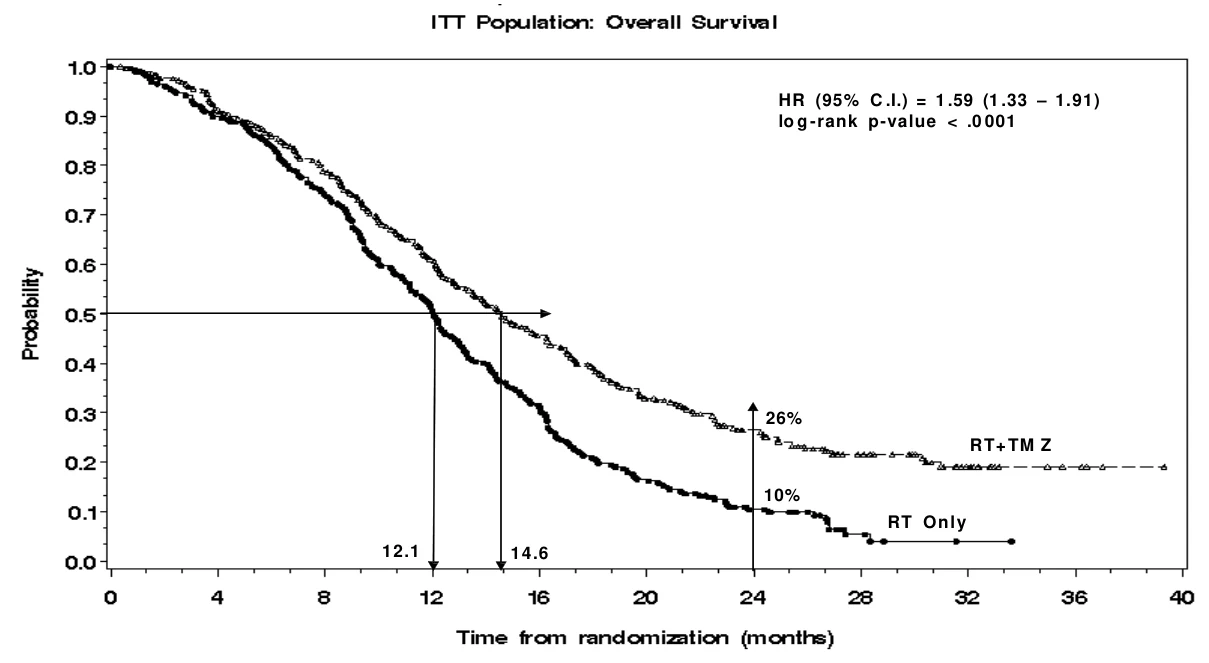
HR (95% C .I.) = 1 .59 (1 .33 – 1.91)
lo g -rank p-value < .0 001
26%
RT+TM Z
10%
RT Only
12.1 14.6 Figure 1 Kaplan-Meier curves for overall survival (intent-to-treat population)
The results from the trial were not consistent in the subgroup of patients with a poor performance status (WHO PS=2, n=70), where overall survival and time to progression were similar in both arms. However, no unacceptable risks appear to be present in this patient group.
Recurrent or progressive malignant glioma
Data on clinical efficacy in patients with glioblastoma multiforme (Karnofsky performance status [KPS] ≥ 70), progressive or recurrent after surgery and RT, were based on two clinical trials with oral temozolomide. One was a non-comparative trial in 138 patients (29% received prior chemotherapy), and the other was a randomised active-controlled trial of temozolomide vs procarbazine in a total of 225 patients (67% received prior treatment with nitrosourea based chemotherapy). In both trials, the primary endpoint was progression-free survival (PFS) defined by MRI scans or neurological worsening. In the non- comparative trial, the PFS at 6 months was 19%, the median progression-free survival was 2.1 months, and the median overall survival 5.4 months. The objective response rate (ORR) based on MRI scans was 8%.
In the randomised active-controlled trial, the PFS at 6 months was significantly greater for temozolomide than for procarbazine (21% vs 8%, respectively – chi-square p = 0.008) with median PFS of 2.89 and 1.88 months respectively (log rank p = 0.0063). The median survival was 7.34 and 5.66 months for temozolomide and procarbazine, respectively (log rank p = 0.33). At 6 months, the fraction of surviving patients was significantly higher in the temozolomide arm (60%) compared with the procarbazine arm (44%) (chi-square p = 0.019). In patients with prior chemotherapy a benefit was indicated in those with a KPS ≥ 80.
Data on time to worsening of neurological status favoured temozolomide over procarbazine as did data on time to worsening of performance status (decrease to a KPS of < 70 or a decrease by at least 30 points). The median times to progression in these endpoints ranged from 0.7 to 2.1 months longer for temozolomide than for procarbazine (log rank p = < 0.01 to 0.03).
Recurrent anaplastic astrocytoma
In a multicentre, prospective phase II trial evaluating the safety and efficacy of oral temozolomide in the treatment of patients with anaplastic astrocytoma at first relapse, the 6 month PFS was 46%. The median PFS was 5.4 months. Median overall survival was 14.6 months. Response rate, based on the central reviewer assessment, was 35% (13 CR and 43 PR) for the intent-to-treat population (ITT) n=162. In 43 patients stable disease was reported. The 6-month event-free survival for the ITT population was 44% with a median event-free survival of 4.6 months, which was similar to the results for the progression-free survival. For the eligible histology population, the efficacy results were similar. Achieving a radiological objective response or maintaining progression-free status was strongly associated with maintained or improved quality of life.
Paediatric population
Oral temozolomide has been studied in paediatric patients (age 3-18 years) with recurrent brainstem glioma or recurrent high grade astrocytoma, in a regimen administered daily for 5 days every 28 days. Tolerance to temozolomide is similar to adults.
5.2 Pharmacokinetic properties
Temozolomide is spontaneously hydrolyzed at physiologic pH primarily to the active species, 3-methyl- (triazen-1-yl)imidazole-4-carboxamide (MTIC). MTIC is spontaneously hydrolyzed to 5-amino- imidazole-4-carboxamide (AIC), a known intermediate in purine and nucleic acid biosynthesis, and to methylhydrazine, which is believed to be the active alkylating species. The cytotoxicity of MTIC is thought to be primarily due to alkylation of DNA mainly at the O6 and N7 positions of guanine.
Relative to the AUC of temozolomide, the exposure to MTIC and AIC is ~ 2.4% and 23%, respectively. In vivo, the t1/2 of MTIC was similar to that of temozolomide, 1.8 hr.
Absorption
After oral administration to adult patients, temozolomide is absorbed rapidly, with peak concentrations reached as early as 20 minutes post-administration (mean time between 0.5 and 1.5 hours). After oral administration of 14C-labelled temozolomide, mean faecal excretion of 14C over 7 days post-dose was 0.8% indicating complete absorption.
Distribution
Temozolomide demonstrates low protein binding (10% to 20%), and thus it is not expected to interact with highly protein-bound substances.
PET studies in humans and preclinical data suggest that temozolomide crosses the blood-brain barrier rapidly and is present in the CSF. CSF penetration was confirmed in one patient; CSF exposure based on AUC of temozolomide was approximately 30% of that in plasma, which is consistent with animal data.
Elimination
The half-life (t1/2) in plasma is approximately 1.8 hours. The major route of 14C elimination is renal. Following oral administration, approximately 5% to 10% of the dose is recovered unchanged in the urine over 24 hours, and the remainder excreted as temozolomide acid, 5-aminoimidazole-4- carboxamide (AIC) or unidentified polar metabolites.
Plasma concentrations increase in a dose-related manner. Plasma clearance, volume of distribution and half-life are independent of dose.
Special populations
Analysis of population-based pharmacokinetics of temozolomide revealed that plasma temozolomide clearance was independent of age, renal function or tobacco use. In a separate pharmacokinetic study, plasma pharmacokinetic profiles in patients with mild to moderate hepatic impairment were similar to those observed in patients with normal hepatic function.
Paediatric patients had a higher AUC than adult patients; however, the maximum tolerated dose (MTD) was 1,000 mg/m2 per cycle both in children and in adults.
5.3 Preclinical safety data
Single-cycle (5-day dosing, 23 days non-treatment), 3- and 6-cycle toxicity studies were conducted in rats and dogs. The primary targets of toxicity included the bone marrow, lymphoreticular system, testes, the gastrointestinal tract and, at higher doses, which were lethal to 60% to 100% of rats and dogs tested, degeneration of the retina occurred. Most of the toxicity showed evidence of reversibility, except for adverse events on the male reproductive system and retinal degeneration. However, because the doses implicated in retinal degeneration were in the lethal dose range, and no comparable effect has been observed in clinical studies, this finding was not considered to have clinical relevance.
Temozolomide is an embryotoxic, teratogenic and genotoxic alkylating agent. temozolomide is more toxic to the rat and dog than to humans, and the clinical dose approximates the minimum lethal dose in rats and dogs.
Dose-related reductions in leukocytes and platelets appear to be sensitive indicators of toxicity. A variety of neoplasms, including mammary carcinomas, keratocanthoma of the skin and basal cell adenoma were observed in the 6-cycle rat study while no tumours or pre-neoplastic changes were evident in dog studies. Rats appear to be particularly sensitive to oncogenic effects of temozolomide, with the occurrence of first tumours within 3 months of initiating dosing. This latency period is very short even for an alkylating agent.
Results of the Ames/salmonella and Human Peripheral Blood Lymphocyte (HPBL) chromosome aberration tests showed a positive mutagenicity response.
6 PHARMACEUTICAL PARTICULARS
6.1 List of excipients
Capsule content:
lactose
sodium starch glycolate type A
stearic acid
tartaric acid
colloidal anhydrous silica
Capsule shell:
gelatin
titanium dioxide (E171)
indigocarmine (E132)
Printing ink:
shellac
black iron oxide (E172)
propylene glycol
6.2 Incompatibilities
Not applicable.
6.3 Shelf life
4 years
6.4 Special precautions for storage
This medicinal product does not require any special temperature storage conditions.
Store in the original bottle in order to protect from moisture.
Keep the bottle tightly closed.
6.5 Nature and contents of container
Type III amber glass bottles with polypropylene child-resistant closures containing 5 or 20 hard capsules.
The carton contains one bottle.
Not all pack sizes may be marketed.
6.6 Special precautions for disposal
Capsules should not be opened. If a capsule becomes damaged, contact of the powder contents with skin or mucous membrane must be avoided. If the capsule contents comes into contact with skin or mucosa, it should be washed immediately and thoroughly with soap and water.
Patients should be advised to keep capsules out of the sight and reach of children, preferably in a locked cupboard. Accidental ingestion can be lethal for children.
Any unused medicinal product or waste material should be disposed of in accordance with local requirements.
7 MARKETING AUTHORISATION HOLDER
Devatis UK Limited
Lower GF Suite (LG35)
Belvedere House,
Basingstoke,
Hampshire,
United Kingdom,
RG21 4HG
8 MARKETING AUTHORISATION NUMBER(S)
PL 60868/0006
9 DATE OF FIRST AUTHORISATION/RENEWAL OF THE
AUTHORISATION
15/01/2026
10 DATE OF REVISION OF THE TEXT
15/01/2026