

Patient leaflet - Subgam Human Normal Immunoglobulin solution 160 g/l solution for injection
1. What Subgam is and what it is used for
This product is a solution containing antibodies. It is prepared from human blood plasma from screened donors and then virally inactivated during manufacture.
It is used to protect you against a variety of infections when you have insufficient levels of your own antibodies. This is because you have a condition that prevents you from making your own antibodies, called antibody deficiency. Your doctor will explain further why this medicine has been given to you. Subgam is given by injection just under the skin (subcutaneously). Your doctor or nurse will give you the injection or instruct you in how to inject yourself.
2. What you need to know before you use Subgam
Do not use Subgam:
- if you are allergic to human immunoglobulins or to any of the other ingredients of this medicine (listed in section 6)
- if you are suffering from any blood disorders which interfere with clotting as this medicine may cause severe bruising where injected
- into a blood vessel (intravenously)
Check with your doctor if you think this applies to you.
Warnings and precautions
Talk to your doctor, pharmacist or nurse before using Subgam:
- as an allergic reaction could occur even if you have not had one before and even if you have used the product before (see section 4 “Possible side effects” for a list of likely symptoms). If you suffer from any of these, or just feel unwell tell your doctor, pharmacist or nurse
as Subgam should be used under close medical supervision if you have a lack of immunoglobulin A (IgA)
with anti-IgA antibodies as allergic reactions are more likely to occur
- as rarely, human normal immunoglobulin can induce a fall in blood pressure with anaphylactic reaction including shock, even in patients who have tolerated previous treatment with human normal immunoglobulin. It is advisable that you are observed for at least 20 minutes after each infusion - if you have particular blood disorders in addition to antibody deficiency, this product may not be suitable for you. Make sure your doctor, pharmacist or nurse is aware
- if you develop severe headache, neck stiffness, drowsiness, fever, dislike of light (photophobia), nausea and vomiting after an infusion, tell your doctor or nurse immediately as these may be symptoms of aseptic meningitis syndrome
- if you need a blood test, tell your doctor or nurse that you are taking Subgam as it may interfere with some blood (serological) tests
- if you develop pain, swelling and unusual warmth of a limb, sudden shortness of breath and chest pain worsening on deep breathing, numbness or weakness on one side, difficulty with speaking or confusion, contact your doctor or nurse immediately as these may indicate a blood clot
- as some medicines may increase the risk of a blood clot, tell your doctor, pharmacist or nurse of all the medicines you are taking
 Virus safety
When medicines are made from human blood or plasma, certain measures are put in place to prevent infections being passed on to patients. These include:
- careful selection of blood and plasma donors to make sure those at risk of carrying infections are excluded,
- the testing of each donation and pools of plasma for signs of virus/infections, - the inclusion of steps in the processing of the blood or plasma that can inactivate or remove viruses. Despite these measures, when medicines prepared from human blood or plasma are administered, the possibility of passing on infection cannot be totally excluded. This also applies to any unknown or emerging viruses or other types of infections.
The measures taken are considered effective for enveloped viruses such as human immunodeficiency virus (HIV), hepatitis B virus, hepatitis C virus and non-enveloped viruses such as hepatitis A and parvovirus B19 viruses.
Immunoglobulins have not been associated with hepatitis A or parvovirus B19 infections possibly because the antibodies against these infections, which are contained in the product, are protective. It is strongly recommended that every time you receive a dose of Subgam, the name and batch number of the medicine are recorded in order to maintain a record of the batches used (a Subgam Infusion Diary for patients prescribed Subgam in the UK can be accessed via www.subgam.co.uk).
Children and adolescents
The listed warnings and precautions apply to both adults and children.
Other medicines and Subgam
Tell your doctor or pharmacist if you are taking or have recently taken or might take any other medicines including those obtained without a prescription.
Tell your doctor or nurse about your treatment with Subgam if any vaccination is being planned. You must not mix other medicines with Subgam.
Pregnancy, breast-feeding and fertility
If you are pregnant or breast-feeding, think you may be pregnant or are planning to have a baby, ask your doctor or pharmacist for advice before this medicine is injected.
Driving and using machines
The ability to drive and operate machines may be impaired by some adverse reactions associated with Subgam. If you experience adverse reactions during treatment, wait for these to resolve before driving or operating machines.
Subgam contains sodium and polysorbate
Sodium
This medicinal product contains up to 0.2 mmol (4.6 mg) sodium per ml (main component of cooking/table salt). To be taken into consideration by patients on a controlled sodium diet.
Polysorbate
Subgam 750 mg contains 0.1 mg of polysorbate 80 in each 5 ml which is equivalent to 0.02 mg/ml. Subgam 1 g contains 0.13 mg of polysorbate 80 in each 6.25 ml which is equivalent to 0.02 mg/ml. Subgam 1500 mg contains 0.2 mg of polysorbate 80 in each 10 ml which is equivalent to 0.02 mg/ml. Subgam 2 g contains 0.25 mg of polysorbate 80 in each 12.5 ml which is equivalent to 0.02 mg/ml. Subgam 4 g contains 0.5 mg of polysorbate 80 in each 25 ml which is equivalent to 0.02 mg/ml. Polysorbates may cause allergic reactions. Tell your doctor if you have or your child has any known allergies.
3. How to use Subgam
Always use this medicine exactly as your doctor, pharmacist or nurse has told you. Check with your doctor, pharmacist or nurse if you are not sure.
Subgam must not be injected into a vein. It must be injected slowly just under the skin. This product may be injected by yourself. Injection of this product under the skin requires either an infusion device, usually a “syringe driver”, or can be administered directly with a syringe and needle. Your doctor or nurse can discuss these options with you and will train you. You will only be allowed to inject yourself just under the skin.
Doses
Your doctor will advise you on the dose and dose frequency for you, which might mean having a blood test to measure the amount of antibodies in your blood.
At the start of treatment at least 0.2-0.5 g/kg body weight may be given. When normal levels of antibodies have been reached in your blood stream, the regular dose will be about 100 mg/kg usually weekly. Alternative frequencies may be suitable for you and your doctor or nurse can discuss these options with you.  Instructions for use
The following table gives instructions for use, either with an infusion device or injecting directly with a syringe and needle. The initial steps 1 to 3 are the same for both options. Then steps 4 to 9 are separated to describe how to correctly use the different equipment needed for each technique.
Initial steps
Step 1: Preparation
Bring Subgam to room temperature – do not apply heat or place in a microwave. • Clean the work area and gather the items needed:
- for infusion – infusion device(s), subcutaneous needle, infusion administration tubing, transfer device or transfer needles, antiseptic wipes, gauze, tape or dressing, sharps bin, your Subgam Infusion Diary
- for direct injection – syringe, subcutaneous needle, transfer needles, antiseptic wipes, tape, sharps bin, your Subgam Infusion Diary
- Wash and dry your hands thoroughly.
Step 2: Check the vials of Subgam solution
- The solution should be clear and colourless. Do not use if the vials may have frozen, the solution is cloudy, contains particles, has changed colour, or has expired.
- Do not use cracked vials or vials that are missing the protective cap.
Step 3: Prepare the Subgam vial(s)
- Remove the protective cap from the vial
Wipe each stopper with an alcohol wipe and allow to dry.
Transfer the solution into the syringe:
If you are using a sterile vented spike (transfer device), follow the manufacturer’s instructions. • If you are using a sterile needle and sterile syringe, follow the instructions below.
- Slowly pull the plunger to fill the syringe with air. Ensure that the amount of air is the same amount as the amount of Subgam you will take from the vial.
- Insert the needle into the centre of the stopper on the vial, making sure the tip of the needle does not go in the solution.
- Gently push the syringe plunger down, which will inject the air from the syringe into the vial. - Turn the vial upside down.
- Slowly pull out the plunger to fill the syringe with the amount of Subgam required. - Remove the syringe from the vial.
- Remove the needle from the syringe and throw away in the sharps bin. Repeat the process for each vial needed.
Instructions for use with an Infusion Device
Step 4: Prepare the infusion device
Follow the manufacturer’s instructions for
preparing the infusion device and tubing.
Attach the syringe filled with Subgam to the
tubing.
Prime the infusion tubing with Subgam to ensure
that no air is left in the tubing. Stop priming when
you can see a droplet at the end of the needle.
Do not allow the fluid to coat the outside of the
needle.
Step 5: Prepare the infusion site(s)
Select an area on your abdomen, thighs, upper
arms or side of upper leg/hip (Figures 1 and 2).
Avoid any bony areas, visible blood vessels,
scars, bruises and any areas of inflammation or
infection.
Use a different site from the last time you infused
Subgam.
If you are using more than one infusion site,
make sure the sites are at least 5 – 10 cm
(2 - 4 inches) apart.
You may use up to 4 infusion sites at the same
time.
Clean the infusion site(s) with an alcohol wipe.
Allow to dry.
Instructions for use with Syringe and Needle
Step 4: Prepare the syringe for injection
- Attach the needle for injection to the syringe. • Ensure that no air is left in the syringe and needle, which is when you can see a droplet at the end of the needle.
Step 5: Prepare the injection site(s)
Select an area on your abdomen or thighs
(Figure 2).
- Avoid any bony areas, visible blood vessels, scars, bruises and any areas of inflammation or infection.
- Use a different site from the last time you injected Subgam.
Clean the injection site with an alcohol wipe.
Allow to dry.
 Step 6: Insert and secure the subcutaneous needle set
- Remove the needle cover.
Firmly pinch a 5 cm (2 inch) fold of skin between
two fingers. Insert the needle into the skin at a 90-degree angle (Figure 3) or as advised by your nurse. Secure the needle with tape or transparent dressing.
If using multiple sites, repeat these steps. • Check correct needle placement – gently pull
back on the plunger of the attached syringe and check for blood return in the tubing.
If blood is seen in the tubing, remove and
discard the subcutaneous needle and repeat steps 4, 5 and 6 with a new subcutaneous needle and infusion site.
Secure the needle set in place by applying a
sterile protective dressing over the site(s). For added security, you may want to “double around” the tubing (Figure 4).
Step 7: Start the infusion
Follow the manufacturer’s instructions to turn on
the infusion device and start the infusion. • Occasionally check the infusion site(s)
throughout the infusion as advised by your nurse.
Step 8: Complete the infusion and remove the needle(s) from the infusion site(s)
- Turn off the infusion device.
Gently remove the needle set from the infusion
site.
Press a small piece of gauze over the needle site
and apply a dressing.
Dispose of the syringe(s), tubing and needle(s) in
the sharps bin.
Step 9: Record the treatment
Place the peel-off label from the vial(s) in your
Subgam Infusion Diary to record the expiry date and batch number and write down the date, time, site(s) and dose of the infusion. • If applicable, write down any reactions after each
infusion.
Dispose of any unused product, disposable
supplies and vials as recommended by your nurse.
Follow the manufacturer’s instructions for
cleaning and storing the infusion device.
Step 6: Insert the subcutaneous needle
- Remove the needle cover.
- Firmly pinch a 5 cm (2 inch) fold of skin between two fingers. Insert the needle into the skin at a 90-degree angle or as advised by your nurse. • Check correct needle placement – gently pull back on the plunger of the attached syringe and check that no blood is pulled into the syringe. • If blood is seen in the syringe, remove and discard the subcutaneous needle and repeat steps 4, 5 and 6 with a new subcutaneous needle and use a different injection site. • You may wish to hold the syringe in place with some tape if this makes the injection easier for you.
Step 7: Start the injection
- Gradually press on the plunger of the syringe as shown by your nurse, until all the fluid in the syringe has been injected, or as explained by your nurse.
Step 8: Complete the injection and remove the needle(s) from the injection site(s)
- Place a small piece of gauze over the needle site. • Pull out the syringe and needle.
- Apply a small dressing.
- Dispose of the syringe and needle in the sharps bin.
Step 9: Record the treatment
Place the peel-off label from the vial(s) in your
Subgam Infusion Diary to record the expiry date and batch number and write down the date, time, site and dose of the injection.
- If applicable, write down any reactions after each injection.
- Dispose of any unused product, disposable supplies and vials as recommended by your nurse.
Figures:
Figure 1 Figure 2 Figure 3 Figure 4 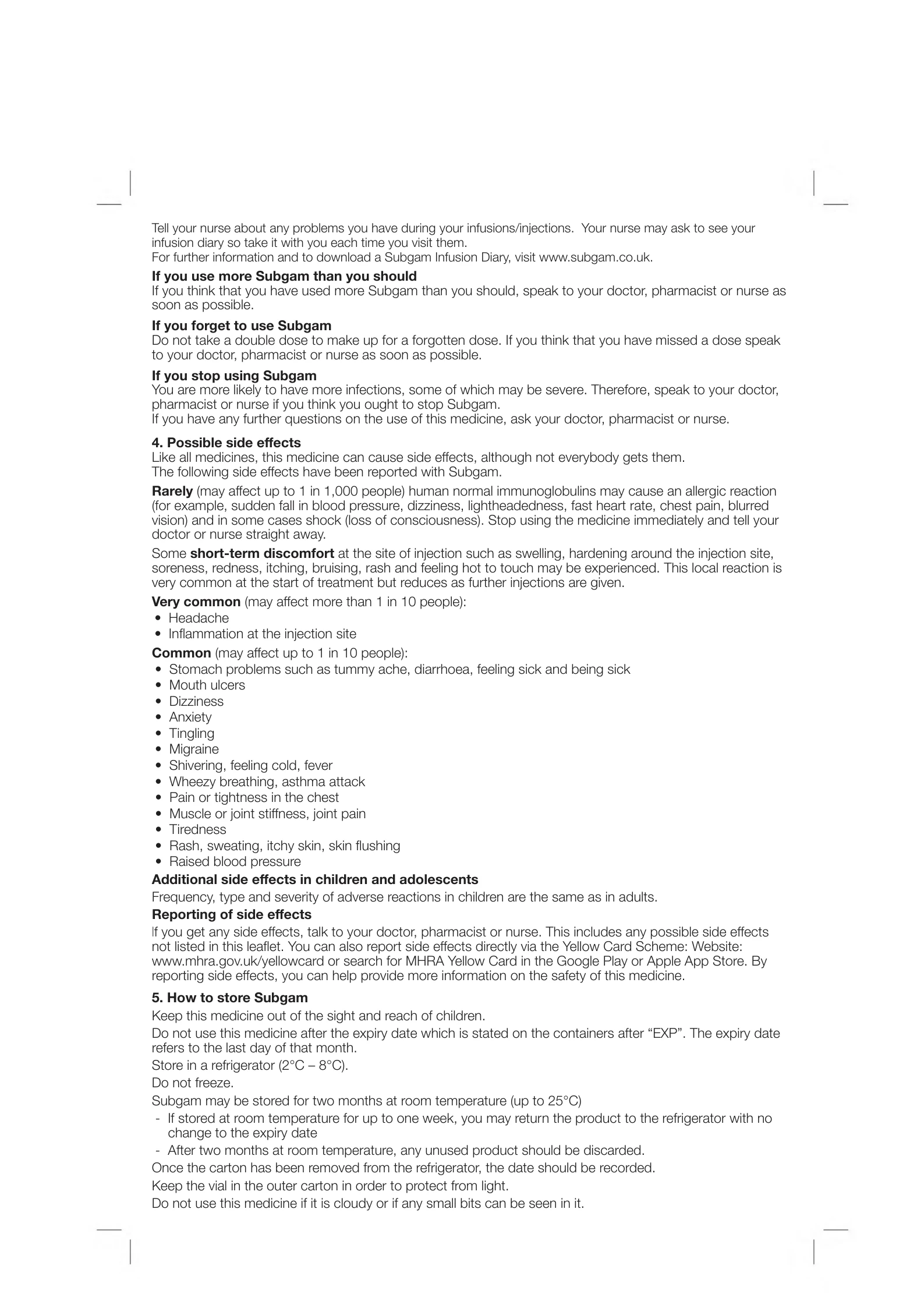 Tell your nurse about any problems you have during your infusions/injections. Your nurse may ask to see your infusion diary so take it with you each time you visit them.
For further information and to download a Subgam Infusion Diary, visit www.subgam.co.uk.
If you use more Subgam than you should
If you think that you have used more Subgam than you should, speak to your doctor, pharmacist or nurse as soon as possible.
If you forget to use Subgam
Do not take a double dose to make up for a forgotten dose. If you think that you have missed a dose speak to your doctor, pharmacist or nurse as soon as possible.
If you stop using Subgam
You are more likely to have more infections, some of which may be severe. Therefore, speak to your doctor, pharmacist or nurse if you think you ought to stop Subgam.
If you have any further questions on the use of this medicine, ask your doctor, pharmacist or nurse.
4. Possible side effects
Like all medicines, this medicine can cause side effects, although not everybody gets them. The following side effects have been reported with Subgam.
Rarely (may affect up to 1 in 1,000 people) human normal immunoglobulins may cause an allergic reaction (for example, sudden fall in blood pressure, dizziness, lightheadedness, fast heart rate, chest pain, blurred vision) and in some cases shock (loss of consciousness). Stop using the medicine immediately and tell your doctor or nurse straight away.
Some short-term discomfort at the site of injection such as swelling, hardening around the injection site, soreness, redness, itching, bruising, rash and feeling hot to touch may be experienced. This local reaction is very common at the start of treatment but reduces as further injections are given. Very common (may affect more than 1 in 10 people):
- Headache
- Inflammation at the injection site
Common (may affect up to 1 in 10 people):
- Stomach problems such as tummy ache, diarrhoea, feeling sick and being sick • Mouth ulcers
- Dizziness
- Anxiety
- Tingling
- Migraine
- Shivering, feeling cold, fever
- Wheezy breathing, asthma attack
- Pain or tightness in the chest
- Muscle or joint stiffness, joint pain
- Tiredness
- Rash, sweating, itchy skin, skin flushing
- Raised blood pressure
Additional side effects in children and adolescents
Frequency, type and severity of adverse reactions in children are the same as in adults. Reporting of side effects
If you get any side effects, talk to your doctor, pharmacist or nurse. This includes any possible side effects not listed in this leaflet. You can also report side effects directly via the Yellow Card Scheme: Website: www.mhra.gov.uk/yellowcard or search for MHRA Yellow Card in the Google Play or Apple App Store. By reporting side effects, you can help provide more information on the safety of this medicine.
5. How to store Subgam
Keep this medicine out of the sight and reach of children.
Do not use this medicine after the expiry date which is stated on the containers after “EXP”. The expiry date refers to the last day of that month.
Store in a refrigerator (2°C – 8°C).
Do not freeze.
Subgam may be stored for two months at room temperature (up to 25°C)
- If stored at room temperature for up to one week, you may return the product to the refrigerator with no change to the expiry date
- After two months at room temperature, any unused product should be discarded. Once the carton has been removed from the refrigerator, the date should be recorded. Keep the vial in the outer carton in order to protect from light.
Do not use this medicine if it is cloudy or if any small bits can be seen in it.
 Disposal
After injection of the correct dose, your doctor or nurse will dispose of any solution that remains, along with used syringes, needles and containers. If you are using this medicine at home ask your doctor for a container to dispose material in and take the container back to your doctor when full. Do not throw away any medicines via wastewater or household waste. Ask your pharmacist how to throw away medicines you no longer use. These measures will help protect the environment.
6. Contents of the pack and other information
What Subgam contains
- The active substance is human normal immunoglobulin. One ml contains 160 mg of human plasma protein, of which at least 95% is immunoglobulin type G (IgG).
- This medicine contains trace elements of IgA (not more than 0.064 milligrams/ml). - The other ingredients are: glycine, sodium chloride, sodium acetate and polysorbate 80. What Subgam looks like and contents of the pack
Subgam is a clear or colourless to slightly pearl-like (opalescent) solution, available as single dose glass vials containing antibodies.
Pack sizes
Subgam 750 mg: 1 vial contains 5 ml solution for injection
Subgam 1 g: 1 vial contains 6.25 ml solution for injection
Subgam 1500 mg: 1 vial contains 10 ml solution for injection
Subgam 2 g: 1 vial contains 12.5 ml solution for injection
Subgam 4 g: 1 vial contains 25 ml solution for injection
Not all pack sizes may be marketed.
Marketing Authorisation Holder and Manufacturer
Bio Products Laboratory Ltd
Elstree
WD6 3BX
United Kingdom
For any information about this medicine, please contact the Marketing Authorisation Holder. Please e-mail: medinfo@bpl.co.uk
This leaflet was last revised in September 2024.
bpL