

Summary of Product Characteristics (SmPC) - Spevigo 300 mg solution for injection in Pre-filled syringe
1 NAME OF THE MEDICINAL PRODUCT
Spevigo 300 mg solution for injection in pre-filled syringe
2 QUALITATIVE AND QUANTITATIVE COMPOSITION
Each pre-filled syringe contains 300 mg spesolimab in 2 mL.
Excipients with known effect
Each 2 ml pre-filled syringe contains 0.8 mg polysorbate 20 (E432).
Spesolimab is produced in Chinese hamster ovary cells by recombinant DNA technology.
For the full list of excipients, see section 6.1.
3 PHARMACEUTICAL FORM
Solution for injection (injection)
Clear to slightly opalescent, colourless to slightly brownish-yellow solution.
4 CLINICAL PARTICULARS
4.1 Therapeutic indications
Spevigo is indicated for the prevention of generalised pustular psoriasis (GPP) flares in adults and adolescents from 12 years of age.
4.2 Posology and method of administration
Treatment should be initiated and supervised by physicians experienced in the management of patients with inflammatory skin diseases.
Treatment can be initiated with the pre-filled syringe as a subcutaneous injection to prevent GPP flares or with an intravenous dose of spesolimab to treat a GPP flare (see Spevigo 450 mg concentrate for solution for infusion Summary of Product Characteristics).
Posology
The recommended dose for GPP flare prevention in adults and adolescents from 12 years of age and weighing at least 40 kg is a subcutaneous loading dose of 600 mg (either four 150 mg injections or two 300 mg injections), followed by 300 mg (either two 150 mg injections or one 300 mg injection) administered subcutaneously every 4 weeks.
Spevigo has not been studied in patients weighing less than 40 kg. Based on pharmacokinetic modelling and simulation, the recommended dose for adolescents from 12 years of age weighing ≥ 30 and < 40 kg is a subcutaneous loading dose of 300 mg (either two 150 mg injections or one 300 mg injection), followed by 150 mg (one 150 mg injection) administered subcutaneously every 4 weeks (see section 5.2).
Clinical data on concomitant use of other GPP treatments with spesolimab is limited. Spesolimab is not recommended for use in combination with other GPP treatments, and tapering of previous GPP treatments should be considered at initiation of therapy (see sections 4.4 and 4.5).
GPP flare treatment during subcutaneous GPP prevention treatment If a patient experiences a GPP flare while receiving subcutaneous Spevigo, the GPP flare may be treated with intravenous Spevigo (see Spevigo 450 mg concentrate for solution for infusion Summary of Product Characteristics).
Initiating or reinitiating subcutaneous GPP prevention treatment after intravenous GPP flare treatment
Four weeks after treatment with intravenous Spevigo, subcutaneous Spevigo can be initiated or reinitiated. A subcutaneous loading dose is not required.
Missed dose
If a dose is missed, the dose should be administered as soon as possible. Thereafter, dosing should be resumed at the regular scheduled time.
Special populations
Elderly
No dose adjustment is required.
Renal or hepatic impairment
Spesolimab has not been formally studied in these patient populations. These conditions are generally not expected to have any clinically relevant impact on the pharmacokinetics of monoclonal antibodies and no dose adjustments are considered necessary.
Paediatric population
The safety and efficacy of spesolimab in children less than 12 years of age has not been established.
Method of administration
The injection should be administered subcutaneously in the upper thighs or abdomen. The pre-filled syringe should not be injected into areas where the skin is tender, bruised, erythematous, indurated, or scarred. If multiple injections are required one right after the other, a different injection site should be chosen for each injection, at least 2 cm away from the other injection site.
Adults and adolescents from 12 years of age and weighing at least 40 kg The 600 mg subcutaneous loading dose (see section Posology) should be administered by a healthcare professional.
For subsequent subcutaneous 300 mg doses, if the healthcare professional determines that it is appropriate, patients may self-inject or caregivers may administer the pre-filled syringe after proper training in subcutaneous injection technique.
For a complete 300 mg dose, either two 150 mg pre-filled syringes are required to be injected, one right after the other or one 300 mg pre-filled syringe is required to be injected.
Detailed instructions for use are provided in the respective package leaflet.
Adolescents from 12 years of age weighing ≥ 30 and <40 kg Spevigo should be administered by a healthcare professional. For the 300 mg subcutaneous loading dose (see section Posology) either two 150 mg pre-filled syringes are required to be injected, one right after the other or one 300 mg pre-filled syringe is required to be injected.
For a subsequent 150 mg dose, one 150 mg pre-filled syringe is required to be injected.
4.3 Contraindications
Severe or life-threatening hypersensitivity to the active substance or to any of the excipients listed in section 6.1 (see section 4.4).
Clinically important active infections (e.g. active tuberculosis, see section 4.4).
4.4 Special warnings and precautions for use
Traceability
In order to improve the traceability of biological medicinal products, the name and the batch number of the administered product should be clearly recorded.
Infections
Spesolimab may increase the risk of infections (see section 4.8).
In patients with a chronic infection or a history of recurrent infection, the potential risks and expected clinical benefits of treatment should be considered prior to prescribing spesolimab. Treatment with spesolimab should not be initiated in patients with any clinically important active infection until the infection resolves or is adequately treated. Patients should be instructed to seek medical advice if signs or symptoms of clinically important infection occur during or after treatment with spesolimab.
If a patient is on treatment with Spevigo subcutaneous injection for GPP flare prevention, and develops a clinically important active infection, treatment with Spevigo should be stopped. Re-initiation can be considered once the infection resolves or is adequately treated.
Pre-treatment evaluation for tuberculosis
Prior to initiating treatment with spesolimab, patients should be evaluated for tuberculosis (TB) infection. Spesolimab is contraindicated to patients with active TB infection (see section 4.3).
Anti-TB therapy should be considered prior to initiating spesolimab treatment in patients with latent TB, a history of TB or possible previous exposure to people with active tuberculosis in whom an adequate course of treatment cannot be confirmed. During and after spesolimab treatment, patients should be monitored for signs and symptoms of active TB.
Hypersensitivity reactions
Hypersensitivity reactions may occur with monoclonal antibodies such as spesolimab. Hypersensitivity may include immediate reactions such as anaphylaxis and delayed reactions such as drug reaction with eosinophilia and systemic symptoms (DRESS).
Immediate hypersensitivity reactions, including anaphylactic reactions have been reported in patients treated with spesolimab (see section 4.8).
If a patient develops signs of anaphylaxis or other serious hypersensitivity, spesolimab treatment should be discontinued immediately and appropriate treatment should be initiated (see section 4.3).
Use in patients with an immediate, life-threatening GPP flare
For the treatment of GPP flares, see Spevigo 450 mg concentrate for solution for infusion Summary of Product Characteristics.
There is no experience from the use of spesolimab in patients with an immediate, life-threatening flare of GPP or a flare requiring intensive care treatment.
Concomitant use with other GPP treatments or immunosuppressants
The safety and efficacy of spesolimab in combination with immunosuppressants, including biologics, have not been evaluated systematically. In the GPP flare prevention clinical study, other GPP treatments had to be stopped before initiation of spesolimab treatment, with a washout period for most other treatments (biologics, other systemic immunomodulating treatments), or a stop at the day of randomisation (the day of starting the spesolimab prevention treatment) (see section 5.1).
Spesolimab is not recommended for use in combination with other GPP treatments. To prevent the risk of GPP flares, tapering of previous treatments should be considered at initiation of spesolimab GPP prevention therapy. If needed, other GPP treatments may be used occasionally during treatment (e.g. in case of worsening or after a flare) at the discretion of the treating physician.
Immunisations
It is unknown whether spesolimab affects the efficacy of vaccines.
No data are available on the potential secondary transmission of infection by live vaccines in patients receiving spesolimab (see section 4.5). The interval between live vaccinations and initiation of spesolimab therapy should be at least 4 weeks. Live vaccines should not be administered during and for at least 16 weeks after treatment with spesolimab.
Prior to initiating spesolimab for GPP flare prevention, completion of all appropriate immunisations should be considered according to current immunisation guidelines.
Peripheral neuropathy
The potential for peripheral neuropathy with spesolimab is unknown. Cases of peripheral neuropathy have been reported in clinical trials with spesolimab. Physicians should be vigilant for symptoms potentially indicative of new-onset peripheral neuropathy.
Excipients with known effect
Polysorbates
This medicine contains 0.4 mg of polysorbate 20 in each 1 ml pre-filled syringe and 0.8 mg of polysorbate 20 in each 2 ml pre-filled syringe. Polysorbates may cause allergic reactions.
Sodium
This medicinal product contains less than 1 mmol sodium (23 mg) per dose, that is to say essentially ‘sodium free’.
4.5 Interaction with other medicinal products and other forms of interaction
No interaction studies have been performed. In GPP patients, spesolimab is not expected to cause cytokine-mediated CYP interactions as a perpetrator.
Live vaccines should not be given concurrently with spesolimab (see section 4.4).
There is limited experience from the concomitant use of spesolimab with immunosuppressants (see section 4.4).
4.6 Fertility, pregnancy and lactation
Pregnancy
There are no or limited data from the use of spesolimab in pregnant women. Non-clinical studies using a surrogate, mouse specific anti-IL36R monoclonal antibody do not indicate direct or indirect harmful effects with respect to reproductive toxicity (see section 5.3). Human immunoglobulin (IgG) is known to cross the placental barrier. As a precautionary measure, it is preferable to avoid the use of spesolimab during pregnancy.
Breast-feeding
No data are present on excretion of spesolimab in human milk. In humans, excretion of IgG antibodies in milk occurs during the first few days after birth, which is decreasing to low concentrations soon afterwards. Consequently, transfer of IgG antibodies to the newborns through milk, may happen during the first few days. In this short period, a risk to the breastfed child cannot be excluded. Afterwards, spesolimab can be used during breastfeeding if clinically needed. If treatment was discontinued before the last trimester of pregnancy, breastfeeding can be started immediately after birth.
Fertility
There are no data available on the effect of spesolimab on human fertility. Studies in mice using a surrogate, mouse specific anti-IL36R monoclonal antibody, do not indicate direct or indirect harmful effects with respect to fertility from antagonism of IL36R (see section 5.3).
4.7 Effects on ability to drive and use machines
Spevigo has no or negligible influence on the ability to drive and use machines.
4.8 Undesirable effects
Summary of the safety profile
The most frequently reported adverse reactions are infections (33.3%) with serious infections in 3 patients (3.2%) (see Description of selected adverse reactions).
Tabulated list of adverse reactions
Table 1 provides a list of the adverse reactions reported in clinical trials as well as in the post-marketing setting. The adverse reactions are listed by MedDRA System Organ Class (SOC) and frequency category using the following convention: very common (≥ 1/10), common (≥ 1/100 to < 1/10), uncommon (≥ 1/1 000 to < 1/100), rare (≥ 1/10 000 to < 1/1 000), very rare (< 1/10 000), not known (frequency cannot be estimated from the available data).
Table 1: Adverse reactions
| System organ class | Adverse reactions | Frequencies |
| Infections and infestations | Infectiona) | Very common |
| Immune system disorders | Hypersensitivityb) | Not known |
| Skin and subcutaneous tissue disorders | Pruritus | Common |
| General disorders and administration site conditions | Injection site reactions | Very commonc) |
| Fatigue | Common |
- a) The most commonly reported infections were Urinary tract infection (Common) and Upper respiratory tract infection (Very common)
- b) Derived from open-label extension trials and post-marketing experience
- c)
Not reported in Effisayil 1
Description of selected adverse reactions
Infections
During the 1-week placebo-controlled period in Effisayil 1, infections were reported in 17.1% of patients treated with spesolimab compared with 5.6% of patients treated with placebo. In Effisayil 1, serious infection (urinary tract infection) was reported in 1 patient (2.9%) in the spesolimab group and no patient in the placebo group. During the placebo-controlled period of up to 48 weeks in Effisayil 2, infections were reported in 33.3% of patients treated with Spevigo and 33.3% of patients treated with placebo. In Effisayil 2, serious infections were reported in 3 patients (3.2%) in the Spevigo group and no patient in the placebo group.
Infections observed in clinical trials with spesolimab were generally mild to moderate with no distinct pattern regarding pathogen or type of infection.
Hypersensitivity
Hypersensitivity comprises immediate systemic hypersensitivity reactions, including anaphylactic reaction. Immediate systemic hypersensitivity reactions have been reported in open-label extension trials and the post-marketing setting.
Injection site reactions
Injection site reactions include erythema, swelling, pain, induration, warmth, exfoliation, papule, pruritus, rash, and urticaria at the injection site. Injection site reactions were typically mild to moderate in severity.
Paediatric population
The available data for adolescents are limited. Eight adolescent patients with GPP, 14 to 17 years of age, were enrolled in trial Effisayil 2 (see section 5.1). Overall, the safety profile in adolescents treated with spesolimab (n=6) was consistent with the safety profile in adults and no new safety concerns have been identified.
Reporting of suspected adverse reactions
Reporting suspected adverse reactions after authorisation of the medicinal product is important. It allows continued monitoring of the benefit/risk balance of the medicinal product. Healthcare professionals are asked to report any suspected adverse reactions via the Yellow Card Scheme at: www.mhra.gov.uk/yellowcard or search for MHRA Yellow Card in the Google Play or Apple App Store.
4.9 Overdose
The highest dose of spesolimab administered in clinical trials was 1 200 mg intravenously or subcutaneously. Adverse reactions observed in subjects receiving single or repeated doses up to 1 200 mg were consistent with the known safety profile of spesolimab.
In the event of overdose, it is recommended that the patient be monitored for any signs or symptoms of adverse reactions and symptomatic treatment be instituted as appropriate.
5 PHARMACOLOGICAL PROPERTIES
5.1 Pharmacodynamic properties
Pharmacotherapeutic group: Immunosuppressants, interleukin inhibitors, ATC code: L04AC22
Mechanism of action
Spesolimab is a humanised antagonistic monoclonal immunoglobulin G1 (IgG1) antibody blocking human interleukin 36 receptor (IL36R) signalling. Binding of spesolimab to IL36R prevents the subsequent activation of IL36R by its ligands (IL36 α, β and γ) and downstream activation of pro-inflammatory pathways.
Pharmacodynamic effects
Following treatment with intravenous spesolimab in patients with GPP, reduced levels of C-reactive protein (CRP), IL6, T helper cell (Th1/Th17) mediated cytokines, keratinocyte-mediated inflammation markers, neutrophilic mediators, and proinflammatory cytokines were observed in serum and skin at week 1 compared to baseline and were associated with a decrease in clinical severity. These reductions in biomarkers became more pronounced at the last measurement at week 8 in Effisayil 1.
Clinical efficacy and safety
Effisayil 2 (1368-0027)
A randomised, double-blind, placebo-controlled phase II b study (Effisayil 2) evaluated the efficacy and safety of spesolimab for subcutaneous administration in adult and adolescent patients with a history of GPP, as diagnosed per ERASPEN criteria, regardless of IL36RN mutation status, and with at least two GPP flares of moderate-to-severe intensity in the past. Patients were randomised if they had a GPPGA total score of 0 or 1 at screening and randomisation. Patients were required to discontinue systemic and topical therapy for GPP prior to or at randomisation. These patients must have had a history of flaring while on concomitant treatment for GPP or a history of flaring upon dose reduction or discontinuation of these concomitant medications.
The primary endpoint of the study was the time to the first GPP flare up to week 48 (defined by a GPPGA pustulation subscore of ≥ 2 and an increase in GPPGA total score by ≥ 2 from baseline). The key secondary endpoint of the study was the occurrence of at least one GPP flare up to week 48. Additional secondary endpoints at week 48 were the time to the first worsening of Psoriasis Symptom Scale (PSS) and Dermatology Quality of Life Index (DLQI) defined as a 4-point increase in total score from baseline.
A total of 123 patients were randomised (1:1:1:1) to receive one of the four treatments (see Table 2).
Table 2: Treatment arms in Effisayil 2
| Loading dose | Subsequent doses | |
| spesolimab | 600 mg subcutaneously | 300 mg subcutaneously every 4 weeks |
| spesolimab | 600 mg subcutaneously | 300 mg subcutaneously every 12 weeks |
| spesolimab | 300 mg subcutaneously | 150 mg subcutaneously every 12 weeks |
| Placebo | subcutaneous treatment | subcutaneous treatment every 4 weeks |
The study population consisted of 38.2% men and 61.8% women. The mean age was 40.4 (range: 14 to 75) years with 8 (6.5%) adolescent patients (2 per treatment arm); 64.2% of patients were Asian and 35.8% were Caucasian. Patients included in the study had a GPPGA pustulation sub score of 1 (28.5%) or 0 (71.5%), and patients had a GPPGA total score of 1 (86.2%) or 0 (13.8%). At the time of randomisation, 74.8% of patients were treated with systemic therapy for GPP, which was discontinued at the start of the randomised study treatment.
While 3 dosing regimens were studied in Effisayil 2, the recommended dosing regimen for GPP flare prevention is a subcutaneous loading dose of 600 mg spesolimab followed by 300 mg subcutaneous treatment administered every 4 weeks (see section 4.2). The results summarised below are those for the recommended dosing regimen.
Patients who experienced a flare were eligible to receive up to two open-label, intravenous doses of 900 mg spesolimab (see section 4.2). 2 (6.7%) patients in the spesolimab arm for the recommended dose and 15 (48.4%) patients in the placebo arm received intravenous flare treatment.
Treatment with the recommended spesolimab dose compared to placebo resulted in statistically significant improvement based on the primary and key secondary endpoint (see Table 3).
Table 3: Time to the first GPP flare and occurrence of at least one GPP flare up to week 48 (Effisayil 2)
| Placebo | Recommended spesolimab dose | |
| Number of patients analysed, N | 31 | 30 |
| Patients with GPP flares, N (%)* | 16 (51.6) | 3 (10.0) |
| Hazard ratio (HR)** for the time to the first flare vs placebo (95% CI) | 0.16 (0.05, 0.54) | |
| p-value*** | 0.0005 | |
| Risk difference for GPP flare occurrence vs placebo (95% CI) | -39.0% (-62.1, -15.9) | |
| p-value**** | 0.0013 | |
* The use of intravenous spesolimab treatment or investigator-prescribed standard of care to treat GPP worsening were considered as onset of GPP flare
** Cox regression model stratified by the use of systemic GPP medications at randomisation *** Log-rank test stratified by the use of systemic GPP medications at randomisation, one-sided p-value
**** Cochran-Mantel-Haenszel test after multiple imputation, stratified by the use of systemic GPP medications at randomisation, one-sided p-value
The efficacy of the subcutaneous recommended spesolimab dose compared with placebo was observed shortly after randomisation and was maintained up to week 48 (see Figure 1).
Figure 1: Time to the first GPP flare up to week 48 (Effisayil 2) 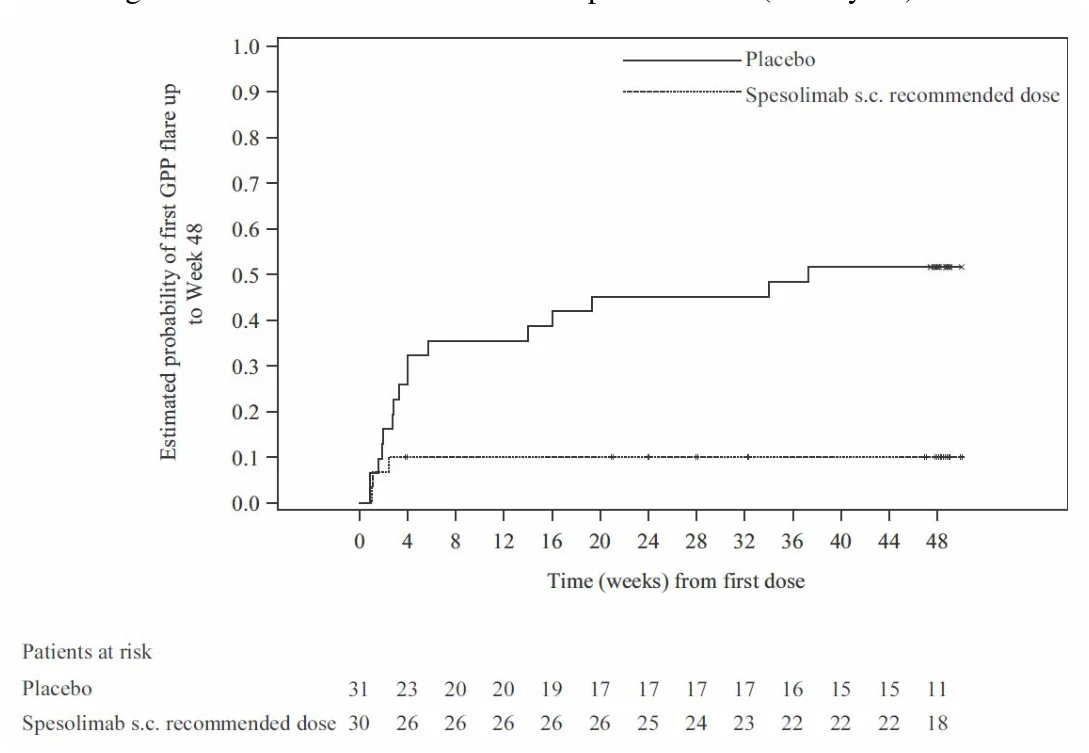
For both primary and key secondary endpoint, treatment effect was observed for all patients regardless of the IL36RN mutation status.
One adolescent patient in the placebo arm received investigator-prescribed standard of care to treat GPP worsening and was considered to have a GPP flare. No adolescent patient in the recommended spesolimab dose arm experienced a GPP flare.
The prevention of GPP worsening in terms of PSS, and DLQI was also observed, as shown by the hazard ratios for PSS 0.42 (95% CI 0.20, 0.91) and for DLQI 0.26 (95% CI 0.11, 0.62).
Immunogenicity
In patients with GPP treated with intravenous spesolimab in Effisayil 1, 46% of patients developed ADAs. A majority of ADA-positive subjects also developed neutralising antibodies. In Effisayil 2, following multiple subcutaneous doses of spesolimab, 41% of the patients developed ADAs. A majority of ADA-positive subjects also developed neutralising antibodies. Clearance of spesolimab increased along with increasing ADA titers. As the majority of patients did not experience a subsequent new flare in Effisayil 1, the data on re-treatment of patients with ADA (n = 4) is limited. It is currently unknown if there is a correlation between the presence of ADA to spesolimab and maintenance of efficacy for flare treatment. After subcutaneous administration of spesolimab in Effisayil 2, there was no apparent impact of ADA presence on efficacy or safety.
Paediatric population
The MHRA has waived the obligation to submit the results of studies with Spevigo in the paediatric population younger than 12 years of age in the treatment of generalised pustular psoriasis (see section 4.2 for information on paediatric use).
5.2 Pharmacokinetic properties
A population pharmacokinetic model was developed based on data collected from healthy subjects, patients with GPP and patients with other diseases. After a single intravenous dose of 900 mg, the population PK model-estimated AUC0-∞ (95% CI) and Cmax (95% CI) in a typical ADA-negative patient with GPP were 4 750 (4 510, 4 970) µg·day/mL and 238 (218, 256) µg/mL, respectively. After a 600 mg subcutaneous loading dose of spesolimab followed by 300 mg spesolimab subcutaneously every 4 weeks, the mean (CV%) steady-state trough concentration ranged from 33.4 µg/mL (37.6%) to 42.3 µg/mL (43.0%).
Absorption
Following subcutaneous single dose administration of spesolimab in healthy volunteers, peak plasma concentrations were achieved between 5.5 to 7.0 days after dosing. After subcutaneous administration in the abdomen, absolute bioavailability was slightly higher at higher doses with estimated values of 58%, 65%, and 72% at 150 mg, 300 mg, and 600 mg, respectively. Based on limited data, absolute bioavailability in the thigh was approximately 85% following a subcutaneous dose of 300 mg spesolimab.
Following subcutaneous administration of a single dose of 300 mg spesolimab in the abdomen, either as one 300 mg injection or as two 150 mg injections, bioavailability was similar in both treatments.
Distribution
Based on the population pharmacokinetic analysis, the typical volume of distribution at steady state was 6.4 L.
Biotransformation
The metabolic pathway of spesolimab has not been characterised. As a humanised IgG1 monoclonal antibody, spesolimab is expected to be degraded into small peptides and amino acids via catabolic pathways in a manner similar to endogenous IgG.
Elimination
In the linear dose range (0.3 to 20 mg/kg), based on the population PK model, spesolimab clearance (95% CI) in a typical ADA-negative patient with GPP, weighing 70 kg was 0.184 L/day. The terminal-half-life was 25.5 days.
Linearity/non-linearity
When administered intravenously, spesolimab exhibited linear pharmacokinetics with dose-proportional increase in exposure across single dose ranges of 0.3 to 20 mg/kg. Both clearance (CL) and terminal half-life were independent of dose. Following subcutaneous single dose administration, spesolimab exposure increased slightly more than dose-proportionally across the dose range of 150 mg to 600 mg due to slightly increased bioavailability at higher doses.
Body weight
Spesolimab concentrations were lower in subjects with higher body weight and higher in subjects with lower body weight. Spesolimab has not been studied in patients with GPP weighing more than 164 kg.
Based on pharmacokinetic modelling and simulation, the recommended dose for adolescents from 12 years of age weighing ≥ 30 and < 40 kg is half the recommended dose than for adults and adolescents from 12 years of age and weighing at least 40 kg (see section 4.2).
The exposure in patients weighing ≥ 30 and < 40 kg receiving the reduced dosing regimen is expected to be comparable with those observed in GPP studies.
Elderly / gender / race
Based on population pharmacokinetic analyses, age, gender and race do not have a clinically relevant effect on the pharmacokinetics of spesolimab.
Hepatic and renal impairment
As a monoclonal antibody, spesolimab is not expected to undergo hepatic or renal elimination. No formal trial of the effect of hepatic or renal impairment on the pharmacokinetics of spesolimab was conducted.
Population PK analysis did not identify mild hepatic impairment or mild or moderate renal impairment as having an influence on the systemic exposure of spesolimab.
Paediatric population
The pharmacokinetics of spesolimab in paediatric patients below the age of 14 years have not been studied.
The plasma pharmacokinetics of spesolimab observed in adolescents were consistent with that observed in adults.
5.3 Preclinical safety data
Non-clinical data reveal no special hazard for humans based on repeated dose toxicity studies.
Developmental and reproductive toxicity
Non-clinical studies conducted in mice using a surrogate antibody directed towards murine IL36R do not indicate direct or indirect harmful effects with respect to pregnancy, embryonic/foetal development or fertility.
Genotoxicity
Genotoxicity studies have not been conducted with spesolimab.
Carcinogenicity
Carcinogenicity and mutagenicity studies have not been conducted with spesolimab.
6 PHARMACEUTICAL PARTICULARS
6.1 List of excipients
Sodium acetate trihydrate (E262)
Glacial acetic acid (E260) (for pH adjustment)
Sucrose
Arginine hydrochloride
Polysorbate 20 (E432)
Water for injections
6.2 Incompatibilities
In the absence of compatibility studies, this medicinal product must not be mixed with other medicinal products.
6.3 Shelf life
2 years
6.4 Special precautions for storage
Store in a refrigerator (2 °C – 8 °C).
Do not freeze. Do not use the Spevigo pre-filled syringe if it has been frozen, even if it has been thawed.
Store in the original package in order to protect from light. Prior to use, the 300 mg pre-filled syringe may be kept at temperatures up to 30 °C for up to 14 days, if stored in the original package in order to protect from light. The 300 mg pre-filled syringe must be discarded if it has been kept at temperatures up to 30 °C for more than 14 days.
6.5 Nature and contents of container
Pre-filled glass syringe assembled with an automatic needle guard, extended finger flange, plunger rod, and plunger stopper (coated butyl rubber, siliconised).
Pack size of 1 pre-filled syringe.
6.6 Special precautions for disposal
The pre-filled syringes should be taken out of the refrigerator and removed from the carton 15 to 30 minutes before injecting to allow to reach room temperature (up to 25 °C). Do not place the pre-filled syringes in direct sunlight.
General special precautions
Prior to use, a visual inspection of each pre-filled syringe is recommended. The solution should be clear to slightly opalescent, colourless to slightly brownish-yellow. The solution may contain a few translucent to white product-related particles. Spevigo should not be used if the solution is cloudy or discoloured, or contains large or coloured particles.
Do not use if the pre-filled syringes have been dropped or look damaged. Do not remove the cap until you are ready to inject.
Each pre-filled syringe is for single use only.
Any unused medicinal product or waste material should be disposed of in accordance with local requirements.
7 MARKETING AUTHORISATION HOLDER
LEO Pharma A/S
Industriparken 55
DK-2750 Ballerup
Denmark
8 MARKETING AUTHORISATION NUMBER(S)
PL 05293/0195
9 DATE OF FIRST AUTHORISATION/RENEWAL OF THE
AUTHORISATION
24/12/2025
10 DATE OF REVISION OF THE TEXT
30/03/2026