

Patient leaflet - Softacort 3.35 mg / ml eye drops solution in single-dose Container
1. What Softacort is and what it is used for
This medicine is an eye drops solution in single-dose containers,
which contains a substance called hydrocortisone. This substance is a corticosteroid which reduces inflammatory symptoms.
It is used to treat mild allergic or inflammation conditions that affect the clear lining that covers the whites of your eye(s) and the insides of your eyelids (your conjunctiva).
The eye should not be infected (see Do not use Softacort).
2. What you need to know before you use Softacort
Do not use Softacort:
- If you are allergic to the active substance (hydrocortisone) or any of the other ingredients of this medicine (listed in section 6).
- If you have high pressure inside the eye (ocular hypertension), known to be due to glucosteroids (family of corticosteroid medicines) or to other causes.
- If you have an eye infection caused by viruses (acute herpes or most other viruses while there are ulcers, unless the infection is being treated with an anti-infective treatment for herpes virus).
- If you have conjunctivitis with inflammation and ulcers on the clear cornea surface of the eye (keratitis) even if it is at an early stage.
- If you have an eye infection caused by bacteria (acute purulent infection, conjunctivitis, blepharitis, stye).
- If you have an eye infection caused by fungus (ocular mycosis).
- If you have a bacterial infection called tuberculosis which affects your eye (ocular tuberculosis).
Warnings and precautions
- Talk to your doctor, pharmacist or nurse before using this medicine.
- If you have a red eye that has not been diagnosed, do not use this medicine.
- If you have a viral eye infection (herpes), only use this medicine if the infection is being treated with an anti-infective treatment and close monitoring of your eyes is required.
- If you have a disease that causes thinning of the outer part of your eye (cornea and sclera), there can be a higher risk of perforation when topical corticosteroids are applied to the eye.
- If you have used or have been using a corticosteroid medicine for a long time and have an eye wound (corneal ulcer), a fungal infection may be suspected.
Close regular monitoring of your eyes is required during your treatment. Prolonged use of corticosteroids has shown to cause an increase of the pressure inside the eye and the start of glaucoma, especially in patients who already suffer from high pressure inside the eye, or if you are known to be at risk of developing this condition with local steroid treatment (see Possible side effects), and to cause a clouding of the lens in the eye (cataract), in particular in children and older people.
- The use of corticosteroids can cause eye infections that may not normally happen (opportunistic eye infections). In addition, corticosteroids given to the eye may increase, make worse or hide signs and symptoms of these eye infections.
- You should avoid wearing contact lenses during treament with this medicine.
- Contact your doctor if you experience blurred vision or other visual disturbances.
Children
There are no data on safety and effectiveness in children.
Continuous long-term treatment with corticosteroids in children may produce adrenal suppression.
The increase of the eye pressure in children occurs more frequently, more severely, and more quickly than in adults.
Other medicines and Softacort
Please tell your doctor or pharmacist if you are using, have recently used or might use any other medicines including medicines you have without a prescription. Some medicines may increase the effects of Softacort and your doctor may wish to monitor you carefully if you are taking theses medicines (including some medicines for HIV such as ritonavir or cobicistat).
Pregnancy and breast-feeding
If you are pregnant or breast-feeding, think you may be pregnant or are planning to have a baby, ask your doctor or pharmacist for advice before taking this medicine.
- The use of this medicine during pregnancy is not recommended except when judged necessary by your doctor and under strict supervision.
- It is not known whether this medicine passes into breast milk. Your doctor will decide if you can use this medicine during breast-feeding or not.
Driving and using machines
Temporary blurred vision or other sight problems may affect the ability to drive or use machines. Do not drive or use machines until normal vision has returned.
Softacort contains phosphates
This medicine contains 0.227mg phosphates in each drop.
3. How to use Softacort
- 3.
Dose
Always use this medicine exactly as your doctor or pharmacist has told you. Check with your doctor or pharmacist if you are not sure.
The recommended dose is 2 drops in the affected eye(s), 2 to 4 times a day, depending on the prescription. Gradually reducing the dose is recommended in order to avoid relapse. The duration of treatment usually varies from a few days to a maximum of 14 days.
The same dose is used for both adults and the elderly.
Use in children
The effectiveness and the safety in children have not been established for this medicine.
How to use the drops
This medicine is to be used in the eye.
Please follow these instructions to use the drops:
- 1. Wash your hands and sit or stand comfortably.
- 2.
Open the sachet containing 10 single-dose containers. Write down the date of first opening on the sachet.
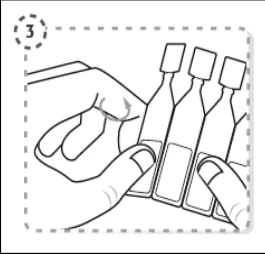
- 3. Break off one single-dose container from the strip.
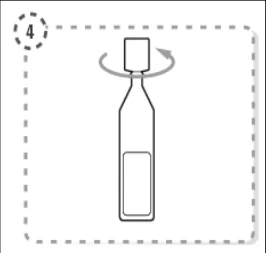
- 4. Twist open the top of the single-dose container as shown. Do not touch the tip after opening the container.
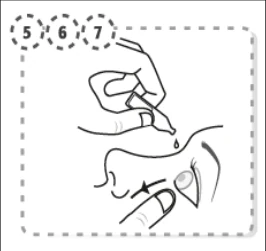
- 5. Use your finger to gently pull down the lower eyelid of your affected eye.
- 6. Place the tip of the single-dose container close to, but not touching your eye.
- 7. Squeeze the single-dose container gently so that two drops go into your eye, then release the lower eyelid.
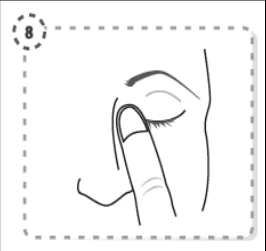
- 8. Press a finger against the corner of the affected eye by the nose. Hold for 1 minute while keeping the eye closed.
- 9. Repeat in your other eye if your doctor has told you to do this. Each single-dose container contains enough solution for both eyes.
- 10. Discard the single-dose container after use. Do not keep it to use it again.
- 11. Put the unopened single-dose containers back in the sachet. Put the opened sachet in the carton. The unopened containers must be used within one month after opening the sachet.
If you are using any other eye medicine, you should wait 5 minutes between using each medicine.
If you use more Softacort than you should
Rinse the eye with sterile water if you have used too much medicine in your eye and have irritation that lasts a long time.
Immediately tell your doctor or pharmacist.
If you forget to use Softacort
Do not take a double dose to make up for a forgotten dose.
If you stop using Softacort
Do not suddenly stop using the medicine. Always tell your doctor if you are thinking about stopping the treatment.
If you have any more questions on the use of this medicine, ask your doctor, pharmacist or nurse.
4. Possible side effects
Like all medicines, this medicine can cause side effects, although not everybody gets them.
Not known: frequency cannot be estimated from the available data
- transient (short-lived) eye discomfort (burning, stinging) after use.
The following side effects were reported with medicines of the
same group (corticosteroids) when used for treating eye conditions.
Not known: frequency cannot be estimated from the available data
- allergic reactions (red, itchy eyes),
- delayed wound healing,
- clouding of the lens in the eye (posterior capsular cataract),
- eye infections that may not normally happen (opportunistic viral infections like herpes, fungal infection),
- increase of pressure in your eye (glaucoma),
- dilation of the pupil (mydriasis),
- drooping eyelids (ptosis),
- inflammation inside your eye (uveitis),
- changes in the thickness of the front of the eye (cornea),
- inflammation of the cornea (crystalline keratopathy),
- blurred vision.
If you suffer from severe damage to the clear layer at the front of the eye (the cornea), phosphates may cause in very rare cases cloudy patches on the cornea due to calcium build-up during treatment.
Reporting of side effects
If you get any side effects, talk to your doctor, pharmacist or nurse. This includes any possible side effects not listed in this leaflet. You can also report side effects directly via the Yellow Card Scheme at: www.mhra.gov.uk/yellowcard or search for MHRA Yellow Card in the Google Play or Apple App Store.
By reporting side effects, you can help provide more information on the safety of this medicine.
5. How to store Softacort
Keep out of the sight and reach of children.
Do not store above 25°C.
After first opening of the sachet: use the single-dose containers within one month.
Keep the single-dose containers in the sachet to protect them from light. Write down the date of first opening on the sachet.
After first opening of the single-dose container: use immediately and throw away the single-dose container after use.
After the individual single-dose container is opened, the solution inside cannot stay sterile, so you must throw away any solution remaining in the container after each use.
Do not use the drops after the expiry date which is stated on the carton, sachet labels and single-dose containers after 'Exp'. The expiry date refers to the last day of that month.
If the drops become discoloured or shows any signs of deterioration, seek the advice of your pharmacist.
Remember if your doctor tells you to stop taking this medicine, return any unused medicine to your pharmacist for safe disposal. Only keep this medicine if your doctor tells you to.
Medicines should not be disposed of via wastewater or household waste. Ask your pharmacist how to dispose of medicines no longer required. These measures will help to protect the environment.
6. Contents of the pack and other information
What Softacort contains
The active ingredient in the Softacort is hydrocortisone sodium phosphate.
Each ml of eye drops solution contains 3.35mg of hydrocortisone sodium phosphate. One drop contains approximately 0.12mg of hydrocortisone sodium phosphate.
The other ingredients are disodium phosphate dodecahydrate, sodium dihydrogen phosphate monohydrate, sodium chloride, disodium edetate, hydrochloric acid (for pH adjustment), water for injections.
What Softacort looks like and contents of the pack
This medicine is an eye drops solution in single-dose containers. The solution is practically clear, colourless to slightly yellow, practically free from particles, packed in a sachet of 10 units, with each single-dose container containing 0.4ml of product.
It is available in pack size of 30 (3 x 10) single-dose containers.
Manufactured by: LABORATOIRES UNITHER,1 rue de I’Arquerie, 50200 Countances, France.
OR
LABORATOIRES UNITHER, ZI de la Guerie, 50 211 COUTANCES CEDEX, France.
Procured from within the EU and repackaged by the Product Licence holder: B&S Healthcare, Unit 4, Bradfield Road, Ruislip, Middlesex, HA4 0NU, UK.
Softacort® 3.35mg/ml eye drops, solution in single-dose container; PL 18799/4169
POM
Leaflet date: 28.11.2025
For any information about this medicine, please contact the Product Licence Holder: B&S Healthcare, Unit 4, Bradfield Road, Ruislip, Middlesex, HA4 0NU, UK.
Tel: 0800 049 9401
Email: regulatorygroup@bnshealthcare.com
Softacort is the registered trademark of Laboratoires Thea.
Blind or partially sighted?
Is this leaflet hard to see or read?
Call 0208 515 3763 to obtain the leaflet in a format suitable for you.