


Summary of Product Characteristics (SmPC) - SODIUM PERTECHNETATE (99MTC) CURIUMNETHERLANDS 2.15-43.00 GBQ RADIONUCLIDE GENERATOR
1 NAME OF THE MEDICINAL PRODUCT
Sodium pertechnetate (99mTc) CuriumNetherlands, 2.15-43.00 GBq, radionuclide generator
2 QUALITATIVE AND QUANTITATIVE COMPOSITION
Sodium pertechnetate (99mTc) injection is produced by means of a (99Mo/99mTc) generator. Technetium (99mTc) decays with the emission of gamma radiation with a mean energy of 140 keV and a half-life of 6.01 hours to technetium (99Tc) which, in view of its long half-life of 2.13 x 10⁵ years can be regarded as quasi stable.
The radionuclide generator containing the parent isotope 99Mo, adsorbed on a chromatographic column delivers sodium pertechnetate (99mTc) injection in sterile solution.
The 99Mo on the column is in equilibrium with the formed daughter isotope 99mTc. The generators are supplied with the following 99Mo activity amounts at activity reference time which deliver the following technetium (99mTc) amounts, assuming a 100% theoretical elution yield and 24 hours time from previous elution and taking into account that branching ratio of 99Mo is about 87%:
Excipient(s) with known effect
Each mL of sodium pertechnetate (99mTc) solution contains 3.5 mg of sodium.
For a full list of excipients, see section 6.1.
99mTc activity (maximum theoretical elutable activity at ART, 06.00 h CET) | 1.90 | 3.81 | 5.71 | 7.62 | 9.53 | 11.43 | 15.24 | 19.05 | 22.86 | 26.67 | 30.48 | 38.10 | GBq |
| 99Mo activity (at ART, 06.00 h CET) | 2.15 | 4.30 | 6.45 | 8.60 | 10.75 | 12.90 | 17.20 | 21.50 | 25.80 | 30.10 | 34.40 | 43.00 | GBq |
3 PHARMACEUTICAL FORM
Radionuclide generator.
4 CLINICAL PARTICULARS
4.1 Therapeutic indications
This medicinal product is for diagnostic use only.
The eluate from the radionuclide generator (sodium pertechnetate (99m Tc) Injection is indicated for:
- labelling of various kits for radiopharmaceutical preparation developed and approved for radiolabelling with such solution
- Thyroid scintigraphy: direct imaging and measurement of thyroid uptake to give information on the size, position, nodularity and function of the gland in thyroid disease
Salivary gland scintigraphy: diagnosis of chronic sialadenitis (e.g.
(Sjögren's Syndrom) as well as assessment of salivary gland function and duct patency in salivary glands disorders and monitoring of the response to therapeutic interventions (in particular radio iodine therapy)
- Location of ectopic gastric mucosa (Meckel's diverticulum)
- Lacrimal duct scintigraphy: to assess functional disorders of lacrimation and monitoring of the response to therapeutic interventions
4.2 Posology and method of administration
Posology
If sodium pertechnetate (99m Tc) is administered intravenously, activities may vary widely according to the clinical information required and the equipment employed. The injection of activities greater than local DRLs (Diagnostic Reference Levels) should be justified for certain indications. Recommended activities are as follows:
Adults (70kg) and the elderly population:
- Thyroid scintigraphy: 20-80 MBq
Salivary gland scintigraphy: 30 to 150 MBq for static images up to 370
MBq for dynamic images
- Meckel's diverticulum scintigraphy: 300 - 400 MBq
- Lacrimal duct scintigraphy: 2-4 MBq per drop per eye
Renal impairment
Careful consideration of the activity to be administered is required since an increased radiation exposure is possible in these patients.
Paediatric population
The use in children and adolescents has to be considered carefully, based upon clinical needs and assessing the risk/benefit ratio in this patient group. The activity to be administered to children and adolescents must be adapted and may be calculated according to the recommendations of the European Association of Nuclear Medicine (EANM) paediatric dosage card; the activity administered to children and to adolescents may be calculated by multiplying a baseline activity (for calculation purposes) by the weight-dependent correction factor given in the table below (see Table 1).
A[MBq]Administered = Baseline Activity × Multiple
Thyroid scintigraphy: Activity administered [MBq] = 5.6 MBq x correction factor (Table 1). A minimal activity of 10 MBq is necessary for obtaining images of sufficient quality.
Identification/location of ectopic gastric mucosa: Activity administered [MBq] = 10.5 MBq x correction factor (Table 1). A minimal activity of 20 MBq is necessary in order to obtain images of sufficient quality.
Table 1: Weight-dependent correction factors in the paediatric population (for thyroid scintigraphy and identification/location of ectopic gastric mucosa) according to the EANM- 2014 guidelines
| Weight (Kg) | Factor | Weight (Kg) | Factor | Weight (Kg) | Factor |
| 3 | 1 | 22 | 5.29 | 42 | 9.14 |
| 4 | 1.14 | 24 | 5.71 | 44 | 9.57 |
| 6 | 1.71 | 26 | 6.14 | 46 | 10.00 |
| 8 | 2.14 | 24 | 6.43 | 48 | 10.29 |
| 10 | 2.71 | 30 | 6.86 | 50 | 10.71 |
| 12 | 3.14 | 32 | 7.29 | 52-54 | 11.29 |
| 14 | 3.57 | 34 | 7.72 | 56-58 | 12.00 |
| 16 | 4.00 | 36 | 8.00 | 60-62 | 12.71 |
| 18 | 4.43 | 38 | 8.43 | 64-66 | 13.43 |
| 20 | 4.86 | 40 | 8.86 | 68 | 14.00 |
Salivary gland scintigraphy: The Paediatric Task Group of EANM (1990) recommends that the activity to be administered to a child should be calculated from the body weight according to the table below (see Table 2) with a minimum dose of 10 MBq in order to obtain images of sufficient quality.
Table 2: Weight-dependent correction factor in the paediatric population (for salivary gland
scintigraphy) according to EANM 1990 recommendations
| Weight (Kg) | Factor | Weight (Kg) | Factor | Weight (Kg) | Factor |
| 3 | 0.1 | 22 | 0.50 | 42 | 0.78 |
| 4 | 0.14 | 24 | 0.53 | 44 | 0.80 |
| 6 | 0.19 | 26 | 0.56 | 46 | 0.82 |
| 8 | 0.23 | 24 | 0.58 | 48 | 0.85 |
| 10 | 0.27 | 30 | 0.62 | 50 | 0.88 |
| 12 | 0.32 | 32 | 0.65 | 52-54 | 0.90 |
| 14 | 0.36 | 34 | 0.68 | 56-58 | 0.92 |
| 16 | 0.40 | 36 | 0.71 | 60-62 | 0.96 |
| 18 | 0.44 | 38 | 0.73 | 64-66 | 0.98 |
| 20 | 0.46 | 40 | 0.76 | 68 | 0.99 |
Lacrimal duct scintigraphy: Recommended activities apply as well for adults as for children.
Method of administration
For intravenous or ocular use.
For multidose use.
For instructions on extemporaneous preparation of the medicinal product before administration, see
For patient preparation, see section 4.4.
In thyroid scintigraphy, salivary gland scintigraphy and identification/location of ectopic gastric
mucosa, the sodium pertechnetate (99mTc) solution is administered by intravenous injection.
In lacrimal duct scintigraphy, drops are instilled in each eye (ocular use).
Image acquisition
Thyroid scintigraphy: 20 minutes after intravenous injection. Salivary gland scintigraphy: immediately after intravenous injection and at regular intervals for
15 minutes.
Identification/location of ectopic gastric mucosa (Meckel Diverticulum): immediately after intravenous injection and at regular intervals for 30 minutes.
Lacrimal duct scintigraphy: dynamic acquisition within 2 minutes after instillation, followed by static images acquired at regular intervals within 20 minutes.
4.3 Contraindications
Hypersensitivity to the active substance or any of the excipients listed in section 6.1.
4.4 Special warnings and precautions for use
Potential for hypersensitivity or anaphylactic reactions
If hypersensitivity or anaphylactic reactions occur, the administration of the medicinal product must be discontinued immediately and intravenous treatment initiated, if necessary. To enable immediate
action in emergencies, the necessary medicinal products and equipment such as endotracheal tube and ventilator must be immediately available.
Individual benefit/risk justification
For each patient, the radiation exposure must be justifiable by the likely benefit. The activity
administered should in every case be as low as reasonably achievable to obtain the required diagnostic information.
Renal impairment
Careful consideration of the benefit risk ratio in these patients is required since an increased radiation exposure is possible.
Paediatric population
For information on the use in paediatric population, see section 4.2. Careful consideration of the indication is required since the effective dose per MBq is higher than in adults (see section 11).
Thyroid blocking is of special importance in the paediatric patient population except for thyroid scintigraphy.
Patient preparation
Pre-treatment of patients with thyroid-blocking medicinal products may be necessary for certain indications.
The patient should be well hydrated before the start of the examination and urged to void as often as possible during the first hours after the examination in order to reduce radiation.
To avoid false positives or to minimise irradiation by reduction of pertechnetate accumulation in the thyroid and salivary glands, a thryroid blocking agent should be given prior to lacrimal duct scintigraphy or Meckel’s diverticulum scintigraphy. Conversely a thyroid blocking agent must NOT be used before thyroid, parathyroid or salivary glands scintigraphy. Before the application of sodium (99mTc)pertechnetate solution for scintigraphy of Meckel’s diverticulum the patient must keep an empty stomach for 3 to 4 hours to reduce intestinal peristalsis.
After in vivo labelling of erythrocytes using stannous ions for reduction sodium pertechnetate (99mTc) is primarily built into erythrocytes, therefore Meckel’s scintigraphy should be performed before or some days after in vivo labelling of erythrocytes.
After the procedure
Close contact with infants and pregnant women should be restricted during 12 hours.
Specific warnings
Sodium pertechnetate (99mTc) solution for injection contains 3.5 mg/mL of sodium.
Depending on the time when the injection is administered, the content of sodium given to the patient may in some cases be greater than 1 mmol (23 mg). This should be taken into account in patient on low sodium diet. When sodium pertechnetate (99mTc) solution is used for labelling of a kit, the determination of the overall sodium content must take into account the sodium derived from the eluate and the kit. Please refer to the package leaflet of the kit.
In salivary gland scintigraphy a lower specificity of the method should be expected compared to magnetic resonance sialography.
For precautions with respect to environmental hazard, see section 6.6.
4.5 Interaction with other medicinal products and other forms of interaction
Atropine, isoprenaline and analgesics may cause a delay of gastric emptying and thereby cause a redistribution of (99mTc) pertechnetate in abdominal imaging.
Administration of laxatives should be withheld since they irritate the gastrointestinal tract. Contrast-enhanced studies (e.g. barium) and upper gastro-intestinal examination should be avoided within 48h prior to administration of pertechnetate (99mTc) for Meckel’s diverticulum scintigraphy.
Many pharmacological medicinal products are known to modify the thyroid uptake.
- antithyroid medicinal products (e.g. carbimazole or other imidazole derivatives such as propylthiouracil), salicylates, steroids, sodium nitroprusside, sodium sulfobromophtalein, perchlorate should be withheld for 1 week prior thyroid scintigraphy ;
- phenylbutazone and expectorants should be withheld for 2 weeks ;
- natural or synthetic thyroid preparations (e.g. sodium thyroxine, sodium liothyronine, thyroid extract) should be withheld for 2-3 weeks
- amiodarone, benzodiazepines, lithium should be withheld for 4 weeks
- intravenous contrast agents should not have been administered within 1-2 months.
4.6 Fertility, pregnancy and lactation
Woman of childbearing potential
When an administration of radiopharmaceutical to a woman of childbearing potential is intended, it is important to determine whether or not she is pregnant. Any woman who has missed a period should be assumed to be pregnant until proven otherwise. If in doubt about her potential pregnancy ((if the woman has missed a period, if the period is very irregular, etc.), alternative techniques not using ionising radiation (if there are any) should be offered to the patient.
Pregnancy
Administration of pertechnetate (99mTc) to a mother who is known to be pregnant should be justified by medical need and a positive individual benefit risk assessment for the mother and the foetus.
Alternative non-irradiating diagnostic modalities should be taken into account. 99mTc (as free pertechnetate) has been shown to cross the placental barrier.
Breast-feeding
Before administering a radiopharmaceuticals to a woman who is breast-feeding, consideration should be given of delaying the administration of radionuclide until the mother has ceased breast-feeding and as to what is the most appropriate choice of radiopharmaceuticals, bearing in mind the secretion of activity in breast milk. If the administration is considered necessary, breast-feeding should be interrupted for 12 hours post administration and the expressed feeds discarded.
Close contact with infants should be restricted during this period.
4.7 Effects on ability to drive and use machines
Sodium pertechnetate (99mTc) solution has no influence on the ability to drive and use machines.
4.8 Undesirable effects
Summary of the safety profile
Information on adverse reactions is available from spontaneous reporting. The reported reaction types are anaphylactoid reactions, vegetative reactions, as well as different kinds of injection site reactions. Sodium pertechnetate (99mTc) from the Sodium pertechnetate (99mTc) CuriumNetherlands radionuclide generator is used for radioactive labeling of a variety of compounds. These medicinal products generally have a higher potential for adverse reactions than 99m Tc, and therefore the reported adverse reactions are rather related to the labelled compounds than to 99m Tc. The possible types of adverse reactions following intravenous administration of a 99m Tc-labelled pharmaceutical preparation will be dependent on the specific compound being used. Such information can be found in the SmPC of the kits used for radiopharmaceutical preparation.
Tabulated list of adverse reactions
The frequency of undesirable effects is defined as follows:
Not known (cannot be estimated from the available data).
Immune system disorders
Frequency not known*: Anaphylactoid reactions (e.g. dyspnoea, coma, urticaria, erythema, rash, pruritus, oedema at various location e.g. face oedema)
Nervous system disorders
Frequency not known *: Vasovagal reactions (e.g. syncope, tachycardia, bradycardia, dizziness, headache, vision blurred, flushing)
Gastrointestinal disorders
Frequency not known *: Vomiting, nausea, diarrhoea
General disorders and administration site conditions
Frequency not known *: Injection site reactions (e.g. Cellulitis, pain, erythema, swelling)
* Adverse reactions derived from spontaneous reporting
Exposure to ionising radiation is linked with cancer induction and a potential for development of hereditary defects. As the effective dose is 5.2 mSv when the maximal recommended activity of 400 MBq is administered these adverse reactions are expected to occur with a low probability.
Description of selected adverse reactions
Anaphylactoid reactions (e.g. dyspnoea, coma, urticaria, erythema, rash, pruritus, oedema at various locations [e.g. face oedema])
Anaphylactoid reactions have been reported following intravenous injection of sodium perchtechnetate (99mTc) and include various skin or respiratory symptoms like skin irritations, oedema, or dyspnoea.
Vegetative reactions (nervous system and gastrointestinal disorders) Single cases of severe vegetative reactions have been reported, however, most of the reported vegetative reactions include gastrointestinal reactions like nausea or vomiting. Other reports include vasovagal reactions like headache or dizziness. Vegetative reactions are rather considered to be related to the examinational setting than to technetium (99mTc), especially in anxious patients.
General disorders and administration site conditions
Other reports describe local injection site reactions. Such reactions are related to extravasation of the radioactive material during the injection, and the reported reactions rank from local swelling up to cellulitis. Depending on the administered radioactivity and the labeled compound, extended extravasation may necessitate surgical treatment.
Reporting of suspected adverse reactions
Reporting suspected adverse reactions after authorisation of the medicinal product is important. It allows continued monitoring of the benefit/risk balance of the medicinal product. Healthcare professionals are asked to report any suspected adverse reactions via the Yellow Card Scheme
Website: www.mhra.gov.uk/yellowcard
4.9 Overdose
In the event of the administration of a radiation overdose with sodium pertechnetate (99mTc), the absorbed dose should be reduced where possible by increasing the elimination of the radionuclide from the body by defaecation, forced diuresis and frequent bladder voiding. The uptake in the thyroid, salivary glands and the gastric mucosa can be significantly reduced when sodium or potassium perchlorate is given immediately after an accidentally high dose of sodium pertechnetate (99mTc) was administered.
5 PHARMACOLOGICAL PROPERTIES
5.1 Pharmacodynamic properties
Pharmacotherapeutic group: Diagnostic radiopharmaceuticals, various thyroid diagnostic radiopharmaceuticals ATC code: V09F X01
No pharmacological activity has been observed in the range of doses administered for diagnostic purposes.
5.2 Pharmacokinetic properties
Distribution
The pertechnetate ion has similar biological distribution to iodide and perchlorate ions, concentrating temporarily in salivary glands, choroid plexus, stomach (gastric mucosa) and in the thyroid gland, from which it is released unchanged. The pertechnetate ion also tends to concentrate in areas with increased vascularisation or with abnormal vascular permeability, particularly when pre-treatment with blocking agents inhibits uptake in glandular structures. With intact blood brain barrier, sodium pertechnetate (99mTc) does not penetrate into the brain tissue.
Organ uptake
In the blood 70-80% of the intravenously injected sodium pertechnetate (99mTc) is bound to proteins, primarily in an unspecific way to albumin. The unbound fraction (20-30%) accumulates temporarily in thyroid and salivary glands, stomach and nasal mucous membranes as well as in the plexus chorioideus.
Sodium pertechnetate (99mTc) in contrast to iodine, nevertheless, is neither used for the thyroid
hormone synthesis (organification), nor absorbed in the small intestine. In the thyroid the maximum accumulation, depending on functional status and iodine saturation (in euthyroidism approx. 0.3-3%, in hyperthyroidism and iodine depletion up to 25%) is reached about 20 min after injection and then decreases quickly. This also applies for the stomach mucous membrane parietal cells and the salivary glands acinar cells.
In contrast to the thyroid which releases sodium pertechnetate (99mTc) in the bloodstream the salivary glands and the stomach secrete sodium pertechnetate (99mTc) in the saliva and gastric juice, respectively. The accumulation by the salivary gland lies in the magnitude of 0.5% of the applied activity with the maximum reached after about 20 minutes. One hour after injection, the concentration in the saliva is about 10-30 fold higher than in the plasma. The excretion can be accelerated by lemon juice or by stimulation of the parasympathetic nerve system, the absorption is reduced by perchlorate.
Elimination
Half life in plasma is approximately 3 hours. Sodium pertechnetate (99mTc) is not metabolised in the organism. One fraction is eliminated very quickly renally, the rest more slowly via faeces, salivary and tear liquid. Excretion during the first 24 hours following administration is mainly urinary (approximately 25%) with faecal excretion occurring over the next 48 hours. Approximately 50% of the administered activity is excreted within the first 50 hours. When selective uptake of pertechnetate (99mTc) in glandular structures is inhibited by the preadministration of blocking agents, excretion follows the same pathways but there is a higher renal clearance.
The above data are not valid when sodium pertechnetate (99mTc) is used for labelling of another radiopharmaceutical.
5.3 Preclinical safety data
There is no information on acute, subacute and chronic toxicity from single or repeated dose administration. The quantity of sodium pertechnetate (99mTc) administered during clinical diagnostic procedures is very small and apart from allergic reactions, no other adverse reactions have been reported.
This medicinal product is not intended for regular or continous administration. Mutagenicity studies and long-term carcinogenicity studies have not been carried out.
Reproductive toxicity
Placental transfer of 99mTc from intravenously administered sodium pertechnetate (99mTc) has been studied in mice. The pregnant uterus was found to contain as much as 60% of the injected 99mTc when administered without perchlorate pre-administration. Studies performed on pregnant mice during gestation, gestation and lactation, and lactation alone showed changes in progeny which included weight reduction, hairlessness and sterility.
6 PHARMACEUTICAL PARTICULARS
6.1 List of excipients
•Sodium chloride
•Water for injections
6.2 Incompatibilities
This medicinal product must not be mixed with other medicinal products except for those mentioned in section 12.
6.3 Shelf life
Generator: 21 days from the start of manufacturing and 9 days after activity reference time (ART).
The calibration date and the expiry date are stated on the label. Sodium pertechnetate (99mTc) Eluate: after elution, use within 8 hours. The eluate does not require any special storage conditions.
TechneVials for elution vials (Techne vials): 3 years
Eluent vial: 3 years
6.4 Special precautions for storage
Generator do not store above 25°C.
Eluate: for storage conditions after elution of the medicinal product, see section 6.3.
Generators must be kept in an Ultra-TechneKow Safe (with sufficient lead protection) or behind an adequate laboratory shield. Storage of radiopharmaceuticals should be in accordance with national regulations on radioactive materials
6.5 Nature and contents of container
Generator
The generator consists of a cartridge containing an aluminiumoxide column charged with 99Mo and locked between two filters. One side of the cartridge is connected to the shielded, sterile supply needle in the eluent holder. The other side is connected to the similarly shielded, sterile outlet needle in the elution station. A second sterile needle in the eluent holder serves to eliminate the underpressure in the eluent vial under sterile conditions. The generator column is shielded by sufficient lead, depending on the 99Mo activity. The shielded
generator with the built-in station and the eluent holder are packed in an hermetically sealed tin, which is also the package. Elution occurs by placing the eluent vial on the needles in the eluent holder, followed by complete or partial filling of evacuated vials.
Accessories
The first time a Sodium pertechnetate (99mTc) CuriumNetherlands is supplied, it comes with:
- 1 TechneVial shield or UltraVial Shield
1 Sterile vial shielding, unless supplied with the Ultra-
Technekow Safe.
Each Sodium pertechnetate (99mTc) CuriumNetherlands is supplied with:
- 7 TechneVials, sterile, evacuated vials of 5, 11 or 25 ml
- 1 Sterile vial is provided with the elution set.
- 1 Eluent vial, 100 ml of sterile, physiological salt solution
- 7 Disinfection swabs
- 7 Labels with the radioactivity symbol.
6.6 Special precautions for disposal
General warnings
Radiopharmaceuticals should be received, used and administered only by authorised persons in designated clinical settings. Their receipt, storage, use, transfer and disposal are subject to the regulations and/or appropriate licences of local competent official organisations. Radiopharmaceuticals should be prepared by the user in a manner which satisfies both radiation safety and pharmaceutical quality requirements. Appropriate aseptic precautions should be taken. If at any time the integrity of the generator or the vial with the eluted solution is compromised, it should not be used.
Administration procedures should be carried out in a way to minimise risk of contamination of the medicinal product and irradiation of the operators. Adequate shielding is mandatory.
The administration of radiopharmaceuticals creates risks for other persons from external radiation or contamination from spills of urine, vomiting, etc. Radiation protection precautions in accordance with national regulations must therefore be taken.
The residual activity of the generator must be estimated before disposal.
Any unused medicinal product or waste material should be disposed of in accordance with local requirements.
7 MARKETING AUTHORISATION HOLDER
Curium Netherlands B.V.
Westerduinweg 3
1755 LE Petten
Netherlands
8 MARKETING AUTHORISATION NUMBER
PL 12288/0017
9 DATE OF FIRST AUTHORISATION/RENEWAL OF THE
AUTHORISATION
21/03/2001
10 DATE OF REVISION OF THE TEXT
19/02/2025
11 DOSIMETRY
The data listed below are from ICRP 80 and are calculated according to the following assumptions:
(I) Without pre-treatment with a blocking agent:
| Organ | Absorbed dose per administered unit of activity (mGy/MBq) | ||||
| Adults | 15 years | 10 years | 5 years | 1 year | |
| Adrenal glands | 0.0037 | 0.0047 | 0.0072 | 0.011 | 0.019 |
| Bladder wall | 0.018 | 0.023 | 0.030 | 0.033 | 0.060 |
| Bone surfaces | 0.0054 | 0.0066 | 0.0097 | 0.014 | 0.026 |
| Brain | 0.0020 | 0.0025 | 0.0041 | 0.0066 | 0.012 |
| Breasts | 0.0018 | 0.0023 | 0.0034 | 0.0056 | 0.011 |
| Gallbladder | 0.0074 | 0.0099 | 0.016 | 0.023 | 0.035 |
| Gastrointestinal tract | |||||
| 0.026 | 0.034 | 0.048 | 0.078 | 0.16 |
| 0.016 | 0.020 | 0.031 | 0.047 | 0.082 |
| 0.042 | 0.054 | 0.088 | 0.14 | 0.27 |
| 0.057 | 0.073 | 0.12 | 0.20 | 0.38 |
| 0.021 | 0.028 | 0.045 | 0.072 | 0.13 |
| Heart | 0.0031 | 0.0040 | 0.0061 | 0.0092 | 0.017 |
| Kidneys | 0.0050 | 0.0060 | 0.0087 | 0.013 | 0.021 |
| Liver | 0.0038 | 0.0048 | 0.0081 | 0.013 | 0.022 |
| Lungs | 0.0026 | 0.0034 | 0.0051 | 0.0079 | 0.014 |
| Muscles | 0.0032 | 0.0040 | 0.0060 | 0.0090 | 0.016 |
| Oesophagus | 0.0024 | 0.0032 | 0.0047 | 0.0075 | 0.014 |
| Ovaries | 0.010 | 0.013 | 0.018 | 0.026 | 0.045 |
| Pancreas | 0.0056 | 0.0073 | 0.011 | 0.016 | 0.027 |
| Red bone | |||||
| 0.0036 | 0.0045 | 0.0066 | 0.0090 | 0.015 | |
| marrow | |||||
| Salivary | |||||
| 0.0093 | 0.012 | 0.017 | 0.024 | 0.039 | |
| glands | |||||
| Skin | 0.0018 | 0.0022 | 0.0035 | 0.0056 | 0.010 |
| Spleen | 0.0043 | 0.0054 | 0.0081 | 0.012 | 0.021 |
| Testes | 0.0028 | 0.0037 | 0.0058 | 0.0087 | 0.016 |
| Thymus | 0.0024 | 0.0032 | 0.0047 | 0.0075 | 0.014 |
| Thyroid | 0.022 | 0.036 | 0.055 | 0.12 | 0.22 |
| Uterus | 0.0081 | 0.010 | 0.015 | 0.022 | 0.037 |
| Other tissue | 0.0035 | 0.0043 | 0.0064 | 0.0096 | 0.017 |
Effective dose (mSv/MBq) | 0.013 | 0.017 | 0.026 | 0.042 | 0.079 |
(II) With pre-treatment with a blocking agent:
| Organ | Absorbed dose per administered unit of activity (mGy/MBq) when blocking agents are administered | ||||
| Adults | 15 years | 10 years | 5 years | 1 year | |
| Adrenal glands | 0.0029 | 0.0037 | 0.0056 | 0.0086 | 0.016 |
| Bladder wall | 0.030 | 0.038 | 0.048 | 0.050 | 0.091 |
| Bone surfaces | 0.0044 | 0.0054 | 0.0081 | 0.012 | 0.022 |
| Brain | 0.0020 | 0.0026 | 0.0042 | 0.0071 | 0.012 |
| Breasts | 0.0017 | 0.0022 | 0.0032 | 0.0052 | 0.010 |
| Gallbladder | 0.0030 | 0.0042 | 0.0070 | 0.010 | 0.013 |
| Gastrointestinal tract | |||||
| 0.0027 | 0.0036 | 0.0059 | 0.0086 | 0.015 |
| 0.0035 | 0.0044 | 0.0067 | 0.010 | 0.018 |
| 0.0036 | 0.0048 | 0.0071 | 0.010 | 0.018 |
| 0.0032 | 0.0043 | 0.0064 | 0.010 | 0.017 |
| 0.0042 | 0.0054 | 0.0081 | 0.011 | 0.019 |
| Heart | 0.0027 | 0.0034 | 0.0052 | 0.0081 | 0.014 |
| Kidneys | 0.0044 | 0.0054 | 0.0077 | 0.011 | 0.019 |
| Liver | 0.0026 | 0.0034 | 0.0053 | 0.0082 | 0.015 |
| Lungs | 00023 | 0.0031 | 0.0046 | 0.0074 | 0.013 |
| Muscles | 0.0025 | 0.0031 | 0.0047 | 0.0072 | 0.013 |
| Oesophagus | 0.0024 | 0.0031 | 0.0046 | 0.0075 | 0.014 |
| Ovaries | 0.0043 | 0.0054 | 0.0078 | 0.011 | 0.019 |
| Pancreas | 0.0030 | 0.0039 | 0.0059 | 0.0093 | 0.016 |
| Red bone marrow | 0.0025 | 0.0032 | 0.0049 | 0.0072 | 0.013 |
| Skin | 0.0016 | 0.0020 | 0.0032 | 0.0052 | 0.0097 |
| Spleen | 0.0026 | 0.0034 | 0.0054 | 0.0083 | 0.015 |
| Testes | 0.0030 | 0.0040 | 0.0060 | 0.0087 | 0.016 |
| Thymus | 0.0024 | 0.0031 | 0.0046 | 0.0075 | 0.014 |
| Thyroid | 0.0024 | 0.0031 | 0.0050 | 0.0084 | 0.015 |
| Uterus | 0.0060 | 0.0073 | 0.011 | 0.014 | 0.023 |
| Other tissue | 0.0025 | 0.0031 | 0.0048 | 0.0073 | 0.013 |
| Effective dose (mSv/MBq) | 0.0042 | 0.0054 | 0.0077 | 0.011 | 0.019 |
The effective dose resulting from the intravenous administration of 400 MBq of sodium pertechnetate (99mTc) to an adult weighing 70 kg is about 5.2 mSv. After pretreatment of patients with a blocking agent and administration of 400 MBq of sodium pertechnetate (99mTc) to an adult weighing 70 kg the effective dose is 1.7 mSv.
The radiation dose absorbed by the lens of the eye following administration of sodium pertechnetate (99mTc) for lacrimal duct scintigraphy is estimated to be 0.038 mGy/MBq. This results in an effective dose equivalent of less than 0.01 mSv for an administered activity of 4 MBq.
The specified radiation exposure is only applicable if all organs accumulating sodium pertechnetate (99mTc) will function normally. Hyper/hypofunction (e.g. of the thyroid, gastric mucosa or kidney) and extended processes with impairment to the blood-brain-barrier or renal elimination disorders, may result in changes to the radiation exposure, locally even in strong increases of it.
The surface dose rates and the accumulated dose depends on many factors. Overall, radiation
measurement on the environment and during work are critical and should be practiced.
12 INSTRUCTIONS FOR PREPARATION OF
RADIOPHARMACEUTICALS
Instructions for use
The elution must be carried out in an area capable of maintaining the sterility of the generator.
Preparation
1 Remove the seal, open the lever closing ring and store it together with the top cover.
2 Put the Sodium pertechnetate (99mTc) CuriumNetherlands in the Ultra-TechneKow SAFE or behind any other suitable laboratory shielding with the elution station facing forward.
NB The needles are sterile beneath their covers and the generator underneath the top is clean, therefore disinfection with liberal amounts of disinfectants containing alcohol is undesirable and moreover may influence the pertechnetate (99mTc) yield unfavourably.
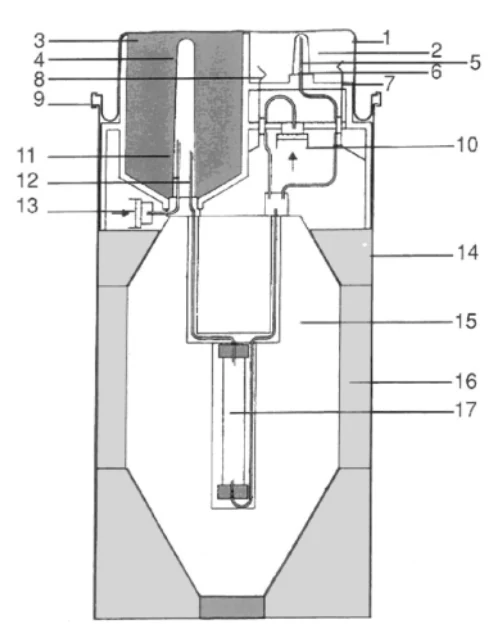
Schematic of the Sodium pertechnetate (99mTc) CuriumNetherlands:
1 Top cover
2 Elution station
3 Eluent vial chamber
4 Plastic cover for eluent needle 5 Rubber cover for eluate needle 6 Eluate outlet needle
7 Safety valve
8 Valve for partial elution 9 Lever closing ring
10 Air filter for partial elution 11 Inlet needle for sterile air 12 Eluent inlet needle
13 Air filter for eluent bottle 14 Containment
15 Lead shield
16 Support for lead shield 17 Generator column
3 Remove the flip-off cover from the capsule of the eluent vial, disinfect the stopper, remove (and store) the plastic cover of the inlet needle and lower the eluent vial into its holder.
4 Remove the flip-off cover from the capsule of the sterile vial and put it into the sterile vial shielding.
5 Remove (and store) the rubber needle protection from the outlet needle and lower the shielded sterile vial into the elution station.
Elution
1 Remove the flip-off cover from the capsule of the required TechneVial, disinfect the stopper, let the disinfectant evaporate completely and put the vial into the UltraVial Shielding. (The TechneVial contains some residual water as a result of the sterilisation process.)
2 Replace the shielded sterile vial by the UltraVial Shield, ensure the lead glass window faces front.
3 Elution starts. The process can be interrupted depending on the required elution volume (Pertechnetate (99mTc) concentration/ml). Elution is always ended by giving the UltraVial Shield a quarter turn, pushing it down and waiting for a few seconds (this causes the TechneVial to be filled with sterile air).
4 Replace the TechneVial Shielding by a shielded unused sterile vial.
Never interrupt elution by lifting the TechneVial Shield without the quarter turn!
Eluates that are not clear or colourless must be rejected. Disposal of waste and return of the generator
1 Remove and dispose of the used sterile vial and the eluent vial. 2 Replace the original needle cover back on the inlet needles. 3 Elute the remaining millilitres of fluid from the generator (see under elution). The generator is now dry.
4 Replace the original outlet needle cover on the outlet needle. 5 Close the generator system with its top cover and lever closing ring. 6 Store the generator in a suitable place for decay to a level acceptable for disposal.
NB: In some countries the possibility exists to return expired generators. Consult the local representative for such a possibility or for details of dismantling.
Elution of the generator must be performed in premises complying with the national regulations concerning the safety of use of radioactive products. The solution eluted is a clear and colourless sodium pertechnetate (99mTc) solution, with a pH between 4 and 8 and a radiochemical purity equal to or greater than 99%.
When sodium pertechnetate (99mTc) solution is used for kit labelling, please refer to the package leaflet of the concerned kit.
Quality control
Radioactivity and molybdenum (99Mo) break-through must be checked before administration.
The test for molybdenum (99Mo) break-through can be performed either according to Ph. Eur. or to any other validated methods able to determine molybdenum (99Mo) content below 0.1% of total radioactivity at the date and hour of administration.
The first eluate obtained from this generator can be normally used, unless otherwise specified.
Eluates even eluted later than 24 hours from the last elution can be used for kit labelling, unless it is excluded by the specifications of the relevant kit SmPC.