

Patient leaflet - Serevent Evohaler
1. WHAT SEREVENT EVOHALER IS AND WHAT IT IS USED FOR
- • Serevent Evohaler contains the medicine salmeterol. It is a ‘long-acting bronchodilator’. It helps the airways in the lungs to stay open. This makes it easier for air to get in and out. The effects are usually felt within 10 to 20 minutes and last for 12 hours or more.
- • The doctor has prescribed it to help prevent breathing problems. These could be caused by asthma. Taking Serevent Evohaler regularly will help prevent asthma attacks. This also includes asthma brought on by exercise or at night.
- • Taking Serevent Evohaler regularly will also help prevent breathing problems caused by other chest illnesses such as Chronic Obstructive Pulmonary Disease (COPD).
- • Serevent Evohaler helps to stop breathlessness and wheezing coming on. It does not work once you are breathless or wheezy. If that happens, you need to use a fast-acting ‘reliever’ medicine, such as salbutamol.
- • Serevent Evohaler is supplied to you in an inhaler. You breathe the medicine directly into your lungs.
- • Serevent Evohaler contains norflurane. This is less harmful to the environment than older inhalers. Older inhalers may taste differently to Serevent Evohaler. This will make no difference to how your medicine works.
If you are being treated for asthma, you should always be given both a Serevent and a steroid inhaler to use together.
2. WHAT YOU NEED TO KNOW BEFORE YOU USE SEREVENT EVOHALER
Do not take Serevent Evohaler if:
you are allergic (hypersensitive) to salmeterol or to the other ingredient norflurane (HFA 134a).
Take special care with Serevent Evohaler
- If your asthma or breathing gets worse tell your doctor straight away. You may find that you feel more wheezy, your chest feels tight more often or you may need to use more of your fast-acting ‘reliever’ medicine. If any of these happen, do not increase your number of puffs of Serevent. Your chest condition may be getting worse and you could become seriously ill. See your doctor as you may need a change in asthma treatment.
- Once your asthma is well controlled your doctor may consider it appropriate to gradually reduce the dose of Serevent.
- If you have been prescribed Serevent for your asthma, continue to use any other asthma medication you are already taking. These could include a steroid inhaler or steroid tablets. Continue taking the same doses as before, unless your doctor tells you otherwise. Do this even if you feel much better. Do not stop taking your steroid inhaler (or any steroid tablets) when you start using Serevent.
- Your doctor may want to check your health regularly if you have an overactive thyroid gland, diabetes mellitus (Serevent may increase your blood sugar) or heart disease, including an irregular or fast heartbeat.
Other medicines and Serevent
- Tell your doctor if you are taking or have recently taken any other medicines. This includes those for asthma or any other medicines obtained without a prescription. This is because Serevent may not be suitable to be taken with other medicines.
Inform your doctor before using Serevent if you are currently being treated for any fungal infections with medicines containing ketoconazole or itraconazole, or if you are being treated for HIV with ritonavir. These medicines may increase the risk of you experiencing side effects with Serevent, including irregular heart beats, or may make side-effects worse.
- Beta-blockers should be avoided when taking Serevent, unless your doctor tells you to take them. Beta-blockers, including atenolol, propranolol and sotalol, are mostly used for high blood pressure or other heart conditions. Tell your doctor if you are taking beta-blockers or have recently been prescribed beta-blockers as they may reduce or abolish the effects of salmeterol.
- Serevent can reduce the amount of potassium in your blood. If this happens you may notice an uneven heartbeat, muscle weakness or cramp. This is more likely to happen if you take Serevent with some medicines used to treat high blood pressure (diuretics) and other medicines used to treat breathing problems such as theophylline or steroids. Your doctor may ask for you to have blood tests to check the amount of potassium in your blood. If you have any concerns discuss them with your doctor.
Pregnancy and breast-feeding
If you are pregnant or breast-feeding, think you may be pregnant or are planning to have a baby, ask your doctor or pharmacist for advice before taking this medicine.
Driving and using machines
The possible side effects associated with Serevent are unlikely to affect your ability to drive or use machines.
3. HOW TO USE SEREVENT EVOHALER
Always use this medicine exactly as your doctor or pharmacist has told you. Check with your doctor or pharmacist if you are not sure.
- If you are being treated for asthma, you should always be given both a Serevent and a steroid inhaler to use together.
- Use Serevent every day, until your doctor advises you to stop.
- You will start to feel your medicine working within the first day of use.
Serevent is for inhalation by mouth only.
Adults and adolescents aged 12 years and older with Asthma
- The usual starting dose is 2 puffs twice a day.
- For people with more severe asthma, your doctor may increase your dose to 4 puffs twice a day.
Children with Asthma
- In children aged 4 to 12 the usual dose is 2 puffs twice a day.
- Serevent is not recommended for use in children below 4 years of age.
Adults with Chronic Obstructive Pulmonary Disease (COPD) including bronchitis and emphysema
- The usual starting dose is 2 puffs twice a day.
- Not applicable for children and adolescents.
Instructions for use
Your doctor, nurse or pharmacist should show you how to use your inhaler. They should check how you use it from time to time. Not using the inhaler properly or as prescribed, may mean that the medicine will not help your asthma or COPD as it should.
The medicine is contained in a pressurised canister in a plastic casing with a mouthpiece.
Testing your inhaler
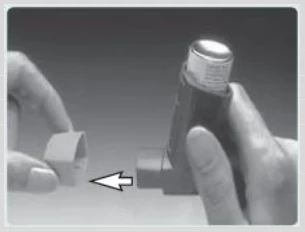
- 1 When using your inhaler for the first time, test that it is working. Remove the mouthpiece cover by gently squeezing the sides with your thumb and forefinger and pull apart.
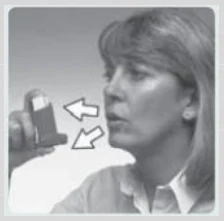
- 2 To make sure that it works, shake it well, point the mouthpiece away from you and press the canister to release two puffs into the air. If you have not used the inhaler for a week or more, also release two puffs of medicine into the air.
Using your inhaler
It is important to start to breathe in as slowly as possible just before using your inhaler.
- 1 Stand or sit upright when using your inhaler.
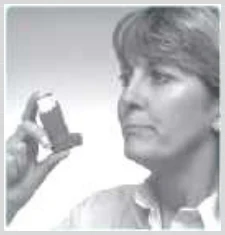
- 2 Remove the mouthpiece cover (as shown in the first picture). Check inside and outside to make sure that the mouthpiece is clean and free of objects.
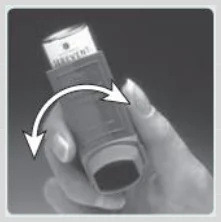
3 Shake the inhaler 4 or 5 4 Hold the inhaler upright with times to ensure that any your thumb on the base, loose objects are removed below the mouthpiece.
and that the contents of the Breathe out as far as is inhaler are evenly mixed. comfortable.
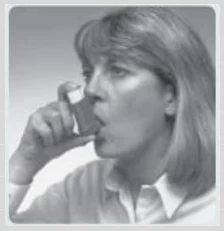
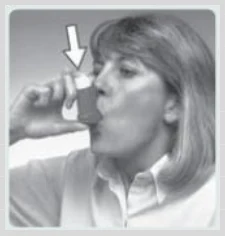
5 Place the mouthpiece in 6 Breathe in through your mouth.
your mouth between your Just after starting to breathe in,
teeth. Close your lips press down on the top of the
around it. Do not bite. canister to release a puff of
medicine. Do this while still
breathing in steadily and deeply.
7 Hold your breath, take the inhaler from
your mouth and your finger from the top of
the inhaler. Continue holding your breath
for a few seconds, or as long as is
comfortable.
8 Wait about half a minute between taking
each puff of medicine and then repeat
steps 3 to 7.
9 After use always replace the mouthpiece cover immediately to keep out dust. Replace the cover by firmly pushing and snapping the cap into position.
Practice in front of a mirror for the first few times. If you see a ‘mist’ coming from the top of your inhaler or the sides of your mouth you should start again
If you or your child find it difficult to use Serevent Evohaler, it may be used with other devices to make its use easier e.g. a Haleraid® or Volumatic® spacer device. Serevent is also available in an alternative device. Talk to your doctor, nurse or pharmacist for further advice.
Cleaning your inhaler
To stop your inhaler blocking up, it is important to clean it at least once a week.
To clean your inhaler:
- Remove the mouthpiece cover.
- Do not remove the metal canister from the plastic casing at any time.
- Wipe the inside and outside of the mouthpiece and the plastic casing with a dry cloth or tissue.
- Replace the mouthpiece cover.
Do not put the metal canister in water.
If you use more Serevent Evohaler than you should
It is important to use the inhaler as instructed. If you accidentally take a larger dose than recommended, talk to your doctor or pharmacist. You may notice your heart beating faster than usual and that you feel shaky and/or dizzy. You may also have a headache, muscle weakness and aching joints.
If you forget to use Serevent Evohaler
Do not take a double dose to make up for a missed dose. Just take your next dose at the usual time.
If you have any further questions on the use of this medicine, ask your doctor or pharmacist.
4. POSSIBLE SIDE EFFECTS
Like all medicines, this medicine can cause side effects, although not everybody gets them. To reduce the chances of side effects, your doctor will prescribe the lowest dose of Serevent to control your asthma or COPD. These are the side effects reported by people taking Serevent.
Allergic reactions: you may notice your breathing suddenly gets worse after using Serevent. You may be very wheezy and cough. You may also notice itching and swelling (usually of the face, lips, tongue or throat). If you get these effects or they happen suddenly after using Serevent, tell your doctor straight away. Allergic reactions to Serevent are very rare (they affect less than 1 person in 10,000).
Other side effects are listed below:
Common (affects less than 1 person in 10):
- Muscle cramps
- Feeling shaky; fast or uneven heartbeat (palpitations), headache, shaking hands (tremor). Tremors are more likely if you are taking more than two puffs twice daily. These side effects do not last long and happen less as treatment with Serevent continues
Uncommon (affects less than 1 person in 100):
- Rash
- Very fast heart rate (tachycardia). This is more likely to happen if you are taking more than two puffs twice daily
- Feeling nervous
Rare (affects less than 1 person in 1,000):
- Feeling dizzy
- Being unable to sleep or finding sleep difficult
A reduction in the amount of potassium in your blood (you may get an uneven heartbeat, muscle weakness, cramp)
Very rare (affects less than 1 person in 10,000):
- Breathing difficulties or wheezing that gets worse straight after taking Serevent. If this happens stop using your Serevent Evohaler. Use your fast-acting ‘reliever’ inhaler to help your breathing and tell your doctor straight away.
- Uneven heartbeat or your heart gives an extra beat (arrhythmias). If this happens do not stop using Serevent but tell your doctor
- Increases in the amount of sugar (glucose) in your blood (hyperglycaemia). If you have diabetes, more frequent blood sugar monitoring and possibly adjustment of your usual diabetic treatment may be required
- Sore mouth or throat
- Feeling sick (nausea)
- Aching, swollen joints or chest pain
Reporting of side effects
If you get any side effects, talk to your doctor, pharmacist or nurse. This includes any possible side effects not listed in this leaflet. You can also report side effects directly via the Yellow Card Scheme at: www.mhra.gov.uk/yellowcard or search for MHRA Yellow Card in the Google Play or Apple App Store. By reporting side effects, you can help provide more information on the safety of this medicine.
5. HOW TO STORE SEREVENT EVOHALER
- • KEEP OUT OF THE SIGHT AND REACH OF CHILDREN.
- • Do not store above 30°C.
- • Straight after use, replace the mouthpiece cover firmly and click it into position. Do not use excessive force.
- • The metal canister contains a pressurised liquid. Do not pierce or burn it even if you think it is empty.
- • Do not use Serevent after the expiry date which is stated on the label and carton. The expiry date refers to the last day of the month.
- • If the inhaler shows any other signs of deterioration, you should seek the advice of your pharmacist who will tell you what to do. Medicines should not be disposed of via household waste. Ask your pharmacist how to dispose of medicines no longer required. These measures will help to protect the environment.
6. CONTENT OF THE PACK AND OTHER INFORMATION
What Serevent Evohaler contains
- Each actuation provides 25 micrograms of the active ingredient salmeterol (as xinafoate).
- It also includes a CFC-free propellant Norflurane (HFA 134a).
What Serevent Evohaler looks like and contents of the pack
- Pressurised aluminium canister closed with a metering valve containing a pressurised inhalation suspension inserted into a green plastic actuator and mouthpiece. The mouthpiece has a light green plastic dust cap.
- There are 120 metered actuations in each canister.
Product Licence holder
Procured from within the EU and repackaged by the Parallel Import Product Licence holder: S&M Medical Ltd, Chemilines House, Alperton Lane, Wembley, HA0 1DX.
Manufacturer
This product is manufactured by Glaxo Wellcome Production, Rue Lavoisier 23, 27000 Evreux, France.
POM PL: 19488/1146
Leaflet revision date: 28 August 2025
Blind or partially sighted? Is this leaflet hard to see or read? Call 02087997607 to obtain the leaflet in large print, tape, CD or Braille.
Serevent® and Evohaler® are registered trademarks of Glaxo Group Limited, UK.
S1146 Leaflet Serevent Evohaler 25mcg 20250828