


Patient leaflet - Scopoderm 1.5 mg patches
1. What Scopoderm 1.5mg Patches are and what they are used for
Scopoderm 1.5mg Patches contain the active substance hyoscine which belongs to the group of medicines called anti-emetics or anti-sickness medicines. They are used to prevent the symptoms of motion sickness such as nausea (feeling sick), vomiting (being sick) and vertigo (loss of balance), which can occur when travelling by boat, train or car.
Travel sickness occurs when your body’s internal balancing system becomes confused by receiving different messages – your eyes say one thing about the position of your body, but your balance mechanisms tell you differently. Anyone can suffer from travel sickness: children are more prone but often grow out of it as they get older.
2. What you need to know before you use Scopoderm
1.5mg Patches
Do not use Scopoderm 1.5mg Patches if you:
have glaucoma or a history of glaucoma (pressure
behind the eye)
are allergic (hypersensitive) to hyoscine or any of the
other ingredients in the patch (see Section 6). Warnings and precautions Talk to you doctor or pharmacist before using Scopoderm 1.5mg Patches if you:
suffer from pyloric stenosis (a condition which affects
your stomach)
- have problems urinating due to a bladder obstruction
- have a blockage of your intestines
are an elderly patient or have any metabolic, liver or
kidney disease
suffer from epilepsy (increased number of fits have been
reported)
have had pain in the eyes, blurred vision, or see rainbow
coloured halos around light. (Scopoderm 1.5mg Patches should only be used after an eye examination by a doctor).
Care should be taken after removal of the patch as side effects may persist for up to 24 hours or longer under these circumstances, Scopoderm 1.5mg patches may be unsuitable for you.
Remove the patch before a medical scan as aluminium is
present in one of the patch layers
- Do not cut the patch.
- Dispose of used patches carefully.
- Do not apply more than one patch at a time.
Children
Scopoderm 1.5mg patches are not recommended for use in children under 10 years of age.
Other medicines and Scopoderm 1.5mg Patches
Tell your doctor or pharmacist if you are taking, have recently taken or might take any other medicines, including those obtained without a prescription.
In particular, tell your doctor if you are taking any of the following medicines, because Scopoderm may interact with them:
- alcohol
- other drugs acting on the brain
- antiallergic medicines
- antidepressants
- antiparkinsons and antivirals
- antiarrhythmics
- other travel sickness medicines.
Scopoderm 1.5mg Patches with food, drink and alcohol
Do not drink alcohol whilst using the patches or until the effects of the patches have worn off (this may last up to 24 hours or longer from the time you have removed it).
Use in the elderly
If you are elderly, you may be more prone to suffer from the side -effects of hyoscine (see Section 4: Possible Side Effects).
Use in children
Can be used in children aged 10 years or over (see dosage for adults).
The use of these patches is not recommended in younger children. See your doctor or pharmacist for alternative medicines.
If you use more Scopoderm 1.5mg Patches than you should
If you accidentally use too many patches, you may feel restless, excited or confused. In cases of higher overdose, you may become disorientated, hallucinate or have fits. In severe cases of overdose, coma and breathing difficulties may occur. Remove the patch / patches immediately, and tell your doctor or go to your nearest casualty department immediately. Take any remaining patches with you.
Pregnancy and breast-feeding
Do not use during pregnancy and breast-feeding unless your doctor advises you to. Ask your doctor or pharmacist for advice before taking any medicine.
If you forget to use Scopoderm 1.5mg Patches
If you forget to put a patch on, apply it as soon as you remember. Do not apply two patches at once to make up for the one that you forgot.
Driving and using machines
Scopoderm 1.5mg Patches may make you feel drowsy, confused or dizzy and may affect your vision. Do not drive, operate any machinery or perform any activity that requires concentration. Care should be taken after removal of the patch as these effects may persist for up to 24 hours or longer.
3. How to use Scopoderm 1.5mg Patches
Always use this medicine exactly as described in this leaflet or as your doctor or pharmacist has told you. Check with your doctor or pharmacist if you are not sure. Do not exceed the recommended dose.
If you stop using Scopoderm 1.5mg Patches
In rare cases – usually after several days of use - symptoms such as dizziness, nausea (feeling sick), vomiting (being sick), headache and disturbances of balance have been reported after discontinuation of the treatment. These symptoms are more likely to occur if you have been wearing a patch for several days. If you are affected in this way, avoid any activities requiring concentration, e.g. driving, or operating machinery, until your symptoms have worn off and consult a doctor. If you have any further questions on the use of this medicine, ask your doctor or pharmacist.
4. Possible side effects
Adults and the elderly
Like all medicines, Scopoderm 1.5mg Patches can cause side effects, although not everybody gets them.
One patch should be applied about 5-6 hours before leaving on your journey (or the evening before) to a clean, dry, hairless area of intact skin behind the ear.
STOP using Scopoderm 1.5mg and seek medical help immediately if you or your child has any of the following 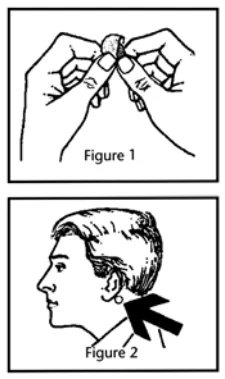 which may be signs of an allergic reaction:
- 1.
Remove the patch from the sachet.
Peel off the clear, hexagonal plastic backing, holding the patch by its edge so as not to touch the sticky side (Figure 1).
- Difficulty in breathing or swallowing
- Swelling of the face, lips, tongue or throat
Severe itching of the skin, with a red rash or raised
bumps
- 2.
Press the silver coloured sticky side of
the patch firmly on to a clean, dry, hairless area of skin behind the ear (Figure 2). Avoid areas of skin that are cut or irritated in any way.
Some side effects could be serious which are very rare
(may affect 1 in every 10,000 people)
Changes in vision with increased pressure in the eye
(possible signs of glaucoma). If you experience this, tell your doctor straight away.
- 3.
Wash your hands thoroughly after
applying the patch. Do not touch the patch once it is in place as you may get the active ingredient on your fingers. If you do touch the patch, wash your hands immediately. Do not get the active ingredient near your eyes. If you get hyoscine on your fingers then touch your eyes, your vision may be temporarily affected.
Some side effects are very common (may affect more than 1 in 10 people)
- Dryness of the mouth.
- Drowsiness, dizziness
Frequently blurring of (near) vision and enlargement of
the pupils (sometimes in one eye only),
- Loss of ability to focus on close or far objects (visual
- 4.
Once your journey is over, take the
accommodation)
patch off and dispose of it carefully.
- 5.
When you take a patch off wash your
Some side effects are common (may affect between 1 and 10 in every 100 people)
hands and also the area of skin where the patch has been.
- Irritation of the eyelids
- Skin irritation
Each patch will last for up to 3 days. If you are travelling for more than three days, take the patch off after 3 days and apply a fresh patch behind the other ear. You can swim, bathe or shower with little risk of the patch coming off, provided that you have applied the patch properly. However, it is best not to stay in the water too long. If the patch accidentally comes off, dispose of it carefully and put on a new patch.
Some side effects are rare (may affect between 1 and 10 in every 1,000 people)
- Difficulty in passing water (urinating)
Impairment of memory or concentration, restlessness,
disorientation, confusion, or hallucinations.
Some side effects are very rare (may affect less than 1 in every 10,000 people)
Skin rash
Not known (frequency cannot be estimated from the available data)
- Reactions at the application site such as itching, redness and burning.
Reporting of side effects
If you get any side effects, talk to your doctor, pharmacist or nurse. This includes any possible side effects not listed in this leaflet. You can also report side effects directly via the Yellow Card Scheme at: www.mhra.gov.uk/yellowcard or search for MHRA Yellow Card in the Google Play or Apple App Store. By reporting side effects you can help provide more information on the safety of this medicine.
5. How to store Scopoderm 1.5mg Patches
- KEEP OUT OF THE SIGHT AND REACH OF CHILDREN
- Do not store above 25°C.
- Do not freeze.
Do not remove from the protective pouch until you need it.
The transdermal patch should be folded in half (sticky side inwards) before being discarded.
Do not use this medicine after the expiry date (shown as
"EXP" on the bottle and carton).
- If you notice signs of your medicine deteriorating, consult your pharmacist.
- Medicines should not be disposed of via waste water or household waste. Ask your pharmacist how to dispose of medicines no longer required. These measures will help to protect the environment.
6. Contents of the pack and other information
What Scopoderm 1.5mg Patches contains
- Each transdermal patch contains a total of 1.5 mg scopolamine (hyoscine). Average absorption rate 1 mg scopolamine (hyoscine) in 72 hours.
- Also includes: polyethylene, ethylene vinyl acetate copolymer, liquid paraffin, polyisobutylene, polypropylene, polyethylene terephthalate and aluminium.
What Scopoderm 1.5mg Patches looks like and contents of the pack
Scopoderm 1.5mg patches are a flat, round patch approximately 1.8 cm in diameter. One side of the patch is tan marked with scopolamine 1mg/3 days the other side is silver and is placed on an oversized clear hexagonal film. Each patch is individually packed into a foil sachet. The pack contains 2 sachets.
Manufacturer
This product is manufactured byGlaxoSmithKline Consumer Healthcare GmbH & Co. KG Barthstraβe 4, 80339 Munich, Germany. Procured from within the EU and repackaged by the Product Licence holder: G Pharma Ltd, Salford M50 2PU.
PL No: 16369/2111
P
Leaflet revision date: 13/07/2021
Scopoderm is a registered trademark of GSK group of companies.
Blind or partially sighted?
Is this leaflet hard to see or read? Call 0161 877 8999 to obtain the leaflet in a format suitable for you.