


Patient leaflet - Salamol Easi-breathe CFC-free inhaler 100 micrograms pressurised inhalation suspension
1. What Salamol Easi-Breathe is and what it is used for
Effect
Salamol Easi-Breathe contains salbutamol sulfate, which belongs to a group of medicines called beta agonists. Salbutamol is a bronchodilator and works by widening the airways in your lungs to allow air in and out. This helps you to feel less breathless, wheezy or tight-chested.
Usage
Salamol Easi-Breathe is used to treat asthma in adults, adolescents and children aged 4 to 11 years. It can also be used to prevent asthma caused by exercise or asthma caused by a reaction to allergens (substances to which you are allergic to e.g. house dust, pollen, dog hair, cat hair, cigarette smoke, etc.) or to treat breathing difficulties associated with reversible airways obstruction (e.g. chronic obstructive pulmonary disease [COPD]). This type of medicine is known as a ‘reliever’. You may be using another medicine to prevent you from having an asthma attack (“controller medication”). You can safely use your controller medication with this medicine.
2. What you need to know before you use Salamol Easi-Breathe
Do not use Salamol Easi-Breathe
- if you are allergic to salbutamol or any of the other ingredients of this medicine (listed in section 6)
- if you unexpectedly go into early labour (premature labour) or threatened abortion.
Warnings and precautions
Talk to your doctor, pharmacist or nurse before using Salamol Easi-Breathe if you:
- are hypersensitive to other sympathomimetics
- have any severe heart conditions, especially recent heart attack, coronary heart disease (coronary artery disease), hypertrophic obstructive cardiomyopathy (chronic heart muscle disease), tachycardia (increase in heart rate above 100 beats per minute) and tachyarrhythmias (heart rhythm disorders with increased heart rate)
- have severe and untreated hypertension (high blood pressure) or an aneurysm (abnormal bulging of the blood vessel wall)
- are taking cardiac glycosides
have hyperthyroidism/thyrotoxicosis (an overactive thyroid)
- have difficult-to-control diabetes mellitus
- have phaeochromocytoma (a certain disease of the adrenal medulla - the inner part of the adrenal gland).
Special treatment instructions
Treatment of asthma should follow a stepwise approach in accordance with disease severity.
It may be dangerous for patients to increase the use of beta2-agonists, such as Salamol Easi-Breathe, of their own accord.
If your breathlessness should suddenly get worse after inhalation (paradoxical bronchospasm), treatment should be discontinued immediately and your treatment plan revised by the doctor.
Salbutamol should not be used as monotherapy in patients with persistent asthma.
An increasing need for beta2-agonists, such as Salamol Easi Breathe, is a sign of worsening disease.
If, despite treatment, there is no satisfactory improvement or even worsening of the disease, the treatment plan must be reviewed by the doctor and, if necessary, reworked by combining it with anti-inflammatories, adjusting the dose of pre-existing anti-inflammatory therapy or co-administering other medicines. If breathlessness should develop suddenly or rapidly get worse, you must seek medical help at once.
Significantly exceeding the recommended doses (in particular the single doses used in an acute attack, but also the total daily dose) can be dangerous because of possible cardiac side effects, especially in association with electrolyte imbalances (e.g., hypokalaemia), and must therefore be avoided.
Effects on the heart and blood circulation system (cardiovascular effects) can occur with the use of sympathomimetics, including salbutamol. Based on data from post-marketing observational studies and from published literature, there is evidence to suggest that myocardial ischaemia (a lack of oxygen to the heart muscle) may rarely occur in association with salbutamol.
Patients with underlying severe heart disease receiving salbutamol should seek urgent medical help if they notice chest pain or symptoms of worsening heart disease.
To assess progression of disease and your response to treatment, daily self-monitoring as instructed by the doctor is important. This is done, for example, by routinely measuring peak expiratory flow using a peak-flow meter.
When anaesthesia using halogenated anaesthetics is scheduled, it should be ensured that, wherever possible, Salamol Easi-Breathe is no longer used for at least 6 hours before the start of anaesthesia.
The blood sugar level can rise if Salamol Easi-Breathe is inhaled at high doses. In patients with diabetes, blood sugar levels should be closely monitored.
Hypokalaemia (a reduction in blood potassium levels) may occur during high-dose treatment with Salamol Easi-Breathe. This can be made even worse if used at the same time as other medicines, especially methylxanthines (e.g. theophylline), corticosteroids (cortisone-like medicines), diuretics (used to increase urine output) or digitalis glycosides (medicines used to treat heart failure), or if you also have hypoxaemia (low blood oxygen levels). Blood electrolyte monitoring is indicated, so that potassium can be administered if necessary.
As with other inhaled treatments, a bronchial spasm (paradoxical bronchospasm) may occur after using Salamol Easi-Breathe, with an immediate increase in wheezing. In this case, a fast-acting bronchodilator should be inhaled immediately. Treatment with Salamol Easi-Breathe should be stopped at once and the treating doctor should be informed. He/she will decide whether further measures are required.
Children
The specific dosage recommendations for children aged 4 to 11 years should be observed (see section 3).
Elderly
No special dosage adjustment is required in the elderly.
Other medicines and Salamol Easi-Breathe
Tell your doctor or pharmacist if you are taking/using, have recently taken/used or might take/use any other medicines.
If you are having treatment that requires a general anaesthetic, please tell your anaesthetist that you are taking Salamol Easi-Breathe. Do not use this medicine for at least six hours before the intended anaesthetic.
Salbutamol can reduce the amount of potassium in your blood. If this happens, you may notice an irregular heartbeat, muscle weakness or cramp. This is more likely to happen if you use salbutamol with some medicines used to treat high blood pressure, other medicines used to treat breathing problems (e.g. steroids), stimulants (e.g. xanthines) and long-term laxatives.
The following medicines may influence the effect of Salamol Easi-Breathe:
- water tablets (diuretics)
medicines for the treatment of chronic alcoholism (e.g. disulfiram)
- the anti-microbial drug metronidazole.
Beta-receptor blockers (used to lower blood pressure)
If used at the same time, Salamol Easi-Breathe and beta-receptor blockers will mutually weaken their respective effects, with the administration of beta-receptor blockers posing a risk of causing severe bronchospasms (bronchial spasms).
Antidiabetic agents (used to treat diabetes)
The blood sugar-lowering effect of antidiabetics can be reduced during treatment with Salamol Easi-Breathe. However, this is generally only to be expected at higher doses that are usual in systemic administration (as tablets or injection/infusion).
Digitalis glycosides (cardiac glycosides) and antiarrhythmic agents
An increased risk of side effects is possible if Salamol Easi-Breathe is given at the same time as antiarrhythmic agents (e.g. digitalis/ quinidine).
Anaesthetics
The use of halogenated anaesthetics (used in general anaesthesia), such as halothane, methoxyflurane or enflurane, must be expected to increase the risk of severe heart rhythm disorders and hypotension (reduction in blood pressure) in patients treated with Salamol Easi-Breathe (see 2. ‘What you need to know before you use Salamol Easi-Breathe’).
Sympathomimetics (medicines that act on the autonomic nervous system)
If given at the same time, Salamol Easi-Breathe and theophylline or other sympathomimetics may mutually enhance their respective effects, with an increased risk of side effects. In addition, substances which themselves enhance sympathomimetic effects, such as L dopa, L thyroxine, oxytocin or alcohol, can have an effect on cardiovascular regulation in interaction with Salamol Easi- Breathe.
Hypokalaemia (reduction in blood potassium levels) possibly triggered by Salamol Easi-Breathe can be made even worse if you are also taking methylxanthines (e.g. theophylline), corticosteroids, diuretics or digitalis glycosides.
Caution is required if you are being treated with ergot alkaloid-type substances, such as ergotamine, at the same time as Salamol Easi-Breathe, as the mutual effect on the vasomotor system (vasodilatory regulation) is difficult to predict individually and may also lead to vasoconstrictor and vasodilator reactions (narrowing or widening of the blood vessels).
If used at the same time, Salamol Easi-Breathe and monoamine oxidase inhibitors or tricyclic antidepressants can trigger an increased effect of salbutamol on the cardiovascular system.
Hypertensive reactions, causing a rise in blood pressure, may occur if procarbazine is given at the same time.
Pregnancy and breast-feeding
If you are pregnant or breast-feeding, think you may be pregnant or are planning to have a baby, ask your doctor or pharmacist for advice before taking this medicine.
Salbutamol crosses the placental barrier. For humans, there is insufficient experience with regard to use during pregnancy. An increase in heart rate (tachycardia) and low blood sugar levels (hypoglycaemia) have been described in newborns with the use of salbutamol as a tocolytic agent.
Animal studies have shown reproductive toxicity in rats at very high doses. The potential risk for humans is unknown.
Salamol Easi-Breathe should not be used during pregnancy, especially during the first three months, unless strictly indicated. The same applies to its use at the end of pregnancy, due to the tocolytic effect, which delays labour.
As salbutamol probably passes into human milk, its use during breast-feeding is recommended only after a careful risk/benefit assessment.
Driving and using machines
No studies have been carried out on the effects on the ability to
drive and operate machinery.
Salamol Easi-Breathe contains ethanol
This medicine contains 3.93 mg of alcohol (ethanol) in each metered dose. The amount in each metered dose of this medicine
is equivalent to less than 0.1 ml beer or wine.
The small amount of alcohol in this medicine will not have any noticeable effects.
3. How to use Salamol Easi-Breathe
Always use this medicine exactly as your doctor or pharmacist has told you. Check with your doctor or pharmacist if you are not sure.
The dosage is individually adjusted according to your doctor’s instructions, based on previous asthma therapy.
For the best results with this medicine you should use it when required to relieve symptoms of asthma and other chest conditions with similar symptoms, such as wheezing, breathlessness and tightness in your chest. Take one puff as a starting dose. This may be increased to two puffs if necessary.
To prevent asthma caused by exercise or allergens (e.g. house dust, pollen etc.), take two puffs 10-15 minutes before you exercise or before exposure to known allergens.
Do not take more than eight puffs in 24 hours. Wait 4 hours between doses.
Use in children and adolescents
The usual dose for children under the age of 12 years to relieve asthma symptoms such as wheezing, breathlessness and tightness in the chest, is one puff as a starting dose. This may be increased to two puffs if necessary.
Children over the age of 12 should refer to the adult dosage instructions above.
The usual dose for children under the age of 12 years to prevent asthma caused by exercise or allergens (e.g. house dust, pollen etc.), is one puff 10-15 minutes before exercise or before exposure to known allergens. This can be increased to two puffs if necessary.
Children over the age of 12 should refer to the adult dosage instructions above.
The usual dose for children under the age of 12 years for regular treatment of asthma is up to 2 puffs, 4 times a day.
Do not take more than eight puffs in 24 hours. Wait 4 hours between doses.
Instructions for use
Important
Before using this medicine, please read this leaflet carefully and follow the instructions.
An adult should always supervise children when they use Salamol Easi-Breathe.
Always remember the following:
- Wait four hours between doses.
- Tell your doctor if your asthma gets worse or if this medicine does not provide as much relief from your asthma as before.
- You should sit or stand upright while taking this medicine. It is important when using this medicine to hold the inhaler upright as it will not work if it is not held in this position.
This inhaler is designed to make it easier for you to use. It is a breath-operated inhaler. This means it only releases a dose when you breathe in.
Using the Inhaler
Opening
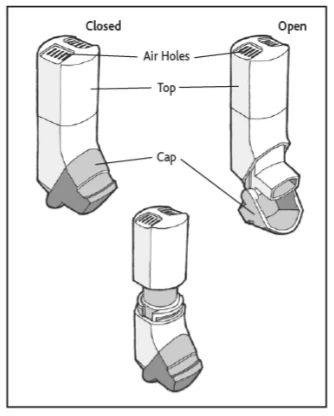
To open the inhaler, fold down the cap which fits over the mouthpiece.
Test spray the inhaler by firing two shots into the air before you use it for the first time and also if you have not used it for a period of five days or more. To test spray your inhaler, unscrew the top of it so you can see the metal can inside. Open the cap, shake the inhaler and spray the aerosol by pressing the can with your finger or thumb. Close the cap and put the top back on.
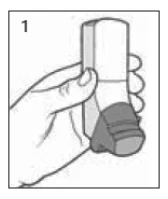
- 1. Shake the inhaler vigorously.
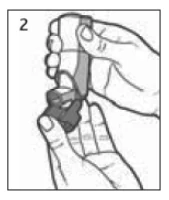
- 2. Hold the inhaler upright and open it by folding down the cap which fits over the mouthpiece.
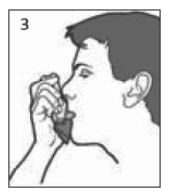
- 3. Breathe out normally as far as you comfortably can. Then hold the mouthpiece firmly between your lips. Hold the inhaler upright and make sure that your hand is not blocking the airholes. Breathe in slowly and deeply through the mouthpiece. Don’t stop breathing when the inhaler puffs the dose into your mouth. Carry on until you have taken a deep breath.
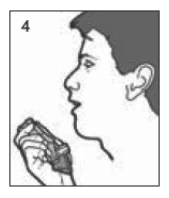
- 4. Take the inhaler out of your mouth and hold your breath for 10 seconds or for as long as you comfortably can. Then breathe out slowly.
- 5. After you have used your inhaler, hold it upright and close the cap immediately.
- 6. If you need to take more than one puff, close the cap, wait about one minute and then start again from step 1.
- 7.
What to do if your inhaler stops working properly?
If your inhaler does not work properly, unscrew the top and press the can down. It is important to clean your inhaler regularly to prevent deposits from the aerosol building up and blocking the inhaler. If your inhaler does not seem to be working, it may be that your inhaler has become blocked and you should clean your inhaler as detailed below.
If your inhaler still does not work, return it to your doctor or pharmacist.
Cleaning the inhaler
You must keep your inhaler clean, especially in the mouthpiece. This will prevent deposits from the aerosol building up. To prevent your inhaler becoming blocked you must clean it once a week.
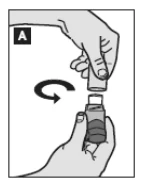
- A To clean your inhaler unscrew and remove the top of the inhaler. Keep this top dry at all times.
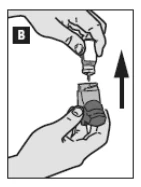
- B Remove the metal can from the bottom of the inhaler. Do not put the metal can into water.
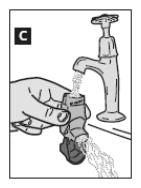
- C
Rinse the bottom of the inhaler with warm running water for at least 30 seconds.
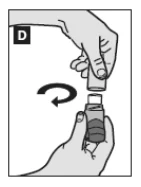
- D Shake off any excess water and dry the bottom of the inhaler thoroughly (leave to dry overnight if possible) but do not use direct heat. Put the can back into the bottom of the inhaler. Close the cap and screw the top and bottom parts of your inhaler back together.
Failure to allow the mouthpiece to dry properly will result in an increase in blockage problems.
If you need to use your inhaler before it is dry, shake off any water from the bottom of the inhaler and put the can back in. Test spray the inhaler by firing two puffs in the air as previously described above. Screw the top and bottom parts of your inhaler together and take your usual dose. When you have taken your usual dose, wash and dry your inhaler again as described above.
If you use more Salamol Easi-Breathe than you should
It is important that you take your dose as stated on the pharmacist’s label or as advised by your doctor. You should not increase or decrease your dose without seeking medical advice.
If you accidentally take a larger dose than recommended, you may notice that your heart is beating faster than usual, that you feel shaky or tense, you may have a headache and your skin may look flushed and feel hot. These effects usually wear off in a few hours, but you should tell your doctor as soon as possible. Your doctor may want to check your blood potassium levels.
4. Possible side effects
Like all medicines, this medicine can cause side effects, although not everybody gets them.
Contact your doctor immediately if you experience allergic (hypersensitivity) reactions. These include
- wheezing, coughing and difficulty in breathing;
- rash, swelling of the face and throat, and a fall in blood pressure.
You might collapse in very rare circumstances.
If you experience any of these side effects or if they occur suddenly after using salbutamol you should stop using your medication straightaway and tell your doctor immediately.
Allergic reactions to salbutamol are very rare (occurring in less than 1 in 10,000 patients).
Other side effects:
Common: may affect up to 1 in 10 people
- high blood glucose levels
- feeling tense and getting headaches (which are more likely with higher doses)
- feeling shaky (muscle tremors)
- dizziness
- rapid heartbeat.
Uncommon: may affect up to 1 in 100 people
- restlessness
- forceful heartbeat that may be rapid or irregular
- poor blood circulation to the heart muscle (myocardial ischaemia) (see also 2. ‘Warnings and precautions’)
- irritation of the mouth or throat region, change in the sense of taste
- muscle pain (myalgia), muscle cramps.
Rare: may affect up to 1 in 1,000 people
- reduction in the amount of potassium in your blood (if this happens, you may notice an irregular heartbeat, muscle weakness or cramp)
- Increase in lactate levels and acid levels in the blood (you may experience symptoms such as persistent nausea and vomiting, unexplained tiredness, shortness of breath and rapid breathing, cold or blue hands and feet)
- sleep disturbances and sensing things that are not real
- increased blood flow to your extremities (peripheral dilatation)
- nausea, vomiting and dry and sore mouth.
Very rare: may affect up to 1 in 10,000 people:
- hypersensitivity reactions including itching, hives (urticaria), swelling of the mouth and throat region (angioedema), skin rash (exanthema), bronchial spasm (bronchospasm), drop in blood pressure and collapse.
- difficulty in sleeping (insomnia);
- heart rhythm disorders, including atrial fibrillation, increase in heart rate (supraventricular tachycardia) and irregular pulse (ventricular extrasystoles) and chest tightness (anginal complaints).
- bronchial spasm (paradoxical bronchospasm)
- itching of your skin;
- trembling (particularly your hands).
Rarely, micturition (urination) disorders, heartburn and increases or decreases in blood pressure can occur.
Additional side effects in children
- Sleep disturbances and sensing things that are not real have been reported.
- Hyperactivity.
Reporting of side effects
If you get any side effects, talk to your doctor, pharmacist or nurse. This includes any possible side effects not listed on this leaflet. You can also report side effects directly via the Yellow Card Scheme at: www.mhra.gov.uk/yellowcard or search for MHRA Yellow Card in the Google Play or Apple App Store. By reporting side effects, you can help provide more information on the safety of this medicine.
5. How to store Salamol Easi-Breathe
- • KEEP OUT OF THE SIGHT AND REACH OF CHILDREN.
- • Do not use this medicine after the expiry date which is stated on the Carton label and Device label after EXP. The expiry date refers to the last day of that month.
- • Do not store above 25°C.
- • Do not refrigerate or freeze. If this medicine gets very cold, remove the metal can from the inhaler and warm it in your hands for a few minutes before you use it. Do not warm the can in any other way. Pressurised aerosol can. Do not puncture, break or burn the can, even if it seems empty.
- • Do not throw away any medicines via wastewater or household waste. Ask your pharmacist how to throw away medicines you no longer use. These measures will help protect the environment.
6. Contents of the pack and other information
What Salamol Easi-Breathe contains
- Contains 100 micrograms salbutamol (as the sulfate) per metered dose.
- The other ingredients are ethanol anhydrous (alcohol) and the propellant norflurane (HFA-134a). This medicine does not contain any CFCs.
What Salamol Easi-Breathe looks like and contents of the pack
- The name of your medicine is Salamol Easi-Breathe CFC-Free Inhaler 100 micrograms Pressurised Inhalation, Suspension.
- Salamol Easi-Breathe is a pressurised aluminium container with a metering valve and breath-operated actuator in a two-tone blue plastic inhaler. The inhaler does not have a dose counter.
- Salamol Easi-Breathe is available as a single inhaler and can which supplies 200 metered doses or two inhalers and two cans. Each can supplies 200 metered doses.
Product Licence holder
Procured from within the EU and repackaged by the Product Licence holder: S&M Medical Ltd., Chemilines House, Alperton Lane, Wembley, HA0 1DX.
Manufacturer
This product is manufactured by
Merckle GmbH, Ludwig-Merckle-Str. 3, 89143 Blaubeuren, Germany
or
- IVAX Pharmaceuticals Ireland, IDA Industrial Park, Waterford Ireland
POM PL : 19488/1845
Leaflet revision date: 29 August 2025
Blind or partially sighted? Is this leaflet hard to see or read? Call 02087997607 to obtain the leaflet in large print, tape, CD or Braille.
Salamol Easi-Breathe® is a registered trade mark of Norton Healthcare Limited, Ireland.
S1845 Leaflet Salamol 100mcg 20250829