

Patient leaflet - Ryjunea 0.1 mg/ml eye drops, solution
1. What Ryjunea is and what it is used for
Ryjunea eye drops contain the active substance atropine sulfate. Atropine sulfate belongs to a group of medicines known as anticholinergics (drugs that stop the action of substances that relay signals from a nerve cell to another cell called acetylcholine).
It is used to slow worsening of myopia (nearsightedness) in children aged 3 to 14, whose myopia is between -0.5 and -6 diopters (a measurement of the capacity of the eye to focus) and their progression rate is 0.5 diopters per year or more at the beginning of the treatment with Ryjunea.
The benefit of the use of atropine sulfate eye drops in children is to maintain a better eye sight and to reduce the risk of future complications.
2. What you need to know before you use Ryjunea
Do not use Ryjunea
- if you are allergic to atropine sulfate or any of the other ingredients of this medicine (listed in section 6).
if you are allergic to other so-called anticholinergics (substances that block the action of the
neurotransmitter acetylcholine), like antihistamines, some antidepressants, amantadine, quinidine, disopyramide and metoclopramide.
if you have primary or angle-closure glaucoma (damage to the nerve in the eye caused by high pressure
inside the eye).
Warnings and precautions
You or your child may experience photophobia (increased sensitivity of the eyes to bright light) and accomodative dysfunction (blurred vision due to difficulty focussing the eyes) when using Ryjunea. These effects can last up to 14 days. If your eyes are more sensitive to light, you are advised to wear sunglasses to reduce discomfort.
Stopping treatment may cause your myopia to worsen again (see section 3 “If you stop using Ryjunea”). After you stop taking this medicine, you should continue your eye checks for one year. Talk to your doctor or the doctor treating your child in case your eye sight worsens (rebound).
Using this medicine may increase the risk of synechiae (abnormal adhesions of the iris) where the coloured part of the eye sticks to the tissue around it.
Ryjunea can cause blurred vision which may make seeing difficult in patients with clouding of the lens (cataract), lazy eye (amblyopia) and eye misalignment (strabismus).
Talk to your doctor or pharmacist before using Ryjunea, if the following applies to you or your child:
if you have progressive syndromic nearsightedness of childhood, such as damage to the nerve in the eye
usually caused by high pressure in the eye (glaucoma), progressive vision loss (retinitis pigmentosa), day blindness from birth (congenital hemeralopia), and disorder with nerve fiber of the eyes (myelinated nerve fiber syndrome).
have heart problems such as tachycardia (rapid heartbeat), heart failure (when the heart does not pump
blood as well as it should), coronary stenosis (narrowing of the blood vessels that supply the heart muscle), or hypertension (high blood pressure). Patients who have suffered a recent heart attack may experience potentially life-threatening abnormalities in heart rhythm when using this medicine.
may have the capability for temperature regulation affected by inhibition of sweating, as atropine must be
used with caution in high temperatures, in patients with fever due to the risk of high body temperature.
- have spastic paralysis (a muscle condition of the legs).
- have Down’s syndrome.
Children
Ryjunea is not recommended in children below 3 years. It is not known if it is safe or effective in this age group.
Other medicines and Ryjunea
Ryjunea may interact with other medicines. Before you or your child take Ryjunea, tell your doctor or pharmacist if you are using, have recently used or might use any other medicines, including medicines obtained without prescription. Tell your doctor especially:
if you are taking anticholinergics like antihistamines, phenothiazines, tricyclic and tetracyclic
antidepressants, amantadine, quinidine, disopyramide, metoclopramide.
- if you are taking medicines containing carbachol, pilocarpin or physostigmin to lower your eye pressure.
if you are taking sympathomimetic medicines like dobutamine, dopamine, norepinephrine, epinephrine or
isoproterenol.
if you are taking medicines that prevent muscle weakness (antimyasthenics) like pyridostigmine and
neostigmine, potassium citrate or potassium supplements.
- if you are taking brain or spinal cord (central nervous system) slowing medicines. If you are not sure if the above applies to you or your child, ask your doctor.
Pregnancy and breast-feeding
If you are pregnant or breast-feeding, think you may be pregnant or are planning to have a baby, ask your doctor or pharmacist for advice before using this medicine.
During pregnancy, especially during the last 3 months, Ryjunea should only be used if your doctor considers that the use of this medicine is absolutely necessary for you.
It is not recommended to use this medicine during breast-feeding because Ryjunea is passed into breast milk.
Driving and using machines
Ryjunea has a moderate influence on the ability to drive, ride bikes or scooters, or use machines because this medicine may lead to abnormal or blurred vision (see section 4 ‘Possible side effects”). Do not drive, ride bikes or scooters or use machines until your vision has cleared. This effect may last up to 14 days after stopping treatment.
Ryjunea contains benzalkonium chloride
This medicine contains 0.1 mg benzalkonium chloride in each ml. Benzalkonium chloride may be absorbed by soft contact lenses and may change the colour of the contact lenses. You should remove contact lenses before using this medicine and put them back 15 minutes afterwards.
Benzalkonium chloride may also cause eye irritation, especially if you have dry eyes or disorders of the cornea (the clear layer at the front of the eye). If you feel abnormal eye sensation, stinging or pain in the eye after using this medicine, talk to your doctor.
3. How to use Ryjunea
Always use this medicine exactly as your doctor has told you. Check with your doctor or pharmacist if you are not sure.
The recommended dose is one drop of Ryjunea 0.1 mg/ml in each eye daily. It is recommended to use right before bed time because this can help reduce the impact of side effects like blurred vision or abnormal sensitivity of the eyes to light (see section 4 “Possible side effects”). Your doctor will advise you how long to apply the drops.
If you are using other eye drops, wait at least 15 minutes after using them and then use Ryjunea. If you use contact lenses, you should remove them before use (see section 2 “Ryjunea contains benzalkonium chloride”). If you are using an eye ointment, it should be used after using Ryjunea. This helps Ryjunea to get into your eye and to start working.
How to use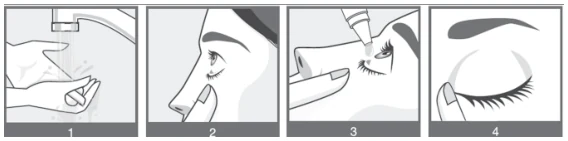 • Wash your hands before you start (picture 1).
Open the bottle. Remove the loose plastic ring from the cap when the bottle is first opened. Take special
care that the tip of the dropper bottle does not touch your eye, the skin around your eye or your fingers.
- Do not use if the tamper evident ring is broken or you notice visible signs of deterioration.
Twist off the bottle cap, and lie the cap on a clean surface on its side. Continue to hold the bottle,
ensuring that the tip doesn’t come into contact with anything.
Hold the bottle, pointing down, between your thumb and fingers.
- Pull down your lower eyelid with a clean finger to form a ‘pocket’ between the eyelid and your eye (picture 2). The drop will go in here.
- Tilt your head back.
- Bring the dropper tip close to the eye. Do this in front of a mirror if it helps.
- Do not touch your eye, eyelid, surrounding areas or other surfaces with the dropper tip. It could contaminate the eye drops.
- Gently squeeze the bottle to release one drop of Ryjunea into your eye (picture 3).
- Only put one drop into your eye. If a drop misses your eye, try again.
Press a finger against the corner of the eye by the nose. Hold for 1 minute whilst keeping the eye closed
(picture 4). A small duct that drains tears away from your eye and into your nose is located here. By pressing at this point, you close down the opening of this drainage duct. This helps to stop Ryjunea getting into the rest of the body.
- You need to use the drops in both eyes, repeat the steps for your other eye while you have the bottle open.
- Put back the bottle cap to close the bottle.
If you use more Ryjunea than you should
Rinse your eye with warm water. Do not put in any more drops until it is time for your next regular dose. If you forget to use Ryjunea
If you forget to use this medicine, skip the dose and use the next dose as you normally would. Do not take a double dose to make up for a forgotten dose.
If you stop using Ryjunea
Do not stop using Ryjunea without first speaking to your doctor or the doctor treating your child. Stopping of this medicine may lead to a worsening of your myopia (rebound). After you stop taking this medicine, you should continue your eye checks for one year. Talk to your doctor or the doctor treating your child in case your eye sight worsens (rebound).
If you have any further questions on the use of this medicine, ask your doctor or pharmacist.
4. Possible side effects
Like all medicines, this medicine can cause side effects, although not everybody gets them. The following side effects have been observed with Ryjunea:
- Very common (may affect more than 1 in 10 people)
- abnormal sensitivity of the eyes to light (photophobia)
- Common (may affect up to 1 in 10 people)
- blurred vision
- eye irritation
- dilation of the pupil (mydriasis)
- eye pain
- feeling there is something in your eye (foreign body sensation)
- headache
- Uncommon (may affect up to 1 in 100 people)
- difficulty focusing vision (accommodation disorder)
- spots of inflammation in the cornea (punctate keratitis)
- papilla in the membrane that lines the white of the eye and the inside of the eyelid (conjunctival papillae) Reporting of side effects
If you get any side effects, talk to your doctor, pharmacist or nurse. This includes any possible side effects not listed in this leaflet. You can also report side effects directly via the Yellow Card Scheme, Website: www.mhra.gov.uk/yellowcard, or search for MHRA Yellow Card in the Google Play or Apple App Store. By reporting side effects you can help provide more information on the safety of this medicine.
5. How to store Ryjunea
Keep this medicine out of the sight and reach of children.
Do not use this medicine after the expiry date which is stated on the bottle label and carton after “EXP”. The expiry date refers to the last day of that month.
This medicine does not require any special storage conditions.
Throw away the bottle 4 weeks after first opening to prevent infections and use a new bottle. Do not use this medicine if you notice that the plastic ring around the cap and neck is missing or broken before you start a new bottle.
Do not throw away any medicines via wastewater or household waste. Ask your pharmacist how to dispose of medicines you no longer use. These measures will help to protect the environment.
6. Contents of the pack and other information
What Ryjunea contains
- The active substance is atropine sulfate. Each ml of solution contains 0.1 mg of atropine sulfate.
- The other ingredients are benzalkonium chloride, citric acid (E330), sodium citrate (E331), sodium chloride, sodium hydroxide (E524)/hydrochloric acid (E507) (for pH adjustment), deuterium oxide. See section 2 “Ryjunea contains benzalkonium chloride”.
What Ryjunea looks like and contents of the pack
Ryjunea eye drops, solution (eye drops) is a clear, colourless liquid in a plastic multidose bottle. Each bottle contains 2.5 ml of the medicine and each pack contains 1 or 3 bottles with a screw-cap. Not all pack sizes may be marketed.
Marketing Authorisation Holder
Santen Oy
Niittyhaankatu 20,
33720 Tampere, Finland
Manufacturer
Santen Oy,
Kelloportinkatu 1,
33100 Tampere, Finland
For any information about this medicine, please contact the local representative of the Marketing Authorisation Holder:
United Kingdom
Santen UK
Tel: +44 (0) 345 075 4863
This leaflet was last revised in September 2025.
P090800014708