

Patient leaflet - Ramipril 5 mg/5 ml oral solution
1. WHAT RAMIPRIL ORAL SOLUTION IS AND WHAT IT
IS USED FOR
Ramipril oral solution contains a medicine called ramipril. This belongs to a group of medicines called ACE inhibitors (Angiotensin Converting Enzyme Inhibitors). Ramipril oral solution works by:
Decreasing your body’s production of substances that
could raise your blood pressure
- Making your blood vessels relax and widen
Making it easier for your heart to pump blood around
your body.
Ramipril oral solution can be used:
- To treat high blood pressure (hypertension)
- To reduce the risk of you having a heart attack or stroke
To reduce the risk or delay the worsening of kidney
problems (whether or not you have diabetes)
To treat your heart when it cannot pump enough blood
to the rest of your body (heart failure)
As treatment following a heart attack (myocardial
infarction) complicated with heart failure.
2. WHAT YOU NEED TO KNOW BEFORE YOU TAKE RAMIPRIL ORAL SOLUTION
DO NOT take Ramipril oral solution:
If you are allergic to ramipril, any other ACE inhibitor
medicine or any of the ingredients of this medicine listed in section 6.
Signs of an allergic reaction may include a rash,
swallowing or breathing problems, swelling of your lips, face, throat or tongue
If you have ever had a serious allergic reaction
called “angioedema”. The signs include itching, hives (urticaria), red marks on the hands, feet and throat, swelling of the throat and tongue, swelling around the eyes and lips, difficulty breathing and swallowing
If you have taken or are currently taking sacubitril/
valsartan, a medicine used to treat a type of long-term (chronic) heart failure in adults.
If you are having dialysis or any other type of blood
filtration. Depending on the machine that is used, Ramipril oral solution may not be suitable for you
If you have kidney problems where the blood supply to
your kidney is reduced (renal artery stenosis)
During the last 6 months of pregnancy (see section
below on “Pregnancy and breast-feeding”)
If your blood pressure is abnormally low or unstable.
Your doctor will need to make this assessment
If you have diabetes or impaired kidney function
and you are treated with a blood pressure lowering medicine containing aliskiren
Do not take Ramipril oral solution if any of the above apply to you. If you are not sure, talk to your doctor before taking Ramipril oral solution.
Warnings and precautions
Talk to your doctor or pharmacist before taking Ramipril oral solution:
- If you have heart, liver or kidney problems
If you have lost a lot of body salts or fluids (through
being sick (vomiting), having diarrhoea, sweating more than usual, being on a low salt diet, taking diuretics (water tablets) for a long time or having had dialysis)
If you are going to have treatment to reduce your allergy
to bee or wasp stings (desensitization)
If you are going to receive an anaesthetic. This may
be given for an operation or any dental work. You may need to stop your Ramipril oral solution treatment one day beforehand; ask your doctor for advice
If you have high amounts of potassium in your blood
(shown in blood test results)
If you are taking medicines or have conditions which
may decrease sodium levels in your blood. Your doctor may carry out regular blood tests, particularly for checking the levels of sodium in your blood especially if you are elderly.
If you are taking medicines that may increase the
risk of angioedema, a serious allergic reaction, such as mTOR inhibitors (e.g., temsirolimus, everolimus, sirolimus), vildagliptin, neprilysin (NEP) inhibitors (such as racecadontril) or sacubitril/valsartan. For sacubitril/ valsartan, see section 2 “Do not take Ramipril oral solution”.
If you have collagen vascular disease such as
scleroderma or systemic lupus erythematosus
You must tell your doctor if you think that you are (or
might become) pregnant. Ramipril oral solution is not recommended in the first 3 months of pregnancy and may cause serious harm to your baby after 3 months of pregnancy (see section below on “Pregnancy and breast-feeding”).
If you are taking any of the following medicines used to
treat high blood pressure:
an angiotensin II receptor blocker (ARBs) (also
known as sartans - for example valsartan, telmisartan, irbesartan), in particular, if you have diabetes-related kidney problems
- aliskiren
Your doctor may check your kidney function blood pressure, and the amount of electrolytes (e.g. potassium) in your blood at regular intervals.
See also information under the heading “DO NOT take Ramipril oral solution”.
Children and adolescents
Ramipril oral solution is not recommended for use in children and adolescents below 18 years of age because the safety and efficacy of Ramipril oral solution in children have not yet been established.
If any of the above apply to you (or you are not sure), talk to your doctor before taking Ramipril.
Other medicines and Ramipril oral solution
Tell your doctor or pharmacist if you are taking, have recently taken or might take any other medicines, including medicines obtained without a prescription (including herbal medicines). This is because Ramipril oral solution can affect the way some other medicines work. Also, some medicines can affect the way Ramipril oral solution works. Tell your doctor if you are taking any of the following medicines. They can make Ramipril oral solution work less well: ▪ Medicines used to relieve pain and inflammation (e.g.,
Non-Steroidal Anti-Inflammatory Drugs (NSAIDs) such as ibuprofen or indometacin and aspirin)
Medicines used for the treatment of low blood
pressure, shock, cardiac failure, asthma or allergies such as ephedrine, noradrenaline or adrenaline. Your doctor will need to check your blood pressure.
Tell your doctor if you are taking any of the following medicines. They can increase the chance of getting side effects if you take them with Ramipril oral solution:
- Sacubitril/valsartan – used for treating a type of long-term (chronic) heart failure in adults (see section 2 ‘Do not take Ramipril oral solution’)
Medicines used to relieve pain and inflammation
(e.g., Non-Steroidal Anti-Inflammatory Drugs (NSAIDs) such as ibuprofen or indometacin and aspirin)
- Medicines for cancer (chemotherapy)
- Medicines to stop the rejection of organs after a transplant such as ciclosporin
- Diuretics (water tablets) such as furosemide
- Medicines which can increase the amount of potassium in your blood such as spironolactone, triamterene, amiloride, potassium salts, trimethoprim alone or in combination with sulfamethoxazole (for infections) and heparin (for thinning blood)
- Steroid medicines for inflammation such as prednisolone
- Allopurinol (used to lower the uric acid in your blood)
- Procainamide (for heart rhythm problems)
- Temsirolimus (for cancer)
- Sirolimus, everolimus (for prevention of graft rejection)
- Vildagliptin (used for treating type 2 diabetes)
- Racecadotril (used against diarrhoea)
- Your doctor may need to change your dose and/or to take other precautions if you are taking an angiotensin II receptor blocker (ARB) or aliskiren (see also information under the headings “Do not take Ramipril oral solution” and “Warnings and precautions”). Tell your doctor if you are taking any of the following medicines. They may be affected by Ramipril oral solution:
- Medicines for diabetes such as oral glucose lowering medicines and insulin. Ramipril oral solution may lower your blood sugar amounts. Check your blood sugar amounts closely while taking Ramipril oral solution
- Lithium (for mental health problems). Ramipril oral
If any of the above apply to you (or you are not sure), talk to your doctor before taking Ramipril oral solution.
Ramipril with food, drink and alcohol
Drinking alcohol with Ramipril oral solution may make you feel dizzy or light-headed. If you are concerned about how much you can drink while you are taking Ramipril oral solution, discuss this with your doctor as medicines used to reduce blood pressure and alcohol can have additive effects.
Ramipril oral solution may be taken with or without food.
Pregnancy and breast-feeding
Pregnancy
You must tell your doctor if you think that you are (or might become) pregnant.
You should not take Ramipril oral solution in the first 12 weeks of pregnancy and you must not take them at all from the 13th week as their use during pregnancy may possibly be harmful to the baby. If you become pregnant while on Ramipril oral solution, tell your doctor immediately. A switch to a suitable alternative treatment should be carried out in advance of a planned pregnancy. Breast-feeding
You should not take Ramipril oral solution if you are breast-feeding.
Ask your doctor or pharmacist for advice before taking any medicine.
Driving and using machines
You may feel dizzy, while taking Ramipril oral solution. This is more likely to happen when you start taking Ramipril oral solution or start taking a higher dose. If this happens, do not drive or use any tools or machines.
Ramipril oral solution contains ethyl para hydroxybenzoate (E214) and methyl para hydroxybenzoate (E218)
Ramipril oral solution contains ethyl para hydroxybenzoate (E214) and methyl para hydroxybenzoate (E218): These may cause an allergic reaction. This allergy may happen sometime after starting the medicine
3. HOW TO TAKE RAMIPRIL ORAL SOLUTION
Always take this medicine exactly as your doctor or pharmacist has told you. Check with your doctor or pharmacist if you are not sure.
How much to take
Treatment of high blood pressure
The usual starting dose is 1.25 mg (2.5ml of
2.5mg/5ml or 1.25 ml of 5mg/5ml) or 2.5 mg (5 ml of 2.5mg/5ml or 2.5 ml of 5mg/5ml) once daily.
- Your doctor will adjust the amount you take until your blood pressure is controlled.
The maximum dose is 10 mg (20 ml of 2.5mg/5ml or
10 ml of 5mg/5ml) once daily.
If you are already taking diuretics (water tablets), your doctor may stop or reduce the amount of the diuretic you take before beginning treatment with ramipril To reduce the risk of you having a heart attack or stroke▪ The usual starting dose is 2.5 mg (5 ml of 2.5mg/5ml or
2.5 ml of 5mg/5ml) once daily.
- Your doctor may then decide to increase the amount you take.
- The usual dose is 10 mg (20 ml of 2.5mg/5ml or 10 ml of 5mg/5ml) once daily.
Treatment to reduce or delay the worsening of kidney problems
You may be started on a dose of 1.25 mg (2.5 ml of
2.5mg/5ml or 1.25 ml of 5mg/5ml) or 2.5 mg (5 ml of 2.5mg/5ml or 2.5 ml of 5mg/5ml) once daily.
- Your doctor will adjust the amount you are taking.
- The usual dose is 5 mg (10 ml of 2.5mg/5ml or 5 ml of 5mg/5ml) or 10 mg (20 ml of 2.5mg/5ml or 10 ml of 5mg/5ml) once daily.
Treatment of heart failure
- The usual starting dose is 1.25 mg (2.5 ml of 2.5mg/5ml or 1.25 ml of 5mg/5ml) once daily.
- Your doctor will adjust the amount you take.
The maximum dose is 10 mg (20 ml of 2.5mg/5ml or
10 ml of 5mg/5ml) daily. Two administrations per day are preferable.
Treatment after you have had a heart attack
The usual starting dose is 1.25 mg (2.5 ml of
2.5mg/5ml or 1.25 ml of 5mg/5ml) once daily to 2.5 mg (5 ml of 2.5mg/5ml or 2.5 ml of 5mg/5ml) twice daily.
- Your doctor will adjust the amount you take.
The usual dose is 10 mg (20 ml of 2.5mg/5ml or
10 ml of 5mg/5ml) daily. Two administrations per day are preferable.
Elderly
Your doctor will reduce the initial dose and adjust your treatment more slowly.
Taking this medicine
Take this medicine by mouth at the same time of the day each day
Method of administration
The dose of Ramipril oral solution must be measured using 160 mm
the 5ml graduated oral syringe supplied in the carton. Open the bottle by pressing the cap while turning it anti-clockwise (figure 1).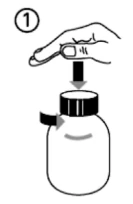
Separate the adaptor from the syringe (figure 2). Insert the adaptor into the bottleneck (figure 3). Ensure it is well fixed. You do not need to remove the adaptor after use.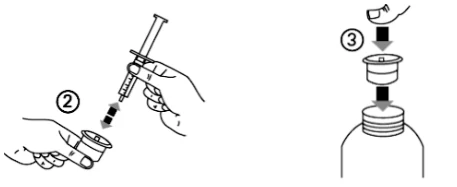
Take the syringe and put it in the adaptor opening (figure 4). Turn the bottle upside down (figure 5).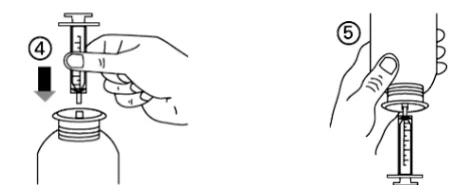
Fill the syringe with a small amount of solution by pulling the piston down (figure 5A), then push the piston upward to remove any possible bubbles (figure 5B). Pull the piston down to the graduation mark corresponding to the quantity in millilitres (ml) prescribed by your doctor (figure 5C).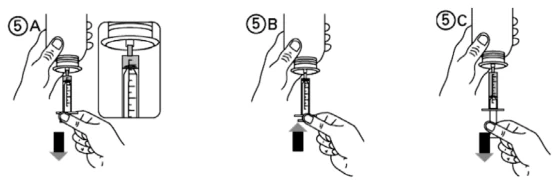
Turn the bottle the right way up (figure 6A). Remove the syringe from the adaptor (figure 6B).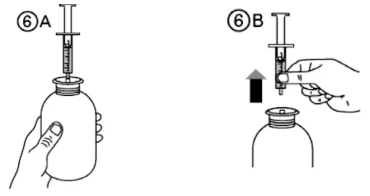
Empty the contents of the oral syringe into your mouth, please ensure that you are sitting upright and the plunger is pushed slowly to allow you to swallow the dose.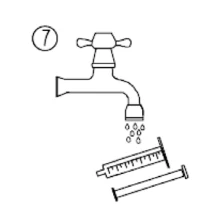
After use close the bottle with the plastic screw cap (you do not need to remove the adaptor).
To clean the oral syringe, rinse with cold water only (figure 7), moving the plunger several times up and down to take up and expel the water, without separating the two components of the syringe.
Keep the bottle, the oral syringe, and the leaflet in the carton.
If you take more Ramipril oral solution than you should
Tell a doctor or go to the nearest hospital casualty department straight away. Do not drive to the hospital, get somebody else to take you or call for an ambulance. Take the medicine pack with you. This is so the doctor knows what you have taken.
If you forget to take Ramipril oral solution
If you forget to take your medicine, take your next dose when it is due. Do not take a double dose to make up for a forgotten dose.
If you stop taking Ramipril oral solution
Your doctor will advise you how long to take this medicine. Your condition may return if you stop using this medicine before you are advised.
If you have any further questions about the use of this medicine, ask your doctor or pharmacist.
4. POSSIBLE SIDE EFFECTS
Like all medicines, this medicine can cause side effects, although not everybody gets them.
Stop taking Ramipril oral solution and see a doctor straight away, if you notice any of the following serious side effects – you may need urgent medical treatment:
Swelling of the face, lips or throat which make it difficult
to swallow or breathe, as well as itching and rashes. This could be a sign of a severe allergic reaction to Ramipril oral solution
Severe skin reactions including rash, ulcers in your
mouth, worsening of a pre-existing skin disease, reddening, blistering or detachment of skin (such as Stevens-Johnson syndrome, toxic epidermal necrolysis or erythema multiform).
Tell your doctor immediately if you experience:
Faster heart rate, uneven or forceful heartbeat
(palpitations), chest pain, tightness in your chest or more serious problems including heart attack and stroke
Shortness of breath or a cough. These could be signs
of lung problems
Bruising more easily, bleeding for longer than normal,
any sign of bleeding (e.g. bleeding from the gums), purple spots, blotching on the skin or getting infections more easily than usual, sore throat and fever, feeling tired, faint, dizzy or having pale skin. These can be signs of blood or bone marrow problems
Severe stomach pain which may reach through to your
back. This could be a sign of pancreatitis (inflammation of the pancreas).
Fever, chills, tiredness, loss of appetite, stomach pain,
feeling sick, yellowing of your skin or eyes (jaundice). These can be signs of liver problems such as hepatitis (inflammation of the liver) or liver damage. Other side effects include:
Tell your doctor if any of the following gets serious or lasts longer than a few days.
Common (may affect up to 1 in 10 people)
- Headache or feeling tired
Feeling dizzy. This is more likely to happen when you
start taking Ramipril or start taking a higher dose
Fainting, hypotension (abnormally low blood pressure),
especially when you stand or sit up quickly
Dry tickly cough, inflammation of your sinuses (sinusitis)
or bronchitis, shortness of breath
Stomach or gut pain, diarrhoea, indigestion, feeling or
being sick
- Skin rash with or without raised area
- Chest pain
- Cramps or pain in your muscles
Blood tests show more potassium than usual in your
blood.
Uncommon (may affect up to 1 in 100 people)
- Balance problems (vertigo)
Itching and unusual skin sensations such as numbness,
tingling, pricking, burning or creeping on your skin (paraesthesia)
- Loss or change in the way things taste
- Sleep problems
Feeling depressed, anxious, more nervous
than usual or restless
Blocked nose, difficulty breathing or worsening
of asthma
A swelling in your gut called “intestinal
angioedema” presenting with symptoms like abdominal pain, vomiting and diarrhoea
- Heartburn, constipation or dry mouth
- Passing more water (urine) than usual over the day
- Sweating more than usual
- Loss or decrease of appetite (anorexia)
- Increased or irregular heartbeats
- Swollen arms and legs. This may be a sign of your body holding onto more water than usual
- Flushing
- Blurred vision
- Pain in your joints
- Fever
- Sexual inability in men, reduced sexual desire in men or women
An increased number of certain white blood cells
(eosinophilia) found during a blood test
- Blood tests showing changes in the way your liver, pancreas or kidneys are working.
Rare (may affect up to 1 in 1,000 people)
- Feeling shaky or confused
- Red and swollen tongue
- Severe flaking or peeling of the skin, itchy, lumpy rash
- Nail problems (e.g. loosening or separation of a nail from its bed)
- Skin rash or bruising
- Blotches on your skin and cold extremities
- Red, itchy, swollen or watery eyes
- Disturbed hearing and ringing in your ears
- Feeling weak
- Blood tests show a decrease in the number of red blood cells, white blood cells or platelets or in the amount of haemoglobin.
Very rare (may affect up to 1 in 10,000 people)
- Being more sensitive to the sun than usual.
Other side effects reported:
Tell your doctor if any of the following gets serious or lasts longer than a few days.
- Difficulty concentrating
- Swollen mouth
- Blood tests showing too few blood cells in your blood
- Blood tests showing less sodium than usual in your blood
- Concentrated urine (dark in colour), feel or are sick, have muscle cramps, confusion and fits which may be due to inappropriate ADH (anti-diuretic hormone) secretion. If you have these symptoms contact your doctor as soon as possible
- Fingers and toes changing colour when you are cold and then tingling or feeling painful when you warm up (Raynaud’s phenomenon)
- Breast enlargement in men
- Slowed or impaired reactions
- Burning sensation
- Change in the way things smell
- Hair loss.
Reporting of side effects
If you get any side effects, talk to your doctor, pharmacist or nurse. This includes any possible side effects not listed in this leaflet. You can also report side effects directly via the Yellow Card Scheme at: www.mhra.gov.uk/yellowcard or search for MHRA Yellow Card in the Google Play or Apple App Store.
By reporting side effects, you can help provide more information on the safety of this medicine.
5. HOW TO STORE RAMIPRIL ORAL SOLUTION
Keep this medicine out of the sight and reach of children. Do not use this medicine after the expiry date, which is stated on the label and carton. The expiry date refers to the last day of that month.
Store in a refrigerator (2°C to 8°C). After first opening, do not refrigerate, store below 25°C. Store in the original package in order to protect from light.
After opening the container, this medicine can be used for 60 days.
If your medicine becomes discoloured or shows signs of deterioration, return it to your pharmacist.
Do not throw away any medicines via wastewater or household waste. Ask your pharmacist how to throw away medicines you no longer use. These measures will help protect the environment.
6. CONTENTS OF THE PACK AND OTHER INFORMATION
What Ramipril oral solution contains
The active substance is ramipril.
Each 5 ml of oral solution contains either 2.5 mg or 5 mg of ramipril.
The other ingredients are methyl para hydroxybenzoate (E218), sucralose, ethyl para hydroxybenzoate (E214), citric acid monohydrate, frozen peppermint flavour 501524 1T and purified water.
What Ramipril oral solution looks like and contents of the pack
Ramipril oral solution is a clear colourless solution. Ramipril oral solution is supplied in a 150ml amber-coloured glass bottle with a child-resistant closure. Each carton contains 1 bottle and a 5 ml oral syringe (graduated at every 0.5ml equivalent to either 0.25mg or 0.5mg) with an adaptor.
Marketing Authorisation Holder
Zydus Pharmaceuticals UK Ltd
Sandretto Building
Cavalry Hill Industrial Park
Weedon Northampton
NN7 4PP UK.
Manufacturer:
LM Manufacturing Limited
Sandretto Building,
Cavalry Hill Industrial Park,
Weedon, Northampton,
NN7 4PP, UK.
This leaflet was last revised on 02/2026.
To request a copy of this leaflet in Braille, large print or audio format, contact the licence holder at the above address or telephone: 0800 9956034 / email: DrugSafety@ZydusUK. com
Material code