

Summary of Product Characteristics (SmPC) - Provocholine 100 mg powder for nebuliser solution
1 NAME OF THE MEDICINAL PRODUCT
Provocholine® 100 mg Powder for nebuliser solution.
2 QUALITATIVE AND QUANTITATIVE COMPOSITION
Each 20 mL vial contains 100 mg methacholine chloride.
3 PHARMACEUTICAL FORM
Powder for nebuliser solution, for inhalation, non-sterile.
White or off-white deliquescent crystalline powder.
4 CLINICAL PARTICULARS
4.1 Therapeutic indications
This medicinal product is for diagnostic use only.
Provocholine is indicated in adults and children (5 years old and older) to detect bronchial airway hyperreactivity, to assist in the diagnosis of asthma when the clinical history is suggestive of the condition but there is normal spirometry and the diagnosis remains uncertain after additional evaluation (see section 4.2, section 4.4 and section 5.1).
4.2 Posology and method of administration
Methacholine challenge, even if correctly performed, may occasionally induce severe bronchospasm. Methacholine challenge should therefore only be conducted in specialist respiratory centres with appropriate resuscitation facilities.
Posology
Adults and Children (aged 5 years and older):
Provocholine is administered only in solution for inhalation.
Before starting a Provocholine® challenge test, baseline spirometry must be performed. For a patient to be able to undergo the test, he or she must present with baseline FEV1 (Forced Expiratory Volume in 1 second) greater than or equal to 60% of the predicted value (in adults and children) and greater than or equal to 1.5 L (in adults).
At commencement of the Provocholine® challenge test and prior to nebulisation with Provocholine®, FEV1 should be measured following exposure to nebulised diluent (post-diluent FEV1). The methacholine challenge test is considered positive if there is a reduction in FEV1 of 20% or more from FEV1 with the recommended diluent. The test should be stopped at this point. The reduction value must be calculated and recorded before starting the test with Provocholine®.
Paediatric population
The safety and efficacy of Provocholine in children under 5 years of age has not been established. No data are available.
Directions for Reconstitution and Dilution Prior to Administration
Preparation and Administration Instructions (Please refer to the training material included on the product website www.provocholine.co.uk prior to preparation of solutions and administration):
Note: Do not inhale the powder. Do not handle this product if you suffer from asthma or allergies. All dilutions must be made with sterile 0.9% sodium chloride solution for injection, using empty, sterile borosilicate Type I glass vials. After adding the sodium chloride solution, shake each vial until you obtain a clear solution.
Preparation of Serial Dilutions:
Refer to Table 1A and Table 1B for the preparation of serial dilutions of Provocholine® for doubling concentrations and quadrupling concentrations, respectively.
Table 1A: Preparation of serial dilutions using a single vial of Provocholine powder 100 mg for nebuliser solution (methacholine chloride) doubling concentrations:
| Take | Add sterile 0.9% | Obtained dilution | Provocholine® | ||||
| Sodium Chloride | Dose* | ||||||
100 mg Provocholine® | 6.25 mL | 16 mg/mL (A) | 380 mcg | ||||
| 3 mL of dilution A | 3 mL | 8 mg/mL (B) | 190 mcg | ||||
| 3 mL of dilution B | 3 mL | 4 mg/mL (C) | 95 mcg | ||||
| 3 mL of dilution C | 3 mL | 2 mg/mL (D) | 47.5 mcg | ||||
| 3 mL of dilution D | 3 mL | 1 mg/mL (E) | 23.75 mcg | ||||
| 3 mL of dilution E | 3 mL | 0.5 mg/mL (F) | 11.875 mcg |
| 3 mL of dilution F | 3 mL | 0.25 mg/mL (G) | 5.938 mcg |
| 3 mL of dilution G | 3 mL | 0.125 mg/mL (H) | 2.969 mcg |
| 3 mL of dilution H | 3 mL | 0.0625 mg/mL (I) | 1.484 mcg |
3 mL of dilution I | 3 mL | 0.03125 mg/mL (J) | 0.742 mcg |
*The Provocholine® dose corresponding to each Provocholine® concentration was determined based on the dose delivered from the English Wright nebuliser for two (2) minutes of nebulisation using dry compressed air to power the nebuliser, with a pressure regulator set to 50 lb/in2 to produce an output within 10% of 0.13 mL·min−1 (or g·min−1) (measured gravimetrically). The English Wright nebuliser generates aerosol with particles between 1.0 and 1.5 μ
m aerodynamic particle mass median diameter (MMD). Nebulisers with MMD between 1.0 and 3.6 μ
m do not influence the response. Other suitable nebulisers may be used as long as the device output and particle size are characterized (or the nebuliser is known to deliver an aerosol with MMD between 1.0 and 3.6 μ
m), and the dose is calculated (see Method of administration).
Table 1B: Preparation of serial dilutions using a single vial of Provocholine® powder (100 mg) for nebuliser solution (methacholine chloride) - quadrupling concentrations
| ADD 0.9% | Provocholine | ||
| SODIUM | Provocholine® | ® Dose* | |
| Take | |||
| CHLORID | Concentration | ||
| E | |||
100 mg Provocholine® | 6.25 mL | 16 mg/mL (A) | 380 mcg |
| 3 mL of dilution A | 9 mL | 4 mg/mL (B) | 95 mcg |
| 3 mL of dilution B | 9 mL | 1 mg/mL (C) | 23.75 mcg |
| 3 mL of dilution C | 9 mL | 0.25 mg/mL (D) | 5.938 mcg |
| 3 mL of dilution D | 9 mL | 0.0625 mg/mL (E) | 1.484 mcg |
*The Provocholine® dose corresponding to each Provocholine® concentration was determined based on the dose delivered from the English Wright nebuliser for two (2) minutes of nebulisation using dry compressed air to power the nebuliser, with a pressure regulator set to 50 lb/in2 to produce an output within 10% of 0.13 mL·min−1 (or g·min−1) (measured gravimetrically). The English Wright nebuliser generates aerosol with particles between 1.0 and 1.5 μ
m aerodynamic particle mass median diameter (MMD). Nebulisers with MMD between 1.0 and 3.6 μ
m do not influence the response. Other suitable nebulisers may be used as long as the device output and particle size are characterized (or the nebuliser is known to deliver an aerosol with MMD between 1.0 and 3.6 μ
m), and the dose is calculated (see Method of administration).
Use a sterile hydrophilic bacterial-retentive filter of pore size 0.22 μ
m (Millex GV® 0.22 μ
- m) when transferring the solution from each vial (at least 2 mL) to the nebuliser.
Method of administration
The testing should only be conducted under specialist medical supervision by a doctor familiar with all aspects of the methacholine challenge test, see section 4.4.
Dosing
Quadrupling increments are recommended for clinical testing1 but if methacholine challenge testing is used to determine changes in airway reactivity following therapy in patients known to have asthma, using doubling doses will give more precise PD20 values.
Tidal Breathing Method:
The following method is based on the use of the Hudson RCI® MicroMist® Small Volume Nebuliser which has been characterised for delivered dose and aerodynamic particle size distribution with respect to the fine particle (≤
5 µm) fraction and mass median aerodynamic diameter.
With the Hudson RCI® MicroMist® Small Volume Nebuliser operated using a suitable air source (such as dry compressed air) to power the nebuliser and a pressure regulator set to 50 lb/in2 (psi) with a flow controller set to a flow rate of 4.5 LPM and a nebulisation time of one (1) minute, the following characteristics were found:
- The delivered dose (of the respirable fraction) was determined to be 380 mcg methacholine chloride for the 16 mg/mL Provocholine® solution.
The % of particles ≤
5 µm (fine particle fraction) was determined to be 75.1% for the 16 mg/mL Provocholine® solution.
- The mass median aerodynamic diameter (MMAD) was 3.4 µm within the range of 1.0 – 3.6 µm2.
The European Respiratory Society (ERS) technical standard 2017 on bronchial challenge testing provides that other suitable nebulisers may be used as long as the device output and particle size are characterized to enable the calculation of dose. Knowledge of the device relating to device output per minute, the particle size distribution, time of tidal breathing and the ratio of inspiratory time to total breathing time will enable the calculation of the Provocholine® dose.
Substituting nebuliser devices with different characteristics (output rate and particle size distribution) would be expected to deliver a different methacholine dose at the same solution concentration.
1 Coates et al 2017 ERS technical standard on bronchial challenge testing: general considerations and performance of methacholine challenge tests Eur Respir J 2017; 49: 1601526
2American Thoracic Society - Guidelines for Methacholine and Exercise Challenge Testing-1999 Am J Respir Crit Care Med Vol 161 pp 309-329, 2000.
In the case of substitution of the nebuliser device and to improve test standardisation, it will be important to report aerosol amount/airway responsiveness to methacholine in terms of dose/PD20, and not concentration/PC20.
- 1. Use the Hudson RCI® MicroMist® Small Volume Nebuliser and a suitable air source (such as dry compressed air) to power the nebuliser.
- 2.
Using a 3 mL syringe and needle, draw up 2-3 mL of the diluent (sterile 0.9%
Sodium Chloride) and place it in the nebuliser vial. Attach the nebuliser and necessary tubing to an appropriate compressed gas source.
- 3. At this time, the subject should be told that subsequent aerosols may produce mild cough, chest tightness or shortness of breath. Tell the subject that if these symptoms become uncomfortable, to remove the face mask or mouthpiece and to stop inhaling the aerosol immediately. Try to avoid suggesting that these symptoms will definitely develop, as suggestion alone can lower the FEV1. Remember that perception of airway narrowing can vary considerably between subjects, making it advisable to watch and listen for other signs such as wheeze and an altered pattern of breathing. Instructions to cease inhaling the aerosol if symptoms become troublesome should be repeated before every dose.
- 4.
Keeping the nebuliser well away from the patient, set the pressure regulator to
50 lb/in2 (psi) and set the flow controller to a flow rate of 4.5 LPM.
- 5.
Instruct the patient to relax and breathe the aerosol quietly (tidal breathing) for
1 minute.
- 6. Place the face mask loosely over the nose and mouth (or the mouthpiece in the mouth). Start the stopwatch immediately. The nebuliser should be kept vertical. The patient should hold the nebuliser so as to avoid warming the solution, and subsequently altering the output.
- 7.
After exactly one minute, remove the nebuliser from the patient's mouth, turn off the flow meter, and discard the solution.
Measure the FEV1 30 and 90 seconds after the end of the inhalation. These values may be left at ambient (spirometer) temperature pressure saturated (ATPS).
- 8. The dose/concentration of the first aerosol of Provocholine® for the methacholine challenge test is either 1.484 mcg/0.0625mg/mL (for quadrupling dosing) or 0.742 mcg/0.0312 mg/mL (if doubling dosing). Subsequent doses are given at 5-minute intervals in doubling or quadrupling doses/concentrations as per dosing increments described in Table 1 A or Table 1 B.
- 9.
Repeat steps 1 through 8 with each increasing dose/concentration of
Provocholine® until the FEV1 has fallen by 20% or more from the post-diluent FEV1, or the highest dose/concentration in Table 1A or Table 1B has been given. At this point, do not give any further aerosols of Provocholine®. Note the last and second last dose of Provocholine® prior to discontinuing inhalations.
- 10.
After the test is completed, administer an inhaled beta-agonist to the patient to expedite the return of the FEV1 to within 90% of baseline and to relieve any discomfort. The majority of patients revert to normal pulmonary function within 5 minutes after administration of a bronchodilator or within 30 – 45 minutes without a bronchodilator.
Wait 10 minutes and measure the FEV1 and Vital Capacity. Patients should not be allowed to leave the laboratory until their FEV1 has returned to within 90% of baseline.
After the test, reusable nebulisers should be sterilized according to manufacturer’s recommendations. Disposable nebulisers should be discarded appropriately.
Calculation and Interpretation of Results:
The provocative concentration causing a 20% fall in FEV1 (PC20) can be calculated as described below:
- 1.
Calculation of PD20
Calculate the PD20 as follows:
- 1.

Where:
D1 = second last Provocholine® dose (< 20% FEV1 decrease)
D2 = last Provocholine® dose (> 20% FEV1 decrease)
R1 = % FEV1 decrease after D1
R2 = % FEV1 decrease after D2
2 . Calculation of PC20
With the tidal breathing method, airway responsiveness may be expressed as that concentration of Provocholine provoking a fall in FEV1 of 20% (PC20). The percent fall in FEV1 can be calculated using the mean baseline FEV1, as shown below: 
% fall in FEV1 is then plotted against the rising concentration of Provocholine (log scale). The PC20 is obtained by linear interpolation between the last two points, as shown in Figure 1.
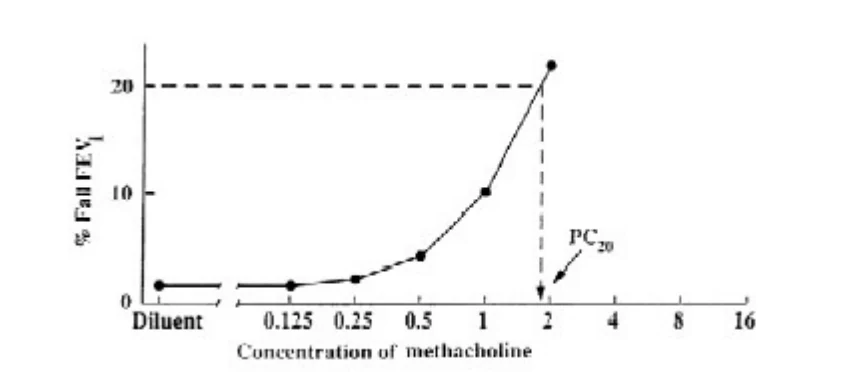 Figure 1: Calculation of PC20
Alternatively, the PC20 may be calculated as follows:

PC20
Where:
C1 = second last concentration (<20% FEV1 fall)
C2 = last concentration (>20% FEV1 fall)
R1 = % fall FEV1 after C1
R2 = % fall FEV1 after C2
- 3. Interpretation of Results
A negative (normal) methacholine challenge result is defined as a FEV1 reduction of less than 20% after all of the doses have been administered. The ERS technical standard on bronchial challenge testing also defines a negative methacholine challenge test as a PD20 > 380 mcg, PC20 > 16 mg/mL).
4.3 Contraindications
Provocholine is contraindicated in the following cases:
- Hypersensitivity to the active substance or other parasympathomimetic agents.
- In children under 5 years of age
- Clinically apparent asthma, wheezing or with results at or below the limit in the baseline respiratory function tests (patients with a baseline FEV1 less than 60% of predicted (in adults and children) and with a baseline FEV1 less than 1.5 L (in adults).
- Patients treated with beta blockers, since the response to methacholine chloride can be emphasized or prolonged and the patient may not respond easily to the treatment used for the restoration of respiration and alleviation of symptoms.
- Repeated administration of Provocholine through inhalation of doses higher than the dose administered on the day of the diagnostic test is contraindicated.
- Bradycardia.
- Known aortic aneurysm.
- Heart attack or stroke in the last 3 months.
- Uncontrolled hypertension.
- Patients with myasthenia gravis undergoing treatment with cholinesterase inhibitors.
- Recent eye surgery
- Risk from elevated intracranial pressure (e.g. cerebral aneurysm)
- Pulmonary embolism
- Pregnancy
- Breast feeding
4.4 Special warnings and precautions for use
The test should be performed in accordance to current clinical practice guidelines. Take full clinical respiratory history, before embarking on methacholine challenge, given the occurrence of false positive test results with methacholine in other respiratory conditions, such as after influenza, upper respiratory tract infections or immunisations, in very old patients or in patients with chronic pulmonary diseases (cystic fibrosis, sarcoidosis, tuberculosis, chronic obstructive pulmonary disease). Challenge testing can be positive in patients with allergic rhinitis without asthma, in smokers, or in patients exposed to aerial contaminants.
Provocholine is to be administered only by inhalation. Provocholine is a bronchoconstrictor agent for diagnostic purposes only and should not be used as a therapeutic agent.
When administered orally or by injection, methacholine chloride is associated with nausea and vomiting, substernal pain or pressure, hypertension, fainting and transient complete heart block.
The challenge testing for Provocholine must only be carried out under specialist medical supervision by a doctor familiar with all aspects of the methacholine inhalation challenge testing technique, all contraindications, warnings and precautions, and the management of respiratory failure. The doctor responsible for the testing must be contactable while it is being carried out and available immediately if needed. If the doctor is carrying out the testing himself, another person must be available to assist him if needed. The patient must never be left unattended during the testing. Emergency equipment and medication must be available immediately to treat acute respiratory failure.
Administration of Provocholine to patients with epilepsy, cardiovascular disease accompanied by bradycardia, vagotonia, peptic ulcer, thyroid disease, urinary tract obstruction or other conditions that could be adversely affected by a cholinergic agent should only be carried out if the doctor deems that the risk/benefit ratio to be positive for the patient.
It is essential that the baseline spirometry is accurate. If the baseline spirometry is not performed or measured accurately, and the initial FEV1 is underestimated, subsequent falls after inhaling Provocholine solutions may not be detected, resulting in too high dose and excessive bronchoconstriction.
As a result of the administration of Provocholine severe bronchoconstriction and a reduction in respiratory function may occur. Patients with airway hyperreactivity can experience bronchoconstriction with doses as low as 0.03125 mg/ml. If severe bronchoconstriction occurs, this must be immediately reversed by administration of a rapid-acting inhaled bronchodilator agent (beta-agonist), precautions for which must be taken when the inhalation challenge testing is performed in patients receiving beta blockers, since it is possible that bronchoconstriction may not be reversed easily.
Subjects who suffer from asthma are noticeably more sensitive to bronchoconstriction induced by methacholine than healthy subjects.
To ensure the safe and effective use of challenge testing with Provocholine, patients should be informed about the symptoms that may occur as a result of the testing and how to manage them.
Laboratory staff with asthma or allergies should be particularly careful and take necessary measures when handling the material or if they are performing testing on patients, see section 6.6.
Paediatric population
Children are also more likely to exhibit positive results due to non-asthmatic increased airways responsiveness. Therefore, it is important for physicians to make sure other possible respiratory conditions are also reviewed in this context.
4.5 Interaction with other medicinal products and other forms of interaction
The concomitant use of Provocholine and beta blockers is contraindicated, see section 4.3.
The following medications for the treatment of asthma inhibit the airways’ response to Provocholine, whereby their use must be interrupted before the test, due to the duration of their effect: beta agonists, anti-muscarinics and theophylline (see the table below for more information).
Table 2: Medications which may decrease airway hyperresponsiveness and withholding time
| Medications | Min. time interval from the last dose to the challenge test (hrs) |
| Short-acting β-agonists in conventional inhaled doses (e.g. Albuterol 200 μg) | 6 |
| Long-acting β-agonists (e.g. salmeterol) | 36 |
Ultra-long-acting β-agonists (e.g. indacaterol, vilanterol, olodaterol) | 48 |
| Ipratropium (Atrovent 40 μg) | 12 |
| Long-acting anti-muscarinic agents | ≥ 168 |
| Oral theophylline | 12-24 |
4.6 Fertility, Pregnancy and lactation
lactation
Pregnancy:
There have been no animal reproduction studies with methacholine chloride. It is not known whether methacholine chloride can cause harm to the foetus when administered to pregnant patients. An inadequate oxygen supply during pregnancy can be harmful to the child.
Breast-feeding:
It is unknown whether methacholine chloride is excreted in human milk.
Fertility:
It is not known whether methacholine chloride affects fertility.
4.7 Effects on ability to drive and use machines
Provocholine has no influence on the ability to drive and on the use of machines.
4.8 Undesirable effects
Adverse reactions associated with inhaled methacholine challenge tests are rare, and include incidences of headache, throat irritation, light-headedness and itching. A positive reaction to methacholine challenge may produce symptoms of bronchospasm, such as chest tightness, cough or wheezing that may require reliever bronchodilators.
The adverse reactions are classified by System Organ Class and frequency defined as follows: Very Common (≥
1/10); Common (≥
1/100, <1/10); Uncommon (≥
1/1,000, <1/100); Rare (≥
1/10,000, <1/1,000); Very Rare (<1/10,000), not known (cannot be estimated from the available data). Undesirable effects were associated with 153 inhaled methacholine chloride challenge tests.
Nervous System Disorders
Rare: Headache, dizziness
Respiratory, thoracic and mediastinal disorders
Rare: Throat irritation
Not known: Bronchospasm, chest tightness, cough, wheezing
Skin and subcutaneous tissue disorders
Rare: Itching
Reporting of suspected adverse reactions:
Reporting suspected adverse reactions after authorisation of the medicinal product is important. It allows continued monitoring of the benefit/risk balance of the medicinal product. Healthcare professionals are asked to report any suspected adverse reactions via the Yellow Card Scheme at www.mhra.gov.uk/yellowcard.
4.9 Overdose
Provocholine is administered only by inhalation. When administered orally or by injection overdose of methacholine chloride can cause syncope, with cardiac arrest and loss of consciousness. Serious toxic reactions should be treated with 0.5 – 1 mg of atropine sulphate, administered IM or IV.
5 PHARMACOLOGICAL PROPERTIES
5.1 Pharmacodynamic properties
Pharmacotherapeutic group: Other diagnostic agents, ATC code: V04CX03
Methacholine chloride is the β
-methyl derivative of acetylcholine and differs from this principally in its long duration and selectivity of action. Bronchial smooth muscle contains significant parasympathomimetic (cholinergic) innervation.
The pharmacological basis for the challenge testing with methacholine chloride in solution is that subjects who suffer from asthma are noticeably more sensitive to induced bronchoconstriction than healthy subjects.
Bronchoconstriction occurs when the vagus nerve is stimulated and acetylcholine is released from the nerve endings. Muscle constriction is essentially confined to the site of release, since acetylcholine is rapidly converted by acetylcholinesterase.
When there is chronic airflow limitation with an FEV1/VC of <70%, the test can be abnormal due to other pathophysiological causes such as smoker's bronchitis, emphysema or cystic fibrosis.
Compared with acetylcholine, methacholine chloride is hydrolysed more slowly by acetylcholinesterase, being practically resistant to inactivation by nonspecific cholinesterase or pseudocholinesterase.
Methacholine challenge aims to detect bronchial airways hyperreactivity to assist in the diagnosis of asthma, when there is diagnostic uncertainty following normal spirometry, and there is either:
- Fractional exhaled nitric oxide (FeNO) level of 40 ppb or more and no variability in peak flow reading; or
- FeNO level of 39 ppb or less with variability in peak flow readings.
Methacholine used in Direct challenge tests3
The most widely-used method of measuring airway responsiveness relies on measuring response in terms of change in FEV1 a set time after inhalation of increasing concentrations of histamine or methacholine. Two thirds, or more, of adults with a positive methacholine challenge have asthma and the false negative rate is less than 10%. Tests of airway responsiveness are of little value in patients with established airflow obstruction as the specificity is low.
Methacholine challenge tests in schoolchildren only marginally increase the diagnostic accuracy after the symptom history is taken into account. However, in a child, a negative methacholine test, which has a high negative predictive value, makes a diagnosis of asthma improbable.
Clinical Studies
3 BTS-Guideline for the management of asthma 2019
In 1,500 asthma patients and 500 non-asthma patients (both atopic and non-atopic), 90% of the asthmatic patients had a medium or highly positive response to methacholine chloride. Less than 5% of individuals with allergies or non-atopic control subjects demonstrated a highly positive response. 27% of patients with allergies had a negative response compared to 49% of control subjects. Patients with allergies and healthy patients had a similar incidence of positive responses. 30% of patients with allergies had a medium-positive response compared with 18% of healthy patients with a family history of asthma and 8% of control subjects with a healthy family history. Differences were observed with healthy subjects where there is no family history of asthma.
Amongst the asthmatic patients, the severity of the asthma determined the bronchial sensitivity of the subjects to the challenge testing with methacholine. The sensitivity varied from 100 to several thousand times compared with that of normal subjects. However, in ex-asthmatic subjects, the level of bronchoconstriction was also related to the severity of previous asthmatic symptoms. The average sensitivity of ex-asthmatic subjects was, approximately, one tenth compared to asthmatic subjects.
In population studies, the prevalence of hyperreactivity to methacholine chloride ranges from 8 to 15%. Whilst the sensitivity level of asthmatic subjects is similar to that of non-asthmatic subjects, asthmatic subjects respond to average lower doses. Less sensitive asthmatic subjects generally have moderate, more stable diseases. The interpretation is easier when the result is either essentially positive (PC20 < 1mg/ml or PD20 < 10 cumulative respiratory units), or clearly negative (minimum change in FEV1 with the maximum released dose).
A study investigating whether prostaglandin synthesis produces methacholine tolerance, revealed that the attenuation of methacholine's effect with repeated testing is not due solely to prostaglandin synthesis and must involve, in part, other mechanisms, such as changes in methacholine deposition, agonist-receptor interactions, or post-receptor responses. In addition, prostaglandin inhibitors may increase baseline methacholine responsiveness in healthy non-asthmatic subjects (Haber and Beckett, 1992).
Using a maximal methacholine concentration of 16 mg/ml in a study that assessed methacholine to predict exercise-induced bronchoconstriction and a clinical diagnosis of asthma, had shown no serious adverse reactions developed by the participants in the study (Anderson et al., 2009).
Paediatric population
A study evaluated methacholine sensitivity in 166 young subjects (mean age 10 years, range 5 to 22 years) who had normal resting spirometry but who presented with signs and symptoms suggesting lower airways hyperreactivity. Nine concentrations of methacholine from 0.075 to 25 mg/ml were used. The challenge test confirmed the severity of symptoms of asthma which matched the sensitivity to methacholine. Children who were positive were more likely to be receiving asthma therapy at the 1-year follow up.
5.2 Pharmacokinetic properties
The extent of systemic absorption of methacholine after inhalation in humans is unknown due to an absence of pharmacokinetic data. See section 5.1 for information on systemic cholinergic pharmacodynamic effects following inhalational administration of methacholine.
5.3 Preclinical safety data
The acute (24 hour) oral LD50 of methacholine chloride and related compounds is 1,100 mg/kg in mice and 750 mg/kg in rats.
Studies of inhaled administration of methacholine chloride for 7 days in monkeys (0.02, 0.08 and 0.4 mg/kg) led to expected dose-dependent bronchoconstriction. This was characterized by an increase in respiratory rate and a decrease in tidal volume after 30 seconds. These changes reached a peak at 2 minutes, followed by a rise in pulmonary resistance and a decrease in compliance. Pulmonary function returned to normal 20 – 25 minutes after exposure ended. Although a typical pulmonary response / recovery sequence was observed after 7 days of repeat dosing, distinct changes in airway resistance were recorded at the end of the study. These changes were not reversed quickly in the maximum equivalent standard dose group, which were observed for 9 weeks.
A bacterial in vitro genotoxicity (Ames) study showed no evidence of mutagenic potential. No long-term animal studies of the carcinogenic effect of methacholine chloride have been performed. In addition, no reproductive toxicity studies have been performed.
6 PHARMACEUTICAL PARTICULARS
6.1 List of excipients
None
6.2 Incompatibilities
Not applicable
6.3 Shelf life
- Unreconstituted vials (powder): 3 years.
- Reconstituted vials should be used immediately, discard any remainder.
6.4 Special precautions for storage
- Unreconstituted vials (powder): Do not store above 30 ºC.
- Reconstituted vials should be used immediately, discard any remainder.
- Reconstituted solution should not be frozen.
6.5 Nature and contents of container
Provocholine is presented in 20 mL amber Type I borosilicate glass vials with flip-off caps, containing 100 mg of methacholine chloride, packed in a carton containing 6 vials.
6.6 Special precautions for disposal
Provocholine is a potent bronchoconstrictor. Do not inhale the powder. Do not handle this material if you have asthma or hay fever. A low resistance filter should be applied to an expiratory port of any dosing apparatus, as necessary, to prevent Provocholine aerosol from being released into the air of the room.
Provocholine is intended for single use only. Reconstituted vials should be used immediately. Any unused liquid should be disposed of safely. Reconstituted solution should not be refrigerated or frozen.
When using Provocholine, any unused solution should be discarded from the nebuliser after each concentration.
7 MARKETING AUTHORISATION HOLDER
Methapharm Ltd.
The Black Church
St Mary's Place
Dublin 7
D07 P4AX
8 MARKETING AUTHORISATION NUMBER(S)
PL 60289/0001
9 DATE OF FIRST AUTHORISATION/RENEWAL OF THE
AUTHORISATION
01/09/2026
10 DATE OF REVISION OF THE TEXT
01/09/2026