

Summary of medicine characteristics - Propiverine 15 mg film-coated tablets
1 NAME OF THE MEDICINAL PRODUCT
Propiverine 15 mg film-coated tablets
2 QUALITATIVE AND QUANTITATIVE COMPOSITION
Each film-coated tablet contains 15 mg propiverine hydrochloride (equivalent to 13.64 mg propiverine).
For the full list of excipients, see section 6.1.
3 PHARMACEUTICAL FORM
Film-coated tablet
White, round, biconvex film-coated tablets
4 CLINICAL PARTICULARS
4.1 Therapeutic indications
Symptomatic treatment of urinary incontinence and/or increased urinary frequency and urgency as may occur in patients with overactive bladder syndrome or neurogenic detrusor overactivity (detrusor hyperreflexia) from spinal cord injuries, e.g. transverse lesion paraplegia
4.2 Posology and method of administration
Posology
The recommended daily doses are as follows:
Adults: As a standard dose one film-coated tablet (= 15 mg propiverine hydrochloride) twice daily is recommended, this may be increased to three times daily. Some patients may already respond to a dosage of 15 mg daily.
For neurogenic detrusor overactivity a dose of one film-coated tablet three times daily is recommended. The maximum recommended daily dose is 45 mg.
Elderly: Generally there is no special dosage regimen for the elderly (see section 5.2).
Paediatric population: Due to a lack of data Propiverine should not be used in children.
Caution should be exercised and physicians should monitor patients carefully for side effects in the following dispositions (see sections 4.4, 4.5, 5.2):
Use in renal impairment
In patients with mild to moderate impairment of renal function, no dose adjustment is required; however, they should be treated with caution. In patients with severely impaired renal function (creatinine clearance < 30 ml/min) the maximum daily dose is 30 mg.
Use in hepatic impairment
In patients with mildly impaired hepatic function there is no need for a dose adjustment; however, treatment should proceed with caution. No studies have been performed to investigate the use of propiverine in patients with moderately or severely impaired hepatic function. Its use is therefore not recommended in these patients.
Patients receiving concomitant treatment with drugs that are potent inhibitors of CYP 3A4 combined with methimazole:
In patients receiving drugs that are potent flavin-containing monooxygenase (FMO) inhibitors such as methimazole in combination with potent CYP 3A4/5 inhibitors treatment should start with a dose of 15 mg per day. The dose may thereafter be titrated to a higher dose. However, caution should be exercised and physicians should monitor these patients carefully for side effects (see sections 4.5, 5.2).
A high fat meal increases the bioavailability of propiverine. Therefore, propiverine should be taken before a meal, especially in patients with renal or hepatic impairment (see section 5.2).
Method of administration
For oral use.
4.3 Contraindications
The drug is contraindicated in patients who have demonstrated hypersensitivity to the active substance or to any of the excipients listed in section 6.1 and in patients suffering from any of the following disorders:
- obstruction of the bowel
- significant degree of bladder outflow obstruction where urinary retention may be anticipated
- myasthenia gravis
- intestinal atony
- severe ulcerative colitis
- toxic megacolon
- uncontrolled angle closure glaucoma
- moderate or severe hepatic impairment
- tachyarrhythmias.
4.4 Special warnings and precautions for use
The drug should be used with caution in patients suffering from:
- autonomic neuropathy
- renal impairment (see section 4.2)
- hepatic impairment (see section 4.2)
Symptoms of the following diseases may be aggravated following administration of the drug:
- severe congestive heart failure (NYHA IV)
- prostatic enlargement
- hiatus hernia with reflux oesophagitis
- cardiac arrhythmia
- tachycardia
Propiverine, like other anticholinergics, induces mydriasis. Therefore, the risk to induce acute angle-closure glaucoma in individuals predisposed with narrow angles of the anterior chamber may be increased.
Drugs of this class, including propiverine, have been reported to induce or precipitate acute angle-closure glaucoma.
Pollakiuria and nocturia due to renal disease or congestive heart failure as well as organic bladder diseases (e.g. urinary tract infections, malignancy) should be ruled out prior to treatment.
4.5 Interaction with other medicinal products and other forms of interaction
Increased effects due to concomitant medication with tricyclic antidepressants (e.g. imipramine), tranquillisers (e.g. benzodiazepines), anticholinergics (if applied systematically), amantadine, neuroleptics (e.g. phenothiazines) and beta-adrenoceptor agonists (beta-sympathomimetics).
Decreased effects due to concomitant medication with cholinergic drugs.
Reduced blood pressure in patients treated with isoniazid.
The effect of prokinetics such as metoclopramide may be decreased.
Pharmacokinetic interactions are possible with other drugs metabolised by cytochrome P450 3A4 (CYP 3A4). However, a very pronounced increase of concentrations for such drugs is not expected as the effects of propiverine are small compared to classical enzyme inhibitors (e.g. ketoconazole or grapefruit juice). Propiverine may be considered a weak inhibitor of cytochrome P450 3A4. Pharmacokinetic studies with patients concomitantly receiving potent CYP 3A4 inhibitors such as azole antifungals (e.g. ketoconazole, itraconazole) or macrolide antibiotics (e.g. erythromycin, clarithromycin) have not been performed.
Patients receiving concomitant treatment with drugs that are potent inhibitors of CYP 3A4 combined with methimazole:
In patients receiving drugs that are potent flavin-containing monooxygenase (FMO) inhibitors such as methimazole in combination with potent CYP 3A4/5 inhibitors treatment should start with a dose of 15 mg per day. The dose may thereafter be titrated to a higher dose. However, caution should be exercised and physicians should monitor these patients carefully for side effects (see sections 4.2, 5.2).
4.6 Fertility, Pregnancy and lactation
Pregnancy
There are no data from the use of propiverine in pregnant women. Studies in animals have shown reproductive toxicity (see section 5.3). Propiverine is not recommended during pregnancy.
Breast-feeding
It is unknown whether propiverine or metabolites are excreted in human milk. Available pharmacodynamic/ toxicological data in animals have shown excretion of propiverine or metabolites in milk. A risk to the newborn or infant cannot be excluded.
A decision must be made whether to discontinue breast-feeding or to discontinue/ abstain from propiverine therapy taking into account the benefit of breast-feeding for the child and the benefit of therapy for the woman.
Fertility
There are no human data on the effect of propiverine on fertility. Animal studies do not indicate direct or indirect harmful effects with respect to fertility (see section 5.3).
4.7 Effects on ability to drive and use machines
No studies on the effects on the ability to drive or use machines have been performed.
Propiverine may produce drowsiness and blurred vision. This may impair the patient's ability to exert activities that require mental alertness such as operating a motor vehicle or other machinery, or to exert hazardous work while taking this drug.
Sedative drugs may enhance the drowsiness caused by propiverine hydrochloride.
4.8 Undesirable effects
Within each system organ class, the undesirable effects are ranked under headings of frequency using the following convention:
Very common (≥1/10)
Common (≥1/100 to <1/10)
Uncommon (≥1/1,000 to <1/100)
Rare (≥1/10,000 to <1/1,000)
Very rare (<1/10,000)
Not known (cannot be estimated from the available data)
All undesirable effects are transient and recede after a dose reduction or termination of the therapy after maximum 1 - 4 days.
| MedDRA System Organ Class | Frequency | Adverse reaction |
| Immune system disorders | Rare | Hypersensitivity |
| Psychiatric disorders | Very rare | Restlessness, confusion |
| Not known | Hallucination | |
| Nervous system disorders | Common | Headache |
| Uncommon | Tremor, dizziness, dysgeusia | |
| Not known | Speech disorder | |
| Eye disorders | Common | Accommodation disorder, visual impairment |
| Cardiac disorders | Rare | Tachycardia |
| Very rare | Palpitation | |
| Vascular disorders | Uncommon | Decreased blood pressure with drowsiness, flushing |
| Gastrointestinal disorders | Very common | Dry mouth |
| Common | Constipation, abdominal pain, dyspepsia | |
| Uncommon | Nausea/vomiting | |
| Skin and subcutaneous tissue disorders | Uncommon | Pruritus |
| Rare | Rash | |
| Renal and urinary disorders | Uncommon | Urinary retention, bladder and urethral symptoms |
| General disorders and administration site conditions | Common | Fatigue |
During long-term therapy hepatic enzymes should be monitored, because reversible changes of liver enzymes might occur in rare cases.
Reporting of suspected adverse reactions
Reporting suspected adverse reactions after authorisation of the medicinal product is important. It allows continued monitoring of the benefit/risk balance of the medicinal product. Healthcare professionals are asked to report any suspected adverse reactions via the Yellow Card Scheme at: www.mhra.gov.uk/yellowcard or search for MHRA Yellow Card in the Google Play or Apple App Store.
4.9 Overdose
Symptoms
Overdose with the muscarinic receptor antagonist propiverine can potentially result in severe anticholinergic effects. Peripheral and central nervous system disturbances may occur, such as:
- severe dry mouth
- bradycardia, possibly leading to tachycardia in the future course
- mydriasis and accommodation disorder
- urinary retention
- inhibition of intestinal motility
- restlessness, confusion, hallucination, confabulation
- dizziness, nausea, speech disorder, muscular weakness
Treatment
- In the event of overdose with propiverine the patient should be treated with activated charcoal suspension with plenty of water.
- Gastric lavage should only be taken into consideration with protective intubation, use of an oiled tube (dryness of mucosa) and if performed within 1 hour after ingestion of propiverine. Vomiting must not be induced.
- Forced diuresis or hemodialysis is not effective to enhance the renal elimination.
- In case of severe central anticholinergic effects such as hallucinations or pronounced excitation antidote treatment physostigmine can be attempted.
- Convulsion or pronounced excitation: treatment with benzodiazepines.
- Respiratory insufficiency: treatment with artificial respiration.
- Urinary retention: treatment with catheterization.
- Mydriasis: treatment with pilocarpine eye drops and/or darkening of the patient’s room.
5 PHARMACOLOGICAL PROPERTIES
5.1 Pharmacodynamic properties
Pharmacotherapeutic group: Urologicals, drugs for urinary frequency and incontinence, ATC code: G04BD06
Mechanism of action
Inhibition of calcium influx and modulation of intracellular calcium in urinary bladder smooth muscle cells causing musculotropic spasmolysis.
Inhibition of the efferent connection of the nervus pelvicus due to anticholinergic action.
Pharmacodynamic effects
In animal models propiverine hydrochloride causes a dose-dependent decrease of the intravesical pressure and an increase in bladder capacity.
The effect is based on the sum of the pharmacological properties of propiverine and the active urinary metabolites as shown in isolated detrusor strips of human and animal origin.
5.2 Pharmacokinetic properties
General characteristics of the active substance
Propiverine is nearly completely absorbed from the gastrointestinal tract. It undergoes extensive first pass metabolism. Effects on urinary bladder smooth muscle cells are due to the parent compound and three active metabolites as well, which are rapidly excreted into the urine.
Absorption
After oral administration of Propiverine 15 mg film-coated tablets propiverine is rapidly absorbed from the gastrointestinal tract with maximal plasma concentrations reached after 2.3 hours. The mean absolute bioavailability of Propiverine 15 mg film-coated tablets is 40.5 % (arithmetic mean value for AUC0-∞ (p.o.) / AUC0-∞ (i.v.)).
Food intake increases the bioavailability of propiverine (mean increase 1.3fold), but does not significantly affect the maximum plasma concentrations of propiverine or of its main metabolite, propiverine-N-oxide. This difference in bioavailability is unlikely to be of clinical significance but adjustment of dose in relation to food intake could be required in patients suffering from impaired renal or hepatic function. Therefore, a regular intake before meals is recommended.
Distribution
After administration of Propiverine 15 mg film-coated tablets t.i.d., steady state is reached after four to five days at a higher concentration level than after single dose application (Caverage = 61 ng/ml). The volume of distribution was estimated in 21 healthy volunteers after intravenous administration of propiverine hydrochloride to range from 125 to 473 l (mean 279 l) indicating that a large amount of available propiverine is distributed to peripheral compartments. The binding to plasma proteins is 90 - 95 % for the parent compound and about 60 % for the main metabolite.
Plasma concentrations of propiverine in 16 healthy volunteers after single and repeated administration of Propiverine 15 mg film-coated tablets (t.i.d. for 6 days):
single dose multiple dose 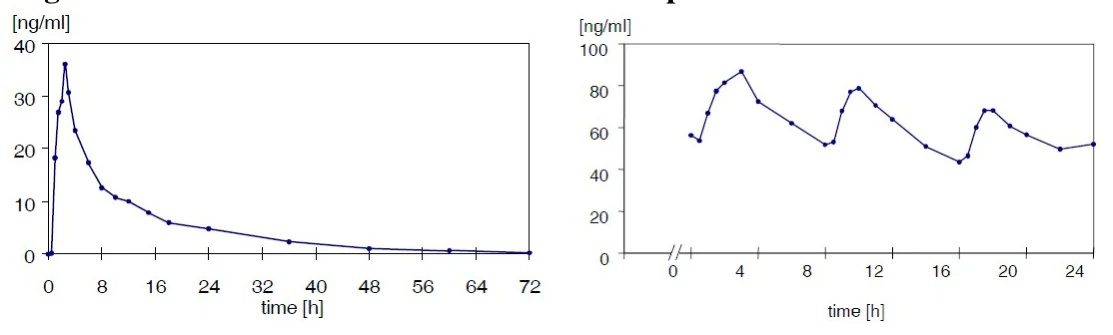
Steady state characteristics of propiverine following multiple-dose administration to 16 healthy volunteers of Propiverine 15 mg film-coated tablets (t.i.d. for 6 days):
Dose interval | AUC0-τ τ | PTF | Caverage | |||
| [h] | [ng·h/ml] | CV [%] | [%] | CV [%] | [ng/ml] | CV [%] |
| 0 - 8 | 515 | 35 | 57 | 16 | 64 | 36 |
| 8 - 16 | 460 | 33 | 70 | 25 | 57 | 33 |
| 16 - 24 | 421 | 36 | 52 | 39 | 52 | 36 |
| CV: coefficient of variation PTF: peak-trough fluctuation | ||||||
Biotransformation
Propiverine is extensively metabolised by intestinal and hepatic enzymes. The primary metabolic route involves the oxidation of the Piperidyl-N and is mediated by CYP 3A4 and flavin-containing monooxygenases (FMO) 1 and 3 and leads to the formation of the much less active N-oxide, the plasma concentration of which greatly exceeds that of the parent substance. Four metabolites were identified in urine; two of them are pharmacologically active and may contribute to the therapeutic efficacy of Propiverine 15 mg film-coated tablets.
In vitro there is a slight inhibition of CYP 3A4 and CYP 2D6 detectable which occurs at concentrations exceeding therapeutic plasma concentrations 10- to 100-fold (see section 4.5).
Elimination
Following administration of 30 mg oral dose of 14C-propiverine hydrochloride to healthy volunteers, 60 % of radioactivity was recovered in urine and 21 % was recovered in faeces within 12 days. Less than 1% of an oral dose is excreted unchanged in the urine. Mean total clearance after single dose administration of 30 mg is 371 ml/min (191 – 870 ml/min). In three studies including a total of 37 healthy volunteers the mean elimination half-life was 14.1, 20.1, and 22.1 hours, respectively.
Linearity/ non-linearity
Pharmacokinetic parameters of propiverine and propiverine-N-oxide following oral administration of 10 - 30 mg of propiverine hydrochloride are linearly related to dose.
There are no changes of pharmacokinetics during steady state compared to single dose administration.
Characteristics in patients
Renal impairment:
Severe renal impairment does not significantly alter the disposition of propiverine and its main metabolite, propiverine-N-oxide, as deduced from a single dose study in 12 patients with creatinine clearance < 30 ml/min. No dose adjustment is to be recommended as long as the total daily dose does not exceed 30 mg (i.e. Propiverine 15 mg film-coated tablets given b.i.d.). In case that higher dose (i.e. 45 mg) shall be administered a careful titration of dose is recommended considering anticholinergic effects as a marker for tolerability.
Hepatic insufficiency:
There were similar steady state pharmacokinetics in 12 patients with mild to moderate impairment of liver function due to fatty liver disease as compared to 12 healthy controls. No data are available for severe hepatic impairment.
Age:
The comparison of trough plasma concentrations during steady state (Propiverine 15 mg film-coated tablets t.i.d. for 28 days) reveals no difference between older patients (60 – 85 years; mean 68) and young healthy subjects. The ratio of parent drug to metabolite remains unchanged in older patients indicating the metabolic conversion of propiverine to its main metabolite, propiverine-N-oxide, not to be an age-related or limiting step in the overall excretion.
Patients with glaucoma:
Intraocular pressure in patients with open angle glaucoma and in patients with treated (controlled) angle closure glaucoma is not increased by Propiverine 15 mg film- coated tablets t.i.d., as demonstrated by two placebo-controlled studies.
5.3 Preclinical safety data
In long term oral dose studies in two mammalian species the main treatment related effects were changes in the liver (including elevation of hepatic enzymes). These were characterised by hepatic hypertrophy and fatty degeneration. The fatty degeneration was reversible upon cessation of treatment.
No effects on male and female fertility and reproduction behaviour were observed in toxicological studies with rats.
In animal studies, skeletal retardation in the offspring occurred when the drug was administered orally at high doses to pregnant females. In lactating mammals propiverine was excreted into the milk.
There was no evidence of mutagenicity. The carcinogenicity study in mice demonstrated an increased incidence of hepatocellular adenoma and carcinoma in high dose males. In the rat carcinogenicity study hepatocellular adenoma, kidney adenoma and urinary bladder papilloma has been demonstrated in high dose male rats, while in female animals endometrial stromal polyps were increased at the high dose levels. Both the rat and mouse tumours were considered to be species specific and therefore not of clinical relevance.
6 PHARMACEUTICAL PARTICULARS
6.1 List of excipients
Tablet core:
Colloidal anhydrous silica
Pregelatinised starch
Calcium hydrogen phosphate dehydrate
Microcrystalline cellulose
Magnesium stearate
Film-coating:
Opadry II 85F18378, which contains:
Poly(vinyl alcohol)
Titanium dioxide (E 171)
Macrogol 3350
Talc
6.2 Incompatibilities
Not applicable
6.3 Shelf life
5 years
6.4 Special precautions for storage
This medicinal product does not require any special storage conditions.
6.5 Nature and contents of container
PVC/aluminium foil blisters containing 28, 30, 49, 50, 56, 98 or 100 film-coated
6.6 Special precautions for disposal
No special requirements.
7 MARKETING AUTHORISATION HOLDER
Ennogen IP Ltd,
Unit G4,
Riverside Industrial Estate, Riverside Way,
Dartford,
DA1 5BS
UK
8 MARKETING AUTHORISATION NUMBER(S)
PL 55612/0050
9 DATE OF FIRST AUTHORISATION/RENEWAL OF THE
AUTHORISATION
12/05/2025
10 DATE OF REVISION OF THE TEXT
12/05/2025