

Patient leaflet - Prednisolone Sodium Phosphate 5 mg/ml eye drops, solution in single-dose Container
What this medicine is and what it is used for
This medicine is an eye drop, solution in single-dose containers. It contains prednisolone sodium phosphate, which belongs to a group of medicines called corticosteroids; these medicines have an anti-inflammatory action. Prednisolone is used in adults for the short-term treatment of inflammatory eye diseases of the anterior part of the eye that has not occurred due to an infection and which respond to corticosteroid treatment.
What you need to know before you use this medicine
Do not use this medicine
y If you are allergic to prednisolone sodium phosphate or any of the other ingredients of this medicine (listed in section 6).
y If you are suffering from an eye infection which is not being treated with appropriate co-therapy. y If you have an eye ulcer which is not being treated with appropriate co-therapy.
y If you have increased eye pressure (glaucoma) which cannot be sufficiently controlled by medicinal products. y If you have an acute herpes simplex infection (dendritic keratitis).
Warnings and precautions
Talk to your doctor or pharmacist before using this medicine. This medicine should never be used if you have a red eye, unless you have been diagnosed with an infection. Take special care with this medicine, if you have a history of viral eye infection (herpes). In this case, this medicine may only be used under strict medical supervision. Talk to your doctor before using this medicine, if you have ever suffered from this condition in the past.
Talk to your doctor before using this medicine, if you currently have, or have ever had, any of the
following conditions:
- eye ulcers or a history of tissue thinning as a result of disease or eye treatment.
- if you have glaucoma or if you are being treated for increased inner eye pressure.
 - if you have been operated for the clouding of the lens (cataract).
- eye infections caused by bacteria, viruses (e.g. herpes virus) or fungi.
Long-term use (more than one month) should be avoided. If long-term use is necessary (for several weeks), the ophthalmologist should check the pressure in your eye on
a regular basis, due to the risk of increased pressure in your eye.
Contact your doctor if you experience blurred vision or other visual disturbances.
Corticosteroids can mask or exacerbate an eye infection. If there is no improvement in your symptoms after several days of use, contact your doctor. In some cases, the use of this medicine may have to be stopped and another treatment should be considered.
Before using this medicine, tell your doctor, if you are, or have been using, other eye drops containing steroids, as frequent or prolonged use of steroids can lead to additional side effects.
You should avoid wearing contact lenses during treatment with this medicine.
Children
The safety and efficacy of this medicine in children have not yet been established.
Other medicines and Prednisolone
Tell your doctor or pharmacist if you are taking, have recently taken or might take any other medicines. Apart from the use of this medicine, if you need to use other eye drops that can increase the pressure in the eye, this side effect can be enhanced.
Pregnancy and breast-feeding
If you are pregnant, think you may be pregnant or are planning to have a baby, ask your doctor or pharmacist for advice before taking this medicine.
Pregnancy
If you are pregnant, ask your doctor or pharmacist for advice before taking this medicine.
Breast-feeding
If you are breast-feeding, ask your doctor or pharmacist for advice before taking this medicine.
Driving and using machines
This medicine is not expected to affect the ability to drive and use machines.
However, if your vision is temporarily blurred after instilling the eye drops, wait until your vision is normal before driving or using machines.
This medicine contains phosphates
This medicinal product contains 0.07mg phosphates in each drop, which is equivalent to 1.8mg/ml. If you suffer from severe damage to the clear layer at the front of the eye (the cornea), phosphates may cause in very rare cases cloudy patches on the cornea due to calcium build-up during treatment.
How to use this medicine
Always use this medicine exactly as your doctor or pharmacist has told you. Check with your doctor or pharmacist if you are not sure.
Unless otherwise prescribed by the doctor, instil 1-2 drops 3-4 times daily into the lower eyelid of the affected eye(s). During the first two days of treatment, you may be instructed to use the eye drops up to every 1 to 2 hours. The use should then be reduced slowly in the following days and weeks.
The duration of treatment is determined by your doctor. If symptoms have not subsided after 2 days, consult your doctor. If you need to be treated for more than 10 days, your ophthalmologist must regularly check your cornea and eye/ eyes pressure.
Use should then be slowly reduced over the following days and weeks.
Use in children
Because of the lack of sufficient safety and efficacy data, no recommendation on a posology can be made. Directions for use
Ocular use only: this medicine is
eye drops to be used in the eye.
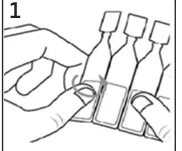
- 1. Wash your hands.
- 2.
Open the package and remove a
container from the sachet. Break off
one single-dose container from the strip (see picture 1).
1
- 3.
Twist and pull cap to separate from
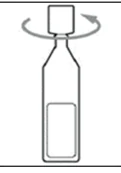 the body of the container (see
picture 2).
- 4.
Lean back your head and pull your
lower eyelid down gently with the
index finger, until there is a ‘pocket’
between eyelid and eye. Position
the tip of the dripper very closely 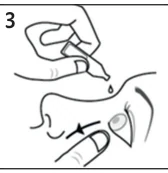 to your eye. Look upwards and
then carefully place 1 or 2 drops
inside your lower eyelid
(see picture 3).
To prevent contamination, please
ensure that the dispenser tip does
not touch your eye nor the eyelid 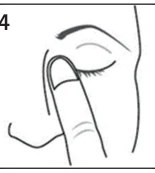 or the area around the eye or any
other objects.
- 5.
Let go of the lower lid, close your
eye and press onto the corner of
your eye beside the nose for a
minute or gently close the eyelid
(see picture 4).
Please immediately clean excess overflow from the face. This prevents this medicine from passing into the rest of the body via the tear duct and the skin.
If you use this medicine in both eyes, repeat the procedure for the other eye.
Discard the opened container after use.
If more than one topical ophthalmic medicinal product is being used, the medicines must be administered at least 5 minutes apart. Eye ointments should be administered last. If you use more Prednisolone than you should Instillation of too many drops into the eye(s) is unlikely to lead to unwanted side effects. If you have inserted too many drops into your eye(s), rinse out your eye(s) with clear water. If this medicine has been drunk by mistake, is also unlikely to lead to unwanted side effects. If any of the above applies to you, tell your doctor immediately.
If you forget to use this medicine
Do not take a double dose to make up for a forgotten dose. You should take the missed dose as soon as you remember, unless it is nearly time for the next dose. If it is nearly time for the next dose, you should take that dose only and not a double dose.
If you stop using this medicine
Your doctor will tell you how long you should use this medicine. Do not stop the treatment before then, because your symptoms may return or get worse. Never stop treatment without talking to your doctor.
If you have any further questions on the use of this medicine, ask your doctor or pharmacist.
Possible side effects
Like all medicines, this medicine can cause side effects, although not everybody gets them.
If you experience eye pain, you should contact your doctor immediately as it may be due to ulcers on the cornea or eye surface.
Other side effects that may occur:
Not known (frequency cannot be estimated from the available data):
y Increased pressure in the eye/eyes during prolonged treatment, burning sensation, tingling, eye irritation, the feeling of having something in the eye
y Blurred vision
y Clouding of the eye lens (cataract)
y Hypersensitivity, hives, headache, pupil dilation, rash or itching, impaired sense of taste, eye infection caused by bacteria, fungus or viruses.
The following side effects have been seen with other glucocorticoids used in the eyes:
Not known (frequency cannot be estimated from the available data):
y eye inflammation, drooping eyelids, difficulty focusing. The following side effect can occur:
In children especially, suppression of the adrenal glands (small glands in the body that produce a variety of hormones) can occur after long-term, local use of corticosteroids.
Reporting of side effects
If you get any side effects, talk to your doctor or pharmacist. This includes any possible side effects not listed in this leaflet. You can also report side effects directly via the Yellow Card Scheme (Website: www.mhra.gov.uk/yellowcard or search for MHRA Yellow Card in the Google Play or Apple App Store). By reporting side effects you can help provide more information on the safety of this medicine.
How to store this medicine
Keep this medicine out of the sight and reach of children. Do not use this medicine after the expiry date which is stated on the carton after EXP. The expiry date refers to the last day of that month.
This medicinal product does not require any special temperature storage conditions.
Keep the container in the sachet in order to protect from light.
After first opening the sachet, keep the single-dose containers in the sachet and use them within 30 days. After opening of the single-dose container: use immediately and throw away the single-dose container after use. Do not throw away any medicines via wastewater or household waste. Ask your pharmacist how to throw away medicines you no longer use. These measures will help protect the environment.
Contents of the pack and other information
What this medicine contains
- The active substance is prednisolone sodium phosphate. Each ml of eye drops, solution contains 5mg of prednisolone sodium phosphate.
- The other ingredients are disodium edetate (E386), sodium chloride, sodium dihydrogen phosphate dihydrate (E339), sodium hydroxide (E524)/hydrochloric acid (E507) (for pH-adjustment) and water for injections. What this medicine looks like and contents of the pack This medicine is a clear, colourless solution.
Each cardboard box contains single-dose containers (LDPE) filled with 0.5ml solution. The containers are presented in polyethylene/aluminum/paper sachets of 5 or 10 single-dose containers.
Packages of 10, 20, 30, 50 or 100 single-dose containers. Not all pack sizes may be marketed.
Marketing Authorisation Holder
Aspire Pharma Ltd
Unit 4, Rotherbrook Court
Bedford Road
Petersfield
Hampshire
GU32 3QG
United Kingdom
Manufacturer
Uni-Pharma Kleon Tsetis
Pharmaceutical Laboratories S.A.
14th km National Road 1
GR-145 64 Kifisia
Greece
This leaflet was last revised in 10/2024
XXXXXXX - P1.2
3
4
| Product name: Prednisolone 5 mg/ml eye drops, solution | ||
| Size: 30g | ||
| PL/PA no: PL35533/0291 | ||
| Type: Leaflet | ||
| Version no: 1.2 | ||
| Date of revision: 13.12.24 | ||
| Colours: As swatches | ||
| Font(s): Strada Pro | ||
| A/W software: | ||
For submission only