

Patient leaflet - Precifit 5 mg/1.25 mg dispersible tablet for dose Dispenser
1. What Precifit is and what it is used for
Precifit improves the signs of Parkinson’s disease. Parkinson's disease is a long-term illness where:
- you become slow and unsteady
- your muscles feel stiff
- you may develop shaking or trembling (called ‘tremor’).
If not treated, Parkinson's disease can make it hard for you to continue your normal daily activities.
Precifit contains two different medicines called levodopa and carbidopa.
- levodopa turns into a material called ‘dopamine’ in your brain. The dopamine helps to improve the signs of your Parkinson’s disease.
- carbidopa belongs to a group of medicines called ‘aromatic amino acid decarboxylase inhibitors’. It helps levodopa work more effectively by slowing the speed at which levodopa is broken down in your body.
Precifit are small dispersible tablets which come in a pre-filled dose dispenser, called OraFID.
2. What you need to know before you take Precifit
Do not take Precifit:
- if you are allergic to carbidopa or levodopa or any of the other ingredients of this medicine (listed in section 6).
- if you have ever had skin cancer or you have any unusual moles which have not been examined by your doctor
- if you are taking certain medicines called ‘MAOIs’ (Monoamine Oxidase Inhibitors) used for depression. You need to stop using these medicines at least two weeks before you start Carbidopa/Levodopa Fair-Med (see also under ‘Taking other medicines’ below).
- if you have a condition called ‘narrow-angle glaucoma’ that may cause a sudden build up of pressure in the eye
- if you suffer from attacks of hypertension induced by tumor of the adrenal medulla (pheochromocytoma)
- hormonal problems (overproduction of cortisol or thyroid hormone)
- if you have severe heart disease
Do not take Precifit if any of the above apply to you. If you are not sure, talk to your doctor or pharmacist before taking Precifit.
Warnings and precautions
Talk to your doctor or pharmacist before taking Precifit:
- if you have a history of fits (convulsions)
- if you have a lung problem (such as bronchial asthma)
- if you have had an ulcer in your gut (called ‘duodenal’ or ‘peptic ulcer’) or have vomited blood
- if you have had a heart attack, heart beat problems, circulation problems
- if you are taking a medicine which may cause low blood pressure when rising from a chair or bed (orthostatic hypotension)
- if you have kidney or liver problems
- if you have hormonal problems
- if you have had depression or other mental problems
- if you have a condition called ‘chronic wide-angle glaucoma’ that may cause a build-up of pressure in the eye. You will need to have regular checks on the pressure in your eye.
- if you sometimes have sudden sleep attacks or sometimes feel very sleepy
- if you are due to have surgery.
Tell the doctor if you or your family/carer notices you are developing urges or cravings to behave in ways that are unusual for you or you cannot resist the impulse, drive or temptation to carry out certain activities that could harm yourself or others. These behaviours are called impulse control disorders and can include addictive gambling, excessive eating or spending, an abnormally high sex drive or an increase in sexual thoughts or feelings. Your doctor may need to review your treatments.
Tell your doctor if you or your family/carer notices you are developing addiction-like symptoms leading to craving for large doses of Precifit and other medicines used to treat Parkinson’s disease.
This medication can affect some laboratory tests that your doctor may perform on blood or urine samples.
If you are unsure if any of the above applies to you, talk to your doctor or pharmacist.
Other medicines and Precifit
Tell your doctor or pharmacist if you are taking, have recently taken or might take any other medicines. This includes herbal medicines. The effect of the treatment may be affected if Precifit and certain other drugs are taken concomitantly.
In particular tell your doctor or pharmacist if you are taking any of the following medicines:
- Parkinson’s disease treatments (such as tolcapone, entacapone, amantadine)
- Severe allergic reactions, asthma, chronic bronchitis, heart diseases and low blood pressure (such as anticholinergics and sympathomimetics)
- Fits (convulsions) or epilepsy (such as phenytoin)
- High blood pressure (antihypertensives)
- Mental problems (antipsychotics such as phenothiazines, butyrophenons and risperidone)
- Depression (such as ‘tricyclic antidepressants’ or ‘non-selective monoamine oxidase inhibitors’)
- Tuberculosis (such as isoniazide)
- Anxiety (such as benzodiazepines)
- Anaemia (such as iron tablets)
- Sickness (such as metoclopramide)
- Spasms in the blood vessels (such as papaverine).
If you are not sure if any of the above apply to you, talk to your doctor or pharmacist before taking this medicine.
Pregnancy, breast-feeding and fertility
Do not take Precifit if you are pregnant as sufficient experience from use in pregnant women is missing.
Do not take Precifit if you are breast-feeding as levodopa passes into human milk.
If you are pregnant or breast-feeding, think you may be pregnant or are planning to have a baby, ask your doctor or pharmacist for advice before taking this medicine.
Driving and using machines
- Precifit affects different people in different ways. Precifit may lower your blood pressure, which may make you feel light-headed or dizzy. Therefore, be particularly careful when you drive or when you use any tools or machines. (see 'Possible side effects').
- Precifit can also make you sleepy or cause 'sudden sleep attacks'. If this happens to you, you must not drive or use tools or machines. Your doctor will tell you if you can start driving again if these attacks stop.
3. How to take Precifit
Always take this medicine exactly as your doctor or pharmacist has told you. Check with your doctor or pharmacist if you are not sure.
The dosage will be decided by your doctor.
Your doctor will monitor you on a regular basis and adjust your dosage if necessary.
The tablets are usually taken at regular time intervals, for example three times a day.
The tablets should be dissolved in half a glass of water. When dissolved in water, a whitish solution is formed that should be taken immediately.
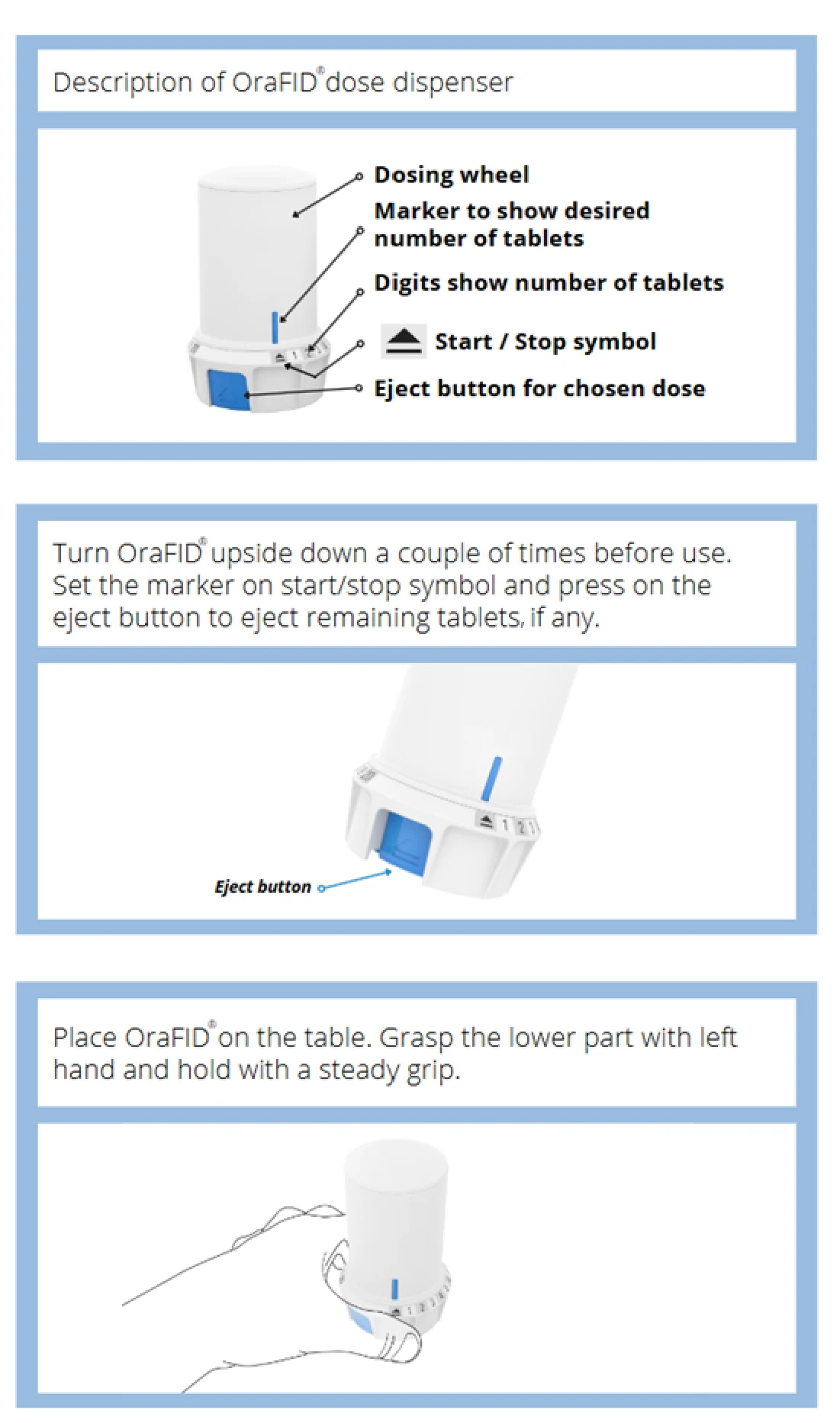
Using your pre-filled dose dispenser OraFID
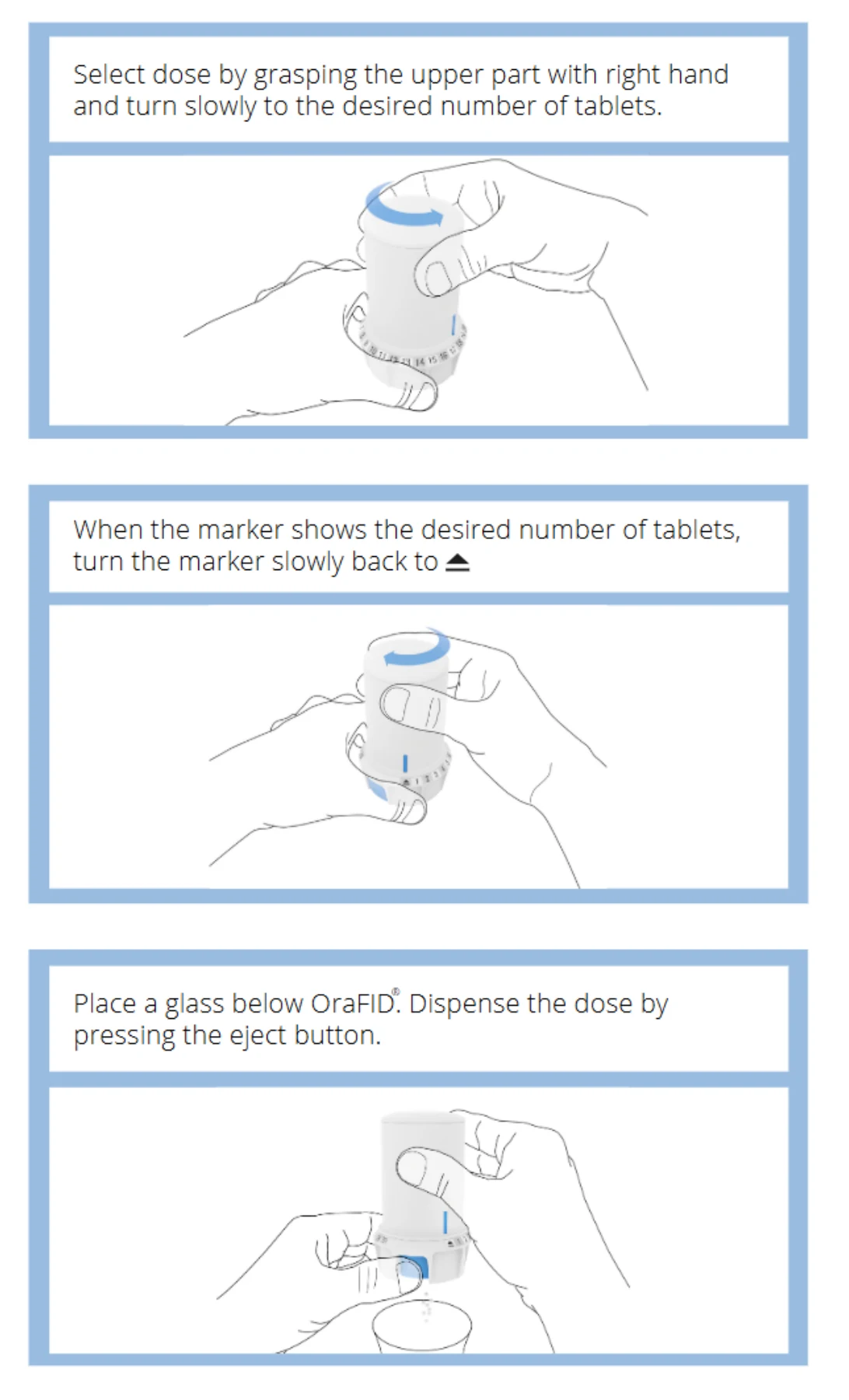
- The pre-filled dose dispenser OraFID contains the dispersible Precifit tablets. Follow the instructions for use below for correct handling.
- The dose dispenser can dispense 1-20 tablets per withdrawal. If your dose is larger than 20 tablets, e.g. 24 tablets, divide the dose in two and eject 12 tablets twice.
- OraFID dispenses the correct number of tablets as long as there are tablets left in the container that are needed for a dose. After each dose gently shake the container and listen. If you hear that there are tablets remaining in OraFID, there is no need to count the number of tablets ejected. When you do not hear a noise of tablets , the tablets ejected should be counted. If the ejected tablets are too few, start using a new OraFID container and eject the missing number of tablets to retreive your full dose. Always keep an extra OraFID container in your supply, so you do not run out of tablets.
- OraFID contains 2 250 dispersible tablets. At a dosage of 300-400 mg levodopa per day, the tablets will last 4-5 weeks.
- The OraFID pre-filled dose dispenser is disposable and should not be refilled.
Instructions for use
Troubleshooting
If you are unsure of the number of tablets that are dispensed, count the tablets and adjust if needed.
- If a tablet gets stuck and you are unable to turn the dosing wheel, try to turn back and eject the tablets. If tablets remain stuck, hold the device upside down and turn the dosing wheel back and forth in the upside down position a couple of times, and then place the marker on the start/stop symbol. Hold the device in the up-right position and eject any tablets in the device by pressing the blue eject button and start from beginning to set number of tablets to be dispensed. Count the number of tablets that are ejected to ensure that you have the correct number of tablets.
- The eject button can only be pressed when the blue marker - is on the start/stop symbol. Do not turn the dosing wheel back to the start/stop symbol before the marker reaches the digit of the desired number of tablets. Only when the marker reaches the desired number to be dispensed, the dosing wheel should be turned back to the start/stop symbol.
Precifit with food and drink: Some patients may experience slightly less effect of Precifit if the tablets are taken with protein rich food. Meat, fish, eggs, beans, milk and cheese contain protein. If possible, take Precifit 30 minutes before or 1 hour after a meal.
If you have not had levodopa before
100 mg (20 dispersible tablets) three times a day. Your doctor will gradually increase the dose.
Patients with unsatisfactory effect at the end of dose interval (wearing off) may be helped by dividing the dosage into smaller, more frequent dosing without, however, altering the daily dose. Your doctor will help you to adjust the dose and dosage frequency.
If you have had levodopa before
your doctor will ask you to stop taking your medicine for Parkinson’s disease before you start taking Precifit.
Use in children and adolescents
The safety of Precifit in patients under 18 years has not been established. There is no relevant use of Precifit for children and adolescents for the treatment of Parkinson's disease.
If you take more Precifit than you should
If you take too many tablets see your doctor immediately.
If you forget to take Precifit
Do not take a double dose to make up for a forgotten dose.
If you stop taking Precifit
Do not stop taking Precifit without talking to your doctor. When you stop taking Precifit you may experience muscles stiffness, high temperature (fever) and mental changes.
If you temporarily have to stop your treatment with Precifit, e.g. before surgery, you should continue with your regular dosage as soon as possible.
If you have any further questions on the use of this medicine, ask your doctor or pharmacist.
4. Possible side effects
Like all medicines, this medicine can cause side effects, although not everybody gets them.
Stop taking Precifit and see your doctor straight away if notice any of the following side effects:
- allergic reaction, the signs may include hives (nettle rash), itching, rash, swelling of your face, lips, tongue or throat. This may cause difficulty in breathing or swallowing
- chest pain
- uneven (irregular) heart beat or palpitations
- • bleeding from your gut which may be seen as blood in your faeces or darkened faeces (gastro-intestinal bleeding)
- blood problems, the signs may include pale skin (pallor), tiredness, fever, sore throat or mild bruising and prolonged bleeding after injury
- muscle stiffness, severe inability to sit still, high fever, sweating, increased salivation and impaired consciousness (neuroleptic malignant syndrome)
- mental changes including delusions, hallucinations and depression (very rarely) suicidal tendencies
- fits (convulsions).
Other side effects that may occur:
Very common (may affect more than 1 in 10 people):
- urinary tract infections
Common (may affect up to 1 in 10 people):
- loss of appetite (anorexia)
- confusion, dizziness, nightmares, drowsiness, tiredness, sleeplessness, feeling of well-being (euphoria), dementia, feeling of stimulation, dream abnormalities
- movement disorders (dyskinesia), a disorder characterised by sudden involuntary movements (chorea), muscle tone disorder (dystonia), movement disorders caused from outside the nervous system , sudden changes in Parkinson’s symptoms ("on-off" symptoms), slowdown in movements during "on-off" periods (bradykinesia)
- a drop in blood pressure caused e.g. by getting up too quickly from a sitting or lying position, sometimes accompanied by dizziness (orthostatic hypotension), tendency to faint
- sudden loss of consciousness
- nausea, vomiting, dry mouth, bitter taste
Uncommon (may affect up to 1 in 100 people):
- weight loss or weight gain
- disturbance of muscle coordination (ataxia), increase in hand tremors
- increase in blood pressure
- hoarseness, chest pain
- constipation, diarrhea, wind
- increased salivation, difficulties in swallowing
- fluid accumulation (oedema)
- muscle spasms
- dark urine
- loss of strength (asthenia), weakness
- feeling of being unwell (malaise)
- hot flushes
Rare (may affect up to 1 in 1,000 people):
- a blood disorder (lack of white blood cells) accompanied by an increased susceptibility to infections (leukopenia), anaemia , a blood disorder (lack of blood platelets) accompanied by bruising and a tendency to bleed (thrombocytopenia)
- excitement (agitation), anxiety, impaired ability to think, disorientation, headache, increased sexual desire, numbness, fits/ seizures
- episodes of serious mental illness, during which control over one’s own conduct and behaviour is impaired
- a serious condition as a result of using neuroleptics, which may manifest as muscle stiffness, a severe inability to sit still, high fever, sweating, increased salivation and impaired consciousness (neuroleptic malignant syndrome),
- feelings of prickling, tingling and itchiness without any apparent cause ,
- more frequent falling, gait disorders, lockjaw
- blurred vision, spasm of the orbicularis oculi muscle surrounding the eye (this may be a sign of overdosage), activation of a pre-existing Horner's syndrome (an eye disorder), double vision, dilated pupils, a deterioration in eye movements,
- inflammation of the veins
- breathlessness, abnormal breathing patterns
- impaired digestion with symptoms such as feelings of fullness in the upper abdomen, upper abdominal pain, belching, nausea, vomiting and heartburn (dyspepsia), stomach and intestinal pain, dark saliva, grinding of teeth, hiccups, stomach and intestinal bleeding , burning tongue, duodenal ulcers
- sudden build-up of fluid in the skin and mucous membranes (e.g. throat and tongue), breathing difficulties and/or itching and skin rash, often appearing as an allergic reaction (angioedema)
- skin rash with severe itching and the formation of wheals (urticaria), itching, facial redness, hair loss, skin rash, increased sweating, dark sweat
- in children, allergy-related bleeding in the skin and gastrointestinal tract wall (Schönlein- Henoch purpura)
- urine retention, involuntary passing of urine, persistent erection (priapism)
Very rare (may affect up to 1 in 10,000 people):
- a very serious blood disorder (lack of white blood cells) accompanied by sudden high fever, severe sore throat and mouth ulcers (agranulocytosis)
- drowsiness and constant daytime fatigue/ sudden attacks of sleep
Not known (frequency cannot be estimated from the available data):
- muscle twitching.
Inability to resist the impulse to perform an action that could be harmful, which may include:
- Strong impulse to gamble excessively despite serious personal or family consequences.
- Altered or increased sexual interest and behaviour of significant concern to you or to others, for example, an increased sexual drive.
- uncontrollable excessive shopping or spending
- binge eating (eating large amounts of food in a short time period) or compulsive eating (eating more food than normal and more than is needed to satisfy your hunger)
- Craving for large doses of Precifit in excess of that required to control motor symptoms, known as dopamine dysregulation syndrome. Some patients experience severe abnormal involuntary movements (dyskinesias), mood swings or other side effects after taking large doses of Precifit.
Tell your doctor if you experience any of these behaviors; they will discuss ways of managing or reducing the symptoms.
If any symptoms persist or you experience any other side effects please tell your doctor or pharmacist. It will help if you make a note of what you experienced, when it started and how long it lasted.
Reporting of side effects
If you get any side effects, talk to your doctor orpharmacist. This includes any possible side effects not listed in this leaflet. You can also report side effects directly via the Yellow Card Scheme. Website: www.mhra.gov.uk/yellowcard
By reporting side effects you can help provide more information on the safety of this medicine.
5. How to store Precifit
- Keep this medicine out of the sight and reach of children.
- Store in the original package in order to protect from light and moisture.
- After the foil bag has been opened, the tablets in OraFID pre-filled dose dispenser should be used within 3 months. Store below 30°C.
- Do not use this medicine after the expiry date which is stated on the OraFID pre-filled dose dispenser after EXP. The expiry date refers to the last day of that month.
- Do not throw away any medicines via wastewater or household waste. Ask your pharmacist how to throw away medicines you no longer use. These measures will help protect the environment.
6. Contents of the pack and other information
What Precifit contains
- The active substances are levodopa and carbidopa.
- The other ingredients are microcrystalline cellulose, colloidal anhydrous silica, maize starch, sodium starch glycolate, magnesium stearate.
What Precifit looks like and contents of the pack
Precifit is white, spherical, dispersible tablets with a diameter of about 3 mm.
The tablets are packed in a polypropylene pre-filled dose dispenser (OraFID). The OraFID is packed inside a sealed aluminium foil bag which contains a desiccant. The dose dispenser can dispense 1-20 tablets per withdrawal.
Pack size: 2 250 dispersible tablets.
When no tablets are left in the plastic container, it should be disposed of in accordance with local requirements.
Marketing Authorisation Holder
Orion Corporation
Orionintie 1
FI-02200 Espoo
Finland
Manufacturer
Desitin Arzneimittel GmbH
Weg beim Jaeger 214
22335 Hamburg
Germany
Orion Corporation Orion Pharma
Orionintie 1
FI-02200 Espoo
Finland
Orion Corporation Orion Pharma
Joensuunkatu 7
FI-24100 Salo
Finland
Navamedic ASA
Henrik Ibsens gate 100
0255 Oslo
Norway
For any information about this medicine, please contact the local representative of the Marketing Authorisation Holder:
Orion Pharma (UK) Limited, Abbey Gardens, 4 Abbey Street, Reading, RG1 3BA